Gamebook store

Showing posts with label Medra. Show all posts

Friday, 20 February 2026

Dwarf days

I first visited the White Dwarf offices in early 1980. I say “offices”, but it was a single room crammed with desks and a paste-up area, roughly ten metres by five metres at a generous guess. WD was strictly a sopra la bottega operation back then, with the Games Workshop store downstairs. No need to say more, as I expect it’s described in Jonathan Green’s Dice Men book -- though the chapter originally used for crowdfunding by the now-disgraced and defunct publisher Unbound was by Jamie Thomson, and you can read that here.

The thing is, I didn’t think of it as the White Dwarf office. It was also where Games Workshop put together their early boardgames and Ian Livingstone and Steve Jackson ran the business. I was there to talk about a new roleplaying game that they wanted to call Adventure, which kept me busy for about a year until GW got the RuneQuest licence and Adventure was quietly binned.

Another year or so, and I met Jamie Thomson who told me he’d just landed an editorial job at White Dwarf. “I used to know those guys,” I said. “You should write for the magazine,” said Jamie.

The offices had moved from Hammersmith (grotty but right in the heart of things) to an industrial estate in Park Royal (big but impersonal). “Sorry about Adventure,” said Ian the first time I showed up with some copy. “We just weren’t set up for that kind of thing before, but now we are and we’d like you to do some work on Questworld.” As you will know, the UK Questworld never happened, but it did act as the catalyst to draw me into White Dwarf, primarily as a RuneQuest contributor.

White Dwarf was a very different magazine in those days, with the focus not on miniatures and tabletop games but on roleplaying. I think of it as the magazine’s golden age, but then I would. I can trace back professional partnerships, friendships, and creative influences to my time as a freelancer, often rolling up mid-morning with a half-bottle of vodka and a pack of menthol cigarettes (now outlawed, but then part of the atmosphere of the office) to pound out articles to fit whatever space Jamie needed to fill that month.

It's now almost half a century since the first issue of White Dwarf. Prior to my involvement with the magazine I didn’t often have a reason buy it, but I do remember coming home from a trip to London with the first issue and thinking the cover would have been more dramatic if it had showed the scene a split-second before the little chap slices the wizard’s head off. Ten years later I’d become a convert to unsubtlety. I remember a conversation with Marc Gascoigne just before the move to Nottingham:

Me: “This new Call of Cthulhu supplement you’ve got coming out. ‘Green Unpleasant Land’ would have been a much better title.”

Marco: “‘Green & Pleasant Land’ is ironic.”

Me: “Well, duh. But in-yer-face would have more impact. And it would be funnier.”

(When it came to withering remarks, in those days we were the irresistible force and the immoveable object. How our friends must have loved us.)

Other memories of back then:

Meeting Andy Slack and Albie Fiore. That was at the Dalling Road office. They immediately made an impression with their intelligence, enthusiasm, and total professionalism. Albie was an inspirational world-builder. He told me about a ruined city in the desert in his roleplaying game; it had been a thriving metropolis until a meteorite destroyed the aqueduct that brought water from the mountains. (Yes, don’t live in the middle of the desert and rely on aqueducts, but even so.) The same care is obvious in Albie’s WD scenarios, “The Halls of Tizun Thane” and “The Lichway”.

Playtesting Adventure with the GW staff. One evening I ran a game for Ian, Steve and the Dalling Road stalwarts. Steve gave me some valuable advice: never to bother with “he says” when giving NPC dialogue – “Just say it. Act it out. Accents help.” Ian was worried that Adventure might end up like Empire of the Petal Throne, which he knew I played. In a sense he was right, as I was devising a world with a detailed non-European culture populated by non-Caucasians, whereas GW really just wanted a British D&D.

Working with Oliver Dickinson was a pleasure not only because of his deep knowledge of RuneQuest and insightful discussions of its world, but also because Oliver is one of the most warm, civilized and decent people I’ve ever met. His delightful Griselda stories (a nod to Damon Runyon) were a highlight of WD. Because Oliver didn’t have access to a player group, he had to run RQ adventures solo – anticipating the mid-‘80s craze for gamebooks by a couple of years, and solo RPGs by even more.

Things I turned to first each month were Dave Langford’s book reviews and Mark Harrison’s The Travellers. Marcus L Rowland’s ideas were always interesting; I liked to read his scenarios even though I never used published scenarios in my own games. Phil Masters was another of the regular writers whose work I admired.

Hanging out at Sunbeam Road with Jamie, Gary Chalk, Ian Marsh and the others. One morning I was there spitballing a D&D scenario when Jamie took a call – “Yes, just by chance he is here. I’ll pass you over…” It was a reader who had picked up the latest issue and fallen foul of a trap in the first instalment of “The Castle of Lost Souls” solo adventure. “It says I’m dead. What am I supposed to do about that?” demanded an angry Scottish voice. I explained there was nothing he could do. “I just have to start again, is that it?” I doubt if he went on to become a big fan of gamebooks.

Leo Hartas showed up with his portfolio but it was press day and Jamie had forgotten he was coming in. Leo had to lay his artwork out on the floor and people were almost stepping over it. A drawing of a magic book that seemed to be three-dimensional made a particular impression, and when a publisher asked me who I wanted to illustrate my Golden Dragon books I got in touch with Leo, snaffling him up before White Dwarf had a chance to. Just as well I went into the Sunbeam Road offices that day, or we’d never have had Mirabilis, the Rathurbosk Bridge, and Fangleworth’s (well, we liked it), the Dark Lord books wouldn’t have been brought to life by Freya Hartas, nor would Jewelspider have benefited from the art of Inigo Hartas – both Freya and Inigo clearly carrying the imaginative genes of Leo and their maternal grandfather, the properly legendary John Vernon Lord.

It all came to an end when Ian and Steve retired (temporarily) to Spain on the earnings of Fighting Fantasy and White Dwarf was handed over to the power of the gods and devils of Nottingham, where it entered its chrysalis as a glorious content-rich butterfly and emerged as a sales catalogue maggot. We can’t blame Games Workshop. They’re a company and their aim is to make money for the shareholders, not bear the torch for roleplaying. I’m sad to see WD’s passing as I was saddened by the loss of Coven 13 and the Beatles and the Silver Age of Marvel comics. Still, nothing lasts forever, nor should it. As Ray Kurzweil said, “Death gives meaning to our lives. It gives importance and value to time. Time would become meaningless if there were too much of it.”

Thursday, 27 October 2022

New worlds in the making

It’s often said that Tolkien is the originator of modern fantasy, and I suppose that’s true if you only consider the dominant strain of fantasy with its vaguely European and vaguely medieval flavour. I can’t knock that, it’s where Legend springs from too, but I have just as much affection for the older variety of fantasy from which sword & sorcery evolved. Barsoom, through the Hyborian Age and Clark Ashton Smith’s Zothique, Poseidonis and Xiccarph, then Planet Stories and Vance through to Moorcock’s Young Kingdoms.

The keynotes of that genus of fantasy are exoticism, the ancient world, priesthoods and demons, typically (not always) lower or less widespread use of magic yet at the same time an admixture of science, or at least scientifically-coloured fantasy. Most importantly, the universe in such science fantasy tends to be realistic, governed by laws of nature (even if they include magic) that are indifferent to humankind. It’s the opposite pole to Jewelspider, where dream logic and prophecies and a real divine presence are woven into the setting.

As a teenager I loved the fantasy worlds of Robert E Howard, Edward P Bradbury (Moorcock again), Jack Vance and Tanith Lee – so naturally when Empire of the Petal Throne appeared in the mid-‘70s I took to it like a tletlakha to water. I owe a creative debt to Professor Barker and his world of Tekumel only partially repaid with the four issues I edited of The Eye of All-Seeing Wonder.

A lot of studios, game developers and book publishers these days are eyeing the success of things like Game of Thrones, The Wheel of Time, and Dune. With networks in the streaming wars all chasing the last big thing, a fully-realized original fantasy/SF world is a lottery ticket with a big jackpot on offer. Suddenly worldbuilding is in.

A little while back I was lamenting the difficulty David Velasco and Riq Sol were having raising funds for their game Expeditionary Company. Probably the answer is to forget about launching it as a boardgame/gamebook, just take it to a developer who wants a great concept for a new MMO. Judging by the rapid rise of Vulcanverse online, if they could find a way to include NFTs in the design they'd have to chase the investors off their front lawn. Or they could see if Jeff Bezos has another half billion and doesn't want to throw it away this time. (It would need a far sexier name than "Expeditionary Company", though.)

There aren't that many fantasy world-builders with expertise in both games and storytelling, so I thought I'd try my hand at creating a "hard fantasy" setting. This was Before the Storm, a novel I was writing while doing jury service in the mid-'90s. I’ll quote from the T-shirt version:

An isolated star system out beyond the galactic rim. For a quarter of the year the night sky is utterly dark with only a few smudges of light marking distant galaxies. Then gradually the galactic rim makes its appearance at night: a vast wheel of stars, not of one galaxy but of two in spectacular collision.

The people of this world are descendants of a crashed colony ship but have no record of their heritage. As far as they know they are alone in the universe. The fauna of their world are not the familiar animals of earth. Instead of horses they ride “destriers”, two-legged animals that because of their cold blood must be warmed beside ovens before they can be used in cold weather. Technology is barely beyond the level of the late middle ages - though there are some features that have not paralleled the development pattern of Earth's history, such as primitive gunpowder weapons and even a type of photography.

Some biotechnology survives from the colony ship that brought the original settlers, often in the form of various algae. There is a hydrogen-producing strain that permit balloons for use in reconnaissance and a cobweb-silk producing strain that is used for weaving immensely strong fabrics. Various other scattered fragments of technology are sometimes found, but to the superstitious inhabitants of this world they are thought of as magic.

There are also civilized nonhumans and semi-humans sharing this world with humanity. At the point when the first novel begins they have only been infrequently contacted and are thought of as mythical.

Medra is a tropical island nation that, by virtue of the industrious and warlike nature of its people, has consolidated an overseas empire much larger than the original archipelago. Medran society is more developed than those of the countries it has conquered, but the rigid caste system that has vitalized it in the past has now reached the point of breakdown. A new society is in the process of emerging.

I never finished the thing. One reason is that I got a job at Eidos that left no time for novel-writing. But that’s really just an excuse. The truth is that it was the kind of fantasy I wanted to write but not really what anyone was reading back then. Publishers wanted the Western style of fantasy I mentioned above set in a  version of the Middle Ages with more modern sensibilities -- effectively, "medieval America". 

By contrast my fantasy world was not the slightest bit medieval nor culturally or ethnically European. It bucked the '90s trend, being more of a modern evolution of those weird and wonderful Planet Stories of yore, but now that the selection pressure is for exotically different fantasy worlds (there is no point in creating a world that isn't uniquely and brandably distinct) it might finally be time to dust it off -- with the necessary changes to make it compatible with current trends in massively multiplayer online play, which is where the demand is coming from. So I am currently repackaging it like this:

A Rapa Nui of the cosmos

The idea of an isolated world is a powerful one, throwing all our human endeavours against the daunting backdrop of uncaring immensity. Here’s a way to do that:

This world orbits the star Edis , a solitary system out in intergalactic space. For several months of the year the night sky is empty of stars. Then only the other planets of the system and the moons of our world are to be seen.

As the season of stars approaches, the rim of a galaxy rises above the horizon – higher month by month until mid-summer, when most of the night sky is taken up by the spectacular sight of two galaxies in collision, intertwining vortices of light formed by great reefs of stars being torn into new configurations.

How do people come to be here? For most, it is a mystery no one even considers. This is where humanity has always been, surely? There are cities, farms, villages. Kings and councils of syndics, priests of the gods who explain portents – and deep forests in which dwell alien creatures that never arose on any world of men.

The truth: a one-in-a-trillion quantum fluctuation in the warp drive of a generation starship, so that instead of its intended destination in the Milky Way the ship was flung across gulfs measureless to the imagination. That it arrived anywhere in real space is a miracle. A return journey would have been impossible to plot or undertake even if the ship had not taken damage.

The crew made their decision. With no future possibility of contact with the rest of human space, no hope of ever returning to space, it would be kindest to raise the new generations with no knowledge of humanity’s past. This world Edis IV, known to the settlers as Anshar , would be the new Eden.

That was hundreds of years in the past. To most people, Anshar is the only world there is.

My initial plan for how to develop it was using The Expanse's serialized book model, though more like a TV writers’ room – ie five or six writers each taking main responsibility for a couple of “episodes” (around 20,000 words each) building over 6-10 months into a 12-episode “season arc” thrashed out from the start by the lead writer(s). Those novellas would be the proof of concept stage, and viable as products in their own right, but if funding could be found they should be repurposed into scripts and released as audio dramas. The plan, then, was to prototype in prose and see if that could lead on to videogames, TV shows, or whatever.

The snag is that really you need artists involved from the start. Words can only take you so far but people want a shared experience -- visuals showing the architecture and clothing and also sounds, the noise of wildlife, the rhythms of music in this fantasy culture.

Whether I’ll get to do more with Edis than I did with that Medra novel thirty years ago remains to be seen. The sword of Damocles over every writer’s head is that all creative work is entirely speculative. The seed capital is the writer’s own time and effort, but when it comes to selling it nobody respects sweat equity the way they respect cash. So taking six or nine months out to devise a complete fantasy world and write a novel set in it is like buying a lottery ticket in the knowledge that, if it looks like winning, some producers or publishers will do their best to claim the lion’s share of the payout.

In any case, after my day jobs (freelance design on a videogame and writing the final Vulcanverse book) my first priority is Jewelspider. I was chivvied about that by some gaming buddies I met up with recently. Oliver Johnson was running a new Legend adventure and resorted to using original Dragon Warriors rules because 'Dave still hasn’t written the Jewelspider magic system!' So I have to do that – and then Abraxas, which will be serialized first to Patreon backers and is a science fantasy setting (prehistoric rather than far-future) that will use a new edition of my Tirikelu rules. And after that, maybe, I’ll take another look at this thing.

* * *

This post originally appeared in longer form on my Patreon page, and included a link to the first 20,000 words of the Medra novel. I mention that not to try to get you to sign up to Patreon (though you would be very welcome) but just for full disclosure.

And here's a reading list to go with:

Thursday, 28 April 2022

A kind of tribalism


The way you choose to roleplay is up to you and your gaming group. Of course it is. But if you’re asking me, I don’t see the point of doing anything if you’re not going to commit to it heart and soul. Roleplaying to me means trying to be somebody else, imagining the reality of their life, and acting as they would. It’s fiction in the moment. And fiction is a parallel reality evoked by imagination that, while the spell lasts, should be taken as seriously as the reality we live in the rest of the time.

The road to Damascus ran through Keble College. It was 1980. I was running a Tekumel campaign and Paul Deacon, playing a pe choi called Keq Yossu, balked after hearing the lead-in to the evening’s adventure. ‘I’m not coming along.’

The others were aghast. ‘But… what are you going to do all evening, in that case?’

‘The whole set-up sounds off to me. You do what you like, but count me out.’ Paul dropped out of character a moment: ‘I’ll help Dave roll for the NPCs.’

It was the first time I’d thought of really getting into the head of a character that way. I admired Paul for it, and I admired him even more when he was proved right a few hours later. The whole party got wiped out. Paul imagined Keq Yossu getting the news back in Jakalla: ‘I did warn them…’

Not long after, in my Medra campaign, Mike Polling’s character Dagronel Kabo-Drasden befriended an NPC who was the sworn enemy of several of the other player-characters. When it came to the crunch, Dagronel sided with the NPC. In the game post-mortem, the other players were indignant. ‘You can’t value friendship with a nonplayer character above your comrades,’ they argued.

Mike pointed out that a roleplaying campaign is a fiction populated by characters. Nobody wears a lanyard saying PLAYER; it isn’t a Westworld style theme park with hosts vs guests. To use Professor Barker’s adage, there are no NPCs. Just characters. It’s only in bad fiction that somebody behaves out of character to ensure the plot goes in a pre-planned direction.

Both Paul and Mike are arts graduates, and it was an eye-opener for this scientist to see them insist on roleplaying as an art form. It was about then I started to eschew underworlds and puzzles. I should’ve known from Columbo that the how and the who are never as interesting as the why. Motivation is what matters. Characters who look at their world and say, ‘This is how it affects me and this is what I must do.’

Without that revelation, heaven knows what Dragon Warriors would have been.

I still come across the old-school approach, but these days it baffles me. A few years back I was playing in an SF campaign set in the Mass Effect universe. One character was a law enforcement agent. Some of the other PCs were rebels or pirates or – look, I don’t know anything about Mass Effect; in Firefly terms most were Browncoats and one was an Alliance officer. When it all kicked off, the agent sided with the local planet’s police and tried to arrest the Johnny Rebs.

Afterwards, one of the players in particular seemed to take it very personally – in real life, that is, not as his character. He went away seething. I asked a friend of his what was the matter. ‘He believes strongly in the players sticking together,’ he said. ‘He’s annoyed that player took the side of the police against the rest of us.’

‘But… what did he expect? The guy was playing a federal agent.’

‘He doesn’t think character should trump party loyalty.’

I honestly don’t know why you’d roleplay if you feel that way. Without commitment to character you might as well be paintballing. If you want PCs to stick up for each other, you have to give them a reason beyond the fact that they're all controlled by people sitting around the same table.


On the other hand, I also care that movies, TV drama and novels maintain integrity to the fiction they’ve created, yet a lot of people seem quite happy to excuse out-of-character swerves that are there to keep the plot on the rails the writer planned. To me that’s just not doing the work. It could explain why when I was a little kid and my school took us all to a Christmas panto it was loathing at first sight.

Everyone’s got their own setting on this dial. An it harm none, do as ye will. But what I want is to plunge right in to the imaginary lives we evoke through roleplaying, convinced there’s something amazing to be found there if just for a few hours we can let go of being ourselves.

Tuesday, 5 January 2021

Adventuring on a shoestring


I have a friend who keeps telling me I should do podcasts. It’s flattering because he does a fair few himself and he’s very good at it, but the field is so crowded already. Mike and Roger on Improvised Radio Theatre With Dice, Ralph on Fictoplasm, Jeff and Hoi on Appendix N Book Club – and not forgetting Dirk the Dice on the Grognard Files.

I’m on the latest of those, mostly chatting about Dragon Warriors and Jewelspider but with a bit about the early days of roleplaying. After the discussion, an interesting point was raised about whether DW would have worked better as a single rulebook, the way games like Runequest and Champions were released at the time, rather than as six standard-format paperbacks. (We’d hoped for twelve, but that’s a detail.)

What happened in the early ‘80s was Ian Livingstone and Steve Jackson had a epiphany. They could see that fantasy games potentially had a huge market but had so far failed to escape the niche of sweaty hobby shops. How to get them out of the shadows and into the mass market bookstores? The lightbulb moment must have come while playing a Fantasy Trip solo adventure. ‘Know what, lad?’ I can imagine Steve saying – or maybe it was Ian. ‘Do something like this for kids and we could have a breakout hit.’

The red-braced MBAs among you will have noticed that Ian and Steve didn’t publish Fighting Fantasy themselves, despite owning White Dwarf magazine and a chain of game stores. They pitched it to Penguin Books and lions were shook into civil streets.

Me, I just rode their coat-tails. I figured that all those tweens and teens who’d now discovered gamebooks might also be waiting for roleplaying. So Oliver Johnson and I took ourselves out to Ealing, where Transworld had their offices, and the game that was to be known as Dragon Warriors was born.

What if we had done DW as a single rulebook? I’d been working on an RPG for Games Workshop that they planned to call Adventure (yeah, not my idea) and that would have sold about 2000-5000 copies. The value to GW was mostly that they could sell figurines on the back of it. Adventure never happened because GW picked up the UK Runequest licence, but it had penetrated even my business-blind consciousness that we could sell ten times as many copies if we got a paperback RPG into high street bookshops.

And where would a chain like W H Smith have put a single-volume rulebook anyway? Not alongside the FF books that all the 10-13 year-olds were snapping up. There might have been a corner of the shop where Jane’s Fighting Ships and Formula One books were stocked. You’d never have seen it. We wouldn’t be talking about it today.

And how much would it have cost? The DW books were £1.75 each – in the mid-80s, a little less than $5. If we’d lumped the content of the six paperbacks into one durable hobby-style RPG hardback, call it £15. About fifty quid in modern money. Not a pocket money purchase, for sure.

And would Transworld have been interested? Probably not. The adult division wouldn’t believe there was a market for fantasy role-playing, the kids’ editors wouldn’t commission a £15 hardback. And if they had, Oliver and I would have got an advance of about £2000 each (that's maybe £7000 in today’s money) to keep us going for a year or more while we wrote the whole game and all the scenarios. Passion project though DW was, just to pay the bills we'd have been tempted away by gamebook contracts instead.

Would I rather have released DW as one book? Well, that’s what I was working on in Adventure. It wouldn’t have been entry-level like DW. It would have been set in the world of Medra rather than Legend. The skill system would have been more complete because it was designed as an entire system rather than piecemeal and episodic the way DW came out. There'd have been no elves or goblins.

Would that game have been as good? Apples and oranges. Single-volume RPGs back then were for the hobby market. Paperbacks like DW and FF and Maelstrom were for the mass market. I'm heartily glad that James Wallis eventually reorganized DW into a single book, and it's far easier to find the rule you want that way, but we had to follow the winding road to get to that point twenty years on.

If I'd really understood the business side of gaming at the time, though, I’d have made the rules d6-based. How many schoolkids even knew where to buy icosahedral dice, still less have the pocket money to spare? It was Britain in the ‘80s, a tatty and corruption-riddled backwater off the coast of Europe. The streets were paved with stale chewing gum and flattened fag butts. Off licences had metal grilles to stop people pinching Watneys Party Sevens. The height of dining out was a gristly steak and chips at the Berni Inn. Kids didn’t have the cash to fling at mobile phones and X-Boxes like they do today. Or did, that is, pre-Brexit.

That dice bit I’ll be fixing with Jewelspider. All you’ll need are a couple of six-siders. It’ll be a small-format book, too, though maybe I should do a hardback as well as a paperback edition if only because that will be more resistant to spilled wine and red-hot fragments of dope. Tell you what, though. It’ll be a bit more than £1.75.

Friday, 1 December 2017

Dealing with demons - part 3

Now, these demon lords. The fact is they were originally devised for Medra, the campaign world of my 1980-82 Oxford campaign. So if you’re wondering why the names don’t sound very much in keeping with other Questworld material I’ve posted here, that’d be why. If we’d got as far as publishing the book I’d probably have changed that, but it was a rush job to write half of White Dwarf and get that QW book finished. Gosh, I was prolific in those days. That’s the energy of youth for you..

Anyway, here’s the final part of “Dealing With Demons”. Next time, as it's just about acceptable to mention Christmas now that we're into December, we'll have something to get you more in the holiday spirit.


Part Three: THE DEMONIC NOBILITY

The demon lords and princes are individual beings of immense power who rule the demon planes. They have, of course, been summoned far less frequently than the lesser demons, so no exact canon of knowledge is available as with the latter. A summoner who does some research may find suggestions and theories as to how to deal with the demon lords (“Rokash the Pious records that the powers of the Lord Eldyr are diminished by bright light...” and so on), but exact wards—if any—are a matter of conjecture.

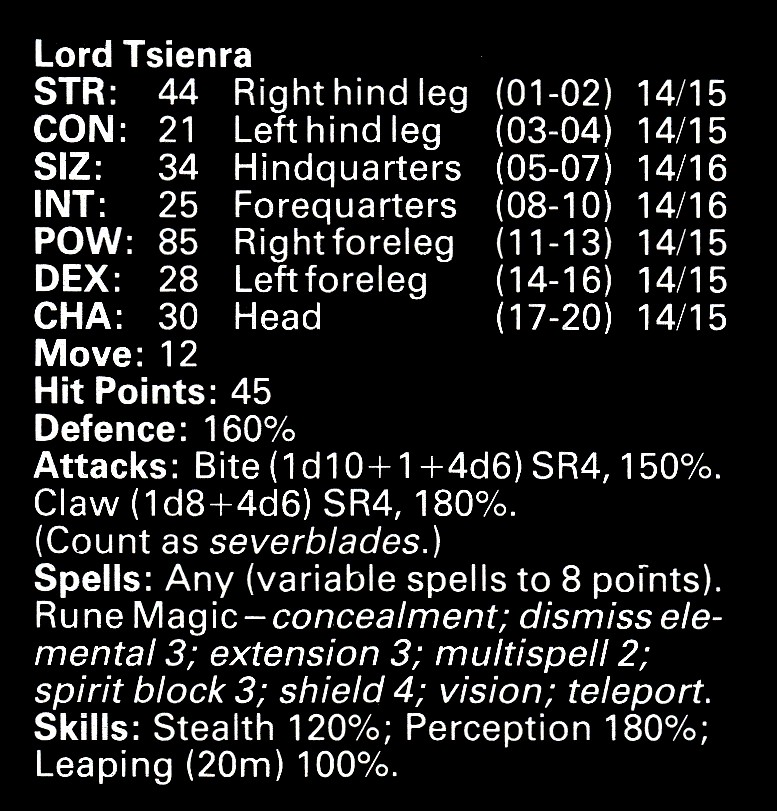
Similarly there is some uncertainty as to the precise levels of power of the demon lords. Tsienra’s stats are given here as a guideline, but referees must design these creatures to suit their own campaigns. They should be virtually impossible to overcome with raw power alone, and if your campaign abounds with 150%-plus Rune Lord-Priests then the abilities of Tsienra and the others should be increased accordingly. When the demon lords have suffered defeats in the past it has been through the summoner’s quick wit and daring rather than from spells and swords.

As a general rule all demon lords will have a personal POW of between 80 and 100, and can draw on unlimited POW reserves from their home dimension for casting battle magic. They are hostile about 20% of the time and otherwise neutral. They will only be friendly if there is a very good reason why they should react favourably to the summoner— Umalu prefers Chaotic berserkers, and so on.

The Gifts
While not precluding the possibility of striking completely unique bargains with a summoned demon lord, there are two types of deal which are ‘commonly’ made. These are the Lesser Gifts—minor exertions from the demon’s point of view, made in exchange for characteristic POW from the summoner—and the Greater Gifts, which are permanent abilities bestowed on the summoner in exchange for a soul-pledge.

A soul-pledge means the summoner gives the demon 1 POW point to seal the bargain and promises him a further 3d10 POW later. These further points are intended to be collected on the summoner’s death, but there is a 2% chance the demon will arrive if it feels the summoner’s life-force is burning low—in game terms, whenever the character’s hit points or POW reach 2 or less. Once the demon arrives nothing can stop it from devouring the POW promised to it. These POW points are permanently lost to the character, at which point the soul-pledge is ended and he loses the Greater Gift. If he survives the POW loss he can later bargain again for a Greater Gift with the same or a different demon lord. A character can buy any number of Lesser Gifts from demon lords (if he can spare the POW), but it is only possible to have one Greater Gift at a time. Note that to receive any gift at least 200 Wheels or equivalent must also be offered.

The Demon Lords
There are a number of other demon-lords that could not be listed here—among them Pazuzu, Lord of Fevers, ruler of the lesser demons commonly called by his name; Bakshuro the Screamer, who inhabits a dimension so hostile that only he can live there; Valladolyn of the Emerald Eye, who sees all; and Lady Kleshkala of the Pit, whose face is so terrible that merely to summon her is to court insanity.

The three important parameters for each demon lord are his or her Resistance to Summoning, Resistance to Binding, and Cross Pentacle ability. The last is applied as a negative modifier to the summoner’s chance of correctly drawing the Pentacle of Protection.

The Lord Tsienra
Screaming Metal Spirit, Demon of Ferocity
Tsienra usually appears as a metallic figure, something like a huge tiger armoured in intricately patterned plates of tarnished silver and with a violet light burning behind his eyes and gaping maw. He embodies the lightning attack, the unrelenting ferocity of battle, the prowling spirit of savage death. Possession by the spirit of Tsienra gives great speed and grace to the recipient’s fighting prowess.

Greater Gift: Tsienra can give the power of ferocity. When a character with this power uses it, his STR and DEX are effectively increased to species maximum for combat purposes, 35% is added to his Attack chance and 10% is subtracted from his Parry. The character expends 2 points of battle magic POW to go into ferocity and then another point for every full turn he keeps it going.

Lesser Gifts: For the sacrifice of 1 POW point, Tsienra will teach his summoner the battle magic spell The Talons of Tsienra. For 2 POW points he will use his skill at stalking between the planes to take the summoner within a few miles of any location he specifies, now matter how great the distance. For 3 POW he will enchant any sword with a permanent bladesharp 2.

The Talons of Tsienra
POW used: 4 points
Type: passive, unfocused, temporal
This battle magic spell causes 30cm talons of red light to spring from the caster’s wrists. He can fight with these using either Fist or Dagger skill. The talons do just 1d4 damage (no STR/SIZ bonuses apply), but the only effective defence against them is the Rune spell shield, which absorbs one point from the talons’ damage for each point of shield. The talons are immaterial, so parrying a weapon with them will damage but not deflect it. The spell can only be learned from Tsienra himself, and if the character tries to teach it to someone else then Tsienra will materialize unbidden and kill him.

Tsienra can make one bite attack and two claw attacks in the same round. These do not all have to be against a single opponent. By splitting his attacks he can make even more strikes in one round, of course. Like most demon lords he can cast any standard battle magic spell by drawing POW from his home plane. When he casts a Rune spell he pays for it using his own POW, just as a normal being would pay for battle magic. Like all demon lords, Tsienra is immune to non-Runic weapons.

His Fell Highness Eldyr
Prince of Deceit, Demon of Persuasion
Eldyr is overlord of Incubi, Succubi and Gremlins. He can pass in any guise he chooses, the better to advance his wiles, but will always eventually cast images aside to reveal his true (perhaps true) self. In the Chronicles of the Conjunction, Eldyr’s own description of himself is recorded: “My hair is like black silk, my skin is burnished copper in the moonlight, my eyes are sapphires and my robe embraces the starry night…” This description was for the benefit of the sorceress Cordelia, who had wisely blindfolded herself before the summoning. Without defences such as this, all in time succumb to Eldyr’s charms; the evocator must attempt to banish him at once, therefore, if he begins to use his powers in a hostile fashion.

Greater Gift: Eldyr can give the power of harmonic spirit. This is a combination of charm and blind luck. It costs nothing to activate this power, but each morning the character must roll POWx5 or less on percentile dice to see if the power works for that day. The chance is increased by 15% if the power was working the previous day, and decreased by 5% if it was not. Any luck roll the character has to make has a 50% chance of working automatically without him having to roll for it; on a roll of 05 or less he may have quite incredible luck – a 20m fall broken by some bushes, for instance. He gets a CHA bonus of +4 and can use his CHA as an Incubus or Succubus does. Finally, he gets an Oratory bonus of +35%.

Lesser Gifts: For 1 POW point, Eldyr will aid a character in an attempt to persuade others of something. He gives the character a 45% bonus to his or her persuasion chances for one use only–and this must be some matter where the character’s chance of persuasion was at least 10% in the first place. The bonus is reduced to 10%-30% in attempts to bargain with demon lords because Eldyr’s powers work only erratically against his peers. For 2 points of POW Eldyr will give a luck ring. This silver ring has 100 charges and each charge can be used to change the chance of something happening by 1%. The event to be influenced must occur within 100m of the wearer and have at least a 10% chance of happening in the first place. You can’t make a healthy warrior suddenly die of a heart attack, for example. The wearer must declare how many charges he is committing before the roll is made. When all charges are expended the ring permanently tarnishes and is powerless thereafter.

The Lord Umalu
The Whip of Chaos, Demon of Pain
The spirit of Umalu is that of glorying in the inflicting of pain. He is a fierce, powerful demon who hates Lawful creatures with an intense passion and is little better disposed towards being of Chaos. Umalu manifests himself as a 3m tall muscular black giant with a long mane of white hair, face perpetually contorted in hatred. He wields a glittering whip which can bestow Reverse Chaos features and an envenomed shortsword which inflicts terrible wounds.

Greater Gifts: Umalu can bestow chaos on a character, giving him or her a Chaotic feature. He can also give the power of excruciation, so that any wound the character inflicts has a 20% chance of dealing an extra 1d8 damage to the victim’s hit point total owing to extreme pain.

Lesser Gifts: In exchange for 1 point of POW he will teach a character an extra 20% in the Torture skill. For 2 POW points he grants the Rune spell curse of anguish (see below). For 3 POW he will personally torture a captive to obtain information on the summoner’s behalf.

Curse of Anguish
Range: 160m
POW used: 2 points
Duration: Permanent, Non-reusable, Not stackable
The caster of the Rune spell is able to inflict racking pain on a victim if he can overcome their POW. He can alter the victim’s hit point total at will to represent the pain, and can thus force the victim into unconsciousness, vary the pain so that they must fight at a disadvantage, or merely threaten them with the effects. The curse of anguish cannot kill– its victim will merely lapse into a coma if the pain level is increased too far. This spell does not affect undead, elementals or other creatures which do not actually experience pain.

Torture
Torture is a manipulation skill with a base score of 15% and is learned at the rates 200/400/800/EXP. Normally a character must join the Guild of Torturers to learn the skill. A successful Torture roll means that the torturer has extracted all or part (40%+ 1d6x10%) of the truth from his captive, failure means that he has got false information. A fumble means that the captive has died. Torture can usually be used only once a day on a given captive – each extra use in the same day doubles the chance of a fumble. Captives can use their CON +POW as a ‘Defence’ against the Torture ‘Attack’ if they wish.

His Demonic Majesty Adelmar
Lord of the Vaults of Eternity, Monarch of Demons
Summon the terrible Adelmar only when you plan such grand designs of mayhem and destruction as would make lesser demons quail, for he is a proud and potent force and should not be summoned lightly. Standing about two and half metres tall, he is ebony-black with the lower body of a serpent, a human torso, and an armoured, horned head like that of a triceratops. He wields enchanted scimitars in each hand. One scimitar feeds on the blood of victims, the other on their souls. Adelmar is said to dwell in a labyrinthine castle on an island in an unknown lake. When Adelmar is summoned, the evocator and his party (up to six others) are carried to this castle to petition the demon.

Greater Gifts: Adelmar has a limited power over time itself, and can give the ability of temporal navigation. This enables a character to cross up to ten years either into the past or future, arriving within 1-12 weeks either side of the required date. Each use of temporal navigation costs the character 1d4 from characteristic POW.

Lesser Gifts: For 1 point of POW Adelmar will open the veils of time to uncover some secret at the summoner's behest. For 3 POW he will send an army of demonic warriors – equivalent to five thousand elite cavalry–to fight in one battle beside the army of the summoner or his employer. Adelmar can also add to a character’s lifespan— five years for 1 POW, ten years for 2 POW, and so on. A character can only petition for this gift once. During the added years the character does not age, but the deal must be phrased with exceptional caution or Adelmar will surely twist things to the summoner’s detriment.

The Lord Akresh
Spirit of Thunder in the Mountains, Demon of Invincibility
Akresh represents steadfast strength of purpose, the glowering look that intimidates a foe, the essence of power that cannot be assailed. Possession by the spirit of Akresh is called waiting-within-a-fortress; it hardens the will, shields the body from harm and augments the recipient's physical might. Akresh himself can only be evoked in mountains, where he usually appears as a shadow against the sky and a booming echo between the peaks.

Greater Gift: The power that Akresh can grant is indomitability. A character with this power must roll POWx5 or less on d100 whenever he wants to use it; once activated, the power costs 2 points of battle magic POW for each full turn the character wishes to use it. While indomitable the character remains fixed in position waiting for attacks. He can automatically sweep aside all attacks made at 25% or lower, including missile attacks; his STR increases to species maximum; he gets a +20% Parry bonus and any parries he makes do an extra 1 d4 damage to the parried weapon. Finally, he gets an extra point of armour protection.

Lesser Gifts: For 1 point of POW Akresh will teach two points of the battle magic spell parry (usually available only to Humakti). For 2 POW he can enchant any shield so that whoever carries it has a permanent protection 1. For 3 POW he will summon mountain storms that can throw whole armies into confusion, or block a pass with landslides.

Her Eldritch Highness Sarasathsa
Princess of Mystery, Demon of Paradox
Sarasathsa has sovereignty over things impenetrable or unknowable. Possession with her spirit-essence renders the recipient immune to spirit combat, as spirits will recoil from her terrible mysteries, but is double-edged in that the recipient could become sunk into lethargy and pensive introspection (roll POWx5 or less when coming out of possession to avoid this. Sarasathsa may have many forms, but is often described as a very tall (2½m), slender, graceful woman in blue and green robes. Her skin is pale and mottled in a serpentine pattern, and the right side of her face is concealed behind a fantastical mask in the form of an embryonic dragon. All summoners describe her as cold and disdainful and rather draconic in temperament.

Greater Gift: Sarasathsa can grant morphetic counsel. Whenever the character has some problem to solve or mystery to uncover she will whisper clues to him in his dreams. This acts as though the character had 80% in the General Knowledge skill, and also allows him important visionary dreams at the referee's discretion.

Lesser Gifts: For 1 POW she will answer any three yes/no questions about the past or present with 99% accuracy. For 2 POW she will convert any powered crystal into another type which the summoner specifies (the crystal's POW is diminished by 1 by this process. For 3 POW she grants a character a permanent 5% bonus on POW gain rolls.

The Lord Kojuro
Who is One with the Sword, Demon of Fighting Skill
Kojuro appears as a slender man with greyish skin and sharp white shark's teeth. He wears white and grey cotton robes and carries a number of swords and throwing knives. His province is skill in combat, particularly swordplay.

Greater Gift: Kojuro can immediately raise a character's skill with swords to 80% or by 15%, whichever is greater.

Lesser Gifts: For 1 POW point Kojuro will increase a character's score in any fighting skill by 5%, to a maximum of 75%. For 2 POW points he will place a single-use truesword spell on a blade; this spell can be activated at any later time by whoever wields the sword. For 3 POW he will increase the skill of an entire army by 5% for a single battle.

The Lord Kesh
Jewelled Serpent, Demon of Confusion and Terror
Kesh embodies the transfixing gaze of a snake. He causes awe by his presence alone, a massive bejewelled, serpentine shape coiling about the Pentacle and rearing up to the roof of the summoning chamber–the summoner must roll POWx5 or less on d100 or lose all power to bargain with the demon. Looking into Kesh's eyes causes demoralization.

Greater Gift: Kesh grants the power of intimidation. Given two rounds in which to talk to foes before he fights them, a character with this power can threaten with such unholy force that those hearing him must roll POWx5 or less on percentile dice or be demoralized. In combat, the character's gaze can transfix like a vampire's.

Lesser Gifts: For 1 POW point Kesh will reveal the location of an ancient treasure hoard of at least 90 treasure factors. For 2 points he will set a giant demonic serpent to guard your treasure for you. For 3 points he will teach you how to brew any venom or acid up to potency 15.

The Lord Engala
Gatherer of Darkness, Demon of the Undead
Engala is usually characterized as the zombie spirit, embodiment of unrelenting attack, but in fact he is the lord of all undead creatures. Engala appears as a dull-eyed, expressionless man with dead white skin, robed in grave-soiled black raiment. His movements are slow and languid, like a corpse underwater, and when he speaks his lips hardly move to his hollow, emotionless tones. Those possessed by his spirit will fight until cut apart.

Greater Gift: Engala can make a character into a vampire or mummy. The customary pledge of POW is useless to Engala because he is an undead being, so instead of that pledge he imposes a peculiar condition on his Gift. Every ten years the character must find a champion to play Engala's representative at a game not unlike chess. If the champion loses, Engala drains him of POW and destroys him. If the character cannot find a champion he must play Engala's representative himself – in this case, if he loses, Engala will come and take the character as one of his personal servants.

Lesser Gifts: In exchange for a powered crystal Engala will give a lead amulet which grants the wearer some protection from undead – hostile undead act neutrally and neutral undead will be friendly, as per the Runequest response table. Occasionally he may give favoured summoners a zombie or skeleton guard to serve them.

The Lord Kyrax
Blizzard Flame, The White Lord, He Who Descends from the Storm
Kyrax is one of the oldest demons. He has the form of a giant white wolf, or sometimes a man of feral aspect. He is the master of stealth and guile, can cause invisibility, blizzards and darkness and particularly aids those who were once mighty, for he is the demon lord of regathering old powers.

Greater Gifts: Kyrax can grant a character 70% in all Stealth skills or raise these by 20%. Or he may personally aid a character in a single master plan.

Lesser Gifts: For 1 POW point he will increase a single Stealth or Tracking skill by 10%. For 2 POW he will give a one-use Rune spell to summon thick mist in a 160m radius; the caster can see up to 30m in this mist but for others the visibility is under 10m. For 3 POW he will summon a blizzard or turn a character invisible for eight hours.

His Excellency Hragahl
Minister of Lightning, Demon of Intellect
This bizarre and ancient demon lord is master of all matters connected with logic and philosophy, and if he is impressed by a summoner's ability in these areas he will have a friendly reaction to him. Hragahl materializes as a giant (1 m) bald, fanged head with silvery-blue skin, incandescent white eyes, and giant wings springing from his temples. He has a tongue of flickering lightning which can snake out up to 20m.

Greater Gift: Hragahl can transform a staff or weapon of the summoner's so that it has powers of a Stormblade [WD39, Runeblades].

Lesser Gifts: For 1 POW point he will summon up a Storm Demon and place it under the summoner's control for fifteen minutes. For 2 points of POW he will give a 5% bonus in General Knowledge (to a maximum of 45%). For 3 POW he can increase a being's INT by one point or summon storms to confound an enemy.

Final Notes
A word of warning: campaigns where demon lords get summoned up every weekend and every other character has a Greater Gift are going to get dull very quickly. Scenarios could involve a demon lord's influence without requiring him to make a personal appearance – player characters could battle a small cult worshipping one of these entities, or inadvertently break a chain of events set in motion by a demon lord long ago.

Bear in mind that even the Lesser Gifts of a demon lord are powerful and hard to come by. There is a high risk factor in any summoning, and the demon lord must have a favourable reaction to the summoner if any deal is to be struck. Few generals would care to swell their army's ranks with demon warriors, even if they can seek out one of the demonologists powerful enough to make such a bargain. Only three cases of military use of demonic powers are recorded in Questworld's history – each time by the extravagant, whimsical Ancients, for whom normal caution and logic seem meaningless.

Lastly, words of thanks to everyone who might have inspired or actively fed me with demonic ideas – in particular, Steve Ditko, P Craig Russell, Richard Lupoff, Miyamoto Musashi, Yvonne Newnham, Mike Polling, Jack Vance, Oliver Johnson and William Burroughs. Vance's short story “The Miracle Workers” directly supplied the idea of possessions, and gives a vivid account of their effects. For a host of further demons, Professor M A R Barker's Book of Ebon Bindings is recommended. It details, with many colourful anecdotes, creatures designed for Barker's world of Tekumel but usable in any setting.

Monday, 31 May 2010

Turn to panel 9

A while ago I mentioned the interactive comic that Russ and I thought of doing back in about 1987. And here are a few test strips we knocked up at the time, though now with the benefit of professional Blambot fonts laid in over my scrappy hand-lettering on the originals.
Would this have been feasible? A full gamebook adventure in a 64-page graphic novel, say? Looking at it now, it would have been a fair old bit of work. But hard work wasn't something either Russ or I would shirk from in those days.
One thing I'm glad to say is that my dialogue writing skills have improved a little bit since then! Anyway, nothing we were contemplating in '87 approaches the mind-bending complexity of Jason Shiga's brilliant branching graphic novel Meanwhile, which is well worth a look to see what happened when gamebooks grew up.