Gamebook store

Showing posts with label Arcana Agency. Show all posts

Tuesday, 28 October 2014

Mean streets of Manhattan


At the end of last week I heard that Paul Gresty's gamebook The Thief of Memories was being converted into an app, and today we have a guest post by Mr Gresty himself. If this was ink it'd still be wet...

*  *  *

It's interesting to see how things come around full circle. Arcana Agency: The Thief of Memories was originally planned as a smartphone/tablet application, a reboot of the first Arcana Agency app that Megara Entertainment released some five years ago, now. Scrutinising Act I and Act II of the story, I can still spot a few holdovers from my initial draft of that app. Most visibly, for instance, each game paragraph is around sixty words long, so that it can neatly fit onto a smartphone screen.

Then, as I was midway through writing that app, Zach Weiner came up with the gamebook Trial of the Clone, and ran a Kickstarter that raised $130,000. Suddenly it seemed a really, really good idea for Megara to run a gamebook Kickstarter of its own.

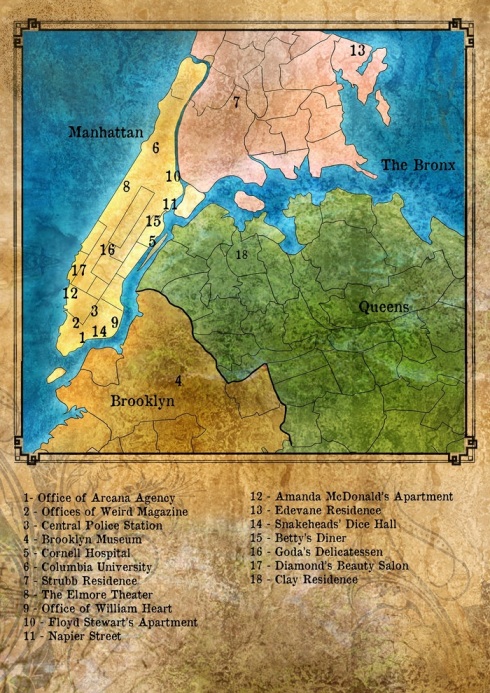
So, Arcana Agency became a print gamebook, in glorious full colour. The setting is New York, 1932, at the height of the Great Depression. The story follows a trio of private detectives - Humphrey Brown, Joe Strelli and Tom Shanigan; respectively studious, streetwise and superstitious - as they investigate the mystery of a man who apparently cannot die, and a wicked cultist long thought dead. The atmosphere is on the dark side, as gamebooks go. The detectives are never quite sure if their murderous antagonist truly possesses supernatural powers, or is merely a gifted charlatan. (And which is it, in the end? No spoilers here, I'm afraid.)

The book was, in some ways, a tricky one to write. Not least because of the level of research involved in order to be historically accurate (what type of car would somebody on Humphrey Brown's pay scale be likely to drive in 1932? Hmm...). And yet I'm really happy with how it turned out. I've read a few reviews that mention a Cthulhu-esque tone to the story. In truth, I've only ever read a handful of Lovecraft's stories in my life and, while I've glanced through the Call of Cthulhu RPG, I've never played it.

No, I feel detective literature was a far greater influence than the horror genre. Certainly, I tried to imbue the setting with a touch of Raymond Chandler's Philip Marlowe stories. Of course, The Big Sleep, the first full Marlowe novel, was published in 1939, so that added to the time spent checking historical accuracy. Sherlock Holmes is my own personal detective of predilection, and there's an air of Holmes about Humphrey Brown. Well, an awkward, unsure version of Holmes, maybe.

The gamebook roots of the book - once we'd decided it would be a gamebook - are likely quite visible. The codeword system and mechanics owe more than a nod to Fabled Lands. Some of the numerical manipulation ('deduct 40 from the current paragraph number if you think you've found the clue...') is reminiscent of a couple of Steve Jackson's books. And the app adaptation will remain faithful to much of this, dice-rolling and all.

But I think there are a lot of fresh elements in there too. The narrative is in the third person, and the past tense. Perspective switches between various characters throughout. There's more interplay, more of a relationship, between the three detectives than you might often see in gamebooks. Occasional interludes take the narrative focus away from the three principal protagonists entirely. A big point: I think the book's villain is credible, and human. Nobody wants a nice villain. But it's important to sympathise with the villain's motives. Gamebooks have a nasty tendency of featuring evil sorcerers who want to destroy the world because... well, you know, because being evil is really cool. Here - yes, the villain is a nasty, murdering scumbag. But, should you manage to reach the end of the story, you kind of get why.

So, here we are two years later. The app that became a book has become an app once more, and I'm lucky enough to get to talk about it on the Fabled Lands blog. Have I mentioned that I originally started working with Megara because they wanted to translate and publish a scenario that I wrote for the Fabled Lands Role-Playing Game? As I said, it's interesting to see how things come around full circle.

Friday, 24 October 2014

Arcana Agency: the app version


Remember Arcana Agency: The Thief of Memories? It was a gamebook by Paul Gresty, published a couple of years ago by by Megara Entertainment using funds raised on Kickstarter. Well, now it's returning as an app, which is currently in review at Apple and should be on sale within a week for iOS, with an Android version not far behind. I'll run a guest post by Paul Gresty when the app actually launches, but to warm things up here's my foreword from the 2013 print edition. 

(Where I got it wrong: gamebooks on Kickstarter are mostly not innovating; they look more '80s than the '80s! But in the digital space there is real innovation in the form of projects like 80 Days from Inkle/Meg Jayanth and Frankenstein by - modest cough - me. So quality gamebooks like The Thief of Memories do have a future, only it'll be as apps rather than expensive KS hardbacks.)

*   *   *

It's generally thought that the boom time for gamebooks was the 1980s. Back then, every publisher wanted at least one gamebook series and it was hard for the small pool of authors willing to wrangle with flowcharts and rules systems to keep up with demand. But who could have imagined that, thirty years on, a first-time gamebook writer would raise the staggering sum of $130,000 – and not as advance against royalties, as publishers pay for new work, but in the form of pure patronage? For that is Kickstarter, today’s answer to François I.

The genius of Mikael Louys, founder of Megara Entertainment, has been in seeing that crowdfunding could point the way to an entirely new funding paradigm for specialist interest publications. Role-playing games and gamebooks, which would have struggled to find a market on the shelves of a bookstore, at one stroke become a very viable proposition when backed by a devoted core of aficionados.

Of course, there is rarely a new thing even in the third millennium, and Kickstarter book ventures in fact represent a return to the 18th century model of publishing whereby a subscription would be raised to pay for the writing and printing of a new work. So gamebooks may have left their ‘80s heyday behind, but reports of their extinction have been wildly exaggerated. Instead they could, alongside other hobby and genre interests, spearhead a whole new evolution in publishing.

It’s not just the financial side of gamebook publishing that’s changing. We are starting to see innovations in content too. Back in the 1980s, it was hard to convince publishers to try anything new because the standard Dungeons-and-Dragons-influenced fantasy gamebooks were selling so well. Now, that whole genre of gaming has been claimed by videogames, which will win hands down when it comes to dungeon crawls and monster bashing. Gamebooks have to get smarter. They have to evolve into new genres and styles. They must thrive by identifying the things they can do better than videogames. More complex characterization. A greater variety of situations. Deeper exploration of themes. That level of moral and emotional richness that prose can do better than any other medium.

Arcana Agency is just one such work and it can only do so much. But I’m interested in the mold-breaking aspects that Paul Gresty is trying out here. The usual second-person, present tense that has been the standard register of gamebooks since Steve Jackson’s Death Test has gone, throwing us into a medium that feels grown-up, intriguing, and full of properly differentiated characters. I’m not even sure that I’d use the label ‘gamebook’ anymore. That seems to imply something to read on the bus home from school, something to fit in after homework. Mr Gresty is writing interactive literature here, making full use of the medium at his disposal to provoke, stimulate and challenge the reader in interesting ways, and I’m sure we’ll look back on Arcana Agency as a pioneer of a whole new phase in the ongoing evolution of the interactive novel.


Saturday, 8 June 2013

Some like the perfume in Spain...

Listen carefully. I shall say this only once...

Who am I kidding? I'm sure to keep saying it. Jamie and I would love to continue the Fabled Lands series. We have some ideas of our own, and more importantly we have a team of trusted writers who we could work with so that it wouldn't take till the first peal of eternity to get it all finished.

Here's the but. Writers need paying. Even if Jamie and I don't pay ourselves, as we often don't, the writers and artists we work with have mortgages, kids, cats and goldfish to feed. I know what you're thinking. Feed the goldfish to the cats; it's a logic puzzle. Unfortunately, mortgage lenders don't accept repayment in the form of children, however much we all wish they would.

So, what about Kickstarter? The sonic screwdriver of funding, answer to every problem.

I did a post this week over on the Mirabilis blog about using Kickstarter to fund a publishing operation. (The t-shirt version: you can't. The longer version: unless you're famous.) This is not to say Kickstarter isn't a grand idea. You may remember that our good friends at Megara used it to launch their Arcana Agency gamebook, The Thief of Memories, and that was a very successful campaign. My buddy James Wallis used in to get the ball rolling on his Alas Vegas role-playing game. And just today - just today! - Sandy Petersen raised $231,000 for his Cthulhu Wars boardgame.

Let's not try to draw the graph that goes through that last one. It's Cthulhu, after all, and Mr Petersen has a track record adapting Mr Lovecraft's creations to a gaming context. It's an average of $195 per backer - significantly higher than usual for a game project. That doesn't necessarily mean Sandy will be on a Gulfstream to the Bahamas this weekend. The money "raised", you see, actually has to pay for stuff. Manufacture of playing pieces, a board, payment to the artists, postage.

In short, a business with a turnover of a quarter of a million is not making a profit of a quarter million. Or anything like.

Most gamebook Kickstarters begin with books that are already written, or (as in the case of Arcana Agency) that are being funded by enthusiam and willing work as much as by upfront cash. The snag about Fabled Lands is that we have six books to write, each around 750 sections. And then there's the art. Six lovely colour paintings - well, we can't get Kevin Jenkins back, much as I'd like to, as he's an art director at Framestore now and FL couldn't even pay for him to do a sketch on a napkin. And call it a hundred and twenty interior illustrations. Once those are all in, we can set somebody to do the typesetting.

And after all of that is done, we can launch a Kickstarter.

Jamie and I do plan to do something on Kickstarter. But to begin with it needs to be with books that are already written. If we raise some staggering sum and if, after parcelling up all those copies of Blood Sword or whatever, we are left with anything resembling a profit, you can be sure we'll plough it back into new projects.

What Kickstarter really is, and what it works brilliantly at, is a combined tool for pre-subscription sales and publicity. (Hmm, could that be why they gave it the name? Exactly what it says on the tin, right?) Moreover, this is publicity that generates money instead of costing money - though admittedly with a strong upfront risk component. So that's how Jamie and I are planning to use it. We want to build awareness of our many classic gamebook series. Yes, I know you know, but if we expect to get all the way across the Violet Ocean we're going to need a bigger boat. So expect to see some of our work appearing in Kickstarter campaigns over the next six months. And, if you like what you see, throw a few shards our way. You can have a free ride on our Gulfstream, honest.

Friday, 7 December 2012

One kick is all it takes

Arcana Agency: The Thief of Memories, Megara Entertainment's revolutionary reboot of the choose-your-own format, is now past the 60% mark for funding on Kickstarter. That's the good news. The other news - not bad as such, but urgent - is that there are only 6 days left to go.

I'm looking at the rewards, and for $40 (that's about £25) you get the lavish full-colour hardback Arcana Agency gamebook by Paul Gresty, and a PDF of Megara's beautiful Art of the Fabled Lands book. Not to mention the satisfaction of helping a team of passionate creative people to bring a really worthwhile product into existence.

So... six days to go. That means the project just needs 22 new backers a day to get over the finishing line. If you still aren't sure, check out this article on the game mechanics, or this one on Paul Gresty's love of detective stories, from Sherlock Holmes to Detective Comics. Or just pick up this free taster adventure and find out why Arcana Agency is part of the exciting new generation of interactive fiction.

Incidentally, if anyone has tried the free adventure and feels like starting a discussion - on the setting, the writing, the game system or anything else - well, that's what the comments button is there for!

Friday, 2 November 2012

The Thief of Memories

What is it about Depression-era Manhattan that makes it such a compelling place to set a story?

I guess it all began with those archetypal pulp heroes like the Shadow. The passage of time, far from attenuating the lure of those rain-wreathed skyscrapers, Deco-styled apartments, spats, and Duesenbergs, has added the heft of hindsight. Now we can populate the darkened alleyways with Cthulhoid monsters, and envisage the smart uptown set watching the unwrapping of mummies while sipping highballs. And over this nervy world of light and dark, innocence and corruption, hangs the darkest shadow of all: impending war against the Axis.

I'm a sucker for this world. From Wesley Dodds doling out bad dreams for the wicked to Lobster Johnson facing Nazis and nastier, from Edward Carnby finding himself alone in the dark to Jeff Daniels scouring Hoboken for the purple rose of Cairo, I'm always first in line. I can even take Alec Baldwin as the Shadow, if that's the price tag for Russell Mulcahy's luminous vision of 1930s Manhattan and Jon Lone's perfect take on Shiwan Khan.

In light of all this, it's amazing that up till now there hasn't been a thirties 'tec gamebook. (If I'm wrong about that, somebody will correct me.) But it was worth the wait. Paul Gresty has penned a trilogy of interactive adventures titled Arcana Agency: The Thief of Memories. It's a 200-page hardback, gorgeously illustrated by the team at Megara Entertainment, the talented group behind the Fabled Lands iOS apps and the forthcoming Way of the Tiger RPG.

So where do you sign up? On Kickstarter, actually. Megara need your backing to bring this ambitious project to completion, and they've found a printer who can deliver a high-quality, full-colour hardcover for the price of a paperback.

What makes Arcana Agency really innovative is that Paul Gresty has avoided the traditional second-person hero, choosing instead to write it in third person with a cast of characters. This makes a lot of sense. Teamwork is an essential element of pulp mythology - Doc Savage, the Shadow, Lobster Johnson, etc, all have their band of trusty sidekicks. But this is not simply a nod to the conventions of the genre, it's a new gamebook technique that allows a much broader and more complex story to be told. Don't you love it when a plan comes together?

Arcana Agency: Thief of Memories is on Kickstarter till early December. Go take a look. If gamebooks are your thing, I think you'll find this one's a doozy.