


Why put the Oracle into a gamebook? Simple. I was hired to write for the Vulcanverse series, and the background they'd chosen was Greek myth. My personal preference in fantasy is for original settings like Tekumel, but the Greek angle made it easy. I just had to arm myself with a copy of Graves and figure out which stories to use in the books.
In fact there was another reason I wanted to do something with the Oracle. I'll come to that later.
The sixty-four thousand drachma question: how to use oracles in a gamebook? Prophecies are tricky enough in roleplaying games, where you have a bit of latitude in interpretation and you can if need be nudge events in line with what's supposed to happen.
Here's the way I planned to do it. You can request a prophecy on one of several tasks. First you must pay a lava gem to be admitted to see the Pythia, then: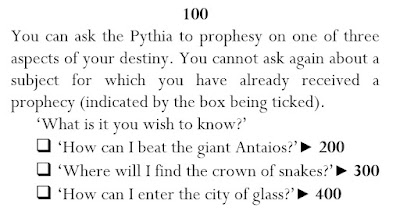


If you meet Antaios after you've already seen the Pythia, and so have the codeword DoneAntaios, then the prophecy will come true with your inevitable defeat. But if you meet Antaios before you've visited the Pythia and been given the codeword by her then you get the usual “unfated” encounter, meaning that you have a chance to defeat him. Without the prophecy, your fate is in your own hands. Then at the end of that encounter you'll get the codeword DoneAntaios which ensures the Pythia can’t give you a prophecy about something that's already happened.

The other reason for putting an Oracle into the Vulcanverse books is that they are open world adventures. My original idea for those (see Cities of Gold & Glory, for example) was that players could define their own goals. That's what my role-playing campaigns tend to be like. If a PC decides they want to climb the highest mountain in each of the kingdoms, for example, they can just go and do it. If there are pre-planned quests you have to come across them, not be handed them. But many gamebook fans and players of traditional D&D are accustomed to being given an objective at the start. "Your mission, should you choose to accept..."
The Oracle is a way of giving players a choice. Want an assigned quest? Go to the Oracle -- but she might doom you to failure before you've even begun. Or you can go looking for your own adventures, disdaining any sense that destiny controls you; be the captain of your own fate. In the Vulcanverse, the choice is yours.
