Gamebook store

Showing posts with label Cities of Gold and Glory. Show all posts

Thursday, 9 February 2023

Seen in the smoke

Why put the Oracle into a gamebook? Simple. I was hired to write for the Vulcanverse series, and the background they'd chosen was Greek myth. My personal preference in fantasy is for original settings like Tekumel, but the Greek angle made it easy. I just had to arm myself with a copy of Graves and figure out which stories to use in the books.

In fact there was another reason I wanted to do something with the Oracle. I'll come to that later.

The sixty-four thousand drachma question: how to use oracles in a gamebook? Prophecies are tricky enough in roleplaying games, where you have a bit of latitude in interpretation and you can if need be nudge events in line with what's supposed to happen.

Here's the way I planned to do it. You can request a prophecy on one of several tasks. First you must pay a lava gem to be admitted to see the Pythia, then:
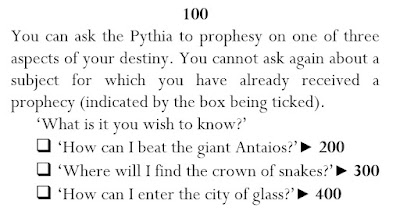

Each answer sets a definite outcome to a challenge – two good, one bad. Once that’s set it cannot be changed. For example, take the bad prophecy. The Pythia says you will fall to Antaios, and if you've been given that prophecy then when you meet him he will certainly overcome you without the usual combat choices. (Though maybe there’d be a last chance to reverse the defeat, ie you are overcome but might still escape.)


If you meet Antaios after you've already seen the Pythia, and so  have the codeword DoneAntaios, then the prophecy will come true with your inevitable defeat. But if you meet Antaios before you've visited the Pythia and been given the codeword by her then you get the usual “unfated” encounter, meaning that you have a chance to defeat him. Without the prophecy, your fate is in your own hands. Then at the end of that encounter you'll get the codeword DoneAntaios which ensures the Pythia can’t give you a prophecy about something that's already happened.

That's the bad outcome. The other two questions, about the crown of snakes and the city of glass, would be answered with prophecies that guaranteed success -- assuming you visit the Pythia before undertaking those quests. (The player shouldn't know in advance which question will get a bad prophecy and which will get good outcomes, of course.)

The other reason for putting an Oracle into the Vulcanverse books is that they are open world adventures. My original idea for those (see Cities of Gold & Glory, for example) was that players could define their own goals. That's what my role-playing campaigns tend to be like. If a PC decides they want to climb the highest mountain in each of the kingdoms, for example, they can just go and do it. If there are pre-planned quests you have to come across them, not be handed them. But many gamebook fans and players of traditional D&D are accustomed to being given an objective at the start. "Your mission, should you choose to accept..." 

The Oracle is a way of giving players a choice. Want an assigned quest? Go to the Oracle -- but she might doom you to failure before you've even begun. Or you can go looking for your own adventures, disdaining any sense that destiny controls you; be the captain of your own fate. In the Vulcanverse, the choice is yours.

Thursday, 11 November 2021

Return to Golnir


I'll just whet your appetite with this gorgeous Golnir map and then hand you over to Victor Atanasov, head of Prime Games, to explain about all the new adventures, new skills, new items and new gameplay features that are waiting for you right now.

Sunday, 24 January 2016

Big issue

Here's something I didn't anticipate when I outlined Fabled Lands Publishing's plans for 2016: a new large format (8" x 10") edition of the existing FL books.

How it came about is that later in the year we're hoping to publish a paperback version of the new book, The Serpent King's Domain. And then Jamie and I realized we couldn't only do a 6" by 8" edition. What about all the FL readers who bought the original large format books back in the '90s - you're going to want book 7 to match those, am I right?

So as a kind of experiment, seeing as we have the text files already edited, we're releasing new 8" by 10" versions of the original books, starting with The War-Torn Kingdom and Cities of Gold and Glory. Now hang on, though. Don't rush out and buy these if you're already happy with the editions you've got. There's no new content here. And we haven't been able to duplicate the fold-out covers of the original Pan Macmillan editions; even though print on demand has come a long way, it isn't there yet. But if you had an incomplete collection of 8" x 10" books and prefer that format, now's your chance. Oh, and these new editions feature Russ's regional maps in full glorious colour, so there is that.

Take your pick. The new large format edition...


...or the 2010 standard paperback:

Monday, 3 September 2012

How Russ got his briefs

Right from when I started writing gamebooks, I wanted Russ Nicholson as one of my artists. That wasn't because he illustrated Warlock of Firetop Mountain, oh no. I'd been a fan long before that, on the basis of his work in White Dwarf and, years before I started reading that, in the brilliant British magazine Fantasy Tales, edited by Stephen Jones. Here's his illustration in issue one (Summer 1977) accompanying Michael Moorcock's self-parody "The Stone Thing":
Thanks to Mr Jones, I tracked Russ down to the jungles of Papua New Guinea, where he was helping a super villain build his lair, and persuaded him to do the illustrations for Eye of the Dragon - not the Fighting Fantasy gamebook; I'm talking about the original one. Since then we've worked on a lot of projects together, but few more ambitious or creatively successful than Fabled Lands. Let's face it, without Russ's images, the world of Harkuna would feel like it was just made up or something. Illustrations like the one here of the canals of Metriciens (below: colourized version from Megara's art team) reach out and drag you into another world. It's not only Coleridge's definition of poetic faith we experience when Russ is on top form; it's the willing commitment to belief.

Enough preamble. This is all by way of saying that, while engaged in the 21st century version of clearing out the attic - to wit, sorting through old folders on my computer - I came across the original art brief I sent to Russ for Fabled Lands book 2. And for the sake of historical interest, here it is - sent by snail mail, of course. We didn't have no fancy international network in those days:

Hi Russ - the maps look great. I love all the detail on the forests - it takes me back to reading The Hobbit and LotR, wondering over the maps. Just what we wanted. The city of Metriciens is missing off the colour map, but that may be because I forgot to put it on the original. (Not all cities from the detailed colour maps will necessarily fit on to the large global map, of course.) 

Also, herewith are the first batch of Fabled Lands illustrations. Phone me to discuss once you've looked through them. I've established generic formats for the pictures: 

Widescreen: 186mm wide by 73mm high
Quarter Page: 88mm by 110mm 
Sixth Page: 88mm by 73mm 
Vignette: 88mm by 55mm or less 

The illustrations for Book Two are:

2 The city of Ringhorn (widescreen) 
A vista of the city, which is a typical medieval city located on a river. This could be done like a medieval map, or as a picture of the city with an inset map and city coat-of-arms, or whatever you like.

25 Castle Ravayne (widescreen)
"The white turrets rise above the treetops. White puffs of cloud float in the sky. From the topmost tower flutters the black lion banner of the Ravayne Clan."

48 The city of Metriciens (widescreen)
The main mercantile port, probably much like Venice at its height. How about a picture showing a palace built along a plaza like those old Canaletto pictures or whoever it was? (Like Ringhorn, you could have inset flag, coat-of-arms or little map if you want.)

71 The town of Wheatfields (quarter page)
"A market town of some size, in the very heart of the fertile farmlands of central Golnir." This can be a view as you approach, street scene, whatever...

94 The Monastery of Molhern (quarter page)
A monastery devoted to the god of learning and crafts. The monks combine hard physical labour with academic study - just like monks in the middle ages were meant to, I suppose. This is set at some remote spot in the countryside.

125 The Temple of Nagil (quarter page)
"Nagil, god of death, is often shown as a cowled figure. Paradoxically, his temple is no stately mausoleum, but a wide high-towered building from whose minaret the priests sing a haunting melody at dusk." This is in a city.

145 The shops of Conflass (widescreen)
"Conflass market consists of tiers of shops surrounding a pleasant square in the middle of the town. You reach the higher shops by means of stepped walkways." I was thinking of the shops in Chester, by the way.

185 Hermit's cottage (quarter page)
A sprawling single-storey cottage in the heart of dense black forest. In front is a man in a homespun tunic who is drawing water from a well.

208 Caught in a spider's web (sixth page)
Typical giant spider descending to gobble you up.

217 Wishport (widescreen)
"Wishport is a picturesque town set at the back of a bay rimmed by white cliffs." To make this a bit different from the other town/city pictures, it could be seen from out at sea. 

255 Ships in Ringhorn harbour (widescreen)
Ships moored, perhaps with bridge to show how wide the river is. I'm thinking of something like the Pool of London in olden times, in that this is a wide sheltered estuary so there is no need for a harbour wall or whatever.

282 In the mountains (sixth page)
"High jagged peaks... As you climb a steep trail, you see a small waterfall gushing from high above."

303 Enchanted waterfall (quarter page)
A wide pool below a large waterfall. Fine spray hangs in the air like mist (goodness knows how you'll show that!) and very faintly it seems that figures are outlined in the mist, but it's impossible to be certain.

330 Waterfront tavern (quarter page)
Typical tavern (whatever a "typical tavern" looks like in the world of Harkuna) where sailors drink and wait to be employed or press-ganged.

360 Smugglers on the beach (quarter page) 
At night, from a vantage point on the cliffs, you see smugglers coming ashore with barrels in a small boat.

386 Pirates at sea (quarter page)
Pirates sail towards you. These pirates are actually privateers of the Kingdom of the Reavers, identifiable by the jagged pennant they fly.

400 Sprites at the roadside (quarter page)
"You are on a lonely stretch of road. Suddenly a bunch of misshapen sprites with grotesque faces emerge from a hedge. They amble over and prod you with gnarled fingers."

428 Tricked by the devil (quarter page)
You are on a country lane. The devil (in the guise of a young bard) has challenged you to deliver a sermon good enough to convert all the local cats. Naturally the cats are milling about taking no notice, at which the young bard seems quite amused.

455 Castle dungeons (quarter page)
A jailer is looking in on you in the gloomy castle dungeons, straight out of Prince Valiant I guess!

473 Storyteller (sixth page)
A storyteller is sitting on a grassy hummock beside a leafy lane, regaling the local children with his tall tales.

514 Samurai in the fens (quarter page)
"On an island in the fens, you are startled to come across a swordsman in exotic armour sitting beside an empty chest. His curved sword is across his knees and he leaps up angrily as you approach."

540 Estragon the Wizard (quarter page)
A crazy old wizard in his laboratory, deep under Castle Ravayne. He's looking annoyed at the bad news you've just brought him. In fact, it looks like he's casting a spell at you!

573 Wraiths on the river (quarter page)
"Just after nightfall, a punt carrying ghostly figures drifts around the bend in the river. The wraiths beckon for you to come aboard and join them." This is out in the middle of nowhere.

599 Damsel in a high tower (sixth page) 
While travelling cross-country, you see a woman who calls down to you from a tower where she has been imprisoned by an evil knight.

621 An eerie inn (quarter page)
"At dusk you are forced to seek shelter from the rain. You go towards a light, finding an inn. An old peeling sign swings in the wind. As you approach, the door opens and the innkeeper invites you in." 

646 Three knights of the death-god (quarter page)
"Three mounted knights encounter you on the road. They wear white tabards and their shields bear the holy symbol of the death-god Nagil." 

677 Fools of Gotham village (quarter page)
Seven simpletons (not all need be shown in the picture!) are trying to convince a cow to climb up a ladder onto the roof of their thatched cottage.

704 A stranger at dusk (quarter page)
"A fellow in grey robes sits on the steps of a caravan by the side of the road. He is playing a flute with a bulb in its stem. As you draw near, he looks up and grins, teeth flashing like pearls in the light of the rising moon." I imagine the flute looking like a snake-charmer's pipe.

741 A charging bull (sixth page)
A bull charging angrily at you for having the temerity to take a short-cut through its field.

765 A country fair (quarter page)
Typical country fair with tents and stalls set out on the village green. Jugglers, pedlars, dancing bears, songbirds, acrobats, musicians, villagers and so forth.

You could also add a few vignettes that will be used as fillers, so can vary between 20mm and 55mm high and one column (88mm) wide. These can illustrate typical "travel" paragraphs in open country, stone road, woodland, riverside, fens, cliffs by sea, or whatever you like - or more usual fillers such as swords, wands, compass and sextant, etc, if you'd rather. We should only need four or five for each book. All for now.