Showing posts with label demonology. Show all posts
Friday, 9 November 2018
Summoned back from oblivion
A little while back I mentioned the Citadel Miniatures box of demonic critters based on the "Dealing With Demons" articles I wrote for White Dwarf, and the tactical battle game I wrote to go in that box. (Purely as a charitable gesture to help out Citadel's struggling finances, you understand; I certainly never saw anything as exotic as a royalty statement.) I assumed that scenario was lost in the mists of time.
But nothing's forgotten, as any Robin of Sherwood fan knows, and so I shouldn't have been surprised when Lee Barklam got in touch to tell me he'd found "The Best Laid Plans" scenario out there on the internet. Steve Casey, the author of the blog where it was posted, described it as "well-written, gripping, and smattered with dark humour." Which seems a far kinder comment that it deserved in my memory, but then I hadn't seen it in thirty years.
Lee has converted the scenario to Dragon Warriors rules (thanks, Lee!) and you can find it among other Legend scenarios on the Cobwebbed Forest site here, or follow the direct download link to get the PDF here.
Friday, 1 December 2017
Dealing with demons - part 3
Now, these demon lords. The fact is they were originally devised for Medra, the campaign world of my 1980-82 Oxford campaign. So if you’re wondering why the names don’t sound very much in keeping with other Questworld material I’ve posted here, that’d be why. If we’d got as far as publishing the book I’d probably have changed that, but it was a rush job to write half of White Dwarf and get that QW book finished. Gosh, I was prolific in those days. That’s the energy of youth for you..
Anyway, here’s the final part of “Dealing With Demons”. Next time, as it's just about acceptable to mention Christmas now that we're into December, we'll have something to get you more in the holiday spirit.
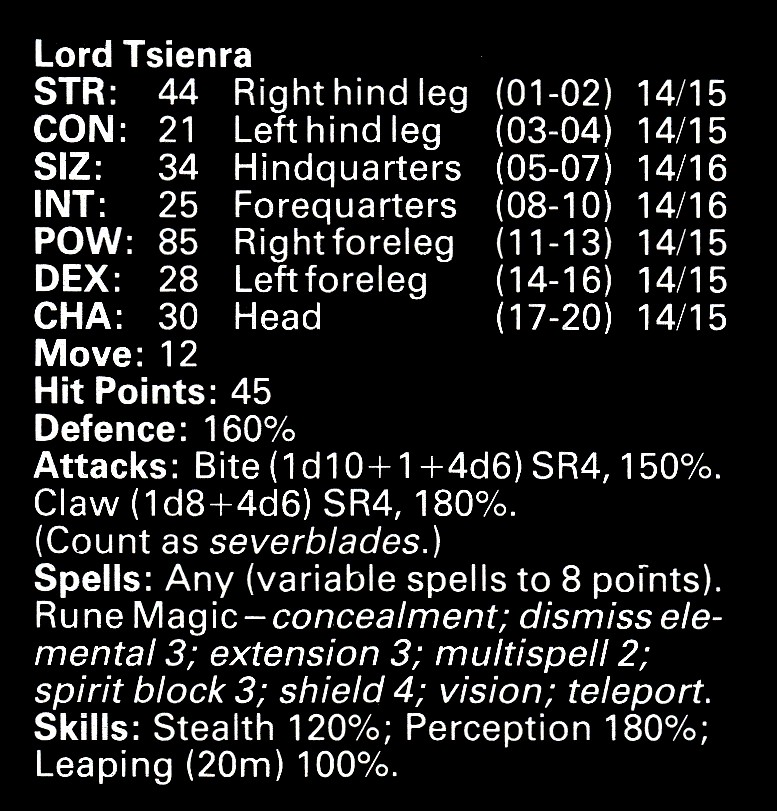
Tsienra can make one bite attack and two claw attacks
in the same round. These do not all have to be against a single opponent. By
splitting his attacks he can make even more strikes in one round, of course.
Like most demon lords he can cast any standard battle magic spell by drawing
POW from his home plane. When he casts a Rune spell he pays for it using his
own POW, just as a normal being would pay for battle magic. Like all demon
lords, Tsienra is immune to non-Runic weapons.
Anyway, here’s the final part of “Dealing With Demons”. Next time, as it's just about acceptable to mention Christmas now that we're into December, we'll have something to get you more in the holiday spirit.
Part
Three: THE DEMONIC NOBILITY
The demon lords and princes are individual beings of
immense power who rule the demon planes. They have, of course, been summoned far
less frequently than the lesser demons, so no exact canon of knowledge is
available as with the latter. A summoner who does some research may find
suggestions and theories as to how to deal with the demon lords (“Rokash the
Pious records that the powers of the Lord Eldyr are diminished by bright
light...” and so on), but exact wards—if any—are a matter of conjecture.
Similarly there is some uncertainty as to the precise
levels of power of the demon lords. Tsienra’s stats are given here as a
guideline, but referees must design these creatures to suit their own
campaigns. They should be virtually impossible to overcome with raw power
alone, and if your campaign abounds with 150%-plus Rune Lord-Priests then the
abilities of Tsienra and the others should be increased accordingly. When the
demon lords have suffered defeats in the past it has been through the summoner’s
quick wit and daring rather than from spells and swords.
As a general rule all demon lords will have a personal
POW of between 80 and 100, and can draw on unlimited POW reserves from their
home dimension for casting battle magic. They are hostile about 20% of the time
and otherwise neutral. They will only be friendly if there is a very good
reason why they should react favourably to the summoner— Umalu prefers Chaotic
berserkers, and so on.
The Gifts
While not precluding the possibility of striking completely
unique bargains with a summoned demon lord, there are two types of deal which
are ‘commonly’ made. These are the Lesser
Gifts—minor exertions from the demon’s point of view, made in exchange for
characteristic POW from the summoner—and the Greater Gifts, which are permanent abilities bestowed on the
summoner in exchange for a soul-pledge.
A soul-pledge means the summoner gives the demon 1 POW
point to seal the bargain and promises him a further 3d10 POW later. These
further points are intended to be collected on the summoner’s death, but there
is a 2% chance the demon will arrive if it feels the summoner’s life-force is
burning low—in game terms, whenever the character’s hit points or POW reach 2
or less. Once the demon arrives nothing can stop it from devouring the POW
promised to it. These POW points are permanently lost to the character, at
which point the soul-pledge is ended and he loses the Greater Gift. If he
survives the POW loss he can later bargain again for a Greater Gift with the
same or a different demon lord. A character can buy any number of Lesser Gifts
from demon lords (if he can spare the POW), but it is only possible to have one
Greater Gift at a time. Note that to receive any gift at least 200 Wheels or
equivalent must also be offered.
The Demon
Lords
There are a number of other demon-lords that could not
be listed here—among them Pazuzu, Lord of Fevers, ruler of the lesser demons
commonly called by his name; Bakshuro the Screamer, who inhabits a dimension so
hostile that only he can live there; Valladolyn of the Emerald Eye, who sees
all; and Lady Kleshkala of the Pit, whose face is so terrible that merely to
summon her is to court insanity.
The three important parameters for each demon lord are
his or her Resistance to Summoning, Resistance to Binding, and Cross Pentacle
ability. The last is applied as a negative modifier to the summoner’s chance of
correctly drawing the Pentacle of Protection.
The Lord
Tsienra
Screaming Metal Spirit, Demon of Ferocity
Tsienra usually appears as a metallic figure,
something like a huge tiger armoured in intricately patterned plates of
tarnished silver and with a violet light burning behind his eyes and gaping
maw. He embodies the lightning attack, the unrelenting ferocity of battle, the
prowling spirit of savage death. Possession by the spirit of Tsienra gives
great speed and grace to the recipient’s fighting prowess.
Greater
Gift: Tsienra can give the power of ferocity. When a character with this power uses it, his STR and DEX
are effectively increased to species maximum for combat purposes, 35% is added
to his Attack chance and 10% is subtracted from his Parry. The character
expends 2 points of battle magic POW to go into ferocity and then another point for every full turn he keeps it
going.
Lesser
Gifts: For the sacrifice of 1 POW point, Tsienra will teach
his summoner the battle magic spell The Talons of Tsienra. For 2 POW points he
will use his skill at stalking between the planes to take the summoner within a
few miles of any location he specifies, now matter how great the distance. For 3
POW he will enchant any sword with a permanent bladesharp 2.
The Talons of Tsienra
POW
used: 4 points
Type:
passive, unfocused, temporal
This battle magic spell
causes 30cm talons of red light to spring from the caster’s wrists. He can
fight with these using either Fist or Dagger skill. The talons do just 1d4
damage (no STR/SIZ bonuses apply), but the only effective defence against them
is the Rune spell shield, which
absorbs one point from the talons’ damage for each point of shield. The talons are immaterial, so
parrying a weapon with them will damage but not deflect it. The spell can only
be learned from Tsienra himself, and if the character tries to teach it to
someone else then Tsienra will materialize unbidden and kill him.
His Fell
Highness Eldyr
Prince of Deceit, Demon of Persuasion
Eldyr is overlord of Incubi, Succubi and Gremlins. He
can pass in any guise he chooses, the better to advance his wiles, but will
always eventually cast images aside to reveal his true (perhaps true) self. In the Chronicles
of the Conjunction, Eldyr’s own description of himself is recorded: “My
hair is like black silk, my skin is burnished copper in the moonlight, my eyes
are sapphires and my robe embraces the starry night…” This description was for
the benefit of the sorceress Cordelia, who had wisely blindfolded herself
before the summoning. Without defences such as this, all in time succumb to
Eldyr’s charms; the evocator must attempt to banish him at once, therefore, if
he begins to use his powers in a hostile fashion.
Greater
Gift: Eldyr can give the power of harmonic spirit. This is a combination of charm and blind luck. It
costs nothing to activate this power, but each morning the character must roll
POWx5 or less on percentile dice to see if the power works for that day. The chance
is increased by 15% if the power was working the previous day, and decreased by
5% if it was not. Any luck roll the character has to make has a 50% chance of
working automatically without him having to roll for it; on a roll of 05 or
less he may have quite incredible luck – a 20m fall broken by some bushes, for
instance. He gets a CHA bonus of +4 and can use his CHA as an Incubus or
Succubus does. Finally, he gets an Oratory bonus of +35%.
Lesser
Gifts: For 1 POW point, Eldyr will aid a character in an
attempt to persuade others of something. He gives the character a 45% bonus to
his or her persuasion chances for one use only–and this must be some matter
where the character’s chance of persuasion was at least 10% in the first place.
The bonus is reduced to 10%-30% in attempts to bargain with demon lords because
Eldyr’s powers work only erratically against his peers. For 2 points of POW
Eldyr will give a luck ring. This silver ring has 100 charges and each charge
can be used to change the chance of something happening by 1%. The event to be
influenced must occur within 100m of the wearer and have at least a 10% chance
of happening in the first place. You can’t make a healthy warrior suddenly die
of a heart attack, for example. The wearer must declare how many charges he is
committing before the roll is made. When all charges are expended the ring
permanently tarnishes and is powerless thereafter.
The Lord
Umalu
The Whip of Chaos, Demon of Pain
The spirit of Umalu is that of glorying in the
inflicting of pain. He is a fierce, powerful demon who hates Lawful creatures with
an intense passion and is little better disposed towards being of Chaos. Umalu
manifests himself as a 3m tall muscular black giant with a long mane of white
hair, face perpetually contorted in hatred. He wields a glittering whip which
can bestow Reverse Chaos features and an envenomed shortsword which inflicts
terrible wounds.
Greater
Gifts: Umalu can bestow chaos
on a character, giving him or her a Chaotic feature. He can also give the power
of excruciation, so that any wound
the character inflicts has a 20% chance of dealing an extra 1d8 damage to the
victim’s hit point total owing to extreme pain.
Lesser
Gifts: In exchange for 1 point of POW he will teach a
character an extra 20% in the Torture skill. For 2 POW points he grants the
Rune spell curse of anguish (see below).
For 3 POW he will personally torture a captive to obtain information on the
summoner’s behalf.
Curse of Anguish
Range:
160m
POW
used: 2 points
Duration:
Permanent, Non-reusable, Not stackable
The caster of the Rune
spell is able to inflict racking pain on a victim if he can overcome their POW.
He can alter the victim’s hit point total at will to represent the pain, and
can thus force the victim into unconsciousness, vary the pain so that they must
fight at a disadvantage, or merely threaten them with the effects. The curse of anguish cannot kill– its victim
will merely lapse into a coma if the pain level is increased too far. This spell
does not affect undead, elementals or other creatures which do not actually
experience pain.
Torture
Torture is a manipulation
skill with a base score of 15% and is learned at the rates 200/400/800/EXP.
Normally a character must join the Guild of Torturers to learn the skill. A
successful Torture roll means that the torturer has extracted all or part (40%+
1d6x10%) of the truth from his captive, failure means that he has got false
information. A fumble means that the captive has died. Torture can usually be
used only once a day on a given captive – each extra use in the same day
doubles the chance of a fumble. Captives can use their CON +POW as a ‘Defence’
against the Torture ‘Attack’ if they wish.
His
Demonic Majesty Adelmar
Summon the terrible Adelmar only when you plan such
grand designs of mayhem and destruction as would make lesser demons quail, for
he is a proud and potent force and should not be summoned lightly. Standing
about two and half metres tall, he is ebony-black with the lower body of a
serpent, a human torso, and an armoured, horned head like that of a
triceratops. He wields enchanted scimitars in each hand. One scimitar feeds on
the blood of victims, the other on their souls. Adelmar is said to dwell in a
labyrinthine castle on an island in an unknown lake. When Adelmar is summoned,
the evocator and his party (up to six others) are carried to this castle to
petition the demon.
Greater
Gifts: Adelmar has a limited power over time itself, and can
give the ability of temporal navigation.
This enables a character to cross up to ten years either into the past or
future, arriving within 1-12 weeks either side of the required date. Each use
of temporal navigation costs the
character 1d4 from characteristic POW.
Lesser
Gifts: For 1 point of POW Adelmar will open the veils of time
to uncover some secret at the summoner's behest. For 3 POW he will send an army
of demonic warriors – equivalent to five thousand elite cavalry–to fight in one
battle beside the army of the summoner or his employer. Adelmar can also add to
a character’s lifespan— five years for 1 POW, ten years for 2 POW, and so on. A
character can only petition for this gift once. During the added years the
character does not age, but the deal must be phrased with exceptional caution
or Adelmar will surely twist things to the summoner’s detriment.
The Lord
Akresh
Spirit of Thunder in the Mountains, Demon of
Invincibility
Akresh represents steadfast strength of purpose, the
glowering look that intimidates a foe, the essence of power that cannot be
assailed. Possession by the spirit of Akresh is called waiting-within-a-fortress; it hardens the will, shields the body
from harm and augments the recipient's physical might. Akresh himself can only
be evoked in mountains, where he usually appears as a shadow against the sky
and a booming echo between the peaks.
Greater
Gift: The power that Akresh can grant is indomitability. A character with this
power must roll POWx5 or less on d100 whenever he wants to use it; once
activated, the power costs 2 points of battle magic POW for each full turn the
character wishes to use it. While indomitable
the character remains fixed in position waiting for attacks. He can
automatically sweep aside all attacks made at 25% or lower, including missile
attacks; his STR increases to species maximum; he gets a +20% Parry bonus and
any parries he makes do an extra 1 d4 damage to the parried weapon. Finally, he
gets an extra point of armour protection.
Lesser
Gifts: For 1 point of POW Akresh will teach two points of
the battle magic spell parry (usually
available only to Humakti). For 2 POW he can enchant any shield so that whoever
carries it has a permanent protection
1. For 3 POW he will summon mountain storms that can throw whole armies into
confusion, or block a pass with landslides.
Her
Eldritch Highness Sarasathsa
Princess of Mystery, Demon of Paradox
Sarasathsa has sovereignty over things impenetrable or
unknowable. Possession with her spirit-essence renders the recipient immune to
spirit combat, as spirits will recoil from her terrible mysteries, but is double-edged
in that the recipient could become sunk into lethargy and pensive introspection
(roll POWx5 or less when coming out of possession to avoid this. Sarasathsa may
have many forms, but is often described as a very tall (2½m), slender, graceful
woman in blue and green robes. Her skin is pale and mottled in a serpentine
pattern, and the right side of her face is concealed behind a fantastical mask
in the form of an embryonic dragon. All summoners describe her as cold and
disdainful and rather draconic in temperament.
Greater Gift: Sarasathsa can grant morphetic counsel. Whenever the
character has some problem to solve or mystery to uncover she will whisper
clues to him in his dreams. This acts as though the character had 80% in the
General Knowledge skill, and also allows him important visionary dreams at the
referee's discretion.
Lesser
Gifts: For 1 POW she will answer any three yes/no questions
about the past or present with 99% accuracy. For 2 POW she will convert any
powered crystal into another type which the summoner specifies (the crystal's POW
is diminished by 1 by this process. For 3 POW she grants a character a
permanent 5% bonus on POW gain rolls.
The Lord
Kojuro
Who is One with the Sword, Demon of Fighting Skill
Kojuro appears as a slender man with greyish skin and
sharp white shark's teeth. He wears white and grey cotton robes and carries a
number of swords and throwing knives. His province is skill in combat,
particularly swordplay.
Greater
Gift: Kojuro can immediately raise a character's skill with
swords to 80% or by 15%, whichever is greater.
Lesser
Gifts: For 1 POW point Kojuro will increase a character's
score in any fighting skill by 5%, to a maximum of 75%. For 2 POW points he
will place a single-use truesword
spell on a blade; this spell can be activated at any later time by whoever
wields the sword. For 3 POW he will increase the skill of an entire army by 5%
for a single battle.
The Lord
Kesh
Jewelled Serpent, Demon of Confusion and Terror
Kesh embodies the transfixing gaze of a snake. He
causes awe by his presence alone, a massive bejewelled, serpentine shape
coiling about the Pentacle and rearing up to the roof of the summoning
chamber–the summoner must roll POWx5 or less on d100 or lose all power to
bargain with the demon. Looking into Kesh's eyes causes demoralization.
Greater
Gift: Kesh grants the power of intimidation. Given two rounds in which to talk to foes before he
fights them, a character with this power can threaten with such unholy force
that those hearing him must roll POWx5 or less on percentile dice or be demoralized. In combat, the character's
gaze can transfix like a vampire's.
Lesser
Gifts: For 1 POW point Kesh will reveal the location of an
ancient treasure hoard of at least 90 treasure factors. For 2 points he will
set a giant demonic serpent to guard your treasure for you. For 3 points he
will teach you how to brew any venom or acid up to potency 15.
The Lord
Engala
Gatherer of Darkness, Demon of the Undead
Engala is usually characterized as the zombie spirit,
embodiment of unrelenting attack, but in fact he is the lord of all undead
creatures. Engala appears as a dull-eyed, expressionless man with dead white
skin, robed in grave-soiled black raiment. His movements are slow and languid,
like a corpse underwater, and when he speaks his lips hardly move to his
hollow, emotionless tones. Those possessed by his spirit will fight until cut
apart.
Greater
Gift: Engala can make a character into a vampire or mummy.
The customary pledge of POW is useless to Engala because he is an undead being,
so instead of that pledge he imposes a peculiar condition on his Gift. Every
ten years the character must find a champion to play Engala's representative at
a game not unlike chess. If the champion loses, Engala drains him of POW and
destroys him. If the character cannot find a champion he must play Engala's
representative himself – in this case, if he loses, Engala will come and take
the character as one of his personal servants.
Lesser
Gifts: In exchange for a powered crystal Engala will give a
lead amulet which grants the wearer some protection from undead – hostile
undead act neutrally and neutral undead will be friendly, as per the Runequest
response table. Occasionally he may give favoured summoners a zombie or
skeleton guard to serve them.
The Lord
Kyrax
Blizzard Flame, The White Lord, He Who Descends from
the Storm
Kyrax is one of the oldest demons. He has the form of
a giant white wolf, or sometimes a man of feral aspect. He is the master of
stealth and guile, can cause invisibility, blizzards and darkness and
particularly aids those who were once mighty, for he is the demon lord of
regathering old powers.
Greater
Gifts: Kyrax can grant a character 70% in all Stealth skills
or raise these by 20%. Or he may personally aid a character in a single master
plan.
Lesser
Gifts: For 1 POW point he will increase a single Stealth or Tracking
skill by 10%. For 2 POW he will give a one-use Rune spell to summon thick mist
in a 160m radius; the caster can see up to 30m in this mist but for others the
visibility is under 10m. For 3 POW he will summon a blizzard or turn a
character invisible for eight hours.
His
Excellency Hragahl
Minister of
Lightning, Demon of Intellect
This bizarre and ancient demon lord is master of all
matters connected with logic and philosophy, and if he is impressed by a
summoner's ability in these areas he will have a friendly reaction to him.
Hragahl materializes as a giant (1 m) bald, fanged head with silvery-blue skin,
incandescent white eyes, and giant wings springing from his temples. He has a
tongue of flickering lightning which can snake out up to 20m.
Greater
Gift: Hragahl can transform a staff or weapon of the
summoner's so that it has powers of a Stormblade [WD39, Runeblades].
Lesser
Gifts: For 1 POW point he will summon up a Storm Demon and
place it under the summoner's control for fifteen minutes. For 2 points of POW
he will give a 5% bonus in General Knowledge (to a maximum of 45%). For 3 POW
he can increase a being's INT by one point or summon storms to confound an
enemy.
Final
Notes
A word of warning: campaigns where demon lords get
summoned up every weekend and every other character has a Greater Gift are
going to get dull very quickly. Scenarios could involve a demon lord's
influence without requiring him to make a personal appearance – player
characters could battle a small cult worshipping one of these entities, or
inadvertently break a chain of events set in motion by a demon lord long ago.
Bear in mind that even the Lesser Gifts of a demon
lord are powerful and hard to come by. There is a high risk factor in any
summoning, and the demon lord must have a favourable reaction to the summoner
if any deal is to be struck. Few generals would care to swell their army's
ranks with demon warriors, even if they can seek out one of the demonologists
powerful enough to make such a bargain. Only three cases of military use of
demonic powers are recorded in Questworld's history – each time by the
extravagant, whimsical Ancients, for whom normal caution and logic seem
meaningless.
Lastly, words of thanks to everyone who might have
inspired or actively fed me with demonic ideas – in particular, Steve Ditko, P
Craig Russell, Richard Lupoff, Miyamoto Musashi, Yvonne Newnham, Mike Polling,
Jack Vance, Oliver Johnson and William Burroughs. Vance's short story “The Miracle Workers” directly supplied the idea of possessions, and gives a vivid
account of their effects. For a host of further demons, Professor M A R Barker's Book of Ebon Bindings is recommended. It
details, with many colourful anecdotes, creatures designed for Barker's world of Tekumel
but usable in any setting.
Friday, 24 November 2017
Dealing with demons - part 2
Not long after this part of the "Dealing With Demons" article came out (White Dwarf 45, September 1983) I learned that Citadel Miniatures was releasing a set of figurines based on my demons. I never did seem able to get across to the GW guys that the articles were my copyright and that I therefore owned what was in them. After mentioning it I got a tenner and the promise of a couple of free boxes of figurines, for which I gave Citadel a free demon-summoning scenario to put in the box; there's a collector's item if you can find it. Next week, in the final instalment, we'll tiptoe in for a closer look at the lords of demonkind.
Part
Two: THE LESSER DEMONS
It is a rash student of demonic magic who expects to
start his career by summoning the great demon lords and princes. Such a career
would be short-lived. It is best to begin with lesser demons, even though their
services are scant beside their masters’ powers.
To the would-be summoner, knowledge is most definitely
power. His Demonology score determines how much he knows about each type of
demon. Any novice will know the names and general skills of common demons such
as those listed here, but their exact strengths and vulnerabilities can only be
found out through exhaustive study and calculation. For example, a character
who had done no more than to leaf through a few compendia of demons would know
that B'krath are stealthy killers that operate to best effect in shadow, but it
is hardly common knowledge that the B’krath do not haggle and will only serve
in exchange for a precise quantity of gold.
Demonology rolls are usually made by the referee on
the character's behalf, so that the character can never be entirely sure that
his information about a demon is correct until he has actually tested it out.
Information is broken down for convenience into five categories:
- The demon's abilities — POW, hit points, fighting skill and damage, etc. A successful Demonology roll means that each ability is known to within ±25% (randomly determined by the referee).
- Special wards against the demon, if any.
- The demon's tractability –the proportion of friendly, neutral and hostile individuals among a given demon race.
- The demon's probable requirements in bargaining.
- The demon's resistance to Binding. A successful Demonology roll lets the character know this to within ±10%.
Characters trying to discover these facts for a
particular type of demon check for them after every 2-20 days (roll two d10).
This represents the time taken in research and meditation. The check is made
for each of the five information categories separately. In each case, if the
referee makes the character's demonology roll then he gives the player the
correct information —within the limits given above. On a fumble the Referee
gives the player completely erroneous information. Any other result on the
Demonology roll simply means that the character has turned up nothing useful
and will need to spend another 2-20 days in study.
A character might want to double-check his results: he
can go on devoting study time to a demon as long as he wants. For example,
Hajpool the Wary is a student with a Demonology ability of 30% who is trying to
find out about Storm Demons. Hajpool's master has told him most of what he wants
to know, but insists that as an exercise he determines for himself any wards
that can be used, After his first study period, Hajpool is informed by the
referee (correctly, because a 27 was rolled) that the appropriate ward is a
fence of sharp copper rods around the perimeter of the pentacle. Wanting to
make sure, Hajpool spends another 2-20 days in his master's library. This time
he turns up no further information. After six more study periods Hajpool has
twice been told that copper rods are the proper warding, four times drawn a
blank, once been told to use garlic and once that the proper ward is a gold
Life Rune. He realises that the last two must be incorrect results from fumbles
and that the two answers which agree are almost certainly the right answer.
Note that because Demonology is a complex subject,
highly liable to error and miscalculation, the chance of a fumble is twice what
it would normally be for any other skill. A Demonology skill of 30%, for
instance, leads to a fumble on 93-00 rather than 97-00.
In the descriptions below, the first paragraph is
general information about the demon that any demonologist would know or that
could be found in some demon bestiary. The second paragraph is specialized
information that can only be discovered through the right Demonology roll.
Amorphs
At first glance an Amorph could be mistaken for a Gorp
– an oozing blob of grey-mauve protoplasm. But the form of the Amorph is full of
eyes and chattering mouths, and it will occasionally extrude temporary
appendages.
Specialized
knowledge: Amorphs are best used as guards in dank places or as assassins
where there are moats and rivers to be crossed, as they travel freely through
water. Fire causes an Amorph 50% extra damage. Amorphs take 3d3 damage if they
cross a line of eucalyptus oil, so this makes an excellent warding material. Amorphs
serve in exchange for a litre of Gorp acid, on which they feed.
B’krath
B’krath are slender, prowling killers, roughly humanoid
in appearance but with musculature and stance reminiscent of a jaguar. The
jet-black fur of a B’krath makes it particularly adept at stalking in shadows;
its Defence and Stealth abilities are halved in bright light. B’krath fight
with their long powerful talons and needle-sharp teeth.
Specialized
knowledge: B’krath when summoned always appear in groups of
three. The summoner thus temporarily loses 3d3 points of CON. The three B’krath
are identical in their characteristics, reaction to the summoner, etc, and are
in permanent mental rapport (not mindlink)
with one another so that they hunt and fight as a team. The B’krath will not
haggle over payment for their services—indeed, they never communicate with humans
except to receive their instructions. The B’krath will undertake only
assassinations, and must be paid 3000 L worth of gold dust for this.
Demon
Wolves
Large, black wolves with red eyes. They have excellent
tracking skills and are best employed as hunter-killers.
Specialized
knowledge: Demon Wolves are partially resistant to weapons of
non-Runic metal (which cause them only half damage), and moreover anyone striking
a Demon Wolf with such a weapon must resist its POW or suffer one of these
curses:
- Arms paralyzed
- Struck blind
- Struck dumb
- Transformed into a rat
- Leg withered (halves movement)
- Horribly disfigured (-10 from CHA)
A curse can be removed with dispel magic 2. Demon Wolves take double damage from aconite-based
poisons. The minimum payment for a Demon Wolf's services is the sacrifice of a
sentient being. They must be summoned by night, as daylight demoralizes them.
Gremlins
These are small (two and a half feet tall), thin humanoids
with elongated toes and fingers like a lizard’s and a globular head perched on
a narrow neck. They have pale green skin and their large, saucer-shaped eyes
give them a rather comical look. Gremlins are demons of (bad) luck.
Specialized
knowledge: Gremlins are ineffective fighters, but their special
ability is that anyone within 8m of a Gremlin suffers bad luck. Any rolls that
the character makes are adjusted by 1d3x5% so as to be less favourable. Any
luck rolls must be made by the character rolling POW as a percentage, rather
than the usual POWx5%.
Gremlins have 85% natural camouflage in all
surroundings and utilize this to skulk near their victims and bring down upon
them the vicissitudes of disaster. If forced to fight, Gremlins use long
straight-bladed knives. Gremlins will require a minimum payment of 350 Lunars. They
cannot harm anyone tied to the Luck rune.
Nightmares
These large, black demon horses are usually summoned
as a mount for the demonologist, as they can cross any terrain at 30 kilometres
an hour.
Specialized
knowledge: Nightmares can only be evoked after sunset, and
dissolve into mist if exposed to sunlight. There is no other special defence
against them. A nightmare will require a pint (equivalent to 1 d3 STR) of the
summoner's blood in return for its services.
Pazuzu
These demons are thin and manlike., Their taut,
glistening skin is ruddy-bronze in colour, their leonine manes are dusty grey
and their eagle-like wings and talons are darkest black. They can breathe flame
up to 10m.
Specialized
knowledge: Pazuzu make particularly useful servants because of
their powers of illusion (they can cast image
creation at will for no POW cost) and their partial resistance to magic
(one-point battle magic spells cannot affect them). Pazuzu require payment of
about 750L worth of ivory. Offering a Pazuzu water brought from an oasis causes
it to become more tractable (-10 from its reaction roll).
Porphyrs
Vampiric blue-skinned demons, porphyrs are very tall and
gaunt and have all the normal powers of a vampire. They have bald, veined
heads, eyes of limpid yellow and long, seemingly delicate nails. Over its robes
a Porphyr will wear a silver cuirass with intricate designs worked upon it.
Specialized
knowledge: Porphyrs have all the vulnerabilities of any vampire.
They have great difficulty controlling their passionate thirst, and the
summoner should wear a garlic sash as this gives an effective Defence bonus of
+10% against the demon’s attacks. The Porphyr demands at least one bound spirit
familiar as payment. From this it will drain all blood and POW, destroying it.
Rult
Rult have hunched bodies with dry, shredding flesh, a
large head like that of a fly, and skeletal wings draped with a torn web of
skin.
Specialized
knowledge: Rult must be summoned at the place of execution of a
man who has murdered more than once. They will haggle for gold, silver and
gems—a Rult usually requires about 1,000 Lunars. Rult have two special
abilities. First, they can teleport over distances of up to 4 kilometres, with
the restriction that some living or once-living body which they have
encountered is at each end of the teleport. Secondly, Rult can breathe a
poisonous vapour doing 1d3 damage that cannot be healed by magic. Any character
wearing a Man rune amulet has a +10% bonus to harmonize a Rult.
Sraim
Sraim have a giant maggot’s body on four long spidery
legs, with a face which is lumpish and misshapen as though made of putty. They
can detect items that the demonologist has lost and will lead him towards such
an item.
Specialized
knowledge: Sraim serve in return for at least one dose of potency
20 poison. In addition to biting in combat, a Sraim can also spit corrosive
venom (a potency 5 acid) up to 10m with an accuracy of 50%.
Stalkers
Stalkers are the premier demonic assassins. They can
pass freely through wood, stone, etc, although they are tangible to metal and
magical materials, and have excellent Stealth skills. Stalkers appear to be
vaguely humanoid, hunched inside their dusty robes, but have withered brown
skin like tree bark and a cowled vulture’s head.
Specialized
knowledge: A Stalker’s abilities are not bought cheaply. The
demon will require at least one POW storage crystal of at least 10 points
capacity, and may often haggle for significantly more powerful items such as
powered crystals or truestone. The only ward against a Stalker is to blow a
silver whistle on which runes of Stasis, Movement and Air have been etched. For
as long as the whistle is blown within 5m of the Stalker its attack chances are
halved. If a Stalker wounds its foe it matches its POW against his or hers,
with success costing the opponent 2 points of STR which later recover at one
point per hour. Every fifth round a Stalker can cast bolts of white light up to
10m with accuracy of 85%, dealing 1d20 points of damage.
Storm
Demons
These creatures of living lightning can only be evoked
in the midst of a thunderstorm. They appear as flickering, electrical, humanoid
figures up to twice the size of a man.
Specialized
knowledge: Storm Demons are much like elementals in having no
specific hit locations or CON. A Storm
Demon can hurl bolts of energy up to 20m that inflict four 1d8 wounds on the
target, armour giving half normal protection. Alternatively it can grapple an
opponent, causing heatshock like a
fire elemental.
A paling of sharp copper rods will cause 4d6 damage to
any Storm Demon that tries to cross it and will deflect lightning bolts cast by
the demon so that their accuracy is halved. Storm Demons require 800 Lunars’
worth of sapphire dust for their services.
Afterword
This list of demons is not intended to be exhaustive.
Referees are encouraged to shift abilities around and invent demons of their
own to prevent players from becoming complacent.
Demons may have Battle Magic and (in very rare cases)
Rune spells. Assume an 80% chance of 1d8 points of Battle Magic and a 10%
chance of 1d3 Rune spells.
Friday, 17 November 2017
Dealing with demons - part 1
"Dealing With Demons" appeared in White Dwarf issue 44 (August 1983) and was to be an official part of Games Workshop's Questworld pack, except that Questworld never happened. It was later adapted to Dragon Warriors in James Wallis's gorgeous but elusive In From The Cold book, but the translation didn't really work because you can see from the demons' names that they were intended for a culture far less Eurocentric than Legend.
For this post I've reverted to the original Runequest rules. Today we've got the basics of demonology. Come back in a week for the demons and demon lords.
Part
One: DEMON MAGIC
To the superstitious, a demon is any obviously powerful supernatural
being. The word is even used to describe unusually malformed Chaotic creatures
or the less familiar elementals. In the precise sense, however, a demon is a
being which usually lives on another plane of existence, but which is capable
of acquiring a physical presence in the mortal world. The demon’s native plane
must be one that to the demon itself constitutes physical reality. For this
reason the spirit plane does not qualify, so embodied spirits such as dervishes
or elementals are not true demons.
It is fairly well known among those with more than a passing
understanding of the subject that the demonic hierarchy consists of sundry
demon races ruled by ascending ranks of nobility up to the demon princes, each
of whom may reign over several different planes of existence.
The categorization, study, and control of the many demonic types comprises
Demonology, a Knowledge skill with a base score of 0%. Familiarity with Demonology
means that the character knows something of the relationships, powers, and
Runic associations of the various demons. From this, he or she may be able to
infer their weaknesses, if any. The Demonology skill does not include summoning
techniques or other magics, although it is useful to know something about
demons before you start trying to summon them.
The Pentacle of Protection
In case a demon turns out to be hostile, the Pentacle of Protection is a
useful defence for the summoner. The Pentacle must be drawn out with various
substances on some hard surface around the summoner. This takes several minutes
and so must be prepared before the Ritual of Summoning is begun. When the
Pentacle is complete, the summoner casts a point of battle magic POW into it,
thus activating it for the next hour. So long as another POW point is cast into
the design before the hour has passed it will remain active. Once the
Pentacle’s power is allowed to lapse, the design smoulders away into fine ash.
A hostile demon cannot cast spells into nor enter an active Pentacle.
Neither can it use summoned minions of its own to attack the summoner. There
are minor design differences between Pentacles according to the type of demon
the Pentacle is intended to ward against. If the wrong demon materializes, the
Pentacle is useless.
It takes only a few hours to learn to draw a Pentacle. Draw Pentacle is
a skill with a base score of 70% adjusted for characteristics as follows:
Increase in the Draw Pentacle skill is by experience only. Remember that
the summoner won’t know whether he has drawn out the Pentacle correctly until a
hostile demon tries to violate it. Also, one Pentacle cannot be drawn inside
another, so characters cannot double their insurance that way.
Pentacles are not the summoner’s last line of defence by any means.
Common sense and a good grounding in Demonology can provide a beleaguered summoner
with further wards (special herbs, words and spells that the demon will retreat
from, etc) to slow a hostile demon’s attack until it can be dispelled.
The Ritual of Summoning
This is the form of magic most people would think of in connection with
demonology. The Ritual of Summoning is a skill that can be practised by anyone
with POW of at least 10 and with INT and DEX both 12 or more. It has a base
score of 0%, modified as follows:
The Ritual of Summoning takes fifteen minutes to perform and requires
several rare components such as incense, chalks, paints, and certain powders
and distillations. These components are used up in the Ritual and must be
prepared for each summoning, at a cost of 2d4 × 10 Lunars. As the evocator
completes the incantations he rolls against his Ritual of Summoning skill to
see whether the demon appears. Many demons have an innate resistance to
summoning which acts as a negative modifier to the character’s chance of
success. Critical and fumble rolls usually have no special significance, except
that on a roll of 00 some other demon than the one intended will appear.
Bringing the demon into being causes a drain on the summoner’s life
force. At the moment of completing the Ritual he loses ld3 points of CON, later
recovering at the rate of one point per week. Once the demon has been evoked,
it remains on this plane of existence for 1-4 hours and then returns to its own
world. Only the Ritual of Binding will prevent this.
Simply evoking a demon does not give the summoner any control over it,
and if he does not use the Ritual of Binding he will have to bargain for its
services. In this case, use the response table in Appendix J of the Runequest
rulebook. A demon that takes an active dislike to its summoner will attempt to
kill him; if thwarted in this (by a Pentacle of Protection, for example, or if
the summoner is obviously too powerful) it will depart. A moderate response
indicates that the demon is prepared to serve, but may drive a hard bargain; if
offered significantly less than it would normally expect, it may become enraged
and attack (check response again at -10) or simply depart. A friendly demon
will probably settle for a deal close to the summoner’s first offer, as long as
this is not wildly short of its expectations. In the case of NPC summoners,
Bargaining rolls can be used. If the summoner is a player-character, however,
then the referee should take the role of the demon and haggle.
Once the deal has been agreed and the demon has received its payment,
the summoner must say, ‘Here then are my wishes...’ and go on to describe the
service he wants the demon to perform. This must be concisely and carefully
worded. Demons are adept at twisting the meaning of a casual phrase and at
following the letter of an agreement in order to discommode their summoner. The
demon will then embark on the task set and continue until it has done what was
asked of it or until the time limit on its summoning runs out, whichever comes
first. Demons are typically quite happy to undertake suicidal missions because
the destruction of their physical form only returns them prematurely to their
own plane. If the demon’s spirit or freedom of action is endangered, however,
it will be considerably less enthusiastic about completing the task. If it
voluntarily backs out of an agreement, the demon must return 90% of its payment
to the summoner.
The lesser demons are usually called upon to kill, spy or steal in their
evocator’s service. Although the demons may have special skills which make them
excellent for such activities, it is after all much the same sort of thing for
which common thugs or mercenaries might be hired. Demon lords and princes will
not stoop to menial annihilations and the like, but may be persuaded to use their
grand supernatural forces, sometimes to the summoner’s lasting benefit. The
demon Lord Kesh, for example, can teach a character to brew venoms and acids.
The exact services available from the various demons, and the payments they
might ask in return, are described later.
Banishing a Demon
For a number of reasons the summoner of a demon may want to banish it
before it would normally fade from this plane of reality. Banishment requires
the demonologist to chant a mystic phrase. This takes five rounds, during which
time he can defend himself but not attack or cast spells. When the chant is
completed, the summoner rolls to see if his attempt is successful, the chance
of success being the same as his chance of summoning it in the first place. If successfully
banished, the demon disappears immediately. Only one attempt at banishment can
be made; if that fails, other means must be used to destroy the demon.
A character skilled in demon magic will also be able to use banishment
against a demon summoned by someone else. In this case the chance of dispelling
the demon is half what the character’s chance of summoning that demon would be.
As before, the character has only one opportunity to make the banish roll.
The Ritual of Binding
Binding eliminates the necessity of bargaining with a demon but it has
its drawbacks in that attempting to bind a demon without its consent will
certainly enrage it. The Ritual of Binding takes only one melee round to
perform, but to stand even a chance of success the caster must expend battle
magic POW at least equal to the demon’s own POW. The caster can spread the load
over all his bound spirits and POW storage crystals. The POW points are
committed without the character knowing the demon’s exact POW, of course. It is
a good idea to overestimate.
The Ritual of Binding is a Knowledge skill with a base score of 0%. If
the character succeeds then the demon is bound in his service. Instead of
vanishing after a few hours, it remains on this plane until killed or banished.
A bound demon cannot directly harm the one who bound it, nor can it
deliberately kill itself in order to escape from this plane. The binder can
give it one command of up to thirteen words, and the demon will obey this command
literally. Commands such as ‘Obey all my future commands’ or ‘Serve me loyally’
are not effective, and immediately free the demon if tried. That is, the
command must specify particular services and actions rather than establishing
conditions or attitudes for future behaviour.
Bound demons are not like bound spirits. The binder cannot see through
their eyes, nor use their INT and POW for spell purposes. A character cannot
have more than seven demons bound on this plane at one time; if he tries to
bind an eighth, all are freed.
Some demons have a special resistance to binding, which works like
Defence against the binding Attack. With enough POW (and guts) a character
could try binding a demon lord, but their resistance is likely to be 80% or
higher.
Binding can in some cases be to the demon’s advantage. It may want
permanent residence on this plane. Demon lords invariably desire to return to
their realms as soon as possible, but some of the lesser demons lead a
difficult existence in their own world and would prefer being bound to this
plane. The problem is one of trust. There is nothing to prevent a summoner from
agreeing to bind a demon ‘as a favour’ and then giving it any order he likes. There
is thus only about a 1% chance of a demon asking to be bound. If you then
actually keep your word and bind it without giving it a command, you will have
that demon’s eternal gratitude.
The Pact of the Dark
Companion
After successfully bargaining with a demon its summoner can, instead of
requesting a service, offer the Pact of the Dark Companion. This applies only
to lesser demons—demon lords will not even consider making the Pact with any
except the mightiest human heroes. A character can have only one Pact operating
at any given time.
For the demon to accept, it must already be very well-disposed towards the
character (an ‘extremely friendly’ reaction on the response table). The Pact is
then sealed in any of several revolting ways, the result of which is that the
evocator gives the demon some of his own life and soul: his POW and CON both
drop permanently by 1 point. They can still be increased in the usual way, but
the character’s maximum possible score is also reduced by one. After sealing
the Pact, the demonologist receives the demon’s mark and the creature departs.
Thereafter the evocator can call on his Dark Companion at any time. The
normal summoning procedure is unnecessary. There is a 20% chance each round of
calling the demon’s name that it will hear and come to aid him. It will always
serve to the best of its abilities, but cannot remain on this plane for a total
of more than twenty-one Combat Rounds in a single day. If slain, it vanishes
and cannot rematerialize that day.
The Dark Companion must slay at least one sentient being each month as
it feeds on the release of life-energy. If prevented from doing so it will end
the Pact and then seek to slay the evocator before returning to its own world
forever. The evocator can thus force a conclusion to the Pact by withholding
victims. Other methods are to try banishing the demon, dispelling it using the
Curse of Asterion, or destroying it in spirit combat.
The Curse of Asterion
Also called the Curse of Binding Energy, this is a technique for
dispelling a particular demon for all time. It is usable only once in a
character’s lifetime (for reasons which will become obvious), and in fact only
two cases of its use are recorded—once when the noble Asterion employed it to
save his daughter’s life, the other when the lunatic mage Athat turned it
against a demon lord in a moment of arrogant pique.
The Curse is learned by a character reaching 85% in Demonology. A fairly
short phrase, the Curse is only effective if the character follows through the
complex logical arguments associated with it as he speaks the words of the
Curse. This is represented by a roll of INTx5 or less on percentile dice.
The procedure is as follows: the character must touch and grapple with
the demon as he (or she) activates the Curse of Asterion. If successful, both
the demon and the character disappear
forever from this world. Are they both disintegrated by the power of the magic?
Or transported to a dimension of their own where they battle on together
throughout eternity? The truth is unknowable.
Possessions
The possession spells are a group of enchantments for possessing people
(usually the caster's companions) with the spirit-essence of a demon lord. The
demon is not summoned by the spell. The effect of a possession is to enhance
the recipients' fighting prowess or other skills. The exact effect varies
according to the demon invoked.
Possession spells take five rounds to cast and have a duration of
fifteen minutes. Although they cost battle magic POW to cast, possessions do
not have to be memorized within the caster's INT limit like battle magic
spells. Instead the caster must make his roll in the Cast Possession skill for
the spell to work. If he fails, he loses half the POW cost of the spell to no
effect. Cast Possession has a base score of 0% with these characteristic
adjustments:
To cast a possession spell one must also have the talisman appropriate
to the demon lord invoked. This could be a mask, wand, bell, gong, amulet, or
one of several other items. The caster must prepare talismans for any demon
lords he wishes to invoke at a construction cost of 3-18 Lunars each.
Alternatively, he can buy or otherwise obtain talismans prepared by another
demonologist. The character must make his Demonology roll to see whether he has
properly prepared a particular demonic talisman, as Cast Possession will always
fail if the talisman used is defective.
A single casting of possession affects up to three people. To be
affected they must be conscious but passive – the spell cannot be applied to a
character in combat. Possession can be directed at subdued or harmonized
enemies of the caster, but he must overcome their POW for the spell to take
effect. Also, possessions do not give the caster control over the spell's
recipients – the possessed characters retain their own normal aims and motives.
However, they cannot under any circumstances harm the caster so long as he
carries the proper talisman.
The average POW cost of a possession spell is some 12 points. Exact
costs and effects are given later.
Campaign notes
You cannot just walk into a Lankhor Mhy college and enrol in demon magic
classes. Demonologists tend to be scarce and reclusive for several very good
reasons. One is the fact that they occasionally indulge in human sacrifice and
other practices not widely approved of. Another is the very high risk taken by
the habitual summoner. Most telling of all, the priests of established temples
consider demonology synonymous with demon worship, a threat to their own
authority, and so the practice is universally frowned upon if not actually
outlawed.
How then is a character to learn the demonic arts? There are two ways. Either
collect the rare books and study them, or else seek out one of those reclusive
masters and convince him that he needs an apprentice. Both may well be
expensive, but the crucial factor in the character's study will be one of time.
The Skills Table reflects this.
Subscribe to:
Posts (Atom)