Gamebook store

Showing posts with label Jack Vance. Show all posts

Friday, 25 September 2026

A game of wits and wiles

Since Blood Sword was first released almost four decades ago, I wouldn't mind betting that plenty of GMs have used elements of the books in their roleplaying games -- the meteor stalker from book 2, to take just one example. Even so, it wasn't until Tambù's Blood Sword 5e and Prime Games' CRPG adaptation that the whole saga got converted into a detailed campaign.

Dungeons & Dragons is pretty much as good a choice of system as Dragon Warriors, given the relatively high-fantasy variant of Legend on display in Blood Sword. I recently heard from someone who is running a Blood Sword campaign and had to prepare the encounter with the elves from The Kingdom of Wyrd. (You can play through that sequence from the gamebook here and read an excerpt from the novelization here.)

In Blood Sword 5e the checkers game is handled by a series of Intelligence checks if the PCs play fair, and Dexterity (Sleight of Hand) or Charisma (Deception) checks against the elves' Wisdom (Perception) if the PCs try to cheat. The GM wanted to make it less abstract and thought that it might be worth playing it out at the table using chess, not draughts. But, he added: "One of the players is very good at chess and would have no difficulty beating me. So how do I set up a chess game that might reflect the in-game challenge of beating the elf lord? One possibility is that I nakedly cheat, moving pieces illegally until they figure out a workaround. But perhaps there's a better way."

Naturally I began by asking Claude:

The GM could et up an actual chess position, but every few moves, have the elf-king invoke 'ancient rules' that change the game:

    • "Ah, but in the unseelie variant, bishops may leap once per game."
    • "Did I not mention? When the moon is full, as it is tonight, pawns may move backwards."
    • "Of course, in the endgame, my king gains the knight's move."

The players must figure out they need to either bind him to standard rules through a magical contract or else distract him from invoking new rules.

I liked that because it is potentially both funny and hair-pullingly frustrating for the players. It's also quite Vancean, as Claude seems to have realized from the dialogue samples it provided.

As an alternative human-created solution, and inspired by Amarillo Slim's trick for beating a tennis champ, I suggested ways to throw the chess whizz off his/her game. It made sense that the elf lord would propose a game using medieval chess rules, for example. More simply, given that the GM perhaps didn't have time to familiarize himself with a completely different set of rules, he could make it a game of cylindrical chess -- that is, any piece that moves off the left side of the board appears on the corresponding square on the right side, and vice versa. To make it more of a surprise, the elf lord wouldn't tell the player-characters that was the variant they were playing until the first time he needed to move a piece in that way.

Another option is to reflect the elf lord's illusions by having the PC play blind chess while the GM gets to see the whole board.

What did my correspondent do? After the game he reported back: "In the end I decided that the elf lord's cheating would be represented by brazenly illegal moves. The PCs confronted him when one of these moves placed two bishops on the white squares, a situation that obviously could never arise in normal play, and he conceded his queen in penance. As the game built to a climax, the character playing the chess game, who was a sorcerer, simply made his own shamelessly illegal move to deliver checkmate, and that felt dramatically right (the mortal sorcerer has his own tricks, after all) even if a bit more D&D than Legend."

I do like how the player picked up the improvisational aspect and ran with it, but if I were running the game myself I'd be dubious about interrupting the session with a full chess game, so it might be better to fast-forward to a classic endgame and play on from there. Or maybe you have a better idea -- in which case, let's hear it!

Friday, 2 August 2024

Pastiche in four flavours

In case you haven't seen it, Jody Macgregor has a review of HeroQuest: The Fellowship of Four on PC Gamer that's interesting for two reasons. First because the book came out 33 years ago (not that I'm complaining; a good review is worth waiting for) and second because Jody might be the first person in 33 years to spot the four literary antecedents that I drew on (oh, "swiped from" if you must) to spice up the narrative styles of the mage, elf, barbarian and dwarf.

That said, he did overlook the nod to Salman Rushdie's book The Satanic Verses in the opening chapter, which begins with the narrator falling from an altitude of several thousand metres. I didn't attempt to emulate Sir Salman's prose style, which I'll confess is a mite too rich for my tastes.

There's little chance of the book ever being republished, nor the sequels, as the fellow from Hasbro really didn't like it much. Backers of the Jewelspider Patreon might have seen glimpses, but that's only a rumour and I can't possibly comment. And I see you can buy scans from HeroScribe.org. Failing that, listen to the insightful Mr H J Doom talk about it on Fantastic Fights.

Thursday, 27 October 2022

New worlds in the making

It’s often said that Tolkien is the originator of modern fantasy, and I suppose that’s true if you only consider the dominant strain of fantasy with its vaguely European and vaguely medieval flavour. I can’t knock that, it’s where Legend springs from too, but I have just as much affection for the older variety of fantasy from which sword & sorcery evolved. Barsoom, through the Hyborian Age and Clark Ashton Smith’s Zothique, Poseidonis and Xiccarph, then Planet Stories and Vance through to Moorcock’s Young Kingdoms.

The keynotes of that genus of fantasy are exoticism, the ancient world, priesthoods and demons, typically (not always) lower or less widespread use of magic yet at the same time an admixture of science, or at least scientifically-coloured fantasy. Most importantly, the universe in such science fantasy tends to be realistic, governed by laws of nature (even if they include magic) that are indifferent to humankind. It’s the opposite pole to Jewelspider, where dream logic and prophecies and a real divine presence are woven into the setting.

As a teenager I loved the fantasy worlds of Robert E Howard, Edward P Bradbury (Moorcock again), Jack Vance and Tanith Lee – so naturally when Empire of the Petal Throne appeared in the mid-‘70s I took to it like a tletlakha to water. I owe a creative debt to Professor Barker and his world of Tekumel only partially repaid with the four issues I edited of The Eye of All-Seeing Wonder.

A lot of studios, game developers and book publishers these days are eyeing the success of things like Game of Thrones, The Wheel of Time, and Dune. With networks in the streaming wars all chasing the last big thing, a fully-realized original fantasy/SF world is a lottery ticket with a big jackpot on offer. Suddenly worldbuilding is in.

A little while back I was lamenting the difficulty David Velasco and Riq Sol were having raising funds for their game Expeditionary Company. Probably the answer is to forget about launching it as a boardgame/gamebook, just take it to a developer who wants a great concept for a new MMO. Judging by the rapid rise of Vulcanverse online, if they could find a way to include NFTs in the design they'd have to chase the investors off their front lawn. Or they could see if Jeff Bezos has another half billion and doesn't want to throw it away this time. (It would need a far sexier name than "Expeditionary Company", though.)

There aren't that many fantasy world-builders with expertise in both games and storytelling, so I thought I'd try my hand at creating a "hard fantasy" setting. This was Before the Storm, a novel I was writing while doing jury service in the mid-'90s. I’ll quote from the T-shirt version:

An isolated star system out beyond the galactic rim. For a quarter of the year the night sky is utterly dark with only a few smudges of light marking distant galaxies. Then gradually the galactic rim makes its appearance at night: a vast wheel of stars, not of one galaxy but of two in spectacular collision.

The people of this world are descendants of a crashed colony ship but have no record of their heritage. As far as they know they are alone in the universe. The fauna of their world are not the familiar animals of earth. Instead of horses they ride “destriers”, two-legged animals that because of their cold blood must be warmed beside ovens before they can be used in cold weather. Technology is barely beyond the level of the late middle ages - though there are some features that have not paralleled the development pattern of Earth's history, such as primitive gunpowder weapons and even a type of photography.

Some biotechnology survives from the colony ship that brought the original settlers, often in the form of various algae. There is a hydrogen-producing strain that permit balloons for use in reconnaissance and a cobweb-silk producing strain that is used for weaving immensely strong fabrics. Various other scattered fragments of technology are sometimes found, but to the superstitious inhabitants of this world they are thought of as magic.

There are also civilized nonhumans and semi-humans sharing this world with humanity. At the point when the first novel begins they have only been infrequently contacted and are thought of as mythical.

Medra is a tropical island nation that, by virtue of the industrious and warlike nature of its people, has consolidated an overseas empire much larger than the original archipelago. Medran society is more developed than those of the countries it has conquered, but the rigid caste system that has vitalized it in the past has now reached the point of breakdown. A new society is in the process of emerging.

I never finished the thing. One reason is that I got a job at Eidos that left no time for novel-writing. But that’s really just an excuse. The truth is that it was the kind of fantasy I wanted to write but not really what anyone was reading back then. Publishers wanted the Western style of fantasy I mentioned above set in a  version of the Middle Ages with more modern sensibilities -- effectively, "medieval America". 

By contrast my fantasy world was not the slightest bit medieval nor culturally or ethnically European. It bucked the '90s trend, being more of a modern evolution of those weird and wonderful Planet Stories of yore, but now that the selection pressure is for exotically different fantasy worlds (there is no point in creating a world that isn't uniquely and brandably distinct) it might finally be time to dust it off -- with the necessary changes to make it compatible with current trends in massively multiplayer online play, which is where the demand is coming from. So I am currently repackaging it like this:

A Rapa Nui of the cosmos

The idea of an isolated world is a powerful one, throwing all our human endeavours against the daunting backdrop of uncaring immensity. Here’s a way to do that:

This world orbits the star Edis , a solitary system out in intergalactic space. For several months of the year the night sky is empty of stars. Then only the other planets of the system and the moons of our world are to be seen.

As the season of stars approaches, the rim of a galaxy rises above the horizon – higher month by month until mid-summer, when most of the night sky is taken up by the spectacular sight of two galaxies in collision, intertwining vortices of light formed by great reefs of stars being torn into new configurations.

How do people come to be here? For most, it is a mystery no one even considers. This is where humanity has always been, surely? There are cities, farms, villages. Kings and councils of syndics, priests of the gods who explain portents – and deep forests in which dwell alien creatures that never arose on any world of men.

The truth: a one-in-a-trillion quantum fluctuation in the warp drive of a generation starship, so that instead of its intended destination in the Milky Way the ship was flung across gulfs measureless to the imagination. That it arrived anywhere in real space is a miracle. A return journey would have been impossible to plot or undertake even if the ship had not taken damage.

The crew made their decision. With no future possibility of contact with the rest of human space, no hope of ever returning to space, it would be kindest to raise the new generations with no knowledge of humanity’s past. This world Edis IV, known to the settlers as Anshar , would be the new Eden.

That was hundreds of years in the past. To most people, Anshar is the only world there is.

My initial plan for how to develop it was using The Expanse's serialized book model, though more like a TV writers’ room – ie five or six writers each taking main responsibility for a couple of “episodes” (around 20,000 words each) building over 6-10 months into a 12-episode “season arc” thrashed out from the start by the lead writer(s). Those novellas would be the proof of concept stage, and viable as products in their own right, but if funding could be found they should be repurposed into scripts and released as audio dramas. The plan, then, was to prototype in prose and see if that could lead on to videogames, TV shows, or whatever.

The snag is that really you need artists involved from the start. Words can only take you so far but people want a shared experience -- visuals showing the architecture and clothing and also sounds, the noise of wildlife, the rhythms of music in this fantasy culture.

Whether I’ll get to do more with Edis than I did with that Medra novel thirty years ago remains to be seen. The sword of Damocles over every writer’s head is that all creative work is entirely speculative. The seed capital is the writer’s own time and effort, but when it comes to selling it nobody respects sweat equity the way they respect cash. So taking six or nine months out to devise a complete fantasy world and write a novel set in it is like buying a lottery ticket in the knowledge that, if it looks like winning, some producers or publishers will do their best to claim the lion’s share of the payout.

In any case, after my day jobs (freelance design on a videogame and writing the final Vulcanverse book) my first priority is Jewelspider. I was chivvied about that by some gaming buddies I met up with recently. Oliver Johnson was running a new Legend adventure and resorted to using original Dragon Warriors rules because 'Dave still hasn’t written the Jewelspider magic system!' So I have to do that – and then Abraxas, which will be serialized first to Patreon backers and is a science fantasy setting (prehistoric rather than far-future) that will use a new edition of my Tirikelu rules. And after that, maybe, I’ll take another look at this thing.

* * *

This post originally appeared in longer form on my Patreon page, and included a link to the first 20,000 words of the Medra novel. I mention that not to try to get you to sign up to Patreon (though you would be very welcome) but just for full disclosure.

And here's a reading list to go with:

Tuesday, 4 October 2022

Personae

Maskwitches Of Forgotten Doggerland is exactly the sort of setting I love, just 'cause it's different. Oh, and because it looks a bit desperate and bleak, it's steeped in dreamlike deep myth, and it's about the infinite variety and weirdness of humankind. (Though personally I'd forget all about the 1970s stuff, that Stranger Things/Paper Girls shtick getting a bit threadbare* by now, and just play it all out in the Mesolithic.)

Bonus points because it evokes Jack Vance's story "The Miracle Workers", which you should hunt down and read if you can but if not here's an audio version. I also liked Jon Hodgson's recap on Twitter of some surprising historical facts:


*I know they're set in the '80s. But it's the same thing.

Thursday, 21 April 2022

Set out on a journey of fabulous adventure


The Fabled Lands CRPG has been on early access for a while now, but in just a few weeks you'll be able to buy the full release in all its glory. Initially the game will feature all the content from The War-Torn Kingdom, Cities of Gold & Glory, The Plains of Howling Darkness, and The Court of Hidden Faces. The plan is to add Over the Blood-Dark Sea and Lords of the Rising Sun as DLCs later in the year -- and after that, who knows? Possibly all-new FL adventures if the 23,000 people who have wishlisted the CRPG all buy it. Find it on Steam here.

If paper-&-pencil games are more your thing, this is a good opportunity to mention the Lyonesse RPG based on the fantasy novels by Jack Vance. I contributed to the book but it's the work of divers hands, all of them very talented and with the forceful gust of Vance's imagination to fill their creative sails. Video reviewer Pauli Kidd gives a good idea of what to expect:


Find out more on The Design Mechanism's website.

Friday, 18 September 2020

Don't call him Chun!


Before you read a word of this scenario, written by Oliver Johnson and originally published in White Dwarf 58, for goodness’ sake read Jack Vance’s The Dying Earth. If you’ve already read it, read it again. Imprint it on your mind, because this is the literary equivalent of taking a sledgehammer to a Fabergé egg collection. I don’t know what Oliver was thinking (he admires Vance as much as I do) but we were young and we had to pay the rent.

To minimize the vandalism and to preserve the mystery and wonder of the original stories, I’ve changed the names. Chun the Unavoidable (never described in the story, and therefore all the scarier) becomes Papu the Ineluctable here, and so on. I’ve left archveults and IOUN stones because D&D already laid its sticky fingerprints all over those. Why am I even publishing it, then, you ask? Because Games Workshop didn’t buy the copyright, it’s Oliver’s scenario, and completists may want to see it. But those are excuses, of course, not explanations.

All right, don't say you haven't been warned…


"UNAVOIDABLE"

a Dying Earth scenario by Oliver Johnson


INTRODUCTION
The following short adventure is based on “Liane the Wayfarer”, one of Jack Vance's excellent fantasy stories from the first Dying Earth collection. It provides a basis for introducing some of Vance's creatures to the campaign – particularly appropriate because Vance was one of Gary Gygax's prime sources of inspiration.

Lith the Weaver has entered into an infernal agreement with Papu the Ineluctable, a supernatural being who is custodian of the Tapestry of Ariventa in the Palace of Whispers. In exchange for the human eyeballs with which his cloak is embroidered, Papu gives Lith a thread or two of the tapestry. Lith is gradually reweaving the tapestry in her cottage. When it is complete, the tapestry forms a gateway to the magical world of Ariventa, where the process of ageing is arrested and all the fields and orchards are perpetually golden with harvest. The tapestry is now, after many years' work and grisly payment on Lith's part, almost half restored.

THE ADVENTURE
As the characters are travelling across moorland close to the Forest of Illimitable Green, which is on their left, strange blue scaled and crested humanoids burst from the bushes — an ambush!

Archveults
No Appearing: 1-20
Armour Class: As worn, usually 5
Movement: 12"
Hit Dice: 1+1
Treasure: Individuals N, S,T
Attack: By weapon type or galvanic impulse
Alignment: Any Intelligence: Average and up

Archveults are an intelligent species from another world. They have shimmering blue scales, a large black crest over the domed skull, and a hooked beak/snout, but otherwise essentially humanoid in form. Archveults can reach 12th level as fighters and 9th level as assassins or thieves, but are not restricted at all as to level of magic-use. There are no archveult clerics.

All archveults have the special ability to generate an electrical discharge through their bodies which will cause a character touched to pass out for 2-12 rounds if a saving throw vs paralysis is not made. Whether or not the save is successful, the character will take 1-4 points of damage. Once the galvanic impulse has been used, an archveult will take 10-60 minutes to build up the electrical charge for a second such attack.

Archveults mine IOUN stones (see Dungeon Master’s Guide), and any archveult magic-user of 4th level or higher has a 10% chance of having 1-10 Stones.

Archveults are only encountered on this world in small adventuring groups of 1-20 individuals. This particular group of bandit archveults consists of:
  • Xexamedes: 5th level archveult magic-user; AC9; HP15; Move: 12"; Spells: friends, jump, magic missile, shield, strength, web, lightning bolt; six IOUN stones (types 2, 4, 6, 6, 7, 14); 6 platinum pieces.
  • Xexamedes' bodyguard — Three 2nd level archveult fighters; AC4; HP11, 9, 10; one attack at 1-8 (longsword); each has 1 platinum piece, one has a Potion of Healing.
If Xexamedes is searched, a small map will be found, showing a clearing in the Forest of Illimitable Green. It also mentions the Tapestry of Ariventa, apparently a gateway to another world.

As the characters are passing through the forest they eventually come across a cottage in a picturesque clearing. All is not well, however, for a muffled sobbing can be heard within. On closer investigation they find a beautiful woman lying on the floor before a tapestry stretched on a frame. It appears to have been torn in half, the remaining. section showing a pleasing panorama of golden fields and meadows where happy folk cavort and play.

Looking up, the woman blurts out, 'I am Lith. The tapestry you see before you is the last artistic representation of the paradise of Ariventa. It has been rent by the monster Papu the Ineluctable, who but half an hour ago burst in and ravished me before tearing my cherished tapestry in a spirit of gleeful malice. Track him down to his haunt and bring back the half of the tapestry he has taken — he cannot be far hence — and my gratitude will be forever yours.'

Any ranger, and any thief or assassin above 3rd level, will spot the inhuman tracks leading from Lith's cottage. (A ranger of greater than 3rd level will also notice that the tracks have been made on more than one occasion in the last week or so.) Lith will not accompany the party. If anyone attempts to coerce her, she will call on the magical defence which protects her within her cottage: daggers which materialize out of the air. She can call on up to twenty daggers. Each strikes as a 6th level fighter. After striking once, a dagger will disappear forever, so Lith will be sparing in their use.

Lith: 3rd level MU; AC10; HP6; Chaotic Neutral. Spells — friends, dancing lights, pyrotechnics.


The tracks lead out of the woods onto a barren moor. An ancient city must once have stood here; as far as the eye can see are ruined plazas, shattered columns and low, crumbling walls. High above in the sky, the characters notice what at first seem to be half a dozen hawks or large bats. They swoop down from an immense height, nearly blacking out the sun with their enormous wings. More closely, the characters can see the possibility of many antecedents combined in a single nightmarish hybrid—each has a globular belly covered with silvery fur, claw-like hands on dingy leather wings, a horny snout like that of a stag beetle, an array of white fangs like knife blades... They emit almost human cries of pleasure as they swoop to attack.

Lutomons
No Appearing: 1-12
Armour Class: 6
Movement: 6"/24"
Hit Dice: 2d8+ 1
Treasure: None
Attack: 1 bite/claw for 1-8
Intelligence: Average

They are about five feet long and have a fifteen foot wingspan. Vicious predators, they will attack anything that appears vaguely edible. They are not stupid, however, and will break off any combat if necessary.

Passing further into the ruins, the characters discover a partially ruined grotto. Standing in a recess is a beautiful black statue of a strange being. It is draped with creepers and blotched with patches of moss.

This is not a statue but a creature called a teostalt. It will wait until the characters pass before leaping to attack them from the rear. If they do pass, characters should be automatically surprised.

Teostalt
No Appearing: 1
Armour Class: 3
Movement: 15"
Hit Dice: 6d8+ 1
Treasure: 30% chance of 1-3 pieces of jewellery
Attack: Two claws for 2-9 each
Alignment: Chaotic Evil
Intelligence: Average to high
Notes: Surprises a party on 1-5; is never itself surprised

Perhaps created by some ancient magician, teostalts have the form of a handsomely muscled man with dull sable skin, and slit golden eyes like a cat's. Teostalts are able to remain motionless for many hours at a time in order to catch their victims unawares. Their only food is human flesh, which they desire with a constant and terrible craving. They will often taunt people they are pursuing, or implore them to surrender in tones mockingly plaintive. Teostalts are about human sized on average.

Further on, the tracks are lost on the edge of a broad plaza bordered by broken pillars. Many long-dead corpses lie around — both of noble fighters and serfs, bound together only by death and the fact that their eyeballs have been gouged out. Ahead there is a ruinous temple, its inner recesses lost in shadow. A curious whispering noise seems to come softly from all around, but the characters cannot make out what is being said.

They approach the temple and enter its pillared hall. On the far wall, above an altar carved to represent thousands of tormented faces, they see the golden radiance of the other half of the tapestry. No sound can be heard now. The susurration they noticed outside has gone. They cannot see any other entrances to the building apart from the one they entered by, but the dust on the floor here has not been disturbed for some time.

By standing on the altar stone, characters can easily reach the tapestry. As they take it down, they uncover a dark recess in the wall behind it. From this leaps Papu the Ineluctable.

Papu the Ineluctable
No Appearing: 1
Armour Class: 1
Movement: 15"
Hit Points 36 (from 8 dice)
Treasure: G, H
Attack: Two claws for 2-16 each, surprises on a 1-6
Special Attacks: Surprised characters must save vs fear (at +1) or stand defenceless for 1-3 rounds.
Special Defences: Cannot be surprised.

Papu's face resembles that of a large baboon, the white face patch composed of bare bone, with empty sockets where the nose and eyes should be. The rest of his enormous body is covered with black, glistening fur and there is about him a noxious animal reek. He wears a cloak of human eyeballs laced on silk threads. Papu runs with ferocious speed on all fours after anyone who attempts to escape him. He tears the eyes from his victims and laces these onto his cloak. After slaying any group of adventurers whom Lith dupes into going after him, he detaches some threads from the tapestry and takes them to her cottage as repayment.

Papu is very large — he would stand some eighteen feet tall if upright. He takes his soubriquet from a special magic power. Once on a victim's trail, he can follow unerringly until the victim is caught. Even travelling to another dimensional plane will not shake off Papu's pursuit.

CONCLUSION
It may seem that Lith cannot lose out in this scenario — if the players defeat Papu, how will they ever know they've been suckered? In order to give them a chance to lay the blame where it belongs and exact revenge on Lith, have Papu speak to himself while he is fighting. 'Ah, Lith, you have sent fine sets of eyes for me this time!' That should give them enough of a clue. The players may take the tapestry back to Lith, and she will indeed be grateful (after her initial shock of seeing the players alive). Unfortunately, she doesn't actually have anything of value to give them as reward. The players may themselves engineer the situation so that they can use the tapestry. In this case, the referee will have to work out the results — perhaps a campaign set in the world of Ariventa?

Friday, 24 July 2020

The Conclave


I like this cover painting (by David Bergen) because it depicts a wizard who might have stepped from the pages of National Geographic rather than Dragon magazine. I’ve had the book for decades but never so much as read the first page. Now that might change because I’ve been playing in Tim Harford’s marvellous Conclave campaign, inspired by the Earthsea books.

Tim began by stripping everything back to just a few pages of rules. I know people are playing full-on tactical dungeon bash games using platforms like Roll20, but our style is more theatre of the mind anyway, so it made sense to pare the system and dice-rolling to a minimum.

There were seven players and we were all wizards in an archipelago world where magic is brought about by using the true names of things. (That’s Ursula K Le Guin’s idea.) We began by describing our characters. Here’s Oliver Johnson on the background of the mage Wax:
“My mentor was my father, ‘Ear of Ear’, the shaman before me, but now ‘of his bones are coral made’ (see below). At the age of 12 he gave me my true name. Since his death, only he, the wind, and his coral brothers know this name.

“Wax is a shamanistic sorcerer on the Island of the Ear in the scorching southern Sandbanks group of islands. As you point out, these areas were never subject to the rule of the High King and have their own language, Al Vari. Though we can of course speak the Common Tongue when called upon, we prefer our own language and customs. Just out to sea are The Great Southern Shoals.

“Wax is a skinny, sun-tanned fellow with dreadlocks and a perhaps a not very clean loin cloth as his sole wardrobe, he carries a conch shell and a coral staff/spear about five feet long. Like many on the island he is addicted to the dreamberries that grow in profusion among the sand dunes. They give him powerful visions of the past, the present and, sometimes, even of the future…

“Along the coast of the Island of the Ear are the many coral houses of my people, a fishing folk with a peaceful way of life. Apart from, that is, at certain times of the year when the fish are running, such as the great tunny migration, when I am called to ritualistically gather the fish into the Bay of the Larynx and the villagers proceed to batter the hapless creatures to death in the shallows (for this, think the Sicilian Mattanza ceremony) . At other times I am required to raft the dead out to the Great Shoals and lay the corpses upon the exposed reef so they can once more become the sea and the coral. I spend many days there as the bodies fall apart, driving the seagulls away so the spirits of the dead will be of the sea and not the air… The reef speaks to me of its mysteries and the wider oceans beyond. Sometimes at the dead of the moon the coral men come out of the sea and sit once more on the beach and converse of their living days. I sometimes join them, listening to their strange clicking language which over the years I have become quite proficient in. The last time they came from the deeps my father told me of a great treasure they had found in the ocean troughs, an immense object like a metal dragon. He does not know whether it is a thing of evil or good, but suspects the former. The ocean depths and the reefs near it are now absent of life.

“Wax lives in a huge cave complex overlooking the Bay of the Larynx, knows as The Pipes. Strange ululations are caused by the fierce sirocco blowing from the south and it seems the wind brings him news of those far away deserts and their peoples. A secondary aid is his conch shell which he often applies to his ear and from which come the voices of the other sorcerers of the isles and the desert lands who also carry these devices.

“Wax is sometimes referred to as ‘Ear Wax’, for there is another sorcerer with the same name on the nearby Island of Wax (known as ‘Wax Wax’). We are not friends, nor shall we ever be, though he, too, has a conch.”
And my own character:
“I hail from the far north, where lie bleak, flat islands of pebbles whose shores are lapped by an iron-grey sea. Sullen fisherfolk live short, hard lives untouched by beauty. By day the frost and the flensing wind scour all in a cruel embrace. At night the vault of stars is vast beyond grandeur, a pitiless glimpse into cosmic infinity that exposes the utter hopelessness of all human endeavour.

“I dwell within the wind and the darkness, being the god Surma -- or at any rate worshipped as such by the few hundred savages of those islands. When the sun is gone and all must huddle around a spitting driftwood fire, they know they must forfeit their own comfort to save offerings for Surma, god of sudden endings, lord of the final moment, who demands propitiation for all the hours he has withheld his attentions from those who yet sit shivering by the fire.

“Those primitive fishermen belong to a tribe called Tarvastans and they eke out a hard life. In the middle of an empty island strewn with large pebbles stands a spire of crystal about half the size of Cleopatra’s Needle. The fishermen burn offerings to the god Surma who lives here, hoping to propitiate him, for Surma is the spirit of violent death.

“Surma is not in fact a god but a human wizard. His name is Kullervo and he was brought up by the Tarvastans, who treated him harshly as he was a captive from another tribe and not one of their own. One day the young Kullervo found the crystal monolith, which even then the Tarvastans regarded with dread, and discovered that by approaching it in a certain way, ‘stepping sideways from sideways’ as he understood it, he was able to get inside. Within the crystal is much bigger and Kullervo discovered he could hear whispers left over from beings who lived here long ago.

“The Jume are dead, as we understand it, but their words had innate power and could not die. Those words echoed still within the matrices of crystal, speaking to the sensitive mind of the child. Kullervo returned day after day, enduring the blows and cruel commands of the fisherfolk as he learned the secrets of the Jume. Soon he contrived the death of the man who owned him, causing the body to sit up on the third night of its wake and foretell the return of the god Surma. Since then, Kullervo took on the identity of Surma and occasionally protects and occasionally persecutes the Tarvastans, though most of the time he forgets their existence, engrossed as he is in the endless mysteries to be gleaned within his crystalline citadel.”

Tim asked us a few questions before the first game. I only have Surma's answers to those questions, of course:
Who trained you? The endlessly echoing voices of the Jume, which in the crystal sanctum have far outlasted the Jume themselves. From their immortal whispers I gleaned the secrets of my art. In the things of which they spoke I am unrivalled, therefore, but I remain ignorant of the gentler ways of wizardry which the Jume disdained.

Who knows your true name? None, but it is there in the world nonetheless, for in my early days of study I spoke it aloud within the walls of crystal, which allow no sound of magic import to be deleted. Yet I will confound any attempt to learn it from there, for I spoke many other names, equally indelible, so that if any foe somehow found his way into my sanctum (no easy feat in itself) they would hear my voice pronouncing many names. How would they know the true name? They would have to sift it from the reverberating choices I have left there, each cunningly contrived to be as convincing as the next.

Where do you now abide? In my crystal monolith – from outside, a grey quartz splinter on a small, barren, rocky island; yet inside it is a palace in dimension, though austere and unwelcoming to any who does not have iron in their will.

One reason why you are pleased to be summoned to the Conclave is that you have seen worrying changes where you live. You wish to discuss them and seek advice from your peers. The names of new things are more similar to each other than they were in older times, more easily determined by grinding logic than by arcane craft and intuition. It is as if the world is losing the flavour of things, becoming colourless and uniform under the skin of reality. This is why the old songs lose their melody, why the fisherman’s catch is mostly minnows, why the young cast their elders out into the cold, why the storms are violent and unseasonal and dragons hide in distant clouds.
In the set-up we were told we'd been invited to travel to the island of Dain by the Master Summoner of the College of Wizards: "Surrity, Lord of Dain, invites you to a feast in honour of his visitors. Parties at Castle Karmon have a reputation for showy social displays, progressing to other forms of immodesty. The thought may appal or delight you, and the invitation to yours to accept or reject."

Surma replied: "It is right and proper I should be at the feast, as I am in a sense at all feasts. Where I pass, flowers wither, a chill deepens the shadows, and all feel an unease at the momentary reminder of their mortality -- a reminder that those who see beneath my mask of resplendent black harpy feathers will not forget."

My write-up of the first game was from Surma's unique perspective, which didn't even trouble to stick to chronological order:

SESSION ONE
Rarely do I choose to leave my lands, but on a whim I responded to an invitation from one styling himself the Master Summoner of Dain, not the least of my motivations for this being whimsical curiosity, for I have heard that ‘a wizard of Dain’ means a buffoon.
Many new impressions, then, in no particular order:
I visited a tavern, a low-ceilinged smoky hovel into which men press themselves like herd animals in a pen. Here they drink away what little wits they possess, exchanging metal rooted up from the ground by manual effort. And they talk and talk, and thus they squander each breath until the last.
At a circle of nine stone seats, along with Wax and six others, I was enmeshed in a spell and visited by one calling himself the White Watcher. He commanded one of the others to die, resisted the most vindictive thunderbolt I could find in those meagre skies, and even managed to temporarily restrain my own freedom of movement. (Note: perhaps he was another aspect of myself?) While I was preparing a means to escape the binding and counterattack, Wax called down some other bolts, one of which brought the senile Master Summoner to himself and he sent the Watcher away.
In the market one of the mortal wizards bought cloth, but rather than give metal coins for it he cured the stall-owner’s daughter of a fungal infection. Her home was smaller and more squalid even than the moss-roofed bothies of my worshippers. I told light to inhabit it, which the mortal wizards took for an illusion. (Note: a kind of visual trick.) The wizard, who styled himself the Whisperer, said that the disease was once common in the isles but had been thought eradicated.
Lord Surrity is the ruler of the island of Dain. I forgot to ask the relationship, if any, between him and the College of Hythe, but their library is on Dain also. (Note: mortal wizards acquire their magic from books; before I leave for home I should visit the Librarian to look at some.)
The greatest marvel: I saw a man who seemed to have no True Name. He styled himself as a slaver called Jude. You would imagine such a one would live as Wax and I live, with one foot in the otherworld, yet he supped his tankard at an ale-puddled bar and did a sordid deal to sell children to a merchant for sexual violation. (At my instruction, this merchant later took the children to the castle and confessed his crimes to the secular authorities.)
Let us end this account at the beginning. Wax arrived at Dain on the back of Sprugel the Great Turtle, a stylish gesture, and disembarked with the unearthly hints and flavours of dreamberry raptures still trailing him in a cloak of half-seen wisps. I came in the form of lustrous pearls borne in a chest by tritons with the heads of fish and hindquarters like octopuses, caparisoned in coral hauberks and sitting astride brine-spitting sea horses that rode forth from the mouth of a blue whale with two centuries of barnacles on her flanks. I did not notice how the mortal wizards made their way to Dain, but I believe they came by boat.


Tim commented: “Surma is a Vancean mage in a Le Guin universe. It shouldn’t work yet it does.” Whether I'll ever prevail on him to publish The Conclave as an RPG is another matter. He is rather busy with books, radio shows and a podcast, not to mention running our weekly game, so it might take a while, but come back tomorrow for another taste of the campaign.

Thursday, 4 June 2020

A whole heron's nest of untidy ambiguities!


When the waters became calm, Ys of the Ages, Ys the Beautiful, Ys of the Many Palaces, was sunk beneath the sea. In later times, when the light was right and the water clear, fishermen sometimes glimpsed the wonderful structures of marble, where nothing moved but schools of fish.


If you haven't read Jack Vance's Lyonesse trilogy then, really, what are you doing here? Vance was a huge influence on both fantasy fiction and fantasy roleplaying, the Lyonesse books are a delight worth returning to again and again, and in point of fact they'd make a great open-world gamebook in the Fabled Lands style.

I don't have the rights, so we're plumb out of luck as far as the gamebook goes, but Lawrence Whitaker of The Design Mechanism has just published a Lyonesse RPG based on Mythras, the current incarnation of the game formerly known as Runequest. If the video whets your appetite, you can buy it on DriveThruRPG. (Full disclosure: I was one of the writing team and penned the sections on Ys and the Ska. But I'd be recommending it anyway, because it's Vance.)

The new RPG offers an exhaustive (500-page) guide to the world, but what if Mythras/RQ isn't your beaker of the blushful? Once you're read the Lyonesse books you'll no doubt have your own take on how to run it. There was another set of roleplaying rules published in 1999 by Men in Cheese, If you want to focus on the activities of sorcerers and their associates, Lyonesse would be a great fit with Ars Magica, I'd love to see a Powered By The Apocalypse version, and you might even use Dragon Warriors. Whatever your favourite system, just dive in. It's a world that is guaranteed to catalyze your creativity.

Friday, 1 December 2017

Dealing with demons - part 3

Now, these demon lords. The fact is they were originally devised for Medra, the campaign world of my 1980-82 Oxford campaign. So if you’re wondering why the names don’t sound very much in keeping with other Questworld material I’ve posted here, that’d be why. If we’d got as far as publishing the book I’d probably have changed that, but it was a rush job to write half of White Dwarf and get that QW book finished. Gosh, I was prolific in those days. That’s the energy of youth for you..

Anyway, here’s the final part of “Dealing With Demons”. Next time, as it's just about acceptable to mention Christmas now that we're into December, we'll have something to get you more in the holiday spirit.


Part Three: THE DEMONIC NOBILITY

The demon lords and princes are individual beings of immense power who rule the demon planes. They have, of course, been summoned far less frequently than the lesser demons, so no exact canon of knowledge is available as with the latter. A summoner who does some research may find suggestions and theories as to how to deal with the demon lords (“Rokash the Pious records that the powers of the Lord Eldyr are diminished by bright light...” and so on), but exact wards—if any—are a matter of conjecture.

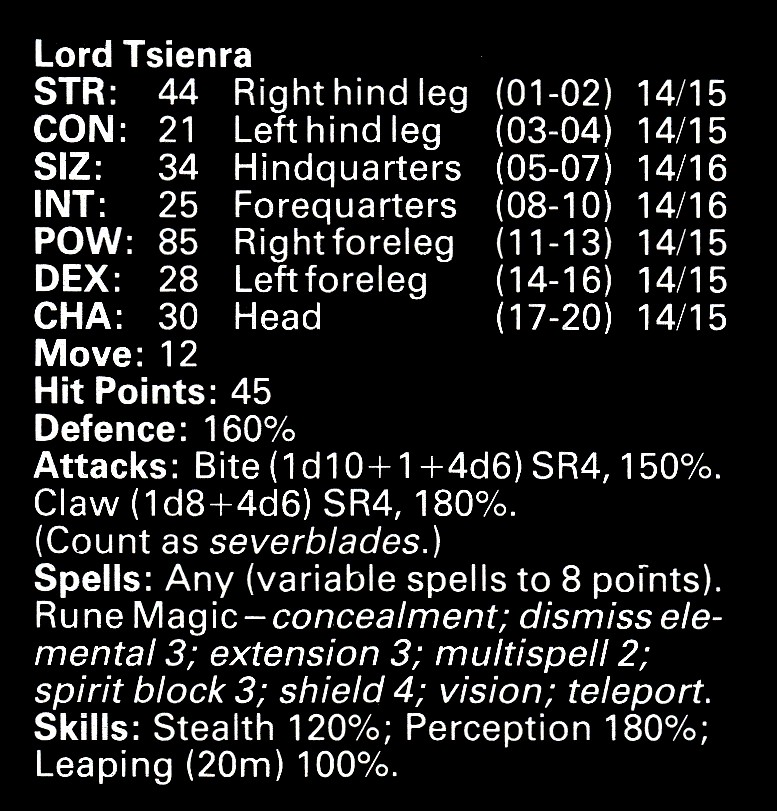
Similarly there is some uncertainty as to the precise levels of power of the demon lords. Tsienra’s stats are given here as a guideline, but referees must design these creatures to suit their own campaigns. They should be virtually impossible to overcome with raw power alone, and if your campaign abounds with 150%-plus Rune Lord-Priests then the abilities of Tsienra and the others should be increased accordingly. When the demon lords have suffered defeats in the past it has been through the summoner’s quick wit and daring rather than from spells and swords.

As a general rule all demon lords will have a personal POW of between 80 and 100, and can draw on unlimited POW reserves from their home dimension for casting battle magic. They are hostile about 20% of the time and otherwise neutral. They will only be friendly if there is a very good reason why they should react favourably to the summoner— Umalu prefers Chaotic berserkers, and so on.

The Gifts
While not precluding the possibility of striking completely unique bargains with a summoned demon lord, there are two types of deal which are ‘commonly’ made. These are the Lesser Gifts—minor exertions from the demon’s point of view, made in exchange for characteristic POW from the summoner—and the Greater Gifts, which are permanent abilities bestowed on the summoner in exchange for a soul-pledge.

A soul-pledge means the summoner gives the demon 1 POW point to seal the bargain and promises him a further 3d10 POW later. These further points are intended to be collected on the summoner’s death, but there is a 2% chance the demon will arrive if it feels the summoner’s life-force is burning low—in game terms, whenever the character’s hit points or POW reach 2 or less. Once the demon arrives nothing can stop it from devouring the POW promised to it. These POW points are permanently lost to the character, at which point the soul-pledge is ended and he loses the Greater Gift. If he survives the POW loss he can later bargain again for a Greater Gift with the same or a different demon lord. A character can buy any number of Lesser Gifts from demon lords (if he can spare the POW), but it is only possible to have one Greater Gift at a time. Note that to receive any gift at least 200 Wheels or equivalent must also be offered.

The Demon Lords
There are a number of other demon-lords that could not be listed here—among them Pazuzu, Lord of Fevers, ruler of the lesser demons commonly called by his name; Bakshuro the Screamer, who inhabits a dimension so hostile that only he can live there; Valladolyn of the Emerald Eye, who sees all; and Lady Kleshkala of the Pit, whose face is so terrible that merely to summon her is to court insanity.

The three important parameters for each demon lord are his or her Resistance to Summoning, Resistance to Binding, and Cross Pentacle ability. The last is applied as a negative modifier to the summoner’s chance of correctly drawing the Pentacle of Protection.

The Lord Tsienra
Screaming Metal Spirit, Demon of Ferocity
Tsienra usually appears as a metallic figure, something like a huge tiger armoured in intricately patterned plates of tarnished silver and with a violet light burning behind his eyes and gaping maw. He embodies the lightning attack, the unrelenting ferocity of battle, the prowling spirit of savage death. Possession by the spirit of Tsienra gives great speed and grace to the recipient’s fighting prowess.

Greater Gift: Tsienra can give the power of ferocity. When a character with this power uses it, his STR and DEX are effectively increased to species maximum for combat purposes, 35% is added to his Attack chance and 10% is subtracted from his Parry. The character expends 2 points of battle magic POW to go into ferocity and then another point for every full turn he keeps it going.

Lesser Gifts: For the sacrifice of 1 POW point, Tsienra will teach his summoner the battle magic spell The Talons of Tsienra. For 2 POW points he will use his skill at stalking between the planes to take the summoner within a few miles of any location he specifies, now matter how great the distance. For 3 POW he will enchant any sword with a permanent bladesharp 2.

The Talons of Tsienra
POW used: 4 points
Type: passive, unfocused, temporal
This battle magic spell causes 30cm talons of red light to spring from the caster’s wrists. He can fight with these using either Fist or Dagger skill. The talons do just 1d4 damage (no STR/SIZ bonuses apply), but the only effective defence against them is the Rune spell shield, which absorbs one point from the talons’ damage for each point of shield. The talons are immaterial, so parrying a weapon with them will damage but not deflect it. The spell can only be learned from Tsienra himself, and if the character tries to teach it to someone else then Tsienra will materialize unbidden and kill him.

Tsienra can make one bite attack and two claw attacks in the same round. These do not all have to be against a single opponent. By splitting his attacks he can make even more strikes in one round, of course. Like most demon lords he can cast any standard battle magic spell by drawing POW from his home plane. When he casts a Rune spell he pays for it using his own POW, just as a normal being would pay for battle magic. Like all demon lords, Tsienra is immune to non-Runic weapons.

His Fell Highness Eldyr
Prince of Deceit, Demon of Persuasion
Eldyr is overlord of Incubi, Succubi and Gremlins. He can pass in any guise he chooses, the better to advance his wiles, but will always eventually cast images aside to reveal his true (perhaps true) self. In the Chronicles of the Conjunction, Eldyr’s own description of himself is recorded: “My hair is like black silk, my skin is burnished copper in the moonlight, my eyes are sapphires and my robe embraces the starry night…” This description was for the benefit of the sorceress Cordelia, who had wisely blindfolded herself before the summoning. Without defences such as this, all in time succumb to Eldyr’s charms; the evocator must attempt to banish him at once, therefore, if he begins to use his powers in a hostile fashion.

Greater Gift: Eldyr can give the power of harmonic spirit. This is a combination of charm and blind luck. It costs nothing to activate this power, but each morning the character must roll POWx5 or less on percentile dice to see if the power works for that day. The chance is increased by 15% if the power was working the previous day, and decreased by 5% if it was not. Any luck roll the character has to make has a 50% chance of working automatically without him having to roll for it; on a roll of 05 or less he may have quite incredible luck – a 20m fall broken by some bushes, for instance. He gets a CHA bonus of +4 and can use his CHA as an Incubus or Succubus does. Finally, he gets an Oratory bonus of +35%.

Lesser Gifts: For 1 POW point, Eldyr will aid a character in an attempt to persuade others of something. He gives the character a 45% bonus to his or her persuasion chances for one use only–and this must be some matter where the character’s chance of persuasion was at least 10% in the first place. The bonus is reduced to 10%-30% in attempts to bargain with demon lords because Eldyr’s powers work only erratically against his peers. For 2 points of POW Eldyr will give a luck ring. This silver ring has 100 charges and each charge can be used to change the chance of something happening by 1%. The event to be influenced must occur within 100m of the wearer and have at least a 10% chance of happening in the first place. You can’t make a healthy warrior suddenly die of a heart attack, for example. The wearer must declare how many charges he is committing before the roll is made. When all charges are expended the ring permanently tarnishes and is powerless thereafter.

The Lord Umalu
The Whip of Chaos, Demon of Pain
The spirit of Umalu is that of glorying in the inflicting of pain. He is a fierce, powerful demon who hates Lawful creatures with an intense passion and is little better disposed towards being of Chaos. Umalu manifests himself as a 3m tall muscular black giant with a long mane of white hair, face perpetually contorted in hatred. He wields a glittering whip which can bestow Reverse Chaos features and an envenomed shortsword which inflicts terrible wounds.

Greater Gifts: Umalu can bestow chaos on a character, giving him or her a Chaotic feature. He can also give the power of excruciation, so that any wound the character inflicts has a 20% chance of dealing an extra 1d8 damage to the victim’s hit point total owing to extreme pain.

Lesser Gifts: In exchange for 1 point of POW he will teach a character an extra 20% in the Torture skill. For 2 POW points he grants the Rune spell curse of anguish (see below). For 3 POW he will personally torture a captive to obtain information on the summoner’s behalf.

Curse of Anguish
Range: 160m
POW used: 2 points
Duration: Permanent, Non-reusable, Not stackable
The caster of the Rune spell is able to inflict racking pain on a victim if he can overcome their POW. He can alter the victim’s hit point total at will to represent the pain, and can thus force the victim into unconsciousness, vary the pain so that they must fight at a disadvantage, or merely threaten them with the effects. The curse of anguish cannot kill– its victim will merely lapse into a coma if the pain level is increased too far. This spell does not affect undead, elementals or other creatures which do not actually experience pain.

Torture
Torture is a manipulation skill with a base score of 15% and is learned at the rates 200/400/800/EXP. Normally a character must join the Guild of Torturers to learn the skill. A successful Torture roll means that the torturer has extracted all or part (40%+ 1d6x10%) of the truth from his captive, failure means that he has got false information. A fumble means that the captive has died. Torture can usually be used only once a day on a given captive – each extra use in the same day doubles the chance of a fumble. Captives can use their CON +POW as a ‘Defence’ against the Torture ‘Attack’ if they wish.

His Demonic Majesty Adelmar
Lord of the Vaults of Eternity, Monarch of Demons
Summon the terrible Adelmar only when you plan such grand designs of mayhem and destruction as would make lesser demons quail, for he is a proud and potent force and should not be summoned lightly. Standing about two and half metres tall, he is ebony-black with the lower body of a serpent, a human torso, and an armoured, horned head like that of a triceratops. He wields enchanted scimitars in each hand. One scimitar feeds on the blood of victims, the other on their souls. Adelmar is said to dwell in a labyrinthine castle on an island in an unknown lake. When Adelmar is summoned, the evocator and his party (up to six others) are carried to this castle to petition the demon.

Greater Gifts: Adelmar has a limited power over time itself, and can give the ability of temporal navigation. This enables a character to cross up to ten years either into the past or future, arriving within 1-12 weeks either side of the required date. Each use of temporal navigation costs the character 1d4 from characteristic POW.

Lesser Gifts: For 1 point of POW Adelmar will open the veils of time to uncover some secret at the summoner's behest. For 3 POW he will send an army of demonic warriors – equivalent to five thousand elite cavalry–to fight in one battle beside the army of the summoner or his employer. Adelmar can also add to a character’s lifespan— five years for 1 POW, ten years for 2 POW, and so on. A character can only petition for this gift once. During the added years the character does not age, but the deal must be phrased with exceptional caution or Adelmar will surely twist things to the summoner’s detriment.

The Lord Akresh
Spirit of Thunder in the Mountains, Demon of Invincibility
Akresh represents steadfast strength of purpose, the glowering look that intimidates a foe, the essence of power that cannot be assailed. Possession by the spirit of Akresh is called waiting-within-a-fortress; it hardens the will, shields the body from harm and augments the recipient's physical might. Akresh himself can only be evoked in mountains, where he usually appears as a shadow against the sky and a booming echo between the peaks.

Greater Gift: The power that Akresh can grant is indomitability. A character with this power must roll POWx5 or less on d100 whenever he wants to use it; once activated, the power costs 2 points of battle magic POW for each full turn the character wishes to use it. While indomitable the character remains fixed in position waiting for attacks. He can automatically sweep aside all attacks made at 25% or lower, including missile attacks; his STR increases to species maximum; he gets a +20% Parry bonus and any parries he makes do an extra 1 d4 damage to the parried weapon. Finally, he gets an extra point of armour protection.

Lesser Gifts: For 1 point of POW Akresh will teach two points of the battle magic spell parry (usually available only to Humakti). For 2 POW he can enchant any shield so that whoever carries it has a permanent protection 1. For 3 POW he will summon mountain storms that can throw whole armies into confusion, or block a pass with landslides.

Her Eldritch Highness Sarasathsa
Princess of Mystery, Demon of Paradox
Sarasathsa has sovereignty over things impenetrable or unknowable. Possession with her spirit-essence renders the recipient immune to spirit combat, as spirits will recoil from her terrible mysteries, but is double-edged in that the recipient could become sunk into lethargy and pensive introspection (roll POWx5 or less when coming out of possession to avoid this. Sarasathsa may have many forms, but is often described as a very tall (2½m), slender, graceful woman in blue and green robes. Her skin is pale and mottled in a serpentine pattern, and the right side of her face is concealed behind a fantastical mask in the form of an embryonic dragon. All summoners describe her as cold and disdainful and rather draconic in temperament.

Greater Gift: Sarasathsa can grant morphetic counsel. Whenever the character has some problem to solve or mystery to uncover she will whisper clues to him in his dreams. This acts as though the character had 80% in the General Knowledge skill, and also allows him important visionary dreams at the referee's discretion.

Lesser Gifts: For 1 POW she will answer any three yes/no questions about the past or present with 99% accuracy. For 2 POW she will convert any powered crystal into another type which the summoner specifies (the crystal's POW is diminished by 1 by this process. For 3 POW she grants a character a permanent 5% bonus on POW gain rolls.

The Lord Kojuro
Who is One with the Sword, Demon of Fighting Skill
Kojuro appears as a slender man with greyish skin and sharp white shark's teeth. He wears white and grey cotton robes and carries a number of swords and throwing knives. His province is skill in combat, particularly swordplay.

Greater Gift: Kojuro can immediately raise a character's skill with swords to 80% or by 15%, whichever is greater.

Lesser Gifts: For 1 POW point Kojuro will increase a character's score in any fighting skill by 5%, to a maximum of 75%. For 2 POW points he will place a single-use truesword spell on a blade; this spell can be activated at any later time by whoever wields the sword. For 3 POW he will increase the skill of an entire army by 5% for a single battle.

The Lord Kesh
Jewelled Serpent, Demon of Confusion and Terror
Kesh embodies the transfixing gaze of a snake. He causes awe by his presence alone, a massive bejewelled, serpentine shape coiling about the Pentacle and rearing up to the roof of the summoning chamber–the summoner must roll POWx5 or less on d100 or lose all power to bargain with the demon. Looking into Kesh's eyes causes demoralization.

Greater Gift: Kesh grants the power of intimidation. Given two rounds in which to talk to foes before he fights them, a character with this power can threaten with such unholy force that those hearing him must roll POWx5 or less on percentile dice or be demoralized. In combat, the character's gaze can transfix like a vampire's.

Lesser Gifts: For 1 POW point Kesh will reveal the location of an ancient treasure hoard of at least 90 treasure factors. For 2 points he will set a giant demonic serpent to guard your treasure for you. For 3 points he will teach you how to brew any venom or acid up to potency 15.

The Lord Engala
Gatherer of Darkness, Demon of the Undead
Engala is usually characterized as the zombie spirit, embodiment of unrelenting attack, but in fact he is the lord of all undead creatures. Engala appears as a dull-eyed, expressionless man with dead white skin, robed in grave-soiled black raiment. His movements are slow and languid, like a corpse underwater, and when he speaks his lips hardly move to his hollow, emotionless tones. Those possessed by his spirit will fight until cut apart.

Greater Gift: Engala can make a character into a vampire or mummy. The customary pledge of POW is useless to Engala because he is an undead being, so instead of that pledge he imposes a peculiar condition on his Gift. Every ten years the character must find a champion to play Engala's representative at a game not unlike chess. If the champion loses, Engala drains him of POW and destroys him. If the character cannot find a champion he must play Engala's representative himself – in this case, if he loses, Engala will come and take the character as one of his personal servants.

Lesser Gifts: In exchange for a powered crystal Engala will give a lead amulet which grants the wearer some protection from undead – hostile undead act neutrally and neutral undead will be friendly, as per the Runequest response table. Occasionally he may give favoured summoners a zombie or skeleton guard to serve them.

The Lord Kyrax
Blizzard Flame, The White Lord, He Who Descends from the Storm
Kyrax is one of the oldest demons. He has the form of a giant white wolf, or sometimes a man of feral aspect. He is the master of stealth and guile, can cause invisibility, blizzards and darkness and particularly aids those who were once mighty, for he is the demon lord of regathering old powers.

Greater Gifts: Kyrax can grant a character 70% in all Stealth skills or raise these by 20%. Or he may personally aid a character in a single master plan.

Lesser Gifts: For 1 POW point he will increase a single Stealth or Tracking skill by 10%. For 2 POW he will give a one-use Rune spell to summon thick mist in a 160m radius; the caster can see up to 30m in this mist but for others the visibility is under 10m. For 3 POW he will summon a blizzard or turn a character invisible for eight hours.

His Excellency Hragahl
Minister of Lightning, Demon of Intellect
This bizarre and ancient demon lord is master of all matters connected with logic and philosophy, and if he is impressed by a summoner's ability in these areas he will have a friendly reaction to him. Hragahl materializes as a giant (1 m) bald, fanged head with silvery-blue skin, incandescent white eyes, and giant wings springing from his temples. He has a tongue of flickering lightning which can snake out up to 20m.

Greater Gift: Hragahl can transform a staff or weapon of the summoner's so that it has powers of a Stormblade [WD39, Runeblades].

Lesser Gifts: For 1 POW point he will summon up a Storm Demon and place it under the summoner's control for fifteen minutes. For 2 points of POW he will give a 5% bonus in General Knowledge (to a maximum of 45%). For 3 POW he can increase a being's INT by one point or summon storms to confound an enemy.

Final Notes
A word of warning: campaigns where demon lords get summoned up every weekend and every other character has a Greater Gift are going to get dull very quickly. Scenarios could involve a demon lord's influence without requiring him to make a personal appearance – player characters could battle a small cult worshipping one of these entities, or inadvertently break a chain of events set in motion by a demon lord long ago.

Bear in mind that even the Lesser Gifts of a demon lord are powerful and hard to come by. There is a high risk factor in any summoning, and the demon lord must have a favourable reaction to the summoner if any deal is to be struck. Few generals would care to swell their army's ranks with demon warriors, even if they can seek out one of the demonologists powerful enough to make such a bargain. Only three cases of military use of demonic powers are recorded in Questworld's history – each time by the extravagant, whimsical Ancients, for whom normal caution and logic seem meaningless.

Lastly, words of thanks to everyone who might have inspired or actively fed me with demonic ideas – in particular, Steve Ditko, P Craig Russell, Richard Lupoff, Miyamoto Musashi, Yvonne Newnham, Mike Polling, Jack Vance, Oliver Johnson and William Burroughs. Vance's short story “The Miracle Workers” directly supplied the idea of possessions, and gives a vivid account of their effects. For a host of further demons, Professor M A R Barker's Book of Ebon Bindings is recommended. It details, with many colourful anecdotes, creatures designed for Barker's world of Tekumel but usable in any setting.