Gamebook store

Showing posts with label BBC. Show all posts

Sunday, 24 March 2024

Speak up

It's that time of year again, when I end up poking a stick into a hornets' nest of controversy. By tradition it should involve a professor, but as far as I know Chimamanda Ngozi Adichie is not currently teaching at a university because those who can, do. Here's her Reith Lecture on the subject of "Freedom of Speech". I recommend listening to the podcast, but if you're pressed for time you could just skim-read the transcript.

For advocating free speech I've been called a fascist, and all I did was retweet Philip Pullman, so goodness knows how much flak Ms Adichie gets for her stance. But if I'm a free speech "fascist", I'm a lazy one, so I'll let her speak for me and just say (as David Baddiel does in the Q&A after the talk) that I agree with almost everything she says here. It was refreshing to hear a grown-up talking, not something we get much of now that we seem to have drifted into Bizarro World.

Friday, 13 October 2023

I'm with Moorcock

"There's a tone to [Tolkien's writing] that pretty much all English children's fiction has. It feels to me, as an English person who grew up with Children's Hour on the BBC, which always had that tone, that they were basically trying to ease me into [...] being a good kid. And I didn't like stuff that asked me to be a good kid. [...] And I don't like children, or indeed hobbits, as the protagonists. I've never been able to get on with kids as protagonists. I like grown-ups as protagonists even if they're not really grown-ups -- like Conan."

That's Michael Moorcock talking to Hoi and Jeff on the Appendix N Book Club podcast. I feel exactly the same way. Although I'm too young to have listened to Children's Hour, that was my reaction to The Lord of the Rings, which I tried reading in my mid-teens but to this day haven't finished, having got no further than the encounter with the wights. Tom Bombadil was such a deus ex machina that I just couldn't be bothered after that. (Here's the Breakfast in the Ruins podcast making that very point.)

Probably I should give it another go. I also abandoned Titus Groan in my early twenties, only to rediscover it a few years ago and now it's one of my all-time favourite fantasy books. On the other hand, I never got beyond the first LotR movie -- so it can't just be the prose style that put me off. Maybe I'm just too familiar with SPI's War of the Ring boardgame, which I played so often that I know the story anyway. (And I don't think Bombadil is in the boardgame, which must have helped.)

Is there any popular fantasy or SF classic that just doesn't click with you? The comments are open.

Friday, 9 December 2022

To business that we love

During my time at the Lucca Comics & Games festival, quite a few people came up and said how much my work meant to them. That's always really lovely to hear. You write to make a connection, hoping that what you do will inspire others. But I always point out to fans that I'm a fan too. There are writers who inspired me (Terry Nation, Stan Lee, Michael Moorcock, Roy Thomas, Robert E Howard, Gene Roddenberry, and many others) and they had writers who inspired them. It's a torch we're passing along.

And because writers are fans as well, I was delighted to come full circle and appear in the December issue of Doctor Who Magazine not as Dave Morris, aspiring Dalek scriptwriter, but as David Morris, my six-year-old self, geeking out over a set visit to watch the rehearsal of "The Brink of Disaster". I won't spoil it with any details here, except to say that it followed a few weeks after my dad took me to meet a real-life Dalek.

This is issue #584 of Doctor Who Magazine. That's pretty impressive, especially for a monthly. It's a show that has inspired generations of sci-fi enthusiasts. Whether you write, read or only watch, those enthusiasms are what make life worth living, so let's celebrate such treasures of the imagination -- and keep passing on the torch.


Thursday, 23 December 2021

Strange things in old speech

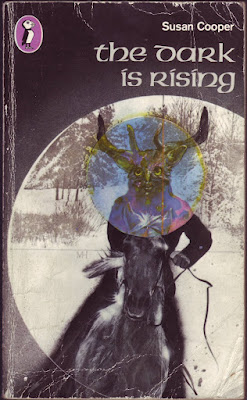
The Dark is Rising is one (well, five) of those kids' fantasy classics that I haven't read. In my defence, the books came out when I was already in my teens, but they have been recommended by younger friends whose judgement I trust, so if you have children you might want to get hold of them.

The general tone of dark rural British folk fantasies with a psychogeographic tinge includes much of Alan Garner, John Masefield, and others. They tend to be set in the depths of winter, steeped in tales of the landscape, with lengthening shadows of mythic figures like Herne or Merlin bringing a chill of delicious danger to the sometimes stiflingly cosy world of childhood.

You feel as if all of these books should exist in 1970s BBC television adaptations, even if most of them don't. Which is why Handspan has produced this album of tracks from the non-existent adaptation of The Dark is Rising and this theme from "In From The Fields", an imaginary kids' series in the manner of Garner or Masefield.

And for grown-ups who want to revisit the comforting nightmares of younger days, there's always Becky Annison's powerful one-shot game When the Dark is Gone.

Thursday, 29 April 2021

The Lovecraft Investigations

I've been listening to The Lovecraft Investigations, a BBC audio serial by Julian Simpson that takes interesting liberties with "The Case Of Charles Dexter Ward", "The Whisperer In Darkness", and "The Shadow Over Innsmouth". I've provided links to the original HPL stories there because I think you'll enjoy the audio serial more if you know what they're riffing off. I'm not sure if people outside the UK can download the episodes from the BBC website for free, but if not try here.

The conceit is that we're listening to a real-life mystery podcast presented by Matthew Heawood (Barnaby Kay) and Kennedy Fisher (Jana Carpenter). These are well executed dramas, with good scripts (bar the occasional exposition-dump episode) and top-notch acting. They even got the superb Nicola Walker on board. How on earth does she have any spare time? I suspect her husband, who plays Heawood, might have twisted her arm.

If I have any quibble (and of course I do) it's that the flavour of scariness is more Delta Green than authentic Lovecraft. And, yes, I know they're not trying to do authentic Lovecraft, but it's a big step down from cosmic horror to cults-&-conspiracies. Secret organizations saving the world from scheming bogeymen? Not again, thanks. Really, what we have here is The Derlethian Investigations, whereas Lovecraft's conception of horror was genuinely innovative and I'd love to see somebody turn his ideas into a modern horror movie, TV show or podcast. That sheer bleak dread was what I was aiming for with the scenario "The End of the Line" but even there the tension can only build for so long before it all breaks up into running and screaming. Maybe that's a problem with all drama: the takeoff is always more atmospheric and interesting than the landing. That could explain Lovecraft's own aversion to plot. Thrillers are just fairground rides, whereas what was at stake in his stories was something much more personal and disquieting.

But anything that retained the existentialist nightmarishness of unadulterated HPL would likely not be that popular. Audiences want the Doctor Who style of panto horror -- the same thinking that inflicted a queen on the Borg, so that they could get actors in to chew the scenery. After a century of tying plucky reporters to chairs and planning rituals that will summon the apocalypse, it's futile to hope that drama is going to change now. But The Lovecraftian Investigations is a great deal better written than Doctor Who is these days, so putting my purist nitpicking aside I'll happily recommend it as a gripping and genuinely creepy modern classic. I've been listening to it while strolling the sunlit woodland of Surrey and it has transported me to shabby London car parks, rain-swept patches of Orford Ness, posh Pall Mall clubs, and spooky old cottages at night. It's true what they say. On radio, the pictures are better.

Coming up tomorrow: what happens when your roleplaying adventure hinges on a key character -- and the player can't make it that week?

Friday, 10 March 2017

Videogames killed the radio star?

Crossing Tom Quad, deserted and sparkling in the December night, gave me the visual inspiration for the roleplaying scenario that eventually became Heart of Ice. The germ of the idea had already come from the briefest of references in Empire of the Petal Throne to “hex 6029: the walled ruins of the Mad City of Du’un”. And the story itself, as I’ve described elsewhere, was an adaptation of It’s a Mad Mad Mad Mad World, in the sense that only one person could have the ultimate prize but to reach it meant cooperating with others along the way.

The original Du’un adventure was pretty old school, as you’d expect for something written in the mid-70s, and in fact the first time I ran it really was at my old school, in the Eastgate block at the RGS, where the Guildford War Studies group used to meet. But I digress…At the end of an embrangling underworld filled with interdimensional pathways, the characters had to fight past an avatar of the god Hrsh to win through to the Chamber of the Heart. Alliances died at the door. Beyond that point it became a cathartic free-for-all.

Primitive though the scenario was, it became the one players talked about. I was persuaded to run it two or three times more for different gaming groups. Probably it was the theme of the scenario that made it really memorable. That heart of ice isn’t really the magic crystal McGuffin buried down deep in the catacombs, it’s the cold ruthlessness needed by the winner.


In the original 1976 scenario that gem of ultimate power was the Heart of Durritlamish, the Black Angel, Opener of Catacombs. In the gamebook it became the Heart of Volent, a cult god of the 22nd century. And in the 1990s radio play “The Heart of Hark’un” it transmogrified into this:
“The god Hark'un once ruled the heavens, but the young gods were jealous of his power and plotted to overthrow him. Defeated in a celestial war, Hark'un fell from the heavens, down through the black sky, until he struck the barren lifeless lands. But as he died, Hark'un’s blood brought the world to life. His spine formed the mountains of the world. His veins became the roots of living things. The body of Hark'un became the world of Harkuna. Every part of the slain god became the seed for new life – except for the heart of Hark'un. That remained whole. Untouched by decay, it still beats on. To touch the heart of the god Hark'un would be to destroy the world. But also to take on the power of a god.”
The play, by Jamie and his brother Peter Thomson, featured some characters based on (or at least named after) player-characters in our Tekumel campaign. Kadar was an older, more embittered version of Jamie’s character Qadarnai, while my own character Shazir became the villain – of course! Arcos I’m not sure about, but he may have been one of the PCs in Mark Smith’s Orb campaign.

The point of all this is to say that you can now listen to all six episodes of “The Heart of Harkun” (let’s leave the grocer's apostrophes out of it, eh?) over on the Spark Furnace website. And if you don’t have the patience for podcasts, the comic book version is still available: issue #1 and issue #2. Or there’s the Heart of Ice gamebook, of course. At some point I might even run the original Du’un scenario that started it all, if I can lay my hands on the underworld maps.

Wednesday, 17 June 2015

Lies, damned lies, and British newspapers


Last month on my own blog I discussed an example of bone-idle British journalism at its worst - and its worst is very bad indeed. In this case, the newspaper in question had apparently got a school leaver to précis a piece from a rival paper, adding her own interpretation of the original article in between quoted extracts.

The original piece, which appeared in the Telegraph, was by Lord Rees, the Astronomer Royal. The rip-off version, which appeared in the Daily Mail, managed to completely reverse the meaning of what he was saying. If the misinterpretation was wilful, then it was a disgrace; if it was the result of stupidity or carelessness then it was a shambles.

Well, Mr Bond, the first time is happenstance. But this week anybody unfortunate enough to look at the Daily Mail will have seen an even more odious example of its descent from journalism into propaganda, in the form of an attack on the BBC that is clearly designed to pave the way for the UK government to reduce or abolish the licence fee. Naturally the very thought of that has the Mail flapping its wings like an excited harpy, as (along with 90% of Britain's often foreign-owned and extremely partisan press) it hates the idea of an independent, publicly funded media entity with a remit to be unbiassed and informative in its reporting.

Here are the facts. The Mail article fails to mention that £270m of the licence fee was taken to support Welsh language channel S4C and a slate of government projects including broadband rollout and local television. By the Mail's calculations, programme costs don't included edit suites, newsrooms, and (especially dear to my heart) story development, and yet without those there would be no programmes. The Mail claims that the BBC "pumps money" into its commercial arm, BBC Worldwide. In fact the two are obliged by charter to conduct business at arm's length; BBC Worldwide receives no share of the licence fee and generates money (for instance by sale of BBC programmes to other countries) that feeds back into programme-making in the UK.

The bottom line is that, completely contrary to the Mail's assertions, 90% of BBC spending is on content, distribution and related support costs. And that figure is independently verified, as the Mail must surely be aware.

This is only the latest blast in a long propaganda campaign that the Mail has been running with the apparent aim of stirring its readership into a state of high dudgeon against the BBC. For example, there was this 2008 report about how BBC "wasted" £45,000 ($70,000) on a party to promote the TV show Merlin. Yet that's a perfectly reasonable cost of doing business, and it paid off. Merlin has now sold to over 180 countries, netting over £100 million in revenue for the BBC on an outlay from the licence fee of less than £40 million. Bearing in mind that the primary purpose of the BBC is to create programmes for the British public, and that turning a profit is a secondary concern, I'd say that was a pretty good return on investment. But not in the eyes of the Mail, whose proprietor has opted for non-domicile status and is a contributor to the Conservative Party, who for years have been trying to chip away at the BBC's popularity - which, I'd venture to say, is considerably higher among the general public than that of either Lord Rothermere or the Tories.

If the UK electorate is gulled by propaganda like this into allowing politicians to scrap the licence fee, the BBC will be severely weakened and we will have lost a vital source of objective reporting and high-quality programmes that are the envy of the world. All to make nasty little rags like the Mail better able to serve their paymasters. So wherever you live in the world, next time you come across a news piece that is striving so desperately to convince you of something, remember to ask yourself: cui bono?

Tuesday, 31 December 2013

Jamie's 2014 treasures

The traditional New Year's freebie coming up tomorrow, but to fill the gap here's a promo picture by Sébastien Brunet from one of Megara's Way of the Tiger hardbacks that Kickstarter backers will be receiving next year.

The first two paperbacks in the Way of the Tiger series should be coming out from Fabled Lands Publishing by February. These will feature Megara's art but - be warned - only in black and white. If you want a full-color set of books, hurry up and order from Megara as they still have some left, but only a strictly limited edition.

Way of the Tiger is also coming out as a series of apps from digital gamebook supremos Tin Man Games. (The technology doesn't exist to do full justice to Blood Sword yet, but they're working on it.) Jamie has written loads of flavor text for every outcome in the fights, making these much more than straight ports of the book text.

Lastly, before you pack 2013 away for good, here's a shout-out on BBC Radio's Open Book program for Jamie's Dark Lord books. He comes in at 24:05 minutes but it's all good stuff.

Friday, 13 September 2013

Listen up

AudioGo have just released two BBC audiobooks in the Dark Lord series. These aren't just written by Jamie, they're narrated by him too. Normally you'd have to be 9 years old and go to a posh school to get the chance of having Jamie come in and do all the voices for you (which are brilliantly funny btw - well worth the school fees) but now the books are available to hoi polloi to download for the cost of a double whopper, cheese and a Coke. Which is where Jamie is heading on the bus there. Ding ding.

Tuesday, 2 July 2013

Mean genes - part 2

  • A sport featuring virtual stars
  • A TV show where content is created by the audience
  • A league that anyone can enter
  • Sit back and watch, or sit forward and join in - it’s your choice
Overview
Players breed a stable of nonhuman gladiators called “myrmidons”. Each myrmidon is a named character with unique attributes based on his underlying “genetics”. Each has his own strengths and weaknesses. It’s up to the player to teach him how to fight.

Training prepares your myrmidons for battle. Myrmidons learn to employ the maneuvers and tactics that you teach them. When you set them against another player’s team, the myrmidons’ AI takes over and the battle is fought without intervention by the trainers.

Each week, the top contests in the league are rendered in high-quality graphics and broadcast on television, complete with human commentators just like any other televised sport.

Individual gladiators will become internet/TV stars and can be hired to other players temporarily or sold outright via the official Conquerors League server. You can play the Conquerors videogame on local networks with friends, or enter the official league online and pit your team against the best in the world. The broadcast content is created as a shared participatory process, and you can enjoy the TV show as a spectator whether or not you choose to enter gladiators in the league.

The great potential of an interactive entertainment product like Conquerors is that it takes in the whole spectrum of involvement, from “lean forward” videogamers to “lean back” television viewers.

Concept
Conquerors is a virtual sport that viewers can watch on TV and can actively participate in via the internet. It is a virtual sport that gives everyone in the audience a shot at being owner and manager of a world champion team.

The Conquerors software package will be bought at retail or downloaded for a fee. The Conquerors software allows players to breed, mutate and train teams of non-human gladiators called “myrmidons”. Training teaches the myrmidons to survive in different environments and to use their natural weaponry (claws, horns, etc) in battles to the death. You can pit your gladiators against AI-run opponents or against other players’ teams over a local network or internet connection.

Players can also submit their trained teams to the Conquerors server where they will be placed in competition against other teams from all over the world. On the Conquerors site, players can post challenges, discuss training strategies, buy or exchange useful genes, auction their champion gladiators, etc.

Each week, the premier division battles will be rendered in high-quality graphics and broadcast on conventional television. Ideally, viewers with an Xbox or Playstation2 will be able to move seamlessly between the TV show and their training stable.

Hence, Conquerors is a theatresports show like WWF except that the athletes are tamagochi-like virtual creatures. And at the same time it’s an open participatory show like Robot Wars, except that anyone in the world can download the core product and enter their own personal team for competition.

In summary, Conquerors viewers/players will be able to do any or all of:
  • Watch the regular non-interactive show on TV (high-quality rendered 3D graphics)
  • Create their own Conquerors team on PC or console
  • Train their team offline or online
  • Play offline on PC or game consoles
  • Submit their team for official league battles online
  • Trade gladiators and training tips online
  • Place wagers on matches
  • View any match on demand on the internet
The game
In essence, Conquerors is a TV show based on an internet videogame in the same way that Popstars was a TV show based on a manufactured band. That is, a product is created (in this case a videogame) that generates a fanbase and feeds back into the show itself.

At the same time, Conquerors is a tactical videogame with an online dimension in which players can put forward their own four-man gladiatorial teams to do battle in various terrain "arenas". Individual gladiators (called Myrmidons) have their own strengths, and their own ways of applying those strengths in combat as part of a team.

Players post challenges on online. Being registered on the server's league table costs a subscription fee, and there might be an additional fee per bout. It's also possible to play local network bouts for free, of course, the downside being that the results of such bouts don't become part of the official league. Subscribers to the Conquerors League can download any bout and watch how it went on a pay-to-view basis, using their local software to reconstruct the bout from the match data. The top bouts will be rendered with a higher quality graphics engine for broadcast on TV.

The gameplay itself has two main features:

(1) Instead of directly setting their team's initial stats, players mutate the Myrmidons using a set of genetic algorithms. Every mutation yields a new generation of Myrmidons each with a unique set of attributes. You continue the mutation process until the Myrmidon has the attributes you're looking for.

(2) You don't directly control your Myrmidons during an on-line battle. Instead, you carry out training bouts beforehand that involve you body-hopping between your Myrmidons as you tell them what to do. As you do this, each Myrmidon is learning the tactics you want him to use. A stealthy scout-character might learn to always shoot and run away when a tough warrior is coming for him, for instance. This learned behavior is what the Myrmidons will use when fighting a real contest on the server.

Creating A Myrmidon
In CRPGs you often start off by allocating characteristic points (either by choice or randomly). Conquerors is a bit like that except that the characteristics are derived from an underlying character gene-string which is mutated to give a wide range of Myrmidons - some with wings, claws, scales, gills, horns, even wheels.

Genetics specify the Myrmidon's potential, but it's in "growing" the Myrmidon that his potential is realized. The growth process builds bone, muscle and hide - all at a cost in points called Chrome. Spending more Chrome makes the Myrmidon bigger, generally increasing his speed, strength, hit points, armour, etc. But you only have so much Chrome to spend in breeding your whole team, so making one of them gigantic will mean another might have to be small and sneaky.

Myrmidon abilities are also limited by the underlying physics of the game environment. There are always trade-offs. If you want a fast Myrmidon then you can't have him heavily armored, if you want him to fly then he can't be too big, and so on.

The procedure for generating your stable of Myrmidons is described below:

1 The parent
A random "parent" is generated and shown on screen. This individual might have long or short legs, wings or fins, claws or fingers, horns or huge ears - all based on a string of numbers that are read as genes.

2 Mutation
A new generation of Myrmidons is created by mutating the parent chromosome (asexual reproduction). Two types of mutation can occur. Firstly, numerical values of genes may change by a small amount in either direction. That’s the most common form of mutation. Secondly, the Gene Reader (which decides the locations on the chromosome that relate to each body part) may slip for one of the body parts - so that the creature's left arm is no longer read from the same sequence as its right arm, for instance. The probability of this second type of "embryological" mutation is small, and is likely to be pre-set to certain sequences that will correspond to different “species” types.

3 Selection
A number of mutants from the original parent are displayed on screen. The number doesn't matter, except that it needs to be sufficient to give you reasonable choice over the direction the mutation is tending. Say half a dozen. You now select one of these to be the parent for the next generation.

4 A Myrmidon is born
Continue with successive generations until you have an individual that you want to add to your stable. Before proceeding, save this individual's genetic code - you might later want to clone him.

Now, what you've got displayed on screen is the nascent Myrmidon's basic morphology - his shape, but not his size. The body template still has to be scaled up to yield the adult Myrmidon. Just as in real life, building bone and muscle costs energy. This energy is provided in the form of Chrome, which you feed to the Myrmidon. Bone has a given cost in Chrome per unit, muscle another cost, and so the amount of Chrome you allocate to the Myrmidon will determine how big he grows.

Myrmidons can also have special abilities including webs, poison attacks, chameleon skin, sonar, and so on. All of these also have a Chrome cost.

In filling your stable, you could produce just the basic four Myrmidons needed to make a team. Or you might prefer to have more to choose from, so as to be able to hand pick each team for the terrain they'll be fighting in. But you only have a limited stock of Chrome to feed all your Myrmidons, so greater versatility has its cost in that each Myrmidon can't be as individually tough.

We want to encourage versatility rather than terrain specialization, as this makes it easier for any two players to field teams against each other. Therefore you do get more Chrome if you're generating more than four Myrmidons - but not in direct proportion. So if you get 100 Chrome Points to generate four Myrmidons, you might get 120 to generate five, 135 to generate six, and so on.

Although Chrome establishes an upper limit to how tough your team can be to start with, two teams can never have exactly equal toughness. How would you define absolute toughness anyway? Differing abilities can't be so easily compared. To take an extreme example, suppose you breed a group of armored Myrmidons - so massively armored that they only move around at a crawl. Confronted by a team that had even a single member with armor-piercing potential, your guys would be doomed. The Chrome you're given to spend at the start thus sets an upper limit on any team's initial toughness, but many other factors (specifically, the game physics and the tactics you use) will play their part in the final outcome.

Physics
Formal game theory is all about trade-offs: such-and-such a feature makes a Myrmidon stronger but it also makes him slower. Consider two Myrmidons with the same lower body morphology and size. One is given little spindly arms, the other huge biceps and massive claws. Obviously the second Myrmidon has the greater offensive capability. But since arm strength doesn't affect locomotive power, and that extra bulk only has the same leg strength to move it around, he'll also be the slower of the two.

The virtual physics system is there so that players can get an intuitive grasp on the game mechanics. Flying requires a lot of energy, for example, so the ideal flying Myrmidon will be very fit and probably unarmored. Also, wing lift goes up with L-squared while mass goes up with L-cubed, so the bigger you make the Myrmidon to start with, the less viable he'll be as a flyer. A big hefty guy will have to win a lot of extra Chrome (building up his muscle efficiency) before he can fly for more than short distances.

The game physics specifically relates to dynamics; that is factors such as:

Acceleration
Based on thrust (leg strength, etc) minus resistance of the medium, divided by body mass.

Maximum speed
Depends on stride and leg flexibility (or equivalent for swimming and flying), traction, resistance of the medium, and the power delivered by the Myrmidon's metabolism (ie, heart/lung system).

Maneuverability
 Determined by the Myrmidon's strength, mass, and his ability to get a grip on the medium he's moving through - hoofed or clawed feet are better than toes, for instance.

Energy
All muscle mass consumes energy even at rest. In use, the muscle consumes extra energy equal to force times the distance it is applied through. As energy stored in the body is used up, fatigue sets in and restricts the muscle's ability to exert maximum force. The Myrmidon's stamina (based on his heart/lung genetics) is a measure of how quickly lost energy is replenished.

Collision
A Myrmidon's main goal in life is to collide his armaments with the enemy's vulnerable bits! Visual acuity and manual dexterity decide if he is successful or not.

Damage potential
A question of weapon mass, speed and sharpness matched against the target's armor and body toughness.

Special abilities
Special abilities will be modeled generically in the design. For example, there will be entangling attacks that all have the same gameplay effect of immobilizing the target for a time. Graphically, various entangling attacks could be shown as a web, a net, a viscous spray, a paralyzing volley of sparks, etc, even though they are functionally the same at root class, only with differences in duration, defenses and counters.

Graphics
The game is set in a true 3D environment which forms the main screen view. There'll also be a small top-down window which you could open to get a view of the whole arena. Different arenas would vary in size, but on average they'd be maybe 9 or 16 times bigger than the scene shown on the main screen. (Smaller arenas favor brute force, larger arenas favor stealth, sniping and ambush tactics.)

Myrmidons could rendered by morphing between the basic body types to reflect the specific mix of attributes for that individual (long arms, horns, webbed feet, or whatever). We would need a set of body-part anims for each leg length, arm length, etc, and these would be assembled at runtime to create a set of procedural animations unique to that Myrmidon. (If it sounds a huge task, remember that we can constrain the phenotype ranges for a force-to-fit solution.)

An alternative system would be to generate each Myrmidon as a 3D model and animate these with a full IK (inverse kinematics) system. This has the advantage of directly incorporating the physics within the game environment (as distinct from precalculating it and applying the effects). The downside is whatever time we'd need to allocate for developing an IK system.

How the game is played
The game has two phases: practice bouts, which allow a player to pit a team of his own against one run by the computer, and contests, where you put forward a team to fight against another player's myrmidons.

Practice bouts
Practice bouts are single-player combats played out in realtime in randomly generated arenas. You control a team of four Myrmidons drawn from your stable, pitted against a computer-run team. The prevailing terrain might be jungle, desert, forest, swamp or hills and, obviously, this affects how well your Myrmidons can use their abilities.

Practice bouts are single-player games in their own right, but the main point of them is to train your Myrmidons in tactical use of their abilities. In a practice bout, you will body-hop between the Myrmidons.

The interface presents you with a range of options specific to that Myrmidon and his weaponry. You might have bred a charioteer with javelin attacks, a lance and a smokescreen ability, say. Maybe you tend to use him to ride in close discharging javelins and then wheel off, using his smokescreen to avoid close combat. Only when in rocky or marshy terrain, when he can't get away quickly, do you favor using the lance. Over time your charioteer's AI will learn these preferences, so that when he goes into the arena for a real bout he can apply the moves you've taught him.

Contests
Contests occur between teams put forward by two players. This can be by direct connection, of course, but the official Conquerors leagues will be run by games centers accessed over the internet.

On the day of a bout, you will need to adjust your team’s exercise regimen throughout the day, tamagochi-style. Myrmidons with high stamina will be enhanced if they are told to spend the day working out. Others are better left to rest and gather their strength. The individual myrmidons’ psychological factors will also have a bearing – some are serene, others will have nervous energy that needs burning off, and so on. It’s envisaged that expert players may change their team’s regimen several times in the hours before the bout (probably via cell phone) and this can have a significant effect on the team’s performance.

Any potential latency issues are avoided because you do not have continual direct control of your Myrmidons as you do in practice bouts. Instead, your Myrmidons will reference the attack priorities and tactics you've taught them to come up with a game plan of their own.

There is no compulsion for players to take part in league contests. Players who aren't involved in a bout can still pay to view it, and (just like in real-life sports) it's possible that most revenue will be generated this way. Many players may prefer to practice at home and never participate in real online battles. This is just the same as the guy who kicks a ball around in the park with his pals on Sunday afternoon and then goes home to watch the football on TV. The fact that Conquerors can be played in a variety of ways to suit the individual player or viewer is what will give it true mass market appeal.

A call to arms
Players name their teams and post challenges online, possibly specifying their choice of battleground or other terms. ("The Spine Suckers will take on anybody in the Jungle Arena. 100 Chrome says we’ll send you home in body bags.")

Fighting it out for real requires both teams to be sent to the official server. The players would pay a fee for this (although maybe the first couple of challenges would be free) and anyone who wanted to spectate would also pay to download the bout.

You won't actually get to find out a rival team's Chrome value before fighting them, but you could study their previous bouts to make sure you weren't outclassed - and to see the tactics they used. Also, there would be no shortage of advice from other Conquerors players on the Arena Newsboard.

Chrome won in a bout is distributed among all your team. Unlike the Chrome you spend when generating a Myrmidon, this doesn't make the individuals grow any more. Instead it increases the toughness of bone and hide, the efficiency of muscle, and the efficacy of special abilities, to superhuman limits. (So a Myrmidon who was once too heavy to use those wings you started him with may eventually be able to get airborne, and so on.)

Money transactions
As well as Chrome, contestants could stake money on the outcome of a bout. Money will be used to trade equipment, healing services, training from expert players, etc. You can use it to buy anything in game that you can convince another player to sell. You might even be able to buy a champion Myrmidon from another team.

Myrmidons will be identified by a code number on the server so they can't be endlessly duplicated. If you sell a veteran Myrmidon to someone else then you can't continue to play him in contest on the league - though you could still use him during practice bouts or in LAN challenges. (However, you could of course sell a Myrmidon's genetic code any number of times, allowing the player who bought it to start a new Myrmidon with the same abilities as your veteran began with.)

Myrmidons as virtual sports stars
The key elements that will captivate an audience are the ways that we will personalize the myrmidons. This will not require complex AI, it is simply a question of having certain distinct “personality types” that will manifest in various ways. (This section was omitted from the version of the treatment requested by the BBC.)

Why teams?
The question may be raised why feature a team of myrmidons. Surely it would be easier simply to have one-on-one battles?

The answer is that one-on-one battles would lead to a very trivial game. You can liken optimum species in an ecosystem to attractor points in an n-dimensional space, where the dimensions are different attributes. When you are competing one individual against another, the solution for an optimum individual will be fairly trivial. For example, boxing trainer Cus D’Amato recognized that the winning heavyweight in a match is almost always one who is stronger, so he set his fighters to weight-training..

At best, in a one-on-one Conquerors match, we would occasionally see intransitive relationships. Eg, Aegis beats Feral beats Speedy beats Aegis. That's at best. More likely there would just be one optimum solution and the TV show would become a tedious process as players homed in on the attractor point representing that specific set of winning attributes. In order to see an interesting variety of winning myrmidons, tactics have to be a major factor in the game and this necessitates teams. We must hope (as development of Conquerors will require collaboration between ourselves and a broadcaster) that the broadcaster will understand this crucial point and wouldn’t end up wasting development time on a fundamentally flawed concept.

Summary
The biggest tasks to be faced in developing the game will be (i) the Myrmidon AI and (ii) the artwork for different genetic patterns.

The AI will need to correlate multiple inputs (terrain, proximity of opponents, current wounds, fatigue, type and range of weaponry of self and opponent, etc) in order to intuit a strategy (attack, defend, support or evade). This is effectively a pattern-recognition system that is defined by the semantic categories we specify as the Myrmidon’s senses. The way that the output strategy is then enacted would be through tactical scripts, a bit like preplanned plays in football. This is not in fact a difficult AI task; it is merely a question of limiting what the Myrmidons can look for (inputs) and what actions they might take (outputs).

The artwork could be handled one of two ways: either by developing a morphing program that generates a custom-built 3D model for each chromosomal makeup, or by building a whole range of models (probably in the form of separate body parts) that are fitted together as needed. The first is more computationally complex, the latter more labour-intensive.

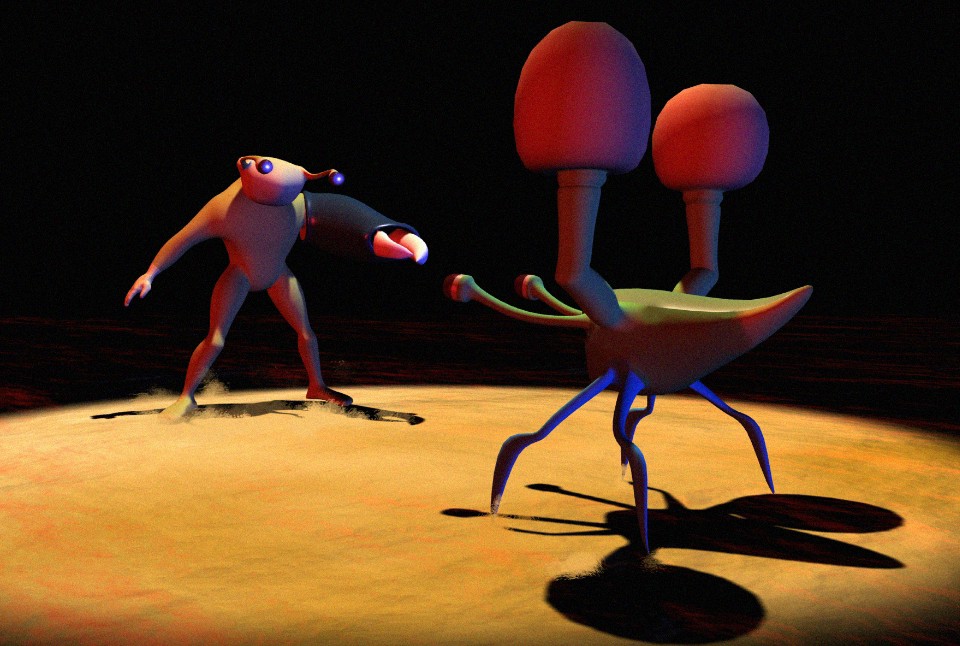
We envisage Myrmidons as being quite alien - more like some kind of reptile/insect hybrid than humanoid fighters. The main reason is exotic visual appeal, but there is also the advantage that animation is easier to get looking right for a nonhuman creature, and by not seeming at all human there will be lower expectation of the AI. Players will be glad their trained critters can learn anything at all, rather than grumbling that they don't act as intelligently as human fighters.

It needs to be emphasized that the game is not the sole (or even necessarily the main) product. The game itself is the hook for capturing larger audiences and revenue via television and the internet. The idea is that viewers enter the “funnel” as casual spectators, then get interested in placing bets, then maybe start buying and selling myrmidons (which they can do without owning the Conquerors software), and then the true aficionados buy the product, subscribe, and become our next generation of content providers.

By comparison, a show like Robot Wars has high barriers to entry in terms of time, cost, resources and ability. But all anyone will need to create a team is the Conquerors software – available in its simplest version free on the internet. Looking at other online games, Everquest has more than 400,000 regular players putting in 20+ hours per week. And Everquest’s followers are just the narrow point of the “funnel” - ie, the active participants - without the publicity boost or audience size possible with a TV show.

Conquerors is truly a new genre – a virtual sport that owes as much to football and tamagotchi as to traditional computer games. Players can choose the extent of their participation, from solo practice bouts through friendly competition on LAN (the “amateur league”) right up to full participation in one of the official internet competitions (the “professional league”). The pleasure of spectating will be as great as taking part, making this a game with true mass-market potential.

Monday, 1 July 2013

Mean genes - part 1

“It’s harnessing nerd power to create television content!” said the guy at the BBC.

Inward sigh of relief. At last, I thought. Pitching anything to the BBC can involve so many meetings you feel like you’re trapped in the afterlife arrivals hall from A Matter of Life and Death. That’s what the first BBC exec I encountered had told me: “You’ll go to a lot of meetings.” He said it like his spirit was broken. More than a dozen meetings later, I was getting to know how he felt. I’d tried explaining this particular concept (Conquerors, by the way – be patient, we’re coming to it) two or three times to an assistant producer. But this new guy was the Big Swinger, just back from his hols with a tan and a breezy attitude, and he got it right out of the gate.

“This is so refreshing,” I may have said. At which point the soundtrack would have carried a portentous note, the kind of musical sting Hans Zimmer loves to write.

Conquerors was the main reason I’d drifted across from games into television. I had the idea originally about five years earlier, while working at Eidos on Warrior Kings. After reading Richard Dawkins’s book Climbing Mount Improbable, I told Ian Livingstone my idea: “You create a stable of gladiatorial monsters. You have to breed, feed and train them, then you pick teams to go up against other players’ teams. What we’ll do, we’ll put the monster creation part free on all Eidos game disks – ”

Ah, you spotted the blunder. It was 1996 and I said “free”. Short of matching wits with a Sicilian, what could be worse?

As I thought about Conquerors, I realized it was more than a game. See, in order to render the battles nicely (quite an issue on mid-nineties PCs) I planned it that you wouldn’t control your team online. The training part was like a regular hands-on game, but once you herded your team off to fight some monsters from Argentina you just had to sit back and wait – and hope they’d learned the tactical lessons you’d taught them. Yes, they only had simple AI and would sometimes do some dumb things, but so would the other guy’s monsters.

Then it struck me. You didn’t have to have a monster in the fight to enjoy this game. It was also a spectator sport. And, because the battles were run on our servers and rendered out in rich 3D, we could edit that into broadcast-quality TV minutes.

It had to be teams, of course. If you pitted single monsters against each other it just became virtual Robot Wars. The qualities required for victory would then become trivial. Kind of like modern heavyweight boxing. The tactical element is needed because physical attributes plus behaviour is what makes for interesting outcomes.

I don’t think I ever got around to explaining that part. If you’re familiar with BBC pitching, you’ll know that the pattern is, first, those endless meetings I mentioned, the long hell of trying to break through indifference, incomprehension and bureaucracy. Then the moment it catches – the guy in the room who gets it, who likes it, who asks you to send over all the details of design, development and costs.

And it's about this time they lose your phone number...

Oh well, Conquerors is still there waiting. Not only could I do it better now, I could bypass the broadcasters and games publishers and BBC Worldwide and just take the whole thing to market via the App Store.

Tomorrow we’ll take a look at the design document. It’s over fifteen years old, remember, so I’d make some changes if I did it now. Still looks pretty innovative, though, if I do say so myself.

Friday, 4 May 2012

Once more, with feeling

I'm on BBC Radio 3 tonight at 10 pm talking about interactive literature with a brief mention of Teenage Mutant Ninja Turtles. The show is The Verb, presented by Ian McMillan. It's only 45 minutes, so blink your lugholes and you could miss me, but there's plenty more worth listening to on the show. Daniel Morden tells the story that Shakespeare ripped off for King Lear, part of The Devil's Violin Company's new show A Love Like Salt, as well as performing part of a gamebook on air. (Is that a first? Maybe.) You can hear Katherine Mitchell's new prize-winning, darkly funny play in its entirety; and there are two brilliant, raw, Hopperesque songs by the immensely talented singer, songwriter, novelist Simone Felice.

Image by AlwaysBreaking.

Sunday, 22 April 2012

Sense and Worth, o'er a' the earth

If you live in Scotland, tune into BBC Radio at 13:15 on Monday for The Book Café, where I'll be discussing my forthcoming Frankenstein interactive novel with Dale Townshend of Stirling University. Listeners in the rest of the United Kingdom can hear it later in the week on BBC iPlayer.

There's also a review of Frankenstein in Monday's edition of The Independent, a British newspaper. And, in case non-UK readers are feeling left out, Frankenstein is one of the books being discussed by Luke Navarro and Kevin McGill on this Tuesday's Guys Can Read podcast.

Frankenstein will be published for iPad and iPhone on Thursday, April 26, by Profile Books. It's alive!

Friday, 30 March 2012

Gamebooks on The World at One

The BBC had a short (very short) feature on gamebooks on their World at One radio show yesterday, ostensibly to celebrate the 30th anniversary of the genre - though really they should have done that in 2004. If you're in the UK you can listen to it here for the next 7 days. Zip right on through to the last 5 minutes if you don't want the discussion on oil prices.

It's as completely flippant, patronizing and inconsequential as you'd expect of BBC coverage of a topic like this, but at least you get to hear Ian Livingstone gamely going along with it with a finely judged tone of Mancunian irony. What I liked was when the interviewer asked, "Will we ever see a literary gamebook?" A very timely question, answered here.

Sunday, 19 June 2011

When Doctor Who was seven weeks old

Here's something for Fathers' Day. Last week I did a post on my other blog that could just as easily have fitted in here, assuming that SF/fantasy gamers have, as I suspect, a wide overlap with Doctor Who fans. It's the story of how I became the first boy ever to meet a Dalek face-to-face. It was 1964. JFK had been shot, the Beatles were about to break big, but all I cared about were fluid links, static electricity, neutron bombs, police boxes and genocidal mutants. Happy days!

Friday, 4 March 2011

Coming attractions

SF author John Whitbourn's first novel, A Dangerous Energy, won the coveted BBC/Gollancz prize for its virtuoso depiction of how a young hedge wizard's progress towards his goal of becoming a master sorcerer is a long, slippery slope over a precipice of damnation. Harry Potter it ain't. The follow up, To Build Jerusalem, won these accolades from one-time White Dwarf book reviewer Dave Langford:

An alternative England where magic works, science is retarded, and everyone grovels to the Vatican. It's a dark world, with witty touches – like Winston Churchill's eulogy to the martyred hero whose successful action shaped this history, Saint Guy Fawkes.

Something is rotten, though, in the alternative 1995. A major new demon is loose, and besides alarming sexual tastes she has a nasty sense of humour. King Charles IV himself is diabolically abducted. So is an entire castle. The workers – the Levellers – are revolting.

Enter papal investigator Adam, a one-man Inquisition who demonstrates painful martial arts on anyone slow to answer questions. After a spectacularly disastrous conjuration in Westminster and gory mayhem in Guildford, Adam locates the she-demon's lethal private universe and leads in the troops...

There are worse things than the demon, whose excesses are limited by an unnamed but guessable Power. England's real rottenness is the dispossession of farm workers, echoing the Thatcherite feeding frenzy of our own world. The fate of the rescued King is an ultra-black joke; Adam's fate is best not thought about.

A worthy successor to A Dangerous Energy: clever, uncompromising and uncosy.

I was lucky enough to play briefly in John Whitbourn's now-legendary Continuum role-playing game, set in the same world as his early novels - as I reminisced in a recent comment on this blog:

Player-characters could summon up magical powers; they just couldn't control them. I remember the first time I called on the Wild Hunt. I was being pursued cross-country by foes and fondly imagined I could sic Herne and his horde on them. Instead, I heard the thudding of hooves, the blaring of horns, I was seized by the scruff of my neck and carried pellmell over miles of fields at terrifying speed, finally to be dumped in a ditch as slavering red-eyed hounds barked around me. The Wild Hunt departed, leaving me bruised and muddy, but far from my enemies. That was real magic - it raises hairs on my neck just remembering it now.

Why mention all this now? Because Fabled Lands Publishing has just snapped up the rights to John Whitbourn's latest novel and we'll be setting it loose on the world in less than a month. If you like your science fiction to be uncompromising, unsettling, amazing and laced with dry-as-a-bone black humour, you're going to love this.