The point of
the Blood Sword series is that you can play through all five books as a kind of epic role-playing campaign. It wasn’t the first time that had been done. Steve Jackson’s
Sorcery books (currently enjoying a new lease of life via Inkle’s app version) paved the way, along with
The Way of the Tiger by Mark Smith and Jamie. But I’ve never been a fan of Chosen One stories, and running a single-player campaign pretty much obliges you to make the hero a lost prince(ss) or a midichlorian messiah. Fantasy has more Enders than it has Frodos. The USP of Blood Sword is that it can be played solo or in a team of up to four, meaning that player-characters must rise on their own merits to become heroes, or fail in the attempt, rather than being born to a spoon-fed destiny.
Looking back, I wonder if the publishers were concerned that I wrote Blood Sword so that four players could make do with a single copy of the book. They’d probably rather have had special editions for Enchanter, Sage, Trickster and Warrior. A little more work, four times the profit. I’ve never thought of my writing in marketing terms, so there’s a lost opportunity – or a beacon of integrity, take your pick.
The Demon’s Claw, the midpoint of the Blood Sword series, is close to 600 sections and the thickest of all the books. This in a series where the shortest book is at least sixty thousand words. What can I say? I like to lose myself in my imagination and I hope you enjoy the ride. So, here are the influences, inspirations and reminiscences about
The Demon's Claw in no particular order:
The title first. The Demon's Claw is the folkname of the Sword of Death, the mirror twin of the Blood Sword (the Sword of Life) which is of course the object of your whole quest. Unless both swords are the object..? That's a complication that starts to get hinted at here in book three and develops through to the finale in
The Walls of Spyte.
Several of the non-player characters in the Blood Sword series are drawn from my own campaigns.
Sir Tobias, the head of the Knights Capellar, was originally played by Steve Foster and if anything was more scary and fanatical in “real” life. (Tobias, that is, not Steve. He's a sweetie.) Anvil, the night watch commander in Crescentium, was one of Mark Smith’s characters in our original
Empire of the Petal Throne campaign. (Mark later provided the template for Harold Shandor in
Heart of Ice, where Steve also appears as Janus Gaunt – though those characters are much more loosely based on their
Tekumel originals, Tlangten and Kanmiyel respectively.) The young knight Sir Balian was based on Jack Bramah’s
EPT character Chaideshu.
I had started thinking about casting choices by now. Prince Susurrien would be played by Omar Sharif, with his voice “soft and deep, suggesting the quietest beat of an enormous drum”. (Oh, you were thinking of Brian Blessed? Fair enough; once you open the cover it becomes your book.) And your arch-foe Icon makes his reappearance, now explicitly under his real
Yamatese name, Aiken. I’d talk about his sister too, but that way lie spoilers.
The major literary influences here are
Michael Moorcock (the ship that sails through time – though, yes, technically that is
G C Edmondson; but I picked it from Elric stories),
Robert Holdstock (
Mythago Wood), and Robert Irwin (
The Arabian Nightmare). If you’ve played Eric Goldberg’s
Tales of the Arabian Nights boardgame then you’ll recognize the impudent hunchback and the garrulous ghoul. Goldberg was the
primum movens of the open world gamebook (Fabled Lands, for instance, or
Fallen London, or
Meg Jayanth's 80 Days) so we all owe him a lot.
As befits a story about the poles of Life and Death, the theme of
The Demon's Claw is ambiguity. For instance, the man whose lower body is made of stone. Is he a spurned lover half-fossilized by a witch, or an incomplete statue given life by a kind-hearted sorceress? As the book’s original introduction put it:
In the words of Hasan i-Sabbah, Grandmaster of the Marijah Assassins, ‘There is no single truth; everything is possible.’ Or, as the Saviour of the True Faith said, ‘From the Cup of Truth one can drink a thousand times.’
In short, the message in encounter after encounter is that the truth remains deliciously unknowable, the box is never opened for sure, and Schrödinger’s cat remains intriguingly both alive and dead.
I like the stop-motion monsters and magical entities in this book, such as the Seven-in-One and the Hatuli. A little bit of
Ray Harryhausen there by way of
Jan Švankmajer. I can imagine them all jerky and a little bit fever-nightmarish. The jinni too, a real hairy blot of a being, a dirty great ink-stain on the clean page of reality. I wanted that folkloric feel. This isn’t a book of smooth Hollywoodized CG effects, it’s a
Singing Ringing Tree of a fantasy.
Readers have noticed that the Blood Sword books are set in the
Dragon Warriors world of Legend. The people of that world refer to it themselves as middle-earth (ie Midgard) but, as Tolkien has made that term his own, I’ve edited most of those references to “the mortal earth” or “the mid-world”. They don’t tend to call it Legend – that was always a term more for the players than the characters. But the interesting question is whether this even
is the Dragon Warriors world or just something that looks a bit like it. In my Legend games you could go ten years and not meet a dragon, much less the World Serpent or an immortal like Hunguk the Pirate King. And there’s only one time we’ve had anything like orcs in Dragon Warriors, and that in a not-what-you-expected scenario by Steve Foster. The best way I can describe it is that if the real Legend is Arthur Conan Doyle’s Sherlock Holmes stories, the Blood Sword version is Guy Richie’s movies or a show like
Penny Dreadful. No excuses here for that, mind you. Blood Sword was for a younger audience and it delivers a big bang whereas DW is all about the down beat.
As for the rules-y stuff, people have asked if you can complete the adventure without a Trickster. Most certainly you can. I reckon you’ll have more fun if there’s a Trickster along – that’s why stories about Odysseus are more interesting than ones about Ajax – but every character class can succeed and they all have their strengths. Personally I think you’re crazy if you don’t do deals with the
sandestins – oops, faltyns – but the beauty of a series like this is you get to configure the kind of team that suits you best.
There’s little else to say about
The Demon’s Claw except that I think it features some of
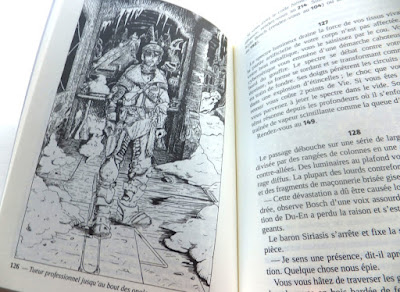
Russ’s very best artwork. Next up in the redux series of blog posts is
Doomwalk (aka “the one where they all go to hell”) but I should have a big announcement before that. Stay tuned.