Gamebook store

Showing posts with label Russ Nicholson. Show all posts

Friday, 4 September 2026

On the road

Suppose you’re writing a gamebook and you want the player to be able to travel from Wishport to Haggart’s Corner on this map. In its simplest form that would require a section (A) for Wishport, a section describing travel on the road (D) with possible side encounters, and a section (F) for arriving at Haggart’s Corner.

In an open-world gamebook it gets a bit more involved. Now you might be travelling on that same stretch of road either north to Haggart’s Corner, or in the other direction south to Wishport. In Fabled Lands we wanted to have random encounters occur when the player is travelling, so we needed a section (C) to handle those. Each encounter could be an entire side-adventure, though the two in this example are both very short. Once the encounters are resolved, or if you didn’t get an encounter, you’re routed to section D and can decide which way to head. Like this:

A

Wishport is a picturesque town set at the back of a bay rimmed by white cliffs. Fish, oil, dyes and other commodities are packed here for transport inland. You can buy a town house here for 100 Shards. If you decide to do that, cross off the money and put a tick in the box by the town house option below.

[Various options in the town]         …

Leave Wishport                           turn to B                  

B

From Wishport, you have the option to put to sea, take the road to Haggart's Corner, or travel cross-country. In order to go by sea, you must either possess a ship which is docked in the harbour (check the Ship's Manifest) or find a captain who is willing to take you as a passenger.

Go to the harbour                                 turn to ---

Take the road north                              turn to C

Go west towards Metriciens               turn to ---
    Go east into the Magwort Fens           turn to ---

C

The road follows the ridge of low hills extending out into the headland of Knucklebones Point.

Roll two dice for encounters:

Score 2-5         Eerie things                            turn to X

Score 6-8         Uneventful journey              turn to D

Score 9-12       Penniless adventurers          turn to Y


D

You are on the road between Wishport and Haggart's Corner.

Follow the road to Wishport              turn to A

Go north to Haggart's Corner             turn to E

Go due south towards the coast          turn to ---

Go east into the Magwort Fens           turn to ---

E

The town of Haggart's Corner stands at a place where three roads meet. Here, in certain seasons of the year, the trau are said to come and trade their marvellous trinkets in exchange for human favours.

Stop at Haggart's Corner            turn to F

Continue on your journey          turn to G

F

Haggart's Corner is a pretty, pastel-hued town. Houses with high gables and mullioned bay windows are set around a series of courts where fountains splash dreamily in the sunlight.

[Various options in the town]         …

Leave Haggart's Corner              turn to G

G

The fey, sleepy, whimsy-tainted air of Haggart's Corner is soon forgotten as you turn your face to the wind and journey onwards.

Take the road to Metriciens                turn to ---

Head to the Monastery of Molhern    turn to ---

Take the road to Wishport                  turn to C

X

Misshapen sprites with grotesque faces come scampering out of the hedge beside the road. Tittering to themselves, they prod you with gnarled fingers and discuss whether you are worth eating.

`Give us an emerald and we'll let you go,' pipes up one of the sprites.

It seems they will accept a green gem to leave you in peace.

Give them a green gem            turn to D

Make a break for it                      turn to Z

Y

Three penniless wanderers tell you a tale of being washed up on a lonely shoreline. ‘Still, we're determined to make names for ourselves,’ they vow. Their predicament reminds you of your own early career, so you give them a tenth of any cash you have on you (rounding fractions up). Only later, while passing through a village, do you remember seeing their faces on a wanted poster.

Turn to D.

Z

Guffawing, the sprites let you go. You run pell-mell until there's no breath left in you. Only then do you notice that they stole one of your fingers. Lose 1 from THIEVERY (down to a minimum score of 1) and turn to D.


This example is a simple one, but as I said those encounters could be entire quests in their own right. That creates some difficulties. First of all, once the player has dealt with a major quest such as exploring a ruined castle we may not want them to experience it again. One way to deal with that is to put a check box in the first section of the sub-quest – something like this:

Section R is the ‘defused’ version of the encounter – the castle is empty, nothing to see here, back to D. That’s assuming you only want the player to have one crack at exploring the castle. If it’s possible for them to fail – and flee, or die there – then you might need to filter it with a keyword, so that they only go to the defused version of the encounter once they’ve handled it successfully. Incidentally in Vulcanverse, where I needed to stop the keywords from proliferating to an unmanageable degree, I used a structure like this instead:

There you embark on the sub-quest at 306. No matter how many times you come back here, if you haven't successfully completed the quest you'll go to 306. When you do complete the quest you'll be told to turn to 41 and tick the box. Section 476 gives you the spiel for having just completed the quest. Section 734 is for if you return here subsequently. (Incidentally I used a similar mechanic in Can You Brexit? to determine when the player had resolved one of the UK/EU negotiating points.)

The other problem with putting sub-quests on a random encounter table is that the player might just walk back and forth among that same section of road repeatedly until they get the special encounter they want. In Fabled Lands that’s a passage of time issue, similar to the way we don’t want players to make investments at the merchants’ guild and walk back in minutes later to collect a windfall:

Notice those keywords Almanac, Brush and Catalyst. You can only get those by travelling to a distant port. Then when you return you get to roll to see how your investments have been doing:

You could use the same mechanic to prevent the player repeatedly traversing the same stretch of road to get that lucky encounter roll. Just mark the encounter as only happening if the player has the keyword Afar or whatever, and remove Afar after they’ve been along the road – so then they’ll have to voyage off to Sokara in book one to collect Afar again.

It’s not ideal, because it’s contrived. We’re trying to represent passage of time, which a paper gamebook obviously can’t do directly, so we say that if you’ve visited a distant location, which we can keep tabs on, then time must have passed. But the player is bound to wonder why going to a specific location in book one arbitrarily unlocks an unrelated quest opportunity in book two. It breaks suspension of disbelief.

If you can think of a better solution, I’m all ears.

Friday, 9 May 2025

The river out of Eden

Back in 1998 or 1999, I was having lunch with Russ Nicholson at the Dumpling Inn in London's Chinatown. I'd been working at Eidos, a videogames publisher, and had written specs for three games: Plague (later renamed Warrior Kings), 2020 Knife Edge, and the Fabled Lands MMO that was destined to morph into Abraxas. Astounding as it may seem today, back then most publishers had no clue that game development is an iterative process that requires continual refinement of the design, and so it had been suggested to me that Eidos wouldn't have much for me to do until their internal teams had finished those three games. I disagreed, and my friend Nick Henfrey and I had given Eidos execs a detailed analysis of how development ought to work (pretty much how every developer does it now, but not in the '90s) but while waiting to hear if the message had got through I was trying to come up with a new project. Russ was also looking for something to work on, hence our brainstorming session over dim sum.

"What about a comic book?" suggested Russ. He didn't need to twist my arm. We both loved comics. Because Russ had worked out in Papua New Guinea and met quite a few tough engineering types, we came up with a scientist/archaeologist and his roustabout minder who are searching for the site of the Garden of Eden. They find two sets of weathered tree roots, which unknown to them are the remains of the Tree of Life and the Tree of Knowledge. That night they get stoned and are forced to run for their lives when attacked by bandits. They run through some kind of interdimensional portal to another world. We follow the scientist character who arrives alone in a beautiful verdant landscape quite unlike the desolate rocky terrain he was camping in moments earlier. But it's a case of out of the frying pan, as a spear thuds into the ground by his foot and he realizes he's being hunted by the natives of this other world. I scribbled the notes as we ate.

Long story short, here was our surprise twist: the roustabout guy ran through the interdimensional rift a few seconds ahead of the scientist, but in this other world that meant he arrived ten years earlier. In that time he's made himself the warlord of the place. He has corrupted paradise. We were quite pleased with ourselves for dreaming that up, and remained so until Outcast came out a few months later and it turned out to feature the exact same idea. Under the sun there is no new thing, it seems. Oh well.

I didn't lament our Garden of Eden story for long. Outcast did it all so brilliantly that it's hard to imagine we could have topped that. In any case, I got drunk with another gaming friend, David Bailey, and after an all-night conversation over whisky we came up with the idea of asking Eidos to set us up as an independent development company. That became Black Cactus and although 2020 Knife Edge and Abraxas fell by the wayside, Warrior Kings finally shipped. In the world of game development, one out of three ain't bad going.

Since then we have lost Russ, sad to say -- two years ago tomorrow, hence this post. Black Cactus and Eidos are no more. Even the Dumpling Inn has gone. The grass withereth and the flower fadeth...

Tuesday, 1 April 2025

Alternate versions of Heart of Ice

This post isn't really an April Fool, but it tickled me. Somebody told me they'd asked ChatGPT what The Warlock of Firetop Mountain might have been like if Oliver Johnson and I had written it. I could tell it that for starters the book wouldn't have sold a tenth as many copies, but it concentrated instead on the stylistic aspects:

"If The Warlock of Firetop Mountain had been written by Dave Morris and Oliver Johnson, it would likely have taken on a more complex, story-driven, and atmospheric quality, with a richer interplay between narrative and character choice. The book would be darker, more sophisticated, and immersive, with a layered story and morally complex characters that invite readers to question the nature of heroism, villainy, and fate. It would keep readers enthralled not just with the challenge of surviving the mountain but with the depth of the world and characters they encounter."

First thought: spare my blushes. But maybe ChatGPT always finds the upside in any comparison? I tried asking it what Heart of Ice would have been like if written by the éminences grises of UK gamebooks. Its reply:

If Heart of Ice had been written by Ian Livingstone and Steve Jackson, it would likely have had a distinctly different tone, structure, and gameplay focus. Here’s how:

1. Emphasis on Combat and Skill Tests

Livingstone and Jackson’s style, particularly in the Fighting Fantasy series, leans heavily on combat encounters and skill tests. Instead of the intricate social interactions and strategic planning that Heart of Ice focuses on, there would likely be more dice-based combat and stat checks woven throughout. Encounters with mutants or dangerous factions might involve straightforward fights rather than diplomatic or strategic solutions.

2. Simplified Storyline and Character Interactions

Heart of Ice is known for its branching paths, character-driven plot, and complex narrative. If Livingstone and Jackson had written it, the story might be more linear and driven by clear objectives rather than complex interpersonal choices. NPCs would be more likely to serve as allies or adversaries without much emotional depth, focusing on the immediate stakes rather than broader story themes.

3. Collectible Inventory and Traps

Livingstone and Jackson often include item collection as a key part of their gameplay, with a particular focus on specific items needed to progress through the story or defeat major challenges. If they had written Heart of Ice, players would probably need to collect certain artifacts to reach critical locations like the chamber of the Heart, and there might be more hidden traps and hazards along the way, requiring particular items or choices to avoid disaster.

4. Greater Focus on Luck-Based Outcomes

Jackson and Livingstone's works often incorporate luck as a major mechanic, where random rolls can dramatically impact outcomes. Instead of just weighing the risks and rewards in Heart of Ice, players might face outcomes that hinge on a luck stat or a random roll, affecting their survival or success.

5. Increased Use of Instant Failures and Dead-Ends

Heart of Ice has a reputation for being fair in its approach to player agency and choices, allowing for a range of ways to succeed. In contrast, Livingstone and Jackson might introduce sudden death options more often, which could increase the difficulty and frustration. This could potentially make Heart of Ice a more challenging but also more punishing journey.

6. A Clear-Cut "Big Bad"

While Heart of Ice presents a nuanced story where antagonism isn’t always black-and-white, a version by Livingstone and Jackson might feature a single, clearly defined “villain” character. This villain would be more traditional, with the player's final objective involving a climactic showdown or battle, in line with the classic fantasy narratives they’re known for.

So, the gamebook might end up as a harsher, combat-heavy adventure with a strong, linear quest through a dangerous landscape rather than the layered and atmospheric narrative exploration Dave Morris crafted.

I haven't read enough Fighting Fantasy books to know how accurate that is, but it sounds pretty impressive. I couldn't resist asking it about other gamebook authors' possible take on the book:

“A Joe Dever version of Heart of Ice would likely be an immersive, heroic journey with a noble character, structured progression, and clear moral and strategic choices—capturing both the danger and the higher purpose of the quest in a more heroic fantasy style. He’d likely weave in a sense of duty, encouraging players to act for a greater good rather than personal gain.”

“In Jonathan Green’s hands, Heart of Ice would become a grimdark, horror-fantasy adventure, filled with visceral details, deadly encounters, and moral ambiguity. Green favours action-packed scenes and deadly encounters, so his version of Heart of Ice would feature frequent, high-stakes battles and physical challenges. It might involve collecting key items to reach the Heart or unlock special advantages. He’d likely add a layer of treasure-hunting, where players need to acquire specific artifacts or resources scattered throughout the wasteland to succeed. He loves a grand finale, so his version would likely end with an epic, high-stakes confrontation at the Heart.”

“Martin Noutch’s version would be a complex, playful, and layered adventure, balancing whimsy with emotional gravity. It would be a unique experience, inviting readers to engage with the story on multiple levels, both as an adventure and as a philosophical exploration of resilience, identity, and purpose in a world gone cold. He might include interactive features like tracking character traits, shifting perspectives, or even a system for moral ‘weight’ that changes based on choices. Noutch would probably play with the medium, encouraging readers to see the book as more than a story—perhaps introducing puzzles or mechanics that reflect the icy world’s desolation and the player’s perseverance.”

“If Paul Mason & Steve Williams had taken on Heart of Ice, the gamebook would be a surreal, philosophical journey, focused on introspection, symbolic encounters, and moral ambiguity. Rather than a straightforward adventure, it would feel like a dream-like, psychological exploration, where the destination matters far less than the journey itself. Their works often explore identity and transformation, so players might undergo changes based on their choices, affecting their skills, personality, or even memories. The players might evolve, not just in ability but in character, with each decision subtly reshaping the protagonist’s sense of self and purpose. The character’s motivations for seeking the Heart might also shift over time, depending on the journey's transformative impact. Instead of a straightforward victory or defeat, the journey might conclude with an open-ended, introspective finale, leaving players to interpret what they’ve achieved or lost. The Heart could be something far more abstract—maybe a philosophical revelation or an understanding about the nature of humanity and survival. The ending might reflect the choices made throughout, leaving players with questions rather than answers.”

“Jamie Thomson & Mark Smith are known for their sometimes irreverent style. Heart of Ice under their pen would probably include more dark humour and satirical elements, especially in character dialogue and descriptions of the setting. It might lean into the grim aspects of the post-apocalyptic world with a slightly tongue-in-cheek twist, letting players confront both the desolation and absurdity of humanity’s downfall.”

There are many other talented gamebook writers, of course, but let's keep this under two thousand words if we can. Also, many of the above examples make some kind of sense as Jamie, Mark, Oliver and Paul were all players in the Tekumel campaign that inspired Heart of Ice.

Finally, as a tonic against mortal hubris, I asked ChatGPT how it would improve on my original book:

To enhance Heart of Ice by Dave Morris, we could build on its strengths—the compelling world-building, intense survival themes, and open-ended structure—while adding new dimensions to enrich the experience. Here are some ideas:

1. Enhance World Interactivity and Dynamic Environment

Expanding the world’s responsiveness to player choices would amplify the sense of a living, evolving environment. For example, the harsh ice-covered world could react to the player’s presence in ways that change terrain, reveal hidden paths, or shift alliances among factions. This could make survival not only about enduring the environment but also influencing and adapting it.

2. Expand Character Development and Relationships

Adding a system where the protagonist's choices influence traits or relationships could deepen player immersion. Perhaps the player could develop unique bonds with NPCs, leading to varied endings or special advantages based on trust, alliances, or rivalries. This would make each choice carry more emotional weight, emphasizing both the loneliness and connection found in such an isolated world.

3. More Nuanced Morality and Consequences

The original story features morally ambiguous choices, but expanding these even further could add complexity to the player's journey. Introducing choices with delayed consequences that unfold in unexpected ways would heighten the stakes and allow the player to see the broader impact of their actions—either in aiding certain factions, using resources, or making ethical compromises.

4. Introduce Mysteries with Long-Term Payoffs

Building in hidden mysteries that only reveal themselves through multiple playthroughs could enrich the lore and encourage exploration. For example, obscure clues found throughout the icy wasteland might hint at ancient technologies, or the true nature of the Heart of Volent might only become clear through carefully pieced-together discoveries. Each run could reveal new layers of history or insight.

5. Expand Mechanics for Resource Management and Survival

Given the harsh, resource-scarce setting, adding more nuanced survival mechanics could make the journey more immersive. Players might have to carefully ration food, water, and warmth or deal with shifting weather conditions, making travel more strategic and emphasizing the environmental dangers of this world.

6. Player-Driven Goals Beyond the City of Du-En

Expanding the story’s focus beyond reaching the Heart itself would add depth, especially if there are varied side quests or goals tied to the protagonist’s backstory. For instance, players might choose to pursue knowledge about the world’s origins, help rebuild a faction’s community, or take on a personal mission with high stakes. These could offer alternative endings based on different player-defined motivations.

7. Deeper NPC Lore and Factional Storylines

The factions and characters in Heart of Ice are intriguing, but expanding on them could add richness. Each faction could have its own lore, unique goals, and internal conflicts that unfold through interactions. Aligning with different groups might lead to varied story paths, and the protagonist could gain insights into the world’s history, politics, and culture.

8. Philosophical or Reflective Elements Linked to the Protagonist’s Journey

Introducing elements that invite the protagonist to reflect on their motivations could add a layer of introspection. Perhaps they occasionally encounter sites of historical significance that reveal more about the decline of civilization, prompting players to consider their role in this world’s legacy. These scenes could add depth and give a more philosophical tone to the player’s mission.

9. Expanded Narrative Endings with Layered Themes

Adding more varied, layered endings based on how the player has changed or impacted the world would reward exploration and role-playing. Endings could reflect the protagonist’s growth, alliances, and decisions, offering insights into what their journey ultimately means in the grander context of the icy wasteland.

With these improvements, Heart of Ice could evolve into a multi-dimensional experience that emphasizes survival, moral complexity, and a sense of both personal and environmental impact—deepening the world and the player’s journey through it.

Good points, but I'm not sure if I could have packed all that into 454 sections -- or 455 if you're going by the revised Kindle version. Thirty years ago even delivering a gamebook as long as Heart of Ice (which is about 70,000 words) was tricky to sell to a book publisher. If I were doing it today I'd love to go up to 120,000 words (like Can You Brexit?) or even 220,000 words (as in Workshop of the Gods) which would allow me to indulge all the backstories of the other characters and to put more detail into settings which in the 1993 edition I could only describe with broad strokes. With Russ Nicholson I planned a 2000AD-style comic story (called "Don't You Just Hate It When That Happens", if you really want to know) expanding on Chaim Golgoth's history with Harek Asfar, which was touched on in the book in just a few lines:


We'd have liked to do a comic for each of the main characters but abandoned the idea because there was nowhere in the UK to publish them. And maybe it's just as well. Economy in writing can be an asset even when it's forced on you by the publisher. Maybe Heart of Ice if twice as long, or bulked out with standalone comics, would just feel self-indulgent.

I do occasionally get an urge to return to Heart of Ice's roots and write the roleplaying mini-campaign. I'd probably use GURPS 4e for that, which might put a lot of people off but it's really the best fit. I certainly wouldn't make it any less bleak. Modern readers sometimes grumble about that, but imagine Brazil or Excalibur or Sunset Boulevard, say, with a happy ending. Ugh.

What I'd really like, given a ring of three wishes or a lottery win, would be to adapt it into a CRPG or a TV show. And if I ever should get to do that, I'm planning to enlist ChatGPT (or maybe Claude, or Perplexity, or DeepSeek, or all four) as a writing partner.

Wednesday, 28 August 2024

A vessel for the finer

I'm no fan of the brand of fantasy popularized by Dungeons & Dragons and Fighting Fantasy, but a book featuring the art of that genre will include magnificent work by the late, great Martin McKenna (above) and Russ Nicholson (below), along with lots of other talented folks obliged to earn their crust by continually depicting a world of cannon-fodder goblins, ale-quaffing dwarves, and vatic old men in taverns. So any wealthy gamebook collector is going to want a copy of Magic Realms: The Art of Fighting Fantasy and next month there's a launch party where you can get a copy signed by the author, Jonathan Green, and Sir Ian Livingstone.

Friday, 19 July 2024

Here come the machines

Now this is interesting. The Last Screenwriter is a movie made from a script written by ChatGPT-4. I'd like to tell you more, but knee-jerk hysteria (or so we're told) meant that the planned screening in London was cancelled. Too bad, as the filmmakers explain on their website that it was made as a non-profit experiment.

I'm curious about the use of generative AI in writing, art, and other fields. I suspect it won't lead to mass unemployment but instead will be a useful tool that creatives will collaborate with to improve their work -- much as desktop publishing has led to an explosion in the number of books. Hmm, given the quality of books these days maybe that's not such a great example.

Some people gripe (well, scream) that AI is stealing from existing authors and artists. Mostly that's a misunderstanding of how the models are trained. Yes, they look at millions of images to learn the way a picture is put together. Contrary to the belief of the pitchfork-bearers heading up to the baron's castle, the generative AI models don't record each individual image and reproduce it. It's more like how human artists and writers learn their craft.

For example, when I was a kid I'd often notice that my favourite comic book artists were having their panels "borrowed" by less well-known artists. The character poses you'd see in British comics in the early '70s (strips such as The Steel Claw in Valiant) had appeared in US comic books a few months earlier. But even among those Marvel & DC artists there was cross-pollination. Barry Windsor Smith famously started out drawing Jack Kirby pastiches and later went Pre-Raphaelite. Dan Adkins was famous for lifting poses from other artists. Writers too: H.P. Lovecraft began by imitating the style of Lord Dunsany. Dunsany was influenced by the King James Bible. Robert Bloch started out copying Lovecraft, and so the cycle continued. 

In the comics I made at school I emulated the art styles of Bernie Wrightson and Barry Windsor Smith; when I wrote my early stories I was following patterns picked up from Robert E Howard, Stan Lee, Roy Thomas, August Derleth, and others. This is how we've always learned -- and it's a much more targeted kind of swiping than the generative AI is doing. The AIs don't play favourites, which is why (now that you can no longer specify "in the style of" in the prompts) their art output tends to look like the soulless photorealistic fantasy paintings you see on DeviantArt.

I've talked before about using AI for artwork in gamebooks and RPGs. It's a good fallback for game designers who have no art budget. The snag is, people lose their shit when you so much as mention it. I've hired human artists whenever possible -- most recently Inigo Hartas for my Jewelspider roleplaying game. Of course you get a better result that way, but most independently published books don't even make enough to pay the author's phone bill. The option is often either AI art or no art -- or else public domain art like the William Harvey illustrations I used in the new print edition of Once Upon A Time In Arabia. Nobody was happy with those. (You can get a copy with Russ Nicholson's artwork on DriveThruRPG.) Another option is to use AI to enhance the writer's own sketches, which may be the best way to get the authentic imagery that the writer had in mind.

In any case, I'd like to see The Last Screenwriter because this is the future and we may as well start getting to grips with it. Smashing the looms never works.

Wednesday, 24 April 2024

You want fries with that?

In a very short time (I say that with fingers crossed) I'll be ready to put my Jewelspider RPG on DriveThruRPG. Urged by regular correspondent Stanley Barnes, and with the help of Simon Barns of Red Ruin Publishing, I thought I'd better learn the DriveThru ropes by uploading some books I did earlier.

So, if you're looking for digital gamebooks, you can now get the Critical IF series from DriveThruRPG:

As well as the grand finale of the Blood Sword series:

And a former Fighting Fantasy title that has been reworked as a standalone adventure in the Fabled Lands series:

And the first Fabled Lands book:

You get a watermarked PDF with all the sections hyperlinked and the original illustrations by Russ Nicholson and Leo Hartas. In the case of Once Upon a Time in Arabia that makes this quite a collector's item, incidentally, as the print version currently lacks Russ's pictures.

Friday, 23 February 2024

Blood Sword to Dragon Warriors - part 2

We're on to the second installment of Oliver's Whawell's conversion of Blood Sword encounters to Dragon Warriors rules. You can download the stat blocks for The Kingdom of Wyrd here.

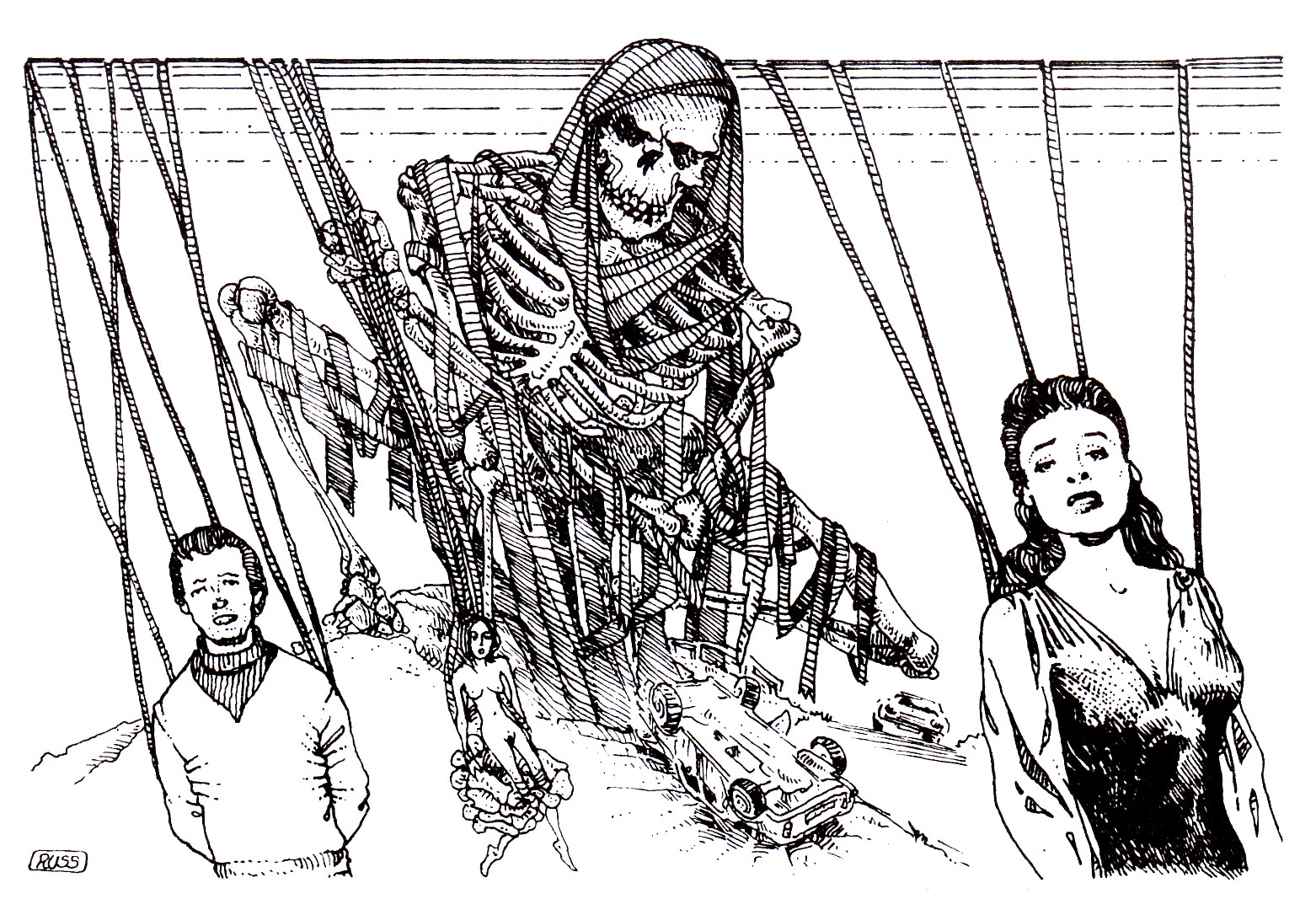
This one is interesting because I already had a crack at converting the Meteor Stalker, a weird creature brilliantly visualized by Russ Nicholson. Patreon backers can read all about that, but in a nutshell (or a meteoritic geode) it's as follows. The characters see a piece break off Blue Moon, one of five celestial bodies in the night sky over Krarth. The object plummets to earth:

"Concealed in the undergrowth around the clearing, you watch the blue flare crash through the trees at the edge of the clearing and explode in a shower of blue sparks at its centre. The high-pitched whistling noise has stopped, but now you hear a hissing sound from where steam rises from the place where it struck. In the centre of the steam you can see a black stone which even as you watch cracks apart like an egg. An area of darkness spreads like a pool of shadow. Then a hunched shape rises up from the shadow as though taking shape out of the very ground. It is a skeleton dressed in black tattered robes. Its eyes are glowing blue crystals. It seems to sniff the air as it looks around."

And the stats I gave for it are:


Oliver's calculations give a very similar result, possibly proving that great minds think alike? Obviously I couldn't possibly comment.

Tuesday, 16 January 2024

Cannes do

Next month I'm going to be at the Festival International des Jeux as guest of our French publisher Alkonost. I rarely attend games conventions but Russ Nicholson, who died last year, would normally have been at something like FIJ. It's yet another reminder how much we miss him.

FIJ won't lack for stalwarts of the industry, however. Jonathan Green, Sir Ian Livingstone and Steve Jackson* will also be there, among others, so if you're able to get to Cannes you'll hear enough gamebook and RPG talk to last you all year.


* But see comments below. I'm only 100% sure about Jon Green.

Friday, 1 September 2023

The Hole in the World

A few months ago we were looking at some of Russ Nicholson's magnificent oeuvre and Jamie mentioned how one of the iconic features of the Fabled Lands came about:

"Russ was doing a map and blotted it by accident. Me and Dave immediately came up with 'The Hole in the World' so it looked like it was deliberate."

That came about because Russ drew the first ever tidied-up version of our world map. For some reason the publishers didn't want to hire him to draw the world map for the books, but they finally gave way and admitted his map was much better than the one they commissioned. Naturally.

Russ needed to draw the whole world first because he was doing all the regional maps and wanted to be consistent about how they looked. Jamie and I used Russ's sketch map for planning all the books. That's why the copy below is covered with our annotations.

Monday, 19 June 2023

Remembering Russ

The latest issue of Casket of Fays is now out, and among the many reasons to pick up your free copy is the tribute I've written to Russ Nicholson.

Inside the Rookery did a special episode last week about Russ's artwork, featuring James Wallis, Marc Gascoigne, and Ian Livingstone. Among the revelations is the fact that he taught art to Sean Phillips, nowadays best known as Ed Brubaker's main collaborator. (Here's some of Mr Phillips's artwork. Is there any influence by Russ? You decide.)

The talk there is about Russ’s art but there's not much about the man himself. I like this recent interview because it not only fills in a lot of his biographical info but lets all of us who were privileged to know him hear again the voice of a much-loved friend and thoroughly decent human being.


Friday, 26 May 2023

He showed us marvels

It’s impossible to imagine the Fabled Lands without the involvement of Russ Nicholson, who died this month. His filler drawings are my favourites, little vignettes necessary for gamebook layout so that options don’t spill over a page, but also perfect for evoking the ambience of each book’s setting. He always put something extra into all the pictures: comic book style inserts, fragments of unknown scripts, characterful onlookers in the background of a scene, a thousand touches that convey personality, colour, humour and reality.

For some reason we had a struggle getting the Pan Macmillan art director to let us use Russ for the world maps. They had a different illustrator lined up but, as you can see by comparing the first four FL books with the last three, Russ’s cartography was streets (and forests, and mountains) ahead. In FL book 3 they printed the two halves of their map the wrong way round, at which point they admitted that maybe we’d been right all along and Russ should handle it.

I put a personal tribute to Russ on my Patreon page (unlocked) and I asked other members of the Fabled Lands team to contribute their memories. Here’s Paul Gresty:

“I first met Russ in 2010, when I was his interpreter at a gaming event in Paris. He’d illustrated many, many books that I owned and loved, and I was incredibly excited to spend a weekend with him. Throughout that event, Russ was interesting, and kind, and humble; whenever a fan of his work asked him to sign a book, Russ also took the time to draw an illustration in there, too.

“At some point that weekend I asked Russ if he’d sign a copy of Citadel of Chaos for me. I was expecting a signature, and perhaps a quick sketch. Instead, Russ took the book back to his hotel room so that he could spend some time on a picture. When he returned the book to me the next day he’d drawn a phenomenal illustration (an axe-wielding warrior and a dragon) right across the book’s copyright and title pages – and he actually apologised that it wasn’t as good as he’d hoped. The paper in the book wasn’t ideal for ink drawing, he explained; the ink had bled on the page a little. I guess that’s an artist term. Bleeding ink or not, I was overjoyed with the illustration.

“I’m happy and grateful that I was able to work with Russ after that, and to meet him in person a few more times. He was a creative powerhouse, and a joy to be around. Incidentally, it was Russ who introduced me to the Fabled Lands books, showing me a book that somebody had brought for him to sign. He (correctly) told me I’d enjoy reading them.”

Jamie Thomson adds:

“A sad loss indeed, both personally and professionally. I remember meeting him in our White Dwarf offices a few times way back when, just a nice guy and so talented. Iconic game book and WD illustrator. I guess the ink blot story is my favourite. He was doing a Fabled Lands map and blotted it by accident. Me and Dave immediately came up with 'The Hole in the World' so it looked like it was deliberate. Well, I think we did, maybe it was Dave or Russ that came up with it, I can't remember. Anyway, there were quite a few things that we added to the stories and the lore that came from Russ; he inspired us too.”

At first I wasn't sure about Jamie’s recollection there because Russ's world map for FL didn't appear in print until books 5 and 6, so how come he drew the Hole in the World before anyone else? It's probable that he drew his own version of the world map right from the outset in order to have a context for the regional maps in each book. It's typical of Russ's boundless enthusiasm for and professional pride in his work that he'd do that even without a commission from the publisher. He improved every idea we gave him. He was our Jack Kirby, our Billy Preston, the Eno to our Roxy Music. As film directors value a great cinematographer, we valued Russ – as a good friend as well as a collaborator. He won’t just be missed, he’s irreplaceable.

He leaves behind his partner Jacqui. His wife, I should say, as they had planned to get married while Russ was in hospital, only he got moved to another ward which couldn’t accommodate a bedside ceremony. Had he come home I’ve no doubt they would have had the wedding then, but sadly he died in hospital. Fans will remember him fondly, friends with love, but the real wrenching loss is Jacqui’s.

However, as long as we have Russ’s art we can still see the expression of his personality. In that sense he’s with us always. Here is a small selection of illustrations by him that you might not have come across before.

This from the summer 1978 issue of Fantasy Tales:

This from A Dying Trade:


A sample page Russ did for The DFC:

Two more sample pages for The DFC, this time for the John Blake strip:


A test page for Mirabilis, because in the early days we thought Leo and Martin would be too busy on the gazetteer book to handle the comic strip chores as well:

Layout page for “Rich and Strange”, one of several Mirabilis standalone stories I wrote to run in The Guardian newspaper:

(Only one story, “A Wrong Turning”, was ever fully illustrated, and that by Martin McKenna whose loss we also mourn.)

Part of the layouts for the Camelot Eclipsed comic book (originally The New Knights of Camelot):

Some concept art for Shadow King:


A rough that Russ prepared for A Town Through Time, a project we pitched without success to publishers in the late ‘90s:


You can see how much on-spec work an artist has to produce in order to nab a few paying gigs. And this is just the tip of the iceberg. Here's another -- Russ's drawings for the Conquerors game.