The Kingdom of Wyrd is where the Blood Sword saga really begins. Well, kind of. You've already met your Big Bad in the form of
Icon the Ungodly, the scene has been set with scheming celestial Magi and a gritty medieval world, and if you don’t know the rules by the time you get out of the Battlepits then no crash course will ever help you. But this is the book where you’re given the quest that’s going to carry you through to Doomsday. Literally.
I wonder if I even knew what the Blood Sword was going to be when I got started on this series. Most likely Oliver sold it to the publisher on the strength of a lurid title. (That’s why the “dragon” in
Dragon Warriors. “It says fantasy.” Me, I wanted to call it something like
Dead Men and Heroes, but these were children’s publishers we were dealing with.) So, title first, and only then we will have figured out how to get a Blood Sword into it. Readers will notice that most of the time in the books I call it the Sword of Life, not least to try to distance myself from the
gore-dripping logo the art director saddled us with.
An ancient magic weapon split into pieces that you must collect… Hmm.
That will have been Oliver. And it sounds like I’m scornful, but he was right. Even back then, I’d have wanted to design the series like my role-playing games – and my campaigns are never about saving the world – but Oliver was forever reminding me that these books were for kids, and the top-sellers in the market were Fighting Fantasy, which back then never knowingly used an original plotline.
Reviewers have observed that in among all the epic world-saving, what really interests me is the personal. People, not ideas. But I can see it helped to have that
MacGuffiny treasure-hunt arc to hang it all on.
Each Blood Sword book has a theme, and in this one it’s the danger of idealism hardening into totalitarianism, revolution coagulating into stasis. Now, I tend to think that gamebooks are better the less dungeon they have in them. By that I’m not ruling out all scrambling through chthonic spaces, just those tidy-as-a-carpark catacombs where you get a logic puzzle in one room and orcs playing skittles with a baby goblin in the next. But I said to a role-playing colleague,
Mike Polling: “I need to suggest the stultification of the imagination, a world where somebody gained the power to shape dreams but their dreams have all grown stale and a bit boring.” And he said: “You just described a dungeon.”
So in a way that’s what the Warlock King’s palace is. A classic dungeon (no orcs, though; no skittles) and it’s justified in story-terms because it’s all a construct in his mind.
The Kingdom of Dreams is the role-playing game where you have to take on the Dungeon Master and slay him. Very apposite for my style of role-playing, that.
The palace isn’t a big part of the adventure, though. Much more of it is a free-wheeling wander around the world of Legend encountering a variety of mad, bad, dishonest, decent, driven, daft, wise or vengeful NPCs. The feminine principle is a big factor in this book. Look how often your bacon is pulled out of the fire by a woman. It’s not that I think the female mind is actually any wiser or more creative than the male, but in the world of mythological archetypes churning away under the skin of the story here, the Warlock King is the ultimate Bad Dad, all controlling and about what’s good for you, while characters like Uraba the seer and the old lady in the woods are aspects of the Mother, the Yin that bends and flows around all opposition. Who knows why I took it in that direction. Margaret Thatcher was in power at the time. She was Britain’s very own Warlock King, driven mad by being too long in power and too absolute in her convictions. So maybe I felt we needed a nice feminine example as an antidote.
Talking of which, my favourite thing about the book is Uraba. She was unexpected. I was learning that good writing is about surprising the reader. And I liked starting the story
in medias res, something I took to Jason Bourne levels in book four.
The vampires out on the pack ice were swiped from August Derleth’s story “
The Drifting Snow”. I read it once when I had a bad cold, and in that slightly feverish state it stayed lodged in my subconscious like a psychic cyst. And then, writing about those poor half-starved player-characters shivering under the gleam of Red Death, it came back to me.
Merci,
Monsieur le Comte.
Oliver Johnson had even less time to help out with this book than on
The Battlepits of Krarth. I detect his hand in much of the last act of the book that takes place inside the Palace of Eternal Dusk, especially the doppelganger on the funeral bier and the various mythic trials – the Leaves of Remembrance, the Handmaidens of Oblivion, and so on. Giving a personal name (Gristun) to the Warlock King’s guardian beast, that will have been Oliver with his background in early Gothic literature. Always mainlining the Hippocrene, him. And I’ll bet he thought of the old knight who needs your help with the Lady in Grey – not least because she doesn’t fit the prevailing theme of this book that the women are the trustworthy ones.
The most purely Johnsonian bit in the book is Captain Lazarus and his obsession with the World Serpent – except I’m pretty sure
I’m the one who came up with all that. We were like Lennon and McCartney, you see, amusing ourselves by pastiching each other’s style. (
The walrus was Paul.) And here’s a funny thing. Editing this book, I was baffled to find that Lazarus doesn’t quietly slip off into the brine if his goal is thwarted. I could have sworn that scene was in there, but I searched the flowchart and couldn’t find it. Then I realized I’d put it into
the novelization of this book, and it was so delicious and fitting a bit of character development that I was tempted to retrofit it into
The Kingdom of Wyrd. But no, I did promise this would be the classic version. All those revisions can wait till the next edition.
I
say that, but I felt the denouement was too unforgiving. I wouldn’t kill my players in an RPG just because they failed to find one item. So I tweaked the final duel with the Warlock King to give you more of a chance. Oh, and classic edition or not, the Enchanter has a whole new spell that can be very useful on those tactical maps. You’ll see.
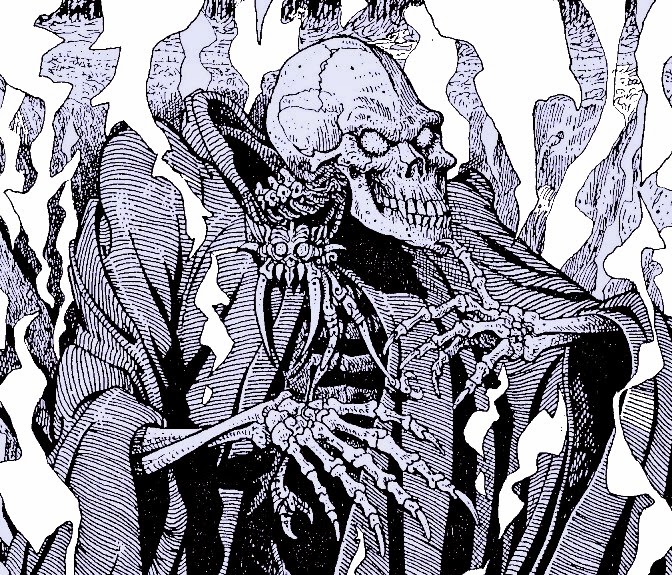
This book has one of my favourite
Russ Nicholson pictures, the one of Blue Moon’s meteorite stalker. And the
original cover wasn’t nearly as awful as the image of Slimer (seriously, why?) on
Battlepits. It's a meaty 570 sections, about 68,000 words not counting the glossary and the rules; I like having room to stretch.
Kingdom is the book where
the series really starts to hit its stride. Next up:
The Demon’s Claw.