I can tell you the where, when and who. Mike Polling, author of the Dragon Warriors adventure “The Key of Tirandor” (recently collected in In From the Cold) had a flat in Edgeley Road, Clapham, where we all gathered for twice-weekly games of Empire of the Petal Throne, RuneQuest and Questworld – the last of which was later to mutate into the Ophis campaign world. Along with Mike there was Jamie, Oliver Johnson and Mark “Min” Smith.
One autumn afternoon in 1983 we sat around the kitchen table. Jamie was working at Games Workshop and must have mentioned that The Warlock of Firetop Mountain was selling better than anyone including its authors (Livingstone and Jackson) could have expected. “Other publishers will be looking for their own gamebook series,” realized Mike, always the most astute of our group. It dawned on us that maybe we should forego that day’s gaming in order to put together a proposal. Min will have been the one to insist on that; Jamie and I would surely have rather just played a game.
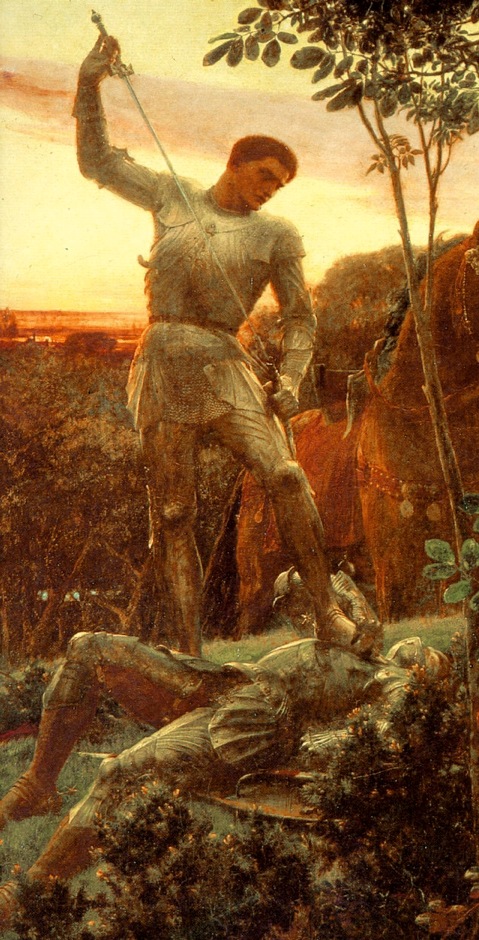
What we came up with that day was a proposal for The Sword of the Silver Dawn. The title was probably Mike’s, and I think I detect an underlying Campbellian framework that will have come from him too. I remember him insisting that the old mentor figure should depart at cockcrow – the first inkling that he might be a ghost. Doubtless more would have been made of that fact later in the series. (Heroes prefer their mentors to be ethereal as it means they’re conveniently available in a crisis, most fantasy worlds lacking mobile phone coverage.)
Galador, the Council of Paladins, Castle Blight – those are classic Oliver Johnson touches. The magic sword is almost certainly Jamie’s. The betrayal of Sussurian (ah, so that’s where I first used that name!) by the champion must have been my idea; I love reversals in unexpected places. The notion of a deeper evil lurking in the castle dungeons, prolonging the curse even when you think you should have triumphed, that again bears Mike’s fingerprints. The actual nature of the final foe as a pure manifestation of hatred and evil I’m sure was Min’s. Always a fan of Leiber’s stories, he particularly liked the Fafhrd and Grey Mouser story “The Cloud of Hate” and later elaborated on the theme in his gamebook The Coils of Hate (soon to be re-released if negotiations work out).
The Sword of the Silver Dawn wouldn’t have been the first gamebook series. Inspired by programmed learning books, the Choose Your Own Adventure series was already going strong by 1983. The American Steve Jackson (of GURPS fame) had extended the concept into role-playing with his Fantasy Trip solo books in the late ‘70s, and of course the UK Steve Jackson and his partner Ian Livingstone had transplanted that variant to high street bookstores with Fighting Fantasy. Joe Dever and Gary Chalk both worked at Games Workshop back then, so Jamie may have got wind that they were planning a series of their own. Nonetheless, Silver Dawn would have been the first ongoing, narrative-driven gamebook with a specific lead character.
It didn’t happen because Jamie and Min got sidetracked by The Talisman of Death, their entry in the Fighting Fantasy series, and then by the Falcon and Way of the Tiger books. Oliver and I were wooed by Philippa Dickinson to write The Lord of Shadow Keep for Fighting Fantasy, but I went off instead to write the Golden Dragon Gamebooks (less money, more control) and Oliver soon joined me there, bringing Shadow Keep with him. And then Dragon Warriors, Blood Sword, and so on.
Perhaps The Sword of the Silver Dawn would have been a bit too generic and D&D-ish to hold our interest over any more than three books, but having found the original proposal just today – a couple of crumpled, typewritten sheets stuffed into one of the Ophis folders – I feel a twinge of regret that we didn’t try our hands at a five-way collaboration. Between us we had the talent to make something truly memorable. Well, that's something I hope we did anyway.