Gamebook store

Showing posts with label Fabled Lands. Show all posts

Friday, 4 September 2026

On the road

Suppose you’re writing a gamebook and you want the player to be able to travel from Wishport to Haggart’s Corner on this map. In its simplest form that would require a section (A) for Wishport, a section describing travel on the road (D) with possible side encounters, and a section (F) for arriving at Haggart’s Corner.

In an open-world gamebook it gets a bit more involved. Now you might be travelling on that same stretch of road either north to Haggart’s Corner, or in the other direction south to Wishport. In Fabled Lands we wanted to have random encounters occur when the player is travelling, so we needed a section (C) to handle those. Each encounter could be an entire side-adventure, though the two in this example are both very short. Once the encounters are resolved, or if you didn’t get an encounter, you’re routed to section D and can decide which way to head. Like this:

A

Wishport is a picturesque town set at the back of a bay rimmed by white cliffs. Fish, oil, dyes and other commodities are packed here for transport inland. You can buy a town house here for 100 Shards. If you decide to do that, cross off the money and put a tick in the box by the town house option below.

[Various options in the town]         …

Leave Wishport                           turn to B                  

B

From Wishport, you have the option to put to sea, take the road to Haggart's Corner, or travel cross-country. In order to go by sea, you must either possess a ship which is docked in the harbour (check the Ship's Manifest) or find a captain who is willing to take you as a passenger.

Go to the harbour                                 turn to ---

Take the road north                              turn to C

Go west towards Metriciens               turn to ---
    Go east into the Magwort Fens           turn to ---

C

The road follows the ridge of low hills extending out into the headland of Knucklebones Point.

Roll two dice for encounters:

Score 2-5         Eerie things                            turn to X

Score 6-8         Uneventful journey              turn to D

Score 9-12       Penniless adventurers          turn to Y


D

You are on the road between Wishport and Haggart's Corner.

Follow the road to Wishport              turn to A

Go north to Haggart's Corner             turn to E

Go due south towards the coast          turn to ---

Go east into the Magwort Fens           turn to ---

E

The town of Haggart's Corner stands at a place where three roads meet. Here, in certain seasons of the year, the trau are said to come and trade their marvellous trinkets in exchange for human favours.

Stop at Haggart's Corner            turn to F

Continue on your journey          turn to G

F

Haggart's Corner is a pretty, pastel-hued town. Houses with high gables and mullioned bay windows are set around a series of courts where fountains splash dreamily in the sunlight.

[Various options in the town]         …

Leave Haggart's Corner              turn to G

G

The fey, sleepy, whimsy-tainted air of Haggart's Corner is soon forgotten as you turn your face to the wind and journey onwards.

Take the road to Metriciens                turn to ---

Head to the Monastery of Molhern    turn to ---

Take the road to Wishport                  turn to C

X

Misshapen sprites with grotesque faces come scampering out of the hedge beside the road. Tittering to themselves, they prod you with gnarled fingers and discuss whether you are worth eating.

`Give us an emerald and we'll let you go,' pipes up one of the sprites.

It seems they will accept a green gem to leave you in peace.

Give them a green gem            turn to D

Make a break for it                      turn to Z

Y

Three penniless wanderers tell you a tale of being washed up on a lonely shoreline. ‘Still, we're determined to make names for ourselves,’ they vow. Their predicament reminds you of your own early career, so you give them a tenth of any cash you have on you (rounding fractions up). Only later, while passing through a village, do you remember seeing their faces on a wanted poster.

Turn to D.

Z

Guffawing, the sprites let you go. You run pell-mell until there's no breath left in you. Only then do you notice that they stole one of your fingers. Lose 1 from THIEVERY (down to a minimum score of 1) and turn to D.


This example is a simple one, but as I said those encounters could be entire quests in their own right. That creates some difficulties. First of all, once the player has dealt with a major quest such as exploring a ruined castle we may not want them to experience it again. One way to deal with that is to put a check box in the first section of the sub-quest – something like this:

Section R is the ‘defused’ version of the encounter – the castle is empty, nothing to see here, back to D. That’s assuming you only want the player to have one crack at exploring the castle. If it’s possible for them to fail – and flee, or die there – then you might need to filter it with a keyword, so that they only go to the defused version of the encounter once they’ve handled it successfully. Incidentally in Vulcanverse, where I needed to stop the keywords from proliferating to an unmanageable degree, I used a structure like this instead:

There you embark on the sub-quest at 306. No matter how many times you come back here, if you haven't successfully completed the quest you'll go to 306. When you do complete the quest you'll be told to turn to 41 and tick the box. Section 476 gives you the spiel for having just completed the quest. Section 734 is for if you return here subsequently. (Incidentally I used a similar mechanic in Can You Brexit? to determine when the player had resolved one of the UK/EU negotiating points.)

The other problem with putting sub-quests on a random encounter table is that the player might just walk back and forth among that same section of road repeatedly until they get the special encounter they want. In Fabled Lands that’s a passage of time issue, similar to the way we don’t want players to make investments at the merchants’ guild and walk back in minutes later to collect a windfall:

Notice those keywords Almanac, Brush and Catalyst. You can only get those by travelling to a distant port. Then when you return you get to roll to see how your investments have been doing:

You could use the same mechanic to prevent the player repeatedly traversing the same stretch of road to get that lucky encounter roll. Just mark the encounter as only happening if the player has the keyword Afar or whatever, and remove Afar after they’ve been along the road – so then they’ll have to voyage off to Sokara in book one to collect Afar again.

It’s not ideal, because it’s contrived. We’re trying to represent passage of time, which a paper gamebook obviously can’t do directly, so we say that if you’ve visited a distant location, which we can keep tabs on, then time must have passed. But the player is bound to wonder why going to a specific location in book one arbitrarily unlocks an unrelated quest opportunity in book two. It breaks suspension of disbelief.

If you can think of a better solution, I’m all ears.

Friday, 10 July 2026

Books that you explore

I'm not sure about the term "ergodic" literature. It's derived from ergon (= work) + hodos (= path) and supposedly refers to a book for which "nontrivial effort is required for the reader to traverse the text". But that's true of a lot of academic textbooks and some novels. I'd certainly have to exert nontrivial effort to make it through a Lee Child or Harlan Coben book. Ergodicity already had a meaning before it was appropriated for tricky books, and it doesn't help anyone if terms end up with multiple meanings (see also: confabulate) so, if we're looking for a fancy-sounding term for gamebooks and other lean-forward texts what about polyhodal?

Whatever term we use, "Lost in the Labyrinth" on the Beautiful Books website provides a very comprehensive guide to such books, from Italo Calvino's If on a Winter's Night a Traveler to Edward Powys Mathers' Cain's Jawbone by way of Choose Your Own Adventure, Fabled Lands, and even Tristram Shandy. There are titles here I'd never heard of, presented in a form that's an exploration in itself. Set off (no need for a map) and see where the journey takes you.

In related news, Riccardo Scaringi, host of the podcast Il Gioco in Tavolo, has just released a book of interviews with such gaming stalwarts as Ken St. Andre, Sandy Petersen, Kenneth Hite, and Shane Hensley. I'm in there too. Narrative at the Crossroads is on sale now.

Also on the subject of gamebooks, Paul Gresty was writing the eighth Fabled Lands book, The Lone & Level Sands, but had to abandon it because of other commitments. That was a shame, The Serpent King's Domain being regarded as perhaps the best in the series, but the good news is that Paul handed over around 750 finished sections. By the standards of most books that's almost finished. We're now looking at bringing in writers to help complete it. The book should eventually round out around 900 sections and will hopefully be the basis of new add-on content for the Prime Games CRPG. To whet your interest, here's the flowchart.


Friday, 22 May 2026

Pit stop

In the library you find the first volume of How to Enter the Underworld. This book is the work of a man called Agrash the Explorer. You learn that the Underworld is the name for the shadowy realm of the creatures like the trau, and of demons and the dead – in short, Hell itself. It has many names: the Land of Roots, the Place of Direful Dreams, the Land Beyond the Dark Mirror, and suchlike. There are several ways in. There is rumoured to be a stairway to the underworld on the other side of the Peaks at the Edge of the World, far to the north. Sailors say you can sail into the underworld through the cave known as the Mouth of Harkun, north of Yarimura. The monks of Noboro monastery claim you can walk into the underworld from Akatsurai, simply by always heading in a north-easterly direction. Scholars of Dweomer claim an entrance lies at the very top of the peak on Starspike Island. Also, the tunnels of the trau are thought to lead inexorably downward into the Realm of Shadows. The end of the book refers to volume two in the series, entitled How to Get Out of the Underworld. You ask one of the archivists if this book is in the library, but he tells you it never got written. ‘Agrash the Explorer never came back to finish it.’

Can we still talk about spoilers for a book that’s been in the publishing equivalent of limbo for thirty years? Into the Underworld was to be the last book in the Fabled Lands series – or maybe the next-to-last, if the whispers about a thirteenth book could be believed.

Throughout the Fabled Lands series, there are plenty of ways for a doomed or daring adventurer to find their way into book 12. You might have had a character stranded there for years, so arguably book 12 is more of a priority than books 8-11, which would wrap up some quests from other books but are otherwise just expansion packs to extend the places you can journey to.

Here are those routes into the underworld. Look away now if you still have hopes of FL book 12 appearing eventually.

Book 2: Cities of Gold and Glory

You can be carried off to the underworld by the Trau:

Book 3: Over the Blood-Dark Sea

You could be lured to the underworld by succumbing to the mermaids’ song:

You might suffer some bad luck while failing to repel a pack of hellions: 

You might descend into a hole among the roots of a tree in the Bluewood on Braelak Isle:

Or climb down inside the hollow mountain on Starspike Island:

Or choose (perhaps unwisely) to dive down to a submerged city:

Book 4: The Plains of Howling Darkness

You can get to the underworld by sailing your ship into the treacherous cave known as the Mouth of Harkun:

Being sucked down by a gigantic whirlpool:

Being hauled into a tunnel by a hairy demon:

Boarding the silver barge at the celestial harbour:

Rapping on a stone slab in the side of a cliff if you aren’t sufficiently sanctified:


Book 6: Lords of the Rising Sun

If you take a misty road heading north-east from Noboro monastery you can walk into the underworld:

And another route is via a nexus of mysterious pathways that would make Einstein and Rosen tear up their maps:

Book 7: The Serpent King's Domain

It’s possible to get yourself teleported to the underworld by the capricious monkey god Shimae:

Fabled Lands Quests: The Castle of Lost Souls

Guided by a pair of enchanted boots, your character is led past the Haunted Hills and through a foul swamp known as the Sodden Blight, eventually descending under a vast ceiling of rock into the underworld. Here you must cross an immense, ashen plain illuminated by an unnatural orange light to reach your destination, the Castle of Lost Souls, fortress of the demon Slank. While navigating the underworld, there are specific environmental rules you must follow:
  1. You must have a source of illumination such as a lantern to travel through the dark caverns
  2. The oppressive nature of the realm means you must temporarily subtract 2 from your COMBAT score, although this penalty is negated once you actually step inside the Castle of Lost Souls
If you fail in your quest -- for instance, if the magic of your infernal boots fades before you can find Slank's castle -- you are given the option to remain in the underworld. If you have Book 12, you wander aimlessly across the ashen plain until you pass through a tunnel and see a "curious city" looming ahead. At this point, you turn to paragraph 689 of Into the Underworld -- the same place as the monkey god sent you in Book 7.


There's also a scene in The Plains of Howling Darkness (FL book 4) where you might get the opportunity to visit the halls of the death-god Nagil --and, even more importantly, the opportunity to leave again. That's presumably located somewhere in the underworld, though there's no obvious route directly into book 12.

What would the FL underworld be like? Perhaps taking a cue from Dante, I envisage it as existing on multiple levels, so your exploration would be more three-dimensional than in other regions of the Fabled Lands. Also, both Jamie and I have used underworlds in previous gamebooks: Sheol in Doomwalk, the fourth Blood Sword book, and Hades in The Houses of the Dead, the first in the Vulcanverse series. For Into the Underworld we'd have to tap a fresh vein of inspiration -- perhaps drawing on our Tekumel games, or going back to the Hippocrene springs that fed them such as Clark Ashton Smith and H.P. Lovecraft.

Saturday, 27 December 2025

Mapping the FL universe

Isn't this a thing of beauty? What is it, you ask? It's a map of all the connections in the seven Fabled Lands books. I don't know who created it, but I'd like to thank them for making the effort. The end result looks a little bit like a map of the actual universe, though naturally that has around a sextillion times as many nodes. You can view the source files (for the FL map, not the universe) here. And now I'm wondering what the Vulcanverse connections map would look like...

Thursday, 27 November 2025

Hear ye

A quick note to let you know that the Fabled Lands CRPG expands today to include The Castle of Lost Souls, as revised and expanded by Paul Gresty. Read more about it here.

And the Dealing With Demons chapbook is free on Kindle till tomorrow. Get your copy here.

Tomorrow: Dragon Warriors goes east, with converted Tetsubo rules for hungry ghosts and dream eaters. See you then.

Thursday, 16 October 2025

A toolkit for open-world gamebook design

The earliest true gamebook (with rules, that is, and disregarding mere multiple-choice texts) was probably Steve Jackson's Death Test in 1978. That allowed players to backtrack and visit the same location multiple times, but throughout the 1980s the main evolution of gamebooks detoured down a different branch with series like Fighting Fantasy, where the arrow of narrative time pointed in one direction. It wasn't until 1995 that the first open-world gamebooks appeared -- followed by silence until, decades later, series like Steam Highwayman and Legendary Kingdoms took up the torch. Finally it seems that open-world gamebooks might be becoming the dominant form.

I have been sent a succinct and comprehensive toolkit for open-world design that would-be gamebook writers will find very useful. Not just would-be writers, either; I've been doing this since the last millennium and even I found it had some handy tips. You can find that toolkit here. The author prefers to be known only as Ruth, so I will respect her anonymity, though it can only be a matter of time before her own open-world gamebook series appears.

In the Vulcanverse books, when I used what Ruth calls Local Changes, typically I'd include another entry:

So you’d arrive at the location and be presented with the situation that could lead to a change. If you complete that correctly you’re told to turn to the original location and tick the box. Then you get a one-off scene that explains the change and assigns any relevant keywords. If you return to the location subsequently you go to X*A which is the location in its changed state.

Regarding keywords, it’s worth differentiating (and incidentally I say this with 20/20 hindsight) between keywords used as logic flags to denote that an event occurred (“a tidal wave hit the city”) and keywords used to indicate a current state (“the city is in ruins”). In Vulcanverse I could have used keywords and titles respectively for those two functions. I didn’t, which meant that sometimes I’d remove a keyword that was no longer applicable, only to realize later that I’d still like to know if the player had originally had that keyword. Eg if I complete a quest for the king and so he makes me the court champion, even if later on I lose the court champion keyword I still need to have the keyword that says I did the quest. (I'll discuss flags and states in more detail in a future post.)

Regarding rules mechanics generally, I keep promising that next time I’ll create an object-oriented rule set so that I could keep track of, say:

  • having one’s face stolen by a mujina
  • getting cursed by a fairy to have a donkey’s head
  • acquiring blue skin
  • being body-swapped into another form

Variously those conditions could mean:

  • You’re not recognized by somebody who should know you
  • You’re mistaken for someone else
  • You are treated differently from other people (potentially in several different ways)

In Fabled Lands I ended up filtering for all those statuses every time I asked the player to check them, whereas if they had been properly organized I could simply have asked, “If you have a status that is listed as transformative and uncanny, go to X”.

Similarly with equipment, where it is useful to have a generic way of identifying whether something can be used as a weapon, or has a blade, or reflects like a mirror, or is made of iron, and so on – rather than having to list the items for each applicable function (such as “if you have the polished shield, the silver mirror, the jade looking-glass…”). Ruth's Multi-Function Item tool covers that one, and could be extended to keywords describing the character’s current status to solve problems like the altered-face one above.

Vulcanverse also used the Current Location feature, a box on your adventure sheet where you record a section number that you are routed to after the current subquest you're on is complete. This allows for encounters to happen at different points around the world, for instance when you're acting as go-between carrying love tokens from Eros to Psyche in The Hammer of the Sun. The Current Location can be used for a lot of things, a common example being when you have a wandering NPC whom the player has to meet up with from time to time, because the different stages of the player's dealings with the NPC don't have to be tied to the geography of the world. You just tell the player to record a Current Location number when the subquest is triggered, then when the next part of their interaction with the NPC (or whatever) is done, you send them back to the Current Location and they resume their travels.

I was going to compile a list of gamebook design resources, but they are many and scattered far and wide. Here are a few to get started. If you know of any others, link to them in the comments.


And while we're on the subject of gamebooks, the Blood Sword 5e hardcover book has just been released in the UK and US. You can buy it at Orc's Nest or from GMS Tabletop Games. The book is a complete 5e roleplaying campaign based on the gamebooks and features some absolutely top-notch design, writing, artwork and production. If you're starting to think about Christmas presents, it's the perfect gift for the avid gamer in your life. Just be aware: they're going to need a bigger stocking.

Friday, 11 April 2025

Roots & Claws

One for the diehard Fabled Lands players this week, as I came across the original titles that Jamie and I were considering for the later books in the series. We must have drawn up this list right after writing FL books 1 and 2. The books up for discussion, clockwise from top left, later became known as Over the Blood-Dark Sea (book 3), The Serpent King's Domain (book 7), The Plains of Howling Darkness (book 4) and The Legions of the Labyrinth (book 10, still unpublished).

I've already recounted our struggles to get the publisher to accept Devils & Howling Darkness as the title of book 4, but WH Smith's were worried that any mention of devils might scandalize fundamentalist religious groups. Jamie and I didn't think they'd buy the FL books anyway, but we argued the point in vain.

The notes refer to our editor, Ian Marsh, who also helmed the Virtual Reality gamebook series. I believe he also digitally typeset the books, though I don't suppose the publishers paid him anything extra for doing that.

My biggest regret here (other than the book 4 title) was not being able to use The Blood-Dimmed Tide for book 3. Jamie and I are both fans of Yeats, as you will have noticed if you read The Chronicles of the Magi novellas -- but there I had to pay out of my own pocket to use the poem, because Yeats's work didn't enter public domain till 2009, and we'd have hit the same problem with FL book 3. So we borrowed a line from Homer instead (oînops póntos) and took liberties with it: haîmops póntos, I suppose it would be, "the blood-eyed sea". Given that the book takes place on the Violet Ocean, maybe wine-coloured would have been a better fit.

Thursday, 30 May 2024

Snake charmer

Big news for Fabled Lands fans: Prime Games have released of the expansion pack for The Serpent King's Domain. Paul Gresty's expansive and ingeniously plotted adventure is now available for players of the FL CRPG. The new DLC includes 180 new items, 34 new achievements, a huge expansion to the explorable world, along with the following:

  • 17 new quests
  • 4 new titles 
  • 48 new enemies
  • 6 new music tracks

There's also new markets, new weapons, new rules (including heat penalties for heavy armour in the jungle), new kinds of blessing and much more. Don't take my word for it -- all the details are here.

Friday, 29 March 2024

Maps of the mind

Martin Noutch, author of the wonderful Steam Highwayman books, is a true scholar of the craft of gamebook writing. One of the reasons his own books are so good might be because he has thoroughly analyzed the works of other writers in the field. The shoulders of giants and all that.

So that you can benefit from his studies too, Martin recently posted his story maps of the Fabled Lands books. Looking at those prompted me to dig out some of the maps I used to plan the books. Astonished that I still have this stuff after 30 years? I'm working on that hoarding obsession.


Trust me when I say that you haven't seen the full possibility of storytelling married to open world gamebooks until you've played the Steam Highwayman series.


And if you like the idea of steam-powered vehicles and picaresque adventures in an early 19th century setting (or style thereof), I recommend Keith Roberts' seminal SF novel Pavane. (It is SF, incidentally, and not steampunk, which is really a branch of fantasy because physics, but I don't want to give any spoilers. Read it and see.)
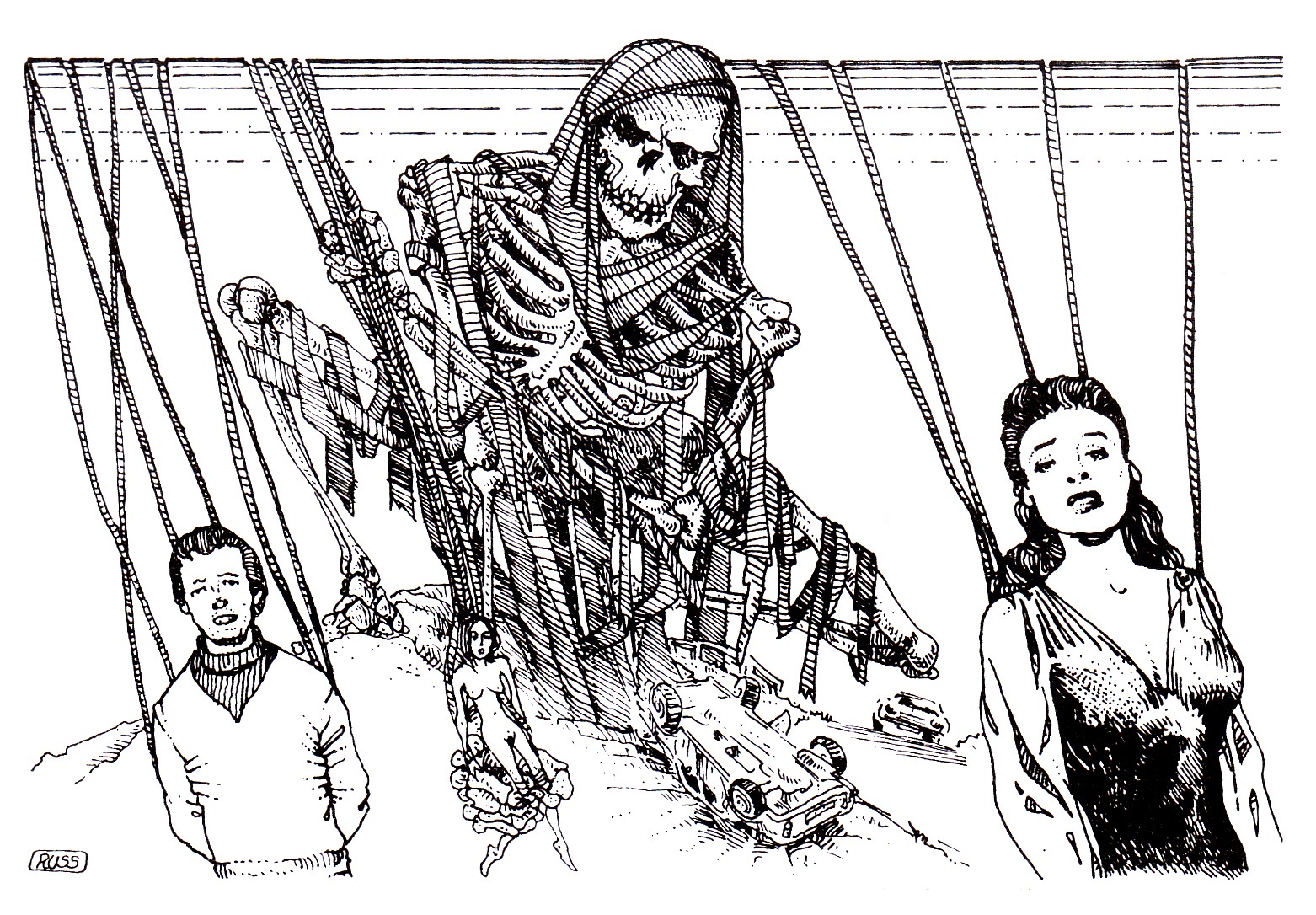
Friday, 1 September 2023

The Hole in the World

A few months ago we were looking at some of Russ Nicholson's magnificent oeuvre and Jamie mentioned how one of the iconic features of the Fabled Lands came about:

"Russ was doing a map and blotted it by accident. Me and Dave immediately came up with 'The Hole in the World' so it looked like it was deliberate."

That came about because Russ drew the first ever tidied-up version of our world map. For some reason the publishers didn't want to hire him to draw the world map for the books, but they finally gave way and admitted his map was much better than the one they commissioned. Naturally.

Russ needed to draw the whole world first because he was doing all the regional maps and wanted to be consistent about how they looked. Jamie and I used Russ's sketch map for planning all the books. That's why the copy below is covered with our annotations.

Friday, 26 May 2023

He showed us marvels

It’s impossible to imagine the Fabled Lands without the involvement of Russ Nicholson, who died this month. His filler drawings are my favourites, little vignettes necessary for gamebook layout so that options don’t spill over a page, but also perfect for evoking the ambience of each book’s setting. He always put something extra into all the pictures: comic book style inserts, fragments of unknown scripts, characterful onlookers in the background of a scene, a thousand touches that convey personality, colour, humour and reality.

For some reason we had a struggle getting the Pan Macmillan art director to let us use Russ for the world maps. They had a different illustrator lined up but, as you can see by comparing the first four FL books with the last three, Russ’s cartography was streets (and forests, and mountains) ahead. In FL book 3 they printed the two halves of their map the wrong way round, at which point they admitted that maybe we’d been right all along and Russ should handle it.

I put a personal tribute to Russ on my Patreon page (unlocked) and I asked other members of the Fabled Lands team to contribute their memories. Here’s Paul Gresty:

“I first met Russ in 2010, when I was his interpreter at a gaming event in Paris. He’d illustrated many, many books that I owned and loved, and I was incredibly excited to spend a weekend with him. Throughout that event, Russ was interesting, and kind, and humble; whenever a fan of his work asked him to sign a book, Russ also took the time to draw an illustration in there, too.

“At some point that weekend I asked Russ if he’d sign a copy of Citadel of Chaos for me. I was expecting a signature, and perhaps a quick sketch. Instead, Russ took the book back to his hotel room so that he could spend some time on a picture. When he returned the book to me the next day he’d drawn a phenomenal illustration (an axe-wielding warrior and a dragon) right across the book’s copyright and title pages – and he actually apologised that it wasn’t as good as he’d hoped. The paper in the book wasn’t ideal for ink drawing, he explained; the ink had bled on the page a little. I guess that’s an artist term. Bleeding ink or not, I was overjoyed with the illustration.

“I’m happy and grateful that I was able to work with Russ after that, and to meet him in person a few more times. He was a creative powerhouse, and a joy to be around. Incidentally, it was Russ who introduced me to the Fabled Lands books, showing me a book that somebody had brought for him to sign. He (correctly) told me I’d enjoy reading them.”

Jamie Thomson adds:

“A sad loss indeed, both personally and professionally. I remember meeting him in our White Dwarf offices a few times way back when, just a nice guy and so talented. Iconic game book and WD illustrator. I guess the ink blot story is my favourite. He was doing a Fabled Lands map and blotted it by accident. Me and Dave immediately came up with 'The Hole in the World' so it looked like it was deliberate. Well, I think we did, maybe it was Dave or Russ that came up with it, I can't remember. Anyway, there were quite a few things that we added to the stories and the lore that came from Russ; he inspired us too.”

At first I wasn't sure about Jamie’s recollection there because Russ's world map for FL didn't appear in print until books 5 and 6, so how come he drew the Hole in the World before anyone else? It's probable that he drew his own version of the world map right from the outset in order to have a context for the regional maps in each book. It's typical of Russ's boundless enthusiasm for and professional pride in his work that he'd do that even without a commission from the publisher. He improved every idea we gave him. He was our Jack Kirby, our Billy Preston, the Eno to our Roxy Music. As film directors value a great cinematographer, we valued Russ – as a good friend as well as a collaborator. He won’t just be missed, he’s irreplaceable.

He leaves behind his partner Jacqui. His wife, I should say, as they had planned to get married while Russ was in hospital, only he got moved to another ward which couldn’t accommodate a bedside ceremony. Had he come home I’ve no doubt they would have had the wedding then, but sadly he died in hospital. Fans will remember him fondly, friends with love, but the real wrenching loss is Jacqui’s.

However, as long as we have Russ’s art we can still see the expression of his personality. In that sense he’s with us always. Here is a small selection of illustrations by him that you might not have come across before.

This from the summer 1978 issue of Fantasy Tales:

This from A Dying Trade:


A sample page Russ did for The DFC:

Two more sample pages for The DFC, this time for the John Blake strip:


A test page for Mirabilis, because in the early days we thought Leo and Martin would be too busy on the gazetteer book to handle the comic strip chores as well:

Layout page for “Rich and Strange”, one of several Mirabilis standalone stories I wrote to run in The Guardian newspaper:

(Only one story, “A Wrong Turning”, was ever fully illustrated, and that by Martin McKenna whose loss we also mourn.)

Part of the layouts for the Camelot Eclipsed comic book (originally The New Knights of Camelot):

Some concept art for Shadow King:


A rough that Russ prepared for A Town Through Time, a project we pitched without success to publishers in the late ‘90s:


You can see how much on-spec work an artist has to produce in order to nab a few paying gigs. And this is just the tip of the iceberg. Here's another -- Russ's drawings for the Conquerors game.