Gamebook store

Showing posts with label Magnum Opus Press. Show all posts

Friday, 11 August 2017

Another look at Dragon Warriors


I recently cracked open the beautiful hardback edition of Dragon Warriors produced by James Wallis’s Magnum Opus Press. As a matter of fact there are some copies on sale on DriveThruRPG at the moment – not at all cheap compared to the fiver my Tirikelu rules will set you back, but definitely worth it.

In the preface I talked a bit about my and Oliver Johnson’s thinking when designing the game:
“Our aim was to put something dark, spooky and magical back into fantasy role-playing. Loathing the medieval Disneyland of Dungeons & Dragons, with its theme park taverns, comedy dwarves, and cannon-fodder profusion of monsters, we made Legend as vividly dreamlike as the Middle Ages seem in stories, a place dripping with a European folktale sensibility. The flavor of what fantasy ought to be.

“In Legend, faerie creatures are as amoral as cats and as heartless as children. A goblin in the rafters can spoil a whole night’s sleep, while a troll under the bridge ahead is reason to change your travel plans. And these creatures are rare. Walking into a tavern in Legend and finding an elf at the bar would be like strolling into your real-life local and seeing a polar bear.

“In the world of Dragon Warriors, human emotion is just as strong as magic. The scenario ‘A Box of Old Bones’ makes it clear that the miracles associated with holy relics are sufficiently rare and vaguely manifested that a fake relic can go unnoticed for years, getting by on the strength of its placebo effect and the willingness of clergy and believers to collude in seeing evidence where they want to see it. Our rule was never to evoke magic if a non-supernatural plot point would do.”
It’s nice to see old work you did getting some love. Normally when that happens people are heaping praise on the land of Legend. The Dragon Warriors rules themselves get overlooked, even by me. (Especially by me, in fact, since I’m forever kicking myself for not listening to Oliver when he said we should dispense with the polyhedral dice.) But then I came across this in-depth review by Charles Akins in which it’s the DW system as much as the world that grabs him. If I ever get around to finishing Jewelspider for publication it’s going to have a new D6-driven system, but Mr Akins’ comments still give me a warm glow inside. As does this mini-review on Legacy Game Mastering:


And if you should feel like a return to the lands of Legend, Serpent King Games have made the core Dragon Warriors rulebook available free as a PDF until the end of this month. That's better than a dragon spitting in your eye. (Although I should add that in all my time in Legend, the nearest we've yet got to a dragon is hearing an ominous slithering in a ditch in the forest one time. Gotta love that low fantasy.)

Friday, 14 October 2016

The unquiet grave

Here's one I did earlier - thirty-two years earlier, as a matter of fact, in the July 1984 issue of White Dwarf. I used to write so much of the magazine in those days that I had to use pseudonyms or the contents page would have looked a bit repetitive. This piece appeared originally under the nom-de-plume 'Phil Holmes'; Phil because I was and am a huge admirer of Professor Barker, and Holmes because of the detective.

*  *  *
Lost on the barren moors of north of the Hourla Hills after nightfall, you have little hope of surviving to see another dawn. You have trudged through the freezing mud for hours but finally you stumble and sink to your knees, your iron will no longer a match for your weariness. You bow your head and compose yourself to meet your god. Your only regret is that you did not die in battle.

Through the closing haze of darkness you seem to see a light, and dully you turn your head to watch it approach. An old man stands before you holding a lantern aloft. When, in later years, you think back to this moment it seems that you recall vividly the look of quiet strength in his grey eyes, and the sound of his cloak as the gale snaps it around his frail body.

Beckoning you to follow, he turns and walks away. Somehow you find the strength to rise and stagger after him. Holding the bobbing lantern up to guide you, he leads the way to a small cottage where a welcoming light shines from latticed windows. A few more steps would take you to the cottage door, but your fatigue is too much and you pass out. Barely conscious, you sense yourself being lifted up and carried towards the cottage. As in a dream, you abstractly wonder at the strength in the old man’s arms. He takes you inside and lays you on a pallet beside the fire. Your last recollection is of thick fur blankets being drawn up around you.

It is noon before you awaken. At first you remember little, but as fragments and tatters of memory return from the previous night you are amazed to find yourself in a dusty, derelict cottage. There is no sign of your rescuer and there does not seem to have been a fire in the grate in the recent past. Outside, the bleak landscape lies bathed in cold, winter sunshine. You see smoke rising from beyond a wooded hill and head in that direction.

An hour’s walk brings you to the village of Hobvale where you quickly seek out an inn and treat yourself to an ample and warming repast. Then, sitting by the fire with a cup of mulled wine in your hand, you relate the events of the previous night to the innkeeper.

‘An extraordinary tale,’ he says, ‘but one which I have in fact heard once or twice before from other travellers like yourself. Some years ago an old monk called Alaric lived in a hermitage out on the moors. Anyone who came to his door would receive shelter, and he often went out with his lantern when a sudden storm or blizzard might have caught wayfarers unawares.’

‘Why, then, clearly this was he.’ You are on your feet at once. ‘Come man, I am no churl. Tell me where he lives now and I shall go to thank this monk and reward him for his kindness.’

The innkeeper shakes his head and waves you back to your chair. ‘Hah! I cannot think you would care to undertake the journey. He took in a stricken traveller some ten years past and then died himself when he braved the storm to fetch the man a doctor. He is buried up there on the moor.’
For thousands of years people have enjoyed ghost stories. A dip into the folklore and literature of any country will uncover dozens of variations on the theme. Unfortunately this rich vein of imaginative material is all too often reduced to absurdity by the need to frame everything in simple game-terms. How impoverished and inadequate the modern horrors of adventure gaming can seem when compared to the originals from which they were derived (Grendel, Dracula, the Green Knight, the Balrog, et al.)

The problem in part comes from trying to define things exactly, for this can also limit them. It would be very difficult to create anything like the story of Macbeth in a standard adventure, say. Banquo’s ghost would either have to be a genuine Dragon Warriors ghost with a 1d12 Fright Attack, or a figment of Macbeth’s guilt-ridden imagination, which could be established if the PCs have some way of detecting spirits or the undead when the ghost next shows. Storytelling allows ambiguity whereas games enforce the leaden certainty of binary logic.

I am not suggesting that creatures should not be defined at all in game-terms. But there should certainly be a shift away from a rules-and-stats approach which makes it all too easy to roll hosts of uninspired random encounters. There must be a sense of (and fear of ) the unknown when encountering fantastic creatures, particularly ghosts and undead. Player-characters should not think of such things as standard, nor should they ever feel that they or anyone else in the world knows very much about them.

To help deal with the problem, here is a new term for referees to use: revenant. A revenant is anyone who returns from the dead—whether in physical form, as an apparition, or as an ambiguous and undefined combination of the two. There is no one set of stats for all revenants, because they are not all of one nature; some you can fight, some you can banish with magic, but many can only be dealt with by discovering their particular weaknesses.

Alaric’s revenant could be thought of as a sort of ‘psychic residue’. It could not harm a character, nor be harmed. It could not be pigeonholed as a standard Dragon Warriors ghost, because it was not a conscious and reasoning entity, it was a part of this honourable man which did not fade from the world when his body died and his soul passed on. Revenants like this will appear in scenarios as a means of giving the characters clues to past events, assisting them, hindering endangering them or simply to create an eerie effect.

Revenants may be brought into existence when a person dies as a result of gross injustice, or with a task or duty still to complete. This is the nebulous and inconstant magic of the human psyche, there is no ‘Create Revenant’ spell!

If you left a companion to die then his revenant might pursue you with a view to evening up the score. Maybe he can only be laid to rest if you go back, find his body and give it a decent burial. Or maybe you will have to fight the revenant because it will only be satisfied by your death. Possibly the revenant will depart if you can merely fool it into thinking you are dead. Scenarios involving a revenant will thus often revolve around finding out what it wants and then accomplishing this with minimal unpleasantness to yourself!

Revenants are a useful way of keeping powerful PCs on their toes. The characters might be able to defeat ghosts and spectres with their hands tied behind them, but they will just have to rely on their wits when facing a revenant which inconveniently ignores all the usual tricks for dealing with undead.

Any powers that a revenant possesses should be counterbalanced by specific vulnerabilities. These could relate to the way the revenant arose, so if a person died in a fire, his her revenant could manifest itself in a form mutilated by horrible burns, becoming able to utilise flame-related attacks and being driven away with water.

When you’re devising a revenant, start by deciding on its ‘life’ history and how you’re going to bring it into the scenario, and only then work out its stats and powers (if any)—let your imagination take the lead and make the rules run to catch up!

Second, take great care in the way you play a revenant. Supposing you have a revenant which wants a character dead. It might make repeated attacks night after night, but it would not plan its attacks as would a human assassin. Revenants are isolated fragments of a psyche, and they lose their qualities of awe and strangeness if made to act like rational living beings.

Scenario Outlines

The High Priest of Nebr’volent
After discovering the pyramid of a wealthy dignitary of Ancient Kaikuhuru in Opalar, a high priest in times long past, the characters return home with a fortune in tomb treasures. Shortly afterwards, a succession of deaths among the NPCs who accompanied them alerts the player characters to the danger they are in. The next night, one of the PCs is visited in a dream by the high priest’s revenant. In the dream, the character finds himself running, parched and weary, across the desert sands. In the moonlight, he sees an oasis and heads for it. As he cups his hands to drink, however, his relief turns to dread—for reflected in the water he sees a terrible apparition standing behind him. It is the mummified corpse of the ancient, dressed in its priestly finery. It reaches for him with clawlike hands but he cannot move or turn to defend himself. The water in his hands turns to dust and he awakes in a cold sweat. The dream recurs every night, and each morning the character finds he is getting weaker. (In game terms, he is losing a Health Point every four nights.)

Consulting local sages, the player characters are told by the most well-read sorcerers and exorcists that someone must sit with the character while he sleeps and cast Hold Off The Dead the moment that it seems the dream is beginning. This course proves partially effective—it drives back the revenant until the next time the character goes to sleep—but the sorcerers are charging a great deal each time they are called on to cast the spell....

The other PCs probably realise it is their turn once the haunted character is dead, so they do everything possible to keep him alive.

In desperation, and after a gentle hint from the referee by way of local lore, the character goes down to the docks and seeks out a notorious sorcerer who lives there. This fellow consults his books, charts and astrological devices and then explains that the tomb was cursed. He tells the character that he has only one hope (choose the solution which fits best into your campaign):

1. (For long-term campaigns) The characters must gather together the priestly regalia they stole and return it to the tomb. The problems arising from this are that they possibly do not have enough cash to buy back some of the items, or a collector who bought one of the items refuses to part with it. Once they manage to get back all of the items and set off for the tomb, the haunted character loses no more Health Points—but he doesn’t recover the Health Points he’s already lost until all the items are safely back and the tomb sealed.

2. (For episodic campaigns) The sorcerer knows of a way to help the character fight back: he must go to sleep clutching a pile of salt in his left hand and an antique jade shortsword (provided by the sorcerer) tied to his right with a silk cord. When the revenant appears behind him in his dream he is able to throw the salt up into its face and then, with its gaze momentarily averted from the pool, he is freed from his paralysis and able to turn and fight it. This is a straight ‘physical’ battle; no spells can be used. The character and the revenant are closely matched, and neither has armour. The revenant wields a mace of mauve stone, so the character has an advantage in that his weapon can impale – and because of the silk cord he cannot lose his grip on it. If he defeats the revenant, he wakes to find he is back to full health. If he doesn’t defeat it then he never wakes up, and the next PC will have to pay the sorcerer for his services.

A Noble Knight
This is intended as a sub-plot to run alongside whatever main adventure the characters are on at the time. A number of strange events occur over a period of several days—e.g. a golden hawk leading the characters to a companion who has fallen in the hills and broken his leg, a lion which silently approaches when they are lost in the mountains at night and guides them to safety. Mention enough of these that the player-characters have a sense of something significant in the offing, but keep them busy enough with the main adventure that they don’t have time to analyse it all.

Eventually, while traversing a mountain pass, they are ambushed by bandits. Things look bad for a while until the sudden intervention of an armoured knight on horseback saves the day. The knight turns out to be an uncommunicative sort, though he does reveal his name (Helvelas) and seems very pious. He walks with a slight limp. At the next town the characters lose him, but he meets up with them when they continue their trek into the mountains in search of whatever tomb or treasure trove they are after. Helvelas accompanies them when they enter a cavern complex infested with monsters, and several times steps into melee to save a character’s life as the party fights on towards its objective.

Finally, after a pitched battle in the main cavern chamber, the characters look around to find Helvelas gone. But while gathering the treasure, they discover the corpse of a knight in the shadows under a shelf of rock to one side of the cave. Mystics with the party can tell that he died of a wasting infection— probably caught from the monsters when they took him prisoner. His left leg was broken. Although his armour was rusted over the years, the characters can still recognise the heraldic design on the breastplate. A golden eagle on a red sun—Helvelas’s coat of arms. His revenant has helped the adventurers reach his body so that they can administer the proper funeral rites.

Recommended sources
Films: The Fog; The Life and Times of Judge Roy Bean; High Plains Drifter; Rashomon; Don Giovanni.
Books: Ghost Stories of an Antiquary by M R James; Dracula by Bram Stoker; British Folktales and Legends by K Briggs; The Room in the Tower by E F Benson; The Bull and the Spear by Michael Moorcock

Not all of these are strictly concerned with revenants, but they are valuable as inspirational material.This article is also available in Magnum Opus's beautifully produced supplement In From The Cold - but good luck finding a copy of that.

Tuesday, 31 March 2015

Memories stolen by a dragon's breath

"Enter a world of magic, folklore and danger. Here, superstition covers people’s lives like autumn mists cover the moors, and terrifying monsters with bizarre powers lurk in the shadows. The king is a weakling, barons scheme against each other, and lordless knights, back from the Crusades without the honour or riches they were promised, roam the countryside in search of adventure, or prey. Ruined castles and burial mounds are the lairs of the supernatural, or newer, more sinister masters. Labyrinthine underworlds lie forgotten below ancient temples and city cellars. The dark places of the world hold riches for those who would search for them, and the keys to great power - or death"
My world, but not my words. That's James Wallis's evocative description of Legend, the setting for the Dragon Warriors RPG.Through his Magnum Opus imprint, James reintroduced the dank, gnarled, cobwebby, and generally eldritch landscapes of Legend to tabletops across the world.

Those Magnum Opus books were beautiful volumes and they have pride of place on the shelf beside my desk. Nowadays you can only get the game in PDF form, sadly - but hie yourself over to Lulu and you can print up a hard copy at a very reasonable price.

But I digress. Legend is characterized by its dark and downbeat tone. Adventurers here are more Gangs of New York than The Iliad. There is magic, but it's rare and capricious and nobody quite trusts it - not even the sorcerers. If you've ever seen Robin of Sherwood, you'll know what I'm talking about. So now try this:
"Icy fogs hung over rivers and marshes, serving all too well the ogres that were then still native to this land. The people who lived nearby... might well have feared these creatures, whose panting breaths could be heard long before their deformed figures emerged from the mist."
Legend? No, this is the undefined but vaguely Dark Ages environment created by Kazuo Ishiguro for his novel The Buried Giant. I bruised and battered it somewhat in my review on the Mirabilis blog, though no worse a drubbing than it got from Tim Martin in The Telegraph. Nonetheless, if you like your fantasy with a tang of melancholy then you should take a look. And the encounter with the pixies who seem like skinned rabbits and sound "like children playing in the distance" as they attack - now that's as sinister a scene as any I've encountered while role-playing in Legend.

Monday, 10 December 2012

A Ballad of Times Past - part one

Among the beautifully produced and re-edited Dragon Warriors releases from Magnum Opus Press a few years back, you may not have noticed In From the Cold, an anthology of White Dwarf scenarios by me, Oliver Johnson and Mike Polling. The book is currently out-of-print (really, that can still happen even in 2012 – I was amazed too) but hopefully it’s only popped out into the snow to relieve itself and will soon be stomping back over to the fireside and ordering ales all round, courtesy of Serpent King Games, who inherited the DW publishing licence from the éminence grise of British gaming, James Wallis. In the meantime, somebody styling himself the Dark Cavalier has become the self-appointed “publisher” and is offering it to anybody who cares to risk a download from his site. (Cheers, Cav; hope I get the chance to nick your Blu-ray player and laptop some time.)

Still, while not necessarily subscribing to the cause espoused by the brethren of the coast, I can see that, at this time of year, yes, content does want to be free. And in that spirit – and incidentally as a roundhead, not a cavalier – in the run-up to Yule I’m serializing “A Ballad of Times Past”, a seasonal standalone scenario in a world with very little magic. Today we’ve got the background and cast of principal NPCs, then the adventure itself in three instalments over the next nine days, giving you plenty of time to arrange a solstitial RPG session.

The adventure is set in Beorsca, a small kingdom in a land very much like Dark Ages Scandinavia. The practitioners of magic are even scarcer in this world than in Legend: all sorcerer, elementalist, warlock and demonologist spells above 2nd level require, as the material component, a pinch of dragon dust made from the powdered shell of an unhatched dragon’s egg (in hatching, the fledgling drains the magic from the shell). As obtaining dust would involve getting past a protective mother dragon, magic is very rare. One whole eggshell would provide one hundred pinches of dust.

Players should be told that spellcasters are almost unknown, but not why. Characters should be generated specifically for this adventure, and are 5th rank. They can be knights or barbarians (retainers of King Athelred involved from the start). There is also room for one mystic and/or one assassin (from the local abbey and minstrel troupe respectively, who join in as indicated in the text). Mystic spells do not require dragon dust, but in this world there are no mystic spells above 3rd level.

Needless to say, if you're going to be playing in this adventure you should stop reading right now and come back after Christmas!

THE CAST


Osric, the heir to the throne of Beorsca, is not quite 18 years old. A tall and handsome youth, he is probably the sort of warrior his father would have liked to be, for although Athelred has remained doggedly true to the new religion, he never has the effortlessly pure heart of his son. Osric’s long golden hair and grey eyes make him much like a younger version of his father, though he has not the king’s full beard or battle scars.


In his youth, Caedmon was a close friend of Athelred. When they befriended the dragon some 20 years ago, Caedmon was given fifty pinches of dragon dust. He now chafes at the fact that his former friend went on to win a kingdom while he lives in his tower in bitter and lonely seclusion. This resentment eventually drove him both mad and evil. He wants enough dragon dust to have a chance of taking over the kingdom, but failing that he will settle for enraging the dragon into causing widespread destruction.

Caedmon has not borne his 42 years as well as Athelred, He is frail and bent. His hair is sparse, and his complexion is unhealthily sallow. Only his eyes reveal the hidden energies within, for they are a clear and most startling sky-blue.


Erik is a slightly built man in his early thirties. He is of medium height with a handsome face and short, golden brown hair. A travelling mercenary, he came to Beorsca six years ago and fell in with Caedmon. He intends to help the wizard get the dragon dust (hopefully with minimum risk to himself ) and eliminate him once they have won the kingdom from Athelred.

Erik is utterly cold-blooded, and quite willing to dispatch anyone in the way of his plans, hence his nickname.

Erik’s sword, Ymir’s Fang, is a +2 two-handed sword. The sword has been passed down in Erik’s family for generations, but it cannot be possessed by an outsider. If Erik is slain and Ymir’s Fang examined, it will be found to be made of murky ice! It will then melt to a puddle of dirty water within minutes.


The dragon is 10 metres long with coppery-red scales along her body. She is only interested in guarding the egg she laid 18 years ago, which is now about to hatch. She can speak, is fully intelligent, if a little slow on the uptake, and can breathe flame.

Thursday, 23 June 2011

Roll up, roll up


A teaser today from Serpent King Games, who have inherited the Dragon Warriors license from Magnum Opus Press to allow MOP supremo James Wallis to focus on his upcoming Facebook game. I don't think I'm allowed to tell you anything about the latter, but everyone in the gaming world knows that a new project by James is sure to make a big splash.

Serpent King have all the old DW books and are hard at work on new titles, and as they are James's own hand-picked DW team you can count on those being top-quality stuff. So fullscreen the trailer and get yourself in the mood for some gritty Brit fantasy action.

Thursday, 10 February 2011

Like one that on a lonesome road...


Jon Hodgson, one of the prime movers behind exciting new venture Serpent King Games, pointed me in the direction of this spine-tingling trailer he put together to promote the handing over of the Dragon Warriors torch from Magnum Opus Press. (Link to YouTube here if your browser isn't displaying it properly above.)

Tantalizingly, Jon describes this as "the first of the Serpent King videos". If a sixty-second trailer can deliver such an authentic shudder, I'd like to know when they're going to start work on the Legend movie.

Longtime DW fans may get a sense of déjà vu here. In the original DW Book Two, The Way of Wizardry, there was a picture of a fellow riding under a tree in whose branches sat a goblin. The man in the saddle looked glum, as if he saw that goblin the same time every morning; the goblin looked contrite as a kitten that couldn't figure out a way down. Jon has finally rendered that scene with all the minatory darkness it should have had. As I've said before, for me he is the definitive visualizer of Legend. And stone me if he didn't write the soundtrack too! Dragon Warriors is in safe hands with these guys.

Monday, 7 February 2011

The Serpent King arises

At last we can lift the lid on what's been cooking over at newly formed Serpent King Games, who inherited the Dragon Warriors licence from Magnum Opus Press and are now starting to reveal some of the marvellous plans they've been weaving throughout the dark winter months.

In terms of pedigree, this Serpent King is no itty-bitty grass snake but the kind of adamant-scaled, century-battened, monster wyrm that could send Thor hurtling through a couple of skyscrapers. These guys are an RPG supergroup; they're the Traveling Wilburys of fantasy gaming. SKG is headed up by industry veterans Gareth Hanrahan (lead designer on the new edition of Traveler), Jon Hodgson (art director at Cubicle 7 ), and Ian Sturrock (former Mongoose writer responsible for the Conan and Slaine RPGs) and their line-up of writers includes most of the folk who are responsible for Dragon Warriors' renaissance over the last few years.

All of these guys were on James Wallis's team at Magnum Opus, and he says of them: "I’ve worked with everybody at Serpent King over the last ten years, and they are fiercely talented. Dragon Warriors and the lands of Legend are in the hands of amazing people who are going to take them in some very exciting directions."

Serpent King Games will be keeping all of the current Dragon Warriors books in print and have a juicy slate of new releases lined up. First is the eagerly awaited DW Players' Book, which you'll be able to get your hands on this summer. Following that, there'll be at least two new books this year. I don't have any details on those but expect new scenarios, new professions, new creatures, new items and new magic. With SKG at the helm, 2011 is set to be the best year ever for Dragon Warriors fans.

Friday, 28 January 2011

Everything you ever wanted to know about the lands of Legend

Magnum Opus Press did a sensational job of bringing Dragon Warriors back from the veils of obscurity with a series of beautifully produced, stunningly illustrated and superbly written scenario packs, rulebooks and source material. Unfortunately, as everybody knows by now, MOP supremo James Wallis has had to move on to other projects - in particular his exciting Facebook-based sim/RPG, of which I can tell you absolutely nothing except that it is certain to become a household name as soon as it's revealed to the world.

But it's not all bad news. In fact, far from it. As one door closes another - equally gilded, bejewelled, enticing and with the requisite hint of dark faerie magic - is swinging open, because a new company will be picking up the DW reins. There are some top industry names involved and you're going to like what they have planned for you.

Before the new stuff starts flowing, Magnum Opus have announced the sort of offer that won't get repeated in this lifetime of the universe. They have packaged up every single one of the new edition DW releases in The Ultimate Legendary Pack, a PDF collection priced at only $88.95, which is way less than half of what all those books would cost you in their unkind-to-trees edition. Check it out over on DriveThruRPG.

Wednesday, 20 October 2010

Home of the Magi

More Blood Sword stuff, and this one's really for the diehards. It's Oliver's map of the chasm known as 'the Cauldron' that surrounds the ruined city of Spyte. For the purposes of the gamebook, the Cauldron was only a few hundred yards across - a bit of licence, that, as in Legend it's actually several miles across, and that's one of the reasons I don't consider the Blood Sword books quite canonical.

What happened with the Blood Sword books was they were originally meant to be written by me and Oliver together. But while I was a full-time author, Oliver had a job at Transworld Publishing (publishers of Dragon Warriors) and his workload began to mushroom, with the result that he had to back out after doing only about 25% of the first book, The Battlepits of Krarth. I then wrote the next three, but we always intended that Oliver would clear enough time that we could partner up on the finale of the series, The Walls of Spyte. Unfortunately, after drawing that first map and writing about half the book he had to drop out owing to a combination of career and personal pressures. That's why Jamie Thomson jumped in at short notice to help out with a couple of hundred paragraphs.

The Blood Sword books are probably quite hard to find these days (legally, anyway) but the first three were turned into my Chronicles of the Magi novels, available as PDFs for $4.95 each on DriveThru. Again, not strictly canonical Legend, but useful for roleplaying in Krarth, Wyrd, Outremer or the Ta'ashim lands. This taster should help you decide:

The heat of the day had long since fled from the desert, and under a sky of a million stars a man stood on the white sands beside a corpse.

In the man’s hand was a long knife, gently curved, whose blade shone dark and wet in the cold moonlight. Stooping, he dipped the knife in the corpse’s gaping chest and used its own blood to draw a circle around where it lay.

The task done, he raised his eyes to the heavens and spoke seventeen syllables in a guttural tongue.

A wind rose, pulling ripples of fine sand across the moon-bleached dunes.

The man directed the knife in turn to each point of the compass, his movements as graceful and precise as those of a dancer or a beast of prey. And as he turned he seemed to sing a spell under his breath in the same exotic language.

At his feet, the corpse’s eyelids rolled open and it stared in blind horror at the stars.

Friday, 10 September 2010

Dear Psyche sweet entranced

This is Claude's famous painting of Psyche outside the palace of Cupid (usually known as "The Enchanted Castle") and the reason it's here is that it was one of the inspirations for Mike Polling's scenario "The Key of Tirandor" which is due to appear in Magnum Opus Press's forthcoming anthology of scenarios titled In from the Cold. These are adventures that originally appeared in White Dwarf magazine in the 1980s and have now been fully revised, refined and adapted to Dragon Warriors by today's top British RPG writing talent.

Mike originally ran the campaign up at Oxford in the spring of 1980. The players included Oliver Johnson, Mark "Min" Smith, creator of Orb, and Robert Dale, sometime contributor to DW and the creator of Brymstone. Mike had intended us to use Dungeons & Dragons rules, but I had recently been commissioned by Games Workshop to design a roleplaying game called Adventure (based on Steve Foster's Mortal Combat rules) and I begged, pleaded, cajoled and arm-twisted until Mike agreed to give that a playtest.

Not only was the Tirandor campaign a big influence on Legend, it was the major inspiration for the second Blood Sword book, The Kingdom of Wyrd, with its story of a king who - but no, that would be too much of a spoiler. It also achieved Mike's goal of measuring up against great literature, in that playing it changed our lives a little. And why not? A role-playing game, after all, has as much right and potential to explore crucial themes and emotions as a novel or a play. You may or may not get the same effect from the written version because, like all great roleplaying referees, Mike let us run his scenario right off the rails. In the end it all hinged on a poem and the redemption of a character who didn't even know he'd gone bad. Near perfection!

Monday, 6 September 2010

Back to the cold

It's official. As most of you will already know, Magnum Opus Press have confirmed that the forthcoming In from the Cold will be the final book in their new-edition Dragon Warriors line. The decision was announced privately on the MOP group months ago, in fact, but it was not until last week that it was made public via the Yahoo DragWars group.

Reviving the game was always a longshot, considering that it came out in the mid-'80s and was heavily rooted in a gritty, low-magic world that owed a lot to miners' strikes, the Falklands War, poll tax riots and Thatcher's Britain. US gamers didn't take to it for some reason - perhaps because of the out-of-date rules rather than the low fantasy setting. Whatever the reason, Dragon Warriors has now, alas, sunk back onto its deathbed - at least as a commercially viable enterprise - and this time it looks like there'll be no miraculous resurrection.

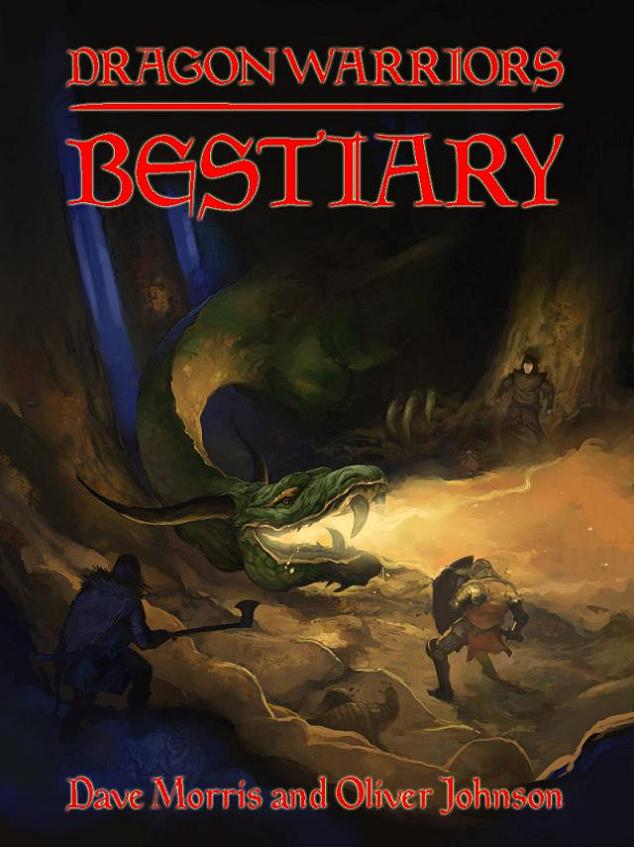
I say all this with great sadness. It may say Fabled Lands at the top there, but you all know that DW is my and Oliver's baby and even after 25 years we're still more attached to the world of Legend than anything else we wrote back in them days. Magnum Opus's 2nd edition DW was a true and glorious rebirth for the game. The scenarios and rules material by Ian Sturrock, Jon Reed, Kieran Turley, Damian May, Shaun Hately, Robin Low, Frazer Payne, Ben Monroe... and others. Guys, I can't list you all but you were the greatest team. Jon Hodgson's covers were the most gorgeous pieces of artwork I've had on any of my books - hell, they're the best any roleplaying game could boast - and for me his style defines Legend now. (That's no hyperbole btw. Look at the Bestiary cover below. This is a man who has seen right to the heart of Legend.)

And of course, none of this would have come about with the amazing efforts of James Wallis, owner of Magnum Opus Press, who championed the game, managed the project, ran the business, directed the team and personally edited and laid it all out. In the DW renaissance, James was the renaissance man. Oliver and I owe him a huge debt of gratitude for giving DW its Indian summer.

For those of you who've thought about trying the game, there's still time to do so (and to ensure something goes back in royalties to that stellar creative team into the bargain) before the books go out of print. Mongoose have the entire DW series on sale here. I'd recommend starting with the core DW rulebook and the Sleeping Gods scenario book. (It's an investment. Trust me, in another two or three decades those 2nd edition books will be gold dust.) And the excellent Ordo Draconis will continue to keep the torch burning, we hope. There is even talk of the long-planned DW Players' Book appearing as an Ordo Draconis special in time for Christmas. James has pledged his full support to the old MOP team and will be continuing to give them the benefit of his experience and commercial acumen, which is certainly unsurpassed in the UK role-playing industry, so maybe it's too soon to be playing "Paint it Black" at full volume.

Looking to the future, the rights to Dragon Warriors are controlled by Fabled Lands LLP and, although the game is not a high priority for the other FL LLP guys, I'm hoping they won't give up on it. If there looks like being any way to bring it back in a commercially viable form - my own preference being Jon Reed's suggestion of a series of system-agnostic Legend books - then Oliver and I will keep prodding at them to chase up all leads. I doubt if another publisher will take up DW now; as James has revealed, it never made MOP anything more than pin money. But the energy of fandom is unconstrained by mere lucre, and DW has a host of enthusiastic fans. And perhaps Legend as a game world can be commercially successful where the quarter-century-old rules of DW were not. I'd like to think so.

Where now? Well, as one door slams shut another is apt to fly open, and the sad news about Dragon Warriors has spurred on some developments we had in the pipeline that are going to have Fabled Lands fans dancing on the tables. There is a silver lining. More on that in a week or so.

Tuesday, 31 August 2010

Fury of the Deep

Magnum Opus Press have just released another brilliant title in their ongoing* rejuvenation of the Dragon Warriors game. This one is Fury of the Deep, a scenario by Jon Reed and Damian May. It’s designed for characters of 4th-6th rank and would fit in neatly as a prequel to some of the adventures in MOP’s forthcoming DW supplement In from the Cold.

The story has the players hired to accompany a merchant’s expedition to the island of Xanthos, lost from civilization for more than a thousand years. On the surface a thrilling adventure through labyrinthine ruins, the insidiously lethal undercurrent being the dark history of greed, vengeance, depravity, power-lust and mythic magic that the characters are destined to uncover.

Fury of the Deep is being published in PDF form only, is priced at $9.95 and you can get it on DriveThruRPG here. Magnum Opus supremo James Wallis is backing it with this offer: “If you can get a review of any Dragon Warriors book published - and that means anywhere from a blog through RPGNow right up to Dragon Magazine and all points in between - then let us know and we will happily give you a free PDF of any other Magnum Opus product.”

More Brymstone campaign characters on Friday in the shape of the dreaded Tobias of Vantery. Be on your best behaviour.

(*I use the term "ongoing" but actually it's just been officially announced that FOTD is the next-to-last of the Magnum Opus DW books. All the more reason to grab 'em while you can!)

Tuesday, 24 August 2010

Believing in faerie

Recent posts and comments about Dragon Warriors, in particular the discussion about how Paul Mason used centaurs in "The Tower of Horglin", have been reminding me why I prefer "low fantasy" over the kind of setting used in most FRP games, and specifically how that preference shaped the DW world of Legend. I characterize it as low fantasy because Legend itself is intended as a pretty realistic milieu into which the fantastic occasionally intrudes. Because centaurs and elves and whatnot are not part of the infrastructure of the society, there is no necessity in DW to treat them as ethnic groups with their own customs and ecology. Instead, they stand for something in the human psyche. They can be (as fantasy should be) illogical and dreamlike.

The article below, in which I explain the thinking behind that preference, originally appeared in the DW fanzine Ordo Draconis which contains loads of useful material for roleplaying campaigns and is not tied exclusively to the DW rules either. It's well worth a look. (Incidentally, there is also a band called Ordo Draconis and their second album was released by Opus Magnum Records, while Magnum Opus Press publishes 2nd edition Dragon Warriors. So you see, there is a God and He has nothing better to do.)

If you've already come across this little article in OD, apologies for repeating it here. My excuse is that many Fabled Lands players may not be all that familiar with what's going on with DW and yet may still find it interesting. The line of reasoning behind these choices when I originally created Legend is pretty much the same as is elaborated in this post on the Lawful Indifferent blog - ie, human beings are so diverse and complex that you'll never get to the end of them, while PC elves and dwarves are just a way of avoiding immersion through stereotypes.

The FL world, of course, is all awash with high fantasy quests and not at all like Legend. So with that caveat in mind, here's the article...

FAERIE FOLK IN THE LANDS OF LEGEND

Lafcadio Hearn wrote a story about a mujina that haunted a stretch of road in old Tokyo. The mujina appeared as a woman without a face, terrifying travellers at night. Because the term “mujina” had not been seen in the West, readers assumed that it meant a creature that had no face. Eventually the word achieved its reductio ad absurdum: an entry in a the monster manual for a dozen fantasy role-playing games that were either set in the Orient or had reached the point of desperation where another few dozen new creatures were needed to sell a supplement and it didn’t matter what part of the world they came from.

The truth is, mujina doesn’t mean a creature with no face. It’s just a word for a goblin, sprite or imp, derived in fact from the medieval Japanese superstition that badgers and foxes were mischievous faerie critters. And the blank face? Just a spooky magic trick. Hearn – a folklorist, not a biologist - never intended it as the defining characteristic of a species.

Elf, dwarf, goblin. Where do those words come from? From the mind of Man, who is never happier than when he’s managed to tie a label on something and put it in a display cabinet.

All very well in our world, but this is Legend. Darwin is never going to exist here. The magic of Legend is not a science and, despite the convenience of the game rules, magic doesn’t yield to strictly logical principles. The creatures of faerie that we may call elves and dwarves may have very different ideas of how to categorize themselves.
Gin ye ca’ me imp or elf,
I rede ye look weel to yourself;
Gin ye ca’ me fairy,
I’ll work ye muckle tarrie.
The fays of Legend are not the elves and dwarves of Tolkien’s Middle-Earth or of Dungeons & Dragons. For one thing, they are rare. The people of Legend believe in elves and dwarves, but they don’t expect ever to meet one. They hope never to meet one, put it that way. Because they are rare, there is misinformation about them; conflicting stories. And because this is Legend, those conflicting stories may all be true. Logic sits in the corner without a dance partner, disapproving and ignored.

But what are fays, or faerie folk? They are the degenerate remnants of pagan nature spirits whose power has sapped away with the coming of the True Faith. As nature spirits, they take their form and their nature from the living landscape. In forests they are shadowy, agile, willowy. In mountains they are squat and strong as barrels. Out on the moors they are gnarled, spiteful and dank-breathed. You can call those elves and dwarves and goblins, but to the creatures themselves the terms would seem irrelevant. No doubt they do see themselves as distinct from each other, but the urge to fit things into categories is not part of a fay’s outlook. Referring to them as species like that means even less than the concept of race among humans.

As you travel about Legend, you’ll encounter local beliefs in the faeries just as you might have done in Cornwall or the Scottish Highlands not so very long ago. When a Cornumbrian tells you of mischievous pookas and an Erewornian tells you of murderous redcaps, the nature of the creature they are describing may simply be the vernacular penchant of the fays, shaped by countryside and weather and the attitudes of mortals.

More often, though, the talk in taverns is of a specific local fay: Long Lankin or Old Ned or Jack Hollyshoes. No two are exactly alike. A hobgoblin is just a goblin that nearly did for you. There’s no such thing as a genome we can use to pin down their faerie lineage. If you want to GM them properly, you can put that rulebook away for a start.
“My name is Eildonas of Hulda Hoo,” I tell him as we walk.
“I take you to be one of the Grey Elves,” he says with a sidelong glance, provoking in me a short laugh, since such categories only interest mortals.
What the fays do recognize is territorial sovereignty and status. An elf of the forest regards himself as cultured aristocracy, and may even model his manners on the etiquette of a mortal court. The kobolds or dwarves of crags and caverns are a more rough-hewn breed, but still pride themselves on having noble status. A mean creature of the moors and ditches, whether you call it a goblin or a boggart, knows its place in the hierarchy of faerie.

Now, all of this is the way it works in “real” Legend – that’s my and Oliver’s Legend. (You did get that I put "real" in inverted commas, right?) You’ve bought the Dragon Warriors books, so your Legend is entirely up to you. We don’t have no truck with authorial privilege in these parts. But I do have a good reason for recommending that you don’t start neatly indexing elves and dwarves and what-have-you into suitable player-character templates. That’s because it will ruin your game.

Mike Polling (the author of “The Key of Tirandor”, an excellent scenario in White Dwarf #49-50 that is to be reprinted in In From The Cold) describes a problem in fantasy fiction and gaming that he calls taxonomic reduction. It begins with a demand for details about elves, for example - their social organization, clothing, breeding habits, and so on. So you get a supplement with all that stuff… hit points for Grey Elves, magic for High Elves, eye colour and what they eat. Now you can play an elf. But actually all you are playing is another kind of human being.

Okay, so now your players start to sense that something has gone. Elves used to be mysterious. Now they know more about them than they do about Yanomami Indians. So you have to bring in something new. You scour legends until you find Trows, say, or Sith. Just words. Now they take the place of the elves who have been filed and categorized into meaninglessness. Yet pretty soon a player says, “How can I get to play a trow character?” and the whole reductive process begins again.

The point is: you don’t need player-character elves or dwarves. Unless of course you want to recreate Lord of the Rings in your games, in which case stop playing Legend right now because it’s not that kind of setting - what you want is D&D or MERP. Human beings (or rather mortals, as the term is in Legend) already have infinite diversity. If you aren’t able to find that in your own role-playing ability, dressing up as an elf isn’t going to do it for you.

We have to have the rules in role-playing, but they’re a necessary evil. They shouldn’t be allowed to shape the way we think about the world and characters. And most especially they shouldn’t be allowed to stifle the magic and mystery that’s the whole point of choosing Legend as your game world in the first place.

Of course, DW is a game system as well as a milieu. So you're perfectly at liberty to chuck out the low-magic medieval setting and spooky flavour and just use the rules for combat and magic. My own gaming group did it the other way round: our games are set in Legend but we use our own GURPS variant, 7URPS.

By the way here's a nice little companion comment on fairies by Alan Moore. And if you should be interested in running games in the authentic Legend style, it's worth tracking down copies of Maureen Duffy's book The Erotic World of Faery and Susanna Clarke's brilliant short story collection The Ladies of Grace Adieu.

Saturday, 7 August 2010

What a Legend warlock really looks like

Friends or Foes is Magnum Opus Press's book of NPCs designed for Dragon Warriors campaigns but equally useful with other fantasy RPGs. You can buy it and other DW books here.

I was recently given a copy of Friends or Foes and while leafing through it I got to thinking about the cast of vivid and memorable characters I've encountered in games over more than thirty years. I'm sure everyone reading this will have had similar experiences, interacting with or playing characters whom any novelist would be proud to have created. And yet, because they are incarnated in the ephemeral milieu of a roleplaying game and not in a novel, few people get to appreciate them.

And so, excruciating as this may seem, I thought I'd run a few write-ups of our own game sessions. I don't always record our sessions. That'd be a bit of a busman's holiday, after all. When I stop work for the day I want to play in fantasy adventures, not write about them. But this particular campaign "Redemption", run by Tim Harford, was so brilliant (surpassed only by Tim's earlier, desperately gritty "Iron Men" saga) that I wanted a record of it. The write-ups only lasted a few sessions and unfortunately did not record the final, doom-laden session when we reached the Day of Reckoning. But if you haven't played in Legend and want a sense of what it's all about, come back on Monday for the first instalment.

To put the write-up in context (and to tie in with the Friends or Foes reference earlier, because we care about that segue stuff in these parts) here is the backstory of my character in the Redemption campaign, one Gaius of Tamrac. Not that he's one of those amazingly memorable characters (I've played my share of them, not to be falsely modest here, however Gaius wasn't one) but he is the narrator of the adventure so you might find it helpful to know a bit about him. Incidentally, his meagre magical abilities are the closest we ever come to having player-character sorcerers in our Legend games.

Gaius of Tamrac was a baronet in service to Earl Montombre. He studied a little with Montombre's wizard, Cynewulf Magister, who claimed he recognized Gaius's magical aptitude, but really the wizard wanted to get close to Gaius's two young twin sons. When the boys started to sicken, Gaius knew enough to realize the wizard was draining off their souls to make himself a doppelganger servant. Gaius tried to counter the spell, but had no real magical training and could not hope to dispel the magic of such a powerful sorcerer. Left with no other recourse, to save their souls he smothered the two lads.

Gaius's noble rank saved his life, but for the crime of killing his own sons he was stripped of his rank and cast out of Montombre's lands. His troubles didn't end there. Cynewulf put Gaius's wife, Abbasia, under a sleep spell that allows him to send her spirit wherever he chooses. He can threaten to send her sleeping spirit to hell, and so has leverage to make Gaius serve him.

Gaius tried again to counter the wizard with magic, but this time his attempts created a backlash, scarring his right eye and leaving it as black as jet. But the eye gives Gaius certain enhanced (if unreliable) abilities: finding lost objects, discerning auras and so forth – even, at times, seeing glimpses of the future. The balance of his skills reflect the kind of man used to performing unsavory tasks in the dead of night: sword, knife, climbing, stealth, lockpicking.
I left it undefined whether the fate of Gaius's family was done with Montombre's knowledge or whether Cynewulf was acting for himself - that's something Gaius himself wouldn't know. Every so often, he receives a sending in his dreams in which the wizard instructs him what service he must perform to spare his wife another night of hellfire. Each such task increases his tally of sins. As the campaign opens, the Archbishop has charged Gaius with a pilgrimage to atone for slaying his sons, but Gaius also perhaps hopes that he can expunge all his sins and, by earning God's favour, win his wife's release from the wizard's power.

Was he destined to succeed? Find out next week - maybe.

Sunday, 25 July 2010

The Darkness of Morning (sleeve notes)

The title was one of those ideas that bubble up to your consciousness from who-knows-where. I suppose I wanted to capture the sense that not every daybreak floods the world with light like Bellini’s St Francis in Ecstasy. Sometimes day comes as a Pyrrhic victory against the night. Or perhaps I had in mind those dawns that set the high places alight but leave troughs of cool darkness below the hills.

At any rate, “The Darkness of Morning” it was. In story terms the title fitted the mood, because I anticipated players would be getting their first taste of the incomplete and somewhat bitter triumph that's the best you can hope for when you have dealings with faerie creatures in the lands of Legend. In DW, heroism usually comes with a high cost; it’s not Boy’s Own.

How it started was like this. Magnum Opus Press wanted an introductory scenario for their revised Dragon Warriors rulebook, Frazer Payne is one of the best Dragon Warriors GMs I know. I put his name forward and, just to get the ball rolling, sent him a few notes. Over time it became a fully worked-out scenario by Frazer, at some point acquiring the title of “The Darkness Before Dawn”.

The idea of this post is to give you the behind-the-scenes of how the scenario got developed. So you don’t need a spoiler alert at this point, do you? If you haven’t already played the scenario, I recommend scooting off to buy a copy of the book here. You may not survive the scenario (when we played it, the party attacked the White Lady on first encountering her and got wiped out) but at least you’ll know what Frazer and I are talking about here.

Okay, so my original and very rough notes were as follows:

Say the players meet for the first time in a village in the early morning after a heavy storm. They all got caught out in the rain and are cold, tired, wet and hungry as they arrive at the village.

The inn has only one guest room, so there's immediately a bit of possible jockeying for status as they decide who will get that room with its nice soft bed while everybody else has to put up with a pallet in the common room - normally all right, but this is daybreak now so they'll be trying to kip with farmers in and out all morning.

To top it off, there's a big commotion in the village square. It seems the young lord of the manor, call him Sir Olvar, went off last night and hasn't come back. The steward Cethric comes to tell everyone Sir Olvar’s cousin Maxim le Cloche is in charge. There are grumblings at that, as many peasants are loyal to Sir Olvar's young bride Lady Angela, but what can they do? Lady Angela is currently in the throes of childbirth, so nobody can get to see her.

If the players ask, they are told that a ghost house is said to haunt the local woods. Each time it appeared in the past is when somebody in the village is giving birth, and the child has then been stillborn. The legend is that the mistress of the house, a "white lady" known locally as Queen Fhionn, eternally mourns her own lost child and so steals the lives of unborn babies. Last night in the storm, the lights of the white house appeared between the lashing branches of the trees. As Lady Angela had gone into labor that afternoon, Sir Olvar rode out to seek the house and demand of Queen Fhionn that she spare his child.

The point of all that btw is that most novice groups will just cut straight to the adventure. But there's enough set-up there (the snake-like steward, drunken wastrel cousin, pure and plucky young wife, doughty peasants, etc) that they could improv a bit if they want to, and that way cotton on to the way scenarios are really planned - ie hardly at all.

Anyway, most players will head off to the woods and you can make much of the dank, dripping undergrowth after last night's storm. This is the run-on-rails bit that Magnum Opus are looking for in the introductory adventure, as I envisage a series of encounter areas (say a clearing, a cave, a hollow oak, or whatever) where you can put fights and/or tests for the players to get a feel for their characters' abilities.

The Hollow Oak

The players find a clearing. The oak has a hole in the side which has a curtain of ferns over it. The curtain pulls back revealing a sort of puppet booth. Puppets corresponding to the players start to enact a story, beginning with a comedy version of their attempt to get to sleep at the inn. This could especially poke fun at whoever got the private room. Anyone watching for more than half a minute has to save or be rooted to the spot – they then take damage as the play turns nasty and their puppet self starts to be injured.

The puppeteer (hidden from view inside the tree) is a red-headed goblin called Erkiss. If a player manages to get into the tree, Erkiss will flee up inside the trunk and run off in the form of a squirrel.


Eventually they arrive at the white house. Around the back of the house is a forlorn, overgrown garden, gloomy because of the low-hanging branches of trees and the fact that it lies north of the house, so never sees daylight. In the garden are row upon row of infant graves with sad little headstones. These are the children whose lives have been taken by “Queen” Fhionn over the years.

They are met at the door by Queen Fhionn’s manservant. They may recognize him as the goblin, Erkiss. (It shouldn’t be obvious – just give them the hints and see if any players cotton on!) In his servant’s costume, Erkiss is not obviously a goblin – he just looks like a wizened young-old man. Mention his ginger eyebrows and maybe he gives a wink that a player might have seen if he climbed up to the treetop in time to see Erkiss transform into a squirrel. Recognizing Erkiss gives the character who first says so a bonus: his next successful blow will automatically bypass armour and strike for double damage.

In the parlor is a small fire that is dwarfed by the huge stone hearth. The coals creak and shift sullenly as if on the verge of going out. The fire does little to dispel the dank chill that pervades the house. It is impossible to imagine ever being warm or comfortable here, and after their trek through the dripping boughs of the wood, the players feel chilled to the marrow of their bones. In front of the fire stands a big, black-canopied cradle awaiting a newborn child. It’s empty at the moment. The black drapes make it seem more like a funeral pyre than a cradle.

Now at last they will have to face Queen Fhionn. She has ensorcelled Sir Olvar who is now her slave.

Here again there's the opportunity for bargaining or guile, but most beginner groups will presumably just lay into her. It'd be a tough fight but maybe things they picked up in the woods will give protection from her power. After they defeat her and leave, if anyone looks back the white house has vanished, and the little infant graves, now exposed to daylight for the first time, have sprouted clumps of flowers.

Then they've got the job of taking Sir Olvar home. He's still dazed by her magic. Maybe they found a pool earlier that reflected one's true nature or something, and if they get the smart idea to take him back that way and show him the pool, he'll recover. Otherwise it's a bittersweet kind of victory, as they return Sir Olvar to his young wife (whose unborn child now seems safe) but he remains addle-witted and therefore the drunkard Maxim le Cloche is still guardian of the manor (though he seems to be under the dominance of the steward). Maybe the players take up Lady Angela's cause, vowing to visit Sir Olvar's liege (Baron Aldred) to ask for help.

The adventure illustrates the key things the introductory scenario will need, which are:

  • Very structured adventure with bits of flavor text to guide the novice GM
  • Opportunity for players to flex their muscles in simple self-contained encounters as they learn the rules
  • A little bit of optional character- and intrigue-based stuff that they can take or leave
  • A lead-in to the further adventures in Baron Aldred's fief
My accompanying email to Fraz:

I think that an introductory scenario should show players what they cannot do as much as what they can. If I were running the scenario, I'd be inclined to make Queen Fhionn impossible for any but the greatest heroes to beat in a straight fight, and novice players would have to outwit her - eg by tricking Erkiss into shapeshifting into a baby and lying in the cradle, or simply putting one of the puppets into the cradle, so that while crooning over her stolen "child" she wouldn't notice the players leading Sir Olvar away.

Realistically, though, I suppose you’ll have to include the possibility of a big fight at the finale. You could say something like, "Normally, beginning characters would have no hope of overcoming a creature as ancient and powerful as this White Lady. Armed with the items they won from their various challenges in the woods, they may be able to defeat her temporarily in a fight. Alternatively, they might be able to outwit her, perhaps substituting a puppet for the child she wants so that she's distracted and allows them to leave with Sir Olvar."

The challenges in the woods are at least in keeping with the tradition of gaining power over a supernatural creature - no matter how powerful - by moral tests and/or cleverness.


Fraz replied:

I hope to enhance the Arthurian 'blighted land' flavor at the front end.

Fhionn = “white cow, she of white cattle”. This made me wonder if the creature should not appear as a grossly fat female (making the players wonder what her diet is!) rather than the fey lady of the lake I had first imagined. In this case, I could allude to her being a kind of twisted avatar of the primitive Earth goddess, the aspect which carries souls back into the earth.

This made me think that the white house might be more primitive, from the outside. I imagine a chalk embankment in a wooded hillside with windows for eyes, surrounded by burning brands which roar up, lighting the mists as the party approach.

Do you like this rather Blair Witch conception, or am I barking up the wrong tree?


I replied:

Well, I would say that the "fey lady" appearance is more in keeping with Legend generally, at the outset anyway - ie kind of saying to the players: beware, in this world things are rarely what they seem. I took it from the Irish "Bean Fhionn" which means literally "White Lady" (cf Bean Sidhe = ghost lady). The grossly fat image - I dunno, that does seem more of a D&D-ish monster idea to me.

But perhaps there's a compromise: she appears to them as the gentle, fey, beautiful but of course heartless lady at first, but if they fight her she gradually changes as her anger grows, becoming the fat, distended hag you're describing. That's in keeping with the way Celtic heroes and villains transform in combat (think Slaine) so imo fits the Legend setting more.

The backstory rationale would be that she was historically a real woman (probably a sorceress) who lost her child by miscarriage. Her grief caused her to do away with herself, and the distraught ghost then attracted the mythago/residue of an ancient but much degraded Earth Mother spirit, as you say, which merged with her to create the creature folk now refer to as Queen Fhionn. I'm thinking of the way that Herne was both a historical figure (Henry VIII's gameskeeper, who hanged himself) and also a carry-over of the Horned God of Celtic times.

I like your conception of the look of the house, most certainly.

Frazer:

My dodgy old mythology book gave me Bo Fhionn, and starts going on about cattle. I like that merging very much. The encounters in the forest could reveal the tragedy of her story, as well as hint at the presence of this older wood-spirit, perhaps by alluding to ancient 'babes in the wood' fireside tales.

Me:

I realize the way I worded it before made it sound a bit like I was damning with faint praise, whereas in fact I think the transformation to gross, ugly hag is a huge enhancement. In that form, the encounter will memorably introduce players to the idea that the faerie creatures of Legend should be feared - much better than just beating up on a pretty lady in a white dress :-)

And I like that the concept was so serendipitous - a sort of misreading of Bo Fhionn (white cow) giving us a really evocatively nasty encounter. Excellent! Great idea to draw in a local babes-in-the-wood myth too. That's nice and creepy. If it was a movie, it should be Pan's Labyrinth.


Postscript: I pre-loaded this post months ago, as I do most of them, but only the other day got some news about Magnum Opus's publishing plans for a new Dragon Warriors book collecting old scenarios from White Dwarf. These adventures were written over a quarter century ago by me, Oliver Johnson and Mike Polling for the unsung editor of WD at that time, none other than Jamie Thomson. Most of the scenarios were originally designed for RuneQuest and/or Dungeons & Dragons, but they've all been adapted to Legend and the DW rules by the brilliant and madly prolific Ian Sturrock. The book is titled In From The Cold (why? why not?) but there have been conflicting rumours about publication date and format, so I recommend you go over to the Magnum Opus website for the latest info. The reissued DW books are splendid, a far cry from the cheap but well-loved paperbacks of yore, and you can buy these deluxe editions here. An asset to any role-playing collection.