Gamebook store

Showing posts with label Legend. Show all posts

Friday, 15 May 2026

Up above the world so high

The Ghosts of the Magi, known colloquially as Pyid (= "the Five") are five small luminous bodies that hurtle through the night sky above Krarth. With a good eye they can be variously seen in other northern regions also, but it is above Krarth that they are brightest.

The peasants of Krarth believe them to be the spirits of the five greatest original magi, cast into the upper heavens by the Blasting of Spyte. The Five have specific astrological significance and are known by these names: Red Death, Blue Moon, Plague Star, Gift Star and White Light. The Krarthian peasants believe they will come into conjunction above Spyte in the year 1000 AS, whereupon the gates of that deathly city will be hurled open.

Astronomers of Khitai or the Ta'ashim lands, where the world is known to be round, could possibly map these moons' orbits and calculate any conjunction – though if such a thing has ever been attempted the results are not known.

The above is what any Dragon Warriors player would have learned from "The Lore of Legend" chapter in DW Book Six, way back in 1986. But as I worked on Jewelspider, my return-to-Legend RPG, I got to wondering: what is official Church teaching regarding the Ghosts of the Magi? 

It struck me that it’s not in the nature of religious thinking to say, “OK, there are these spirits of ancient sorcerers that are hurtling around under the vault of heaven soaking up ineffable secrets for their eventual return to Earth,” because that’s a scientist’s interpretation, like saying, “We accept the origin of these objects and will now try to work out what they are.”

But in fact the Church is likely to take a very different approach: “These things are evidently real. Therefore they must be part of God’s plan, and we can ignore what those heathens in Krarth believe.”

So then I got to thinking that if you put White Light to one side, that gives us four baleful entities – the Four Horsemen, obviously and handily. So then, with a little Wiki-level research, I found that official Church teaching until very recently is not that the Four Horsemen are agents of the Antichrist. Quite the reverse: they are God’s agents who will scour the world to usher in the Last Judgement. And the fifth one? White is associated with the Holy Spirit, so that’s rather a gift.

Hence we have the True Faith’s doctrine as to what those five cometary objects are. The Five (known as the Pentaphan) are regarded as angels who have been appointed to scour the earth at the End of Days, specifically as the Four Horsemen who presage the Apocalypse, and are commonly identified as Apsinthos (ie Wormwood, harbinger of War, replacing Red Death), Qaphsiel (Confusion and Sorrow, standing in for Blue Moon), Abaddon (Destruction, taking the place of Plague Star), Kushiel (Punishment, whom the Krarthians call Gift Star), and the last is thought because of its pure white light to stand for the Holy Spirit through the agency of the archangel Jophiel (Understanding and Judgement).

Friday, 13 February 2026

"Beauty Like A Tightened Bow" (a scenario set in Legend)

The characters are staying at the castle of Baron Albemarle. They needn’t necessarily be honoured guests; they might just be passing through, eating on the lower tables while Albemarle wines and dines some more exalted travellers. All that matters is that there is some visitor here whom Lord Albemarle wants to impress.

Albemarle’s court wizard is Olaudah, a Mungodan who typically dresses in feathers, war-paint and animal skull necklaces despite being a scholar raised the palace of his father, a prince of the Desert of Songs. Olaudah is considerably more cultured than most of the Elleslandic lords and knights around him, but he recognizes the degree to which strangeness can affright a foe, so hides his aristocratic refinement and instead plays the part of a ‘savage’.

After the meal, with night drawing in, the baron calls for Olaudah to read his guests’ palms, which he duly does, issuing them cryptic predictions in the form of riddles. Feeling that the guests are insufficiently impressed by his having a Mungodan sorcerer at his beck and call, Lord Albemarle then insists that Olaudah perform a trick he’s seen him do before, making two ancient servants imagine themselves to be young again. That’s easily achieved by hypnosis, the guests laugh at the old pair’s deluded antics, and Olaudah is hoping he can return to an alchemical experiment he has had to leave at a critical point.

No such luck. One of the visiting knights tosses an apple core into the hearth, belching to show he’s unimpressed. ‘I saw a wizard in Cantorbridge who made rain fall from the ceiling,’ he says to Albemarle.

(If one of the player-characters chooses to be obnoxious, so much the better. It will be more effective if this lesson in manners is not precipitated by an NPC. But don't force it. If your PCs are all well-mannered, the arrogant visiting knight will do.)

Olaudah gives them a self-deprecating smile. ‘My lords, the roofers of Cantorbridge are notorious for their shoddy workmanship.’

‘Oh well,’ says the arrogant knight, ‘there are true wizards and then there are mere conjurers.’

Olaudah’s eyes flash at that, though he retains his bland smile. Lord Albemarle, though, takes it as a personal challenge. ‘My man can do anything those Cantorbridge wizards can. Name anything. Come on, any miracle you like.’

One of the knights sits forward with a leer. ‘Let us see that peerless maid of Argos, whom all the world admires.’

Another nods. ‘The angry Emphidians pursued with ten years' war the rape of such a queen, whose beauty passes all comparison.’

‘Elena of Ilion, she is the one we speak of,’ says the arrogant knight who first spoke. ‘Have your… witchdoctor show us her face and form.’

Olaudah bends to whisper in Albemarle’s ear. The baron scowls, nodding grudgingly. He gives an irritated gesture to indicate that Olaudah should tell the guests what he’s just told him.

‘My lords,’ says Olaudah, ‘I could conjure the Princess Elena here, and you would see her beauty with your own eyes, but that the Church forbids necromancy.’

‘Oh,’ says the arrogant knight, leaning back in his chair with a disdainful grin. ‘Necromancy, I see. Of course. Otherwise you’d do it, obviously.’

Nettled, Olaudah snaps back: ‘I can do better than summon up the shade of a mortal beauty. What of the pagan goddesses? Not one, nor two, but three. Their heavenly beauty is as terrible as the sun at noon.’ He looks around, raising his voice. ‘If anyone is afraid to behold the faces of the comeliest of the immortals, leave the hall now.’

Lord Albemarle leans forward and takes his wizard’s arm. (No one else hears what passes between them, unless the characters use magic to eavesdrop.) ‘Is this wise?’ he whispers in Olaudah’s ear.

‘My lord, it will be but an illusion,’ Olaudah assures him under his breath. ‘But it will be vivid enough to quail the hearts and still the tongues of these yapping dogs.’

Olaudah makes the conjuration more dramatic with a deep, droning chant, a series of flamboyant gestures and lithely executed dance steps, and ends by throwing powder onto a burning brazier to release clouds of pungent yellow smoke.

Silence in the hall. After a moment the arrogant knight speaks up, though his voice sounds less assured now: ‘Is that it? I don’t see – ’

Three tall female figures, covered from head to foot in robes, are present. It seems as though they have been standing here all along, though no one had noticed them until now. Even concealed by the veils, their face and form are enough to excite both desire and fear in all the men. The goddesses glide forward gracefully, silk robes hinting at magnificent physiques, and speak in unison with voices that inspire both admiration and awe:

‘There can be only one to wear beauty’s crown. We three wait to hear the mortal’s verdict. Who will say which of us is fairest? Come to us and render judgement. We await you.’

In the same manner as their arrival, it is now clear the three are no longer here. All around the hall there are looks of ‘wild surmise’. The arrogant knight is shaken, but dissembles with loud derision: ‘Goddesses? Three wenches wrapped up head to toe like sacks of flour – not much of a trick, is it? One brat on another’s shoulders, throw a sheet over them, anyone could do…’

His voice trails off as he notices what everyone else has seen. The far wall is now open to the sky – and outside is no longer the gathering darkness but the bright light of day.

They file out, awestruck, to discover that though inside the room still seems to be the great hall of the castle, outside it’s a ship with lowered gangplank. The ship is moored at a rocky island that rises steeply from the jetty to a high peak where a temple of gleaming white stone can be seen. While the rest of the island consists of dry scrub and a few dusty trees sweltering under a merciless sun, the temple enjoys sparkling water from a spring and is surrounded by lush green foliage. All around the island, an ocean the colour of brass stretches to the horizon.

‘The sun,’ says one of the guests after a while. ‘It’s not moving!’ And indeed he is right. The sun is fixed here at the moment of noon.

They are approached by a youthful-seeming pair: Phalaena, a green-eyed dryad with hair that resembles lush reeds, and a capering satyr called Flute. The two are quite embarrassingly infatuated with each other, openly canoodling even while the characters are talking to them.

‘We are servants of the great queens above,’ they say, pointing to the temple. ‘One among you is to judge their beauty. As you go to meet them, decide who that will be.’

Somebody has to volunteer, and it’s clear that the arrogant knight is in no hurry to put himself forward. Ideally it’ll be one of the player-characters, though they don’t need to decide until they get to the temple. A steep, narrow path winds up the mountain.

What has happened 

Olaudah cast the illusion of three beautiful goddesses and then slipped away to check on his alchemical experiment, figuring it would be safe enough to leave the hall for a minute or so. What he failed to take into account was that a convincing illusion of a goddess includes the illusion of her divine power. In effect, when he conjured the three goddesses he effectively gave them the ability to create a holodeck. And it would not be a convincing illusion of pagan goddesses if they meekly submitted to a beauty parade for the titillation of mortal men, hence their turning the tables by making it a contest – the Judgement of Paris, well-known from myth if only half remembered by most of Lord Albemarle’s guests. None of this would matter if Olaudah were really back right away, but the illusion has altered subjective time for everyone in the hall. While Olaudah adjusts the heat under his alembic and mixes in a few ingredients to the bubbling mixture, seconds are passing for him but minutes are passing for the people experiencing the illusion.

This is supposed to be an adventure seed, not a whole scenario, and in any case I’d expect it to be used to incorporate ongoing themes in the campaign, so I’ll leave the rest as an open canvas. The island can be a stage for various dream encounters, a slightly sinister locus amoenus similar to the Athenian wood in A Midsummer Night’s Dream. As it’s an illusion you can contrive to split the party as they climb to the temple, giving them some strange experiences and hopefully also some clues as to what’s actually going on.

They will have noticed that Olaudah isn’t with them, but if they have a typical adventuring party’s attitude to sorcerers then it’s likely they’ll ascribe that to malice rather than oversight. Is this a ploy to strand Albemarle and his guests in a strange place at the mercy of pagan gods while Olaudah seizes power back in the real world? Work up the paranoia the way Tarantino or Sidney Lumet would.

What might tip them off that this is all an illusion? If they examine any coins, for example if Flute asks for a tip after showing them the way to the mountain path, they may notice that the coins are lacking in details – the king’s face blank, the inscription around the rim only random symbols. Books are unreadable, as in a dream. If they stop to pluck a flower that looks fine at a glance, they’ll see it has no more structure than in a child’s drawing.

They might also notice Flute and Phalaena using a phrase of endearment that the hypnotized old servants did earlier – which is who they are in reality.

After spotting some flaw, if somebody guesses that this is an illusion then they have a chance of finding their way back through to the fringes of reality where they could encounter Olaudah, hurrying back from his lab now that he is beginning to realize that his spell might have been a bit too effective. The sensible thing then would be to get him to dispel it, but if suspicion is running high – he is a wizard, after all, and a foreigner, and probably a pagan, and in the eyes of ignorant knights he might even be supposed to be a cannibal savage at heart – then there could be a fight.

Dispelling the illusion is one way to go. Another is to embrace the experience and see it through to the end. That’s trickier as you’d rather avoid the wrath of the two goddesses who don’t get picked.

First the characters have to decide which of them is going to be the judge. Obviously it’s a lot more fun if that’s a player-character. Other male characters are barred from entering the temple, but female characters are free to do so, and in fact the best way to avoid jealousy is to have the contest judged by a woman. The goddesses, having the pagan mindset that Olaudah imagined them with, don’t mind if a woman judges one of them more beautiful than the others; it’s only a man’s judgement that could annoy them.

At the threshold of the temple, a character might spot something behind a pillar. It’s a soot-blackened apple core. This is a last opportunity to twig that everything is illusory (it’s the same apple core the arrogant knight lobbed into the hearth earlier) before the beauty contest begins.

Inside the temple the goddesses are revealed without their robes – and they are as dazzlingly beautiful as only a dream-image or a true goddess could be. As Olaudah has misremembered the Emphidian myth, the three are Artemis, Athena and Aphrodite. All are tall, radiantly lovely beyond all mortal measure, and incidentally dark-skinned because they sprang from Olaudah’s imagination.

‘You may set any conditions you wish to the contest,’ they tell the appointed judge. ‘We will submit to your wishes. But you must choose which of us is the most beautiful before you leave here.’

If given an opportunity to speak to the judge in private, each goddess attempts to bribe them: Artemis offers grace and sharp senses; Athena offers wisdom and skill at arms; Aphrodite offers the knack of making others fall in love with them. But tempting as these bribes may be, the escalation of the stakes carries an implicit threat that the two disappointed goddesses will find some way to punish them.

Other than appointing a judge, how could the characters avoid having to pick one over the others? One way might be to trick them into making the choice themselves. Another might be to defer the decision to a higher authority such as one of the gods. A clever player-character may find a way to wriggle out of having to choose at all, or to convince each of the goddesses that she is the winner. That’s going to come down to improvisation, quick wits and fast talk, but if your players are anything like mine there’ll be more than one trickster in the party who is up to the challenge.

The illusion ends with clouds drifting across the sun, a reek of chemicals on the sea breeze, and then everyone is back in the great hall. Fumes from Olaudah’s lab fill the air. Anyone who was in the temple finds they are standing in the cavernous hearth. The two elderly servants are entwined like youthful lovers, and perhaps some of the characters are also in compromising positions – the arrogant knight crouching furtively under a table that he thought was a bush in the goddesses’ garden, for instance.

All’s well that ends well? If a character judged the contest then they certainly showed bravery, risking the displeasure of two goddesses, so it would be nice to let them keep a shadow of whatever bribe they were offered – a +1 on Agility from Artemis or whatever. Is that because the illusion actually reached through into a true mythic realm, or simply that the dream gives the character a new confidence? That’s for them to decide.

And there is a lasting effect on anyone who saw the goddesses unrobed – ie the judge and anyone who sneaked in for a peek. They can’t recall exactly what the goddesses looked like, but they are left with an impression of ineffable beauty. A glimpse of heavenly allure, half remembered, snatched away by the return to this world of dirt and discord and time – that is a bittersweet reward indeed.


* * *

This originally appeared in a slightly different form as an adventure seed on my Patreon page that tied in with the post on court magicians. It's available to all followers there, paid or otherwise, along with a lot of other good stuff. Pop over and join us.

And although I said above that it's all the men present who are affected by the goddesses' beauty, I intended to specify the hetero men (and any women who are lesbian/bisexual), meaning that a gay male character could have an unexpected role to play in the adventure. Alternatively, you might opt for a less literal concept of physical attraction; perhaps the goddesses' appearance arouses the admiration of men and not women regardless of their sexuality, on the simple basis that the goddesses are not mortals and so their attributes don't have to conform to mortal notions.

Saturday, 20 December 2025

Spanning a sea of cloud

To give AI art generators some chance to redeem themselves after last time, here's an image of the Rathurbosk that I managed to coax out of ChatGPT (animated below by DeeVid). I've never cared much for that dully realistic trad fantasy style, but at least the AI managed to get a sense of the scale, though still not close to the sense of wonder that even a rough sketch by Leo Hartas conveys. Looks like the best human artists aren't going to be replaced anytime soon.

The setting and environs of the Rathurbosk have a numinous seasonal feel, and if you want to make use of that then Damian May has an excellent adventure seed for you; "Captain of the Gouge" gets right down into the chasm for another angle on Legend's most miraculous bridge. Whether you're spending the holiday period high or low, hot or cold, busy or quiet -- have a good one.

Friday, 5 December 2025

"Water Like A Stone" (a Yuletide adventure set in Legend)

It wouldn’t be Christmas around here without a seasonal scenario by Tim Harford, but we’re trying something a bit different this year. Normally Tim gives me his notes and I lick them into shape so that it’s possible for someone else to run a game from them. Last December, though, there was a fly in the ointment.

As Tim put it, “This one was very skimpy on notes, even by my standards. I was in rebellion against our current D&D game, which has many good qualities, particularly the vividness of the NPCs, but which is overprepared and thus plays too much like a bravura performance from the GM, with not enough player agency. So I really wanted to push the other way and challenge myself to see how far I could get with minimal prep.”

Tim is also a very busy man, so he could hardly take time out to meticulously plot a six-hour roleplaying special just for one use with half a dozen friends. His notes in full were:

Tim adds: “Not much to go on I realise. There is an old scenario for Flashing Blades (‘The Grand Theatre’ in Parisian Adventures) which involves an actor who's also a spy who has stolen secret documents, and two teams of musketeers battling it out backstage. That was a direct inspiration for the Grand Theatre section, although in truth you really only need the premise, don't you? I also had in mind the image of Ferromaine's canals freezing under a supernatural cold, and the thought that a chase scene or a fight scene on ice would be a good challenge if the antagonists were equipped with skates. That's really it.”

That’s quite a challenge. My thinking for a scenario is that if you’re going to go in with a lot of plot elements then you need to work them out in advance, ideally to the extent of having a timeline of everything that would happen if the player-characters did nothing. You need to know those details (if they are going to be there at all) because the players will be trying to make them fit into a coherent picture.

For instance, imagine trying to play a murder mystery game in which all the clues were randomly generated independently of each other; it would be a complete waste of the players’ time because the clues couldn’t be assembled into any logical solution.

But once the game starts, everything can and should be improvised in response to what the players do – and that improvisation works because you had a clear idea of the NPCs and their actions and intentions to begin with. In short: plan your story as tightly as the writer of a novel or movie ought to, and then be perfectly happy to let that planned story disintegrate in response to the interpretations (correct or otherwise) and consequent actions of the player-characters.

Remember von Moltke’s advice: “No operational plan extends with any certainty beyond the first encounter with the main enemy force. Only the layman believes that in the course of a campaign he sees the consistent implementation of an original idea that has been conceived in advance, thought through in every detail, and retained to the end.”

All right, so how are we going to do this? I’ll kick off by describing how it played out in our last Christmas game.

Act One

(Yes, I hate all that Hollywood three-act guff, but we're going to need some structure to get through this bit.)

The characters are in the service of the Cotulio family of Ferromaine. Specifically they have lodgings at an orphanage run by the Abbess Emerentia, sister of Count Saltado Cutulio, who tells them to go and fetch a pine tree from the Drakken forests. Not just any pine tree, either. Rival families are contending to raise the Yule tree in the Piazza San Paolo. The tallest tree will be chosen. And off they go.

In the game as run we went upriver to a town in northern Kurland, so we must have been on the Arakose river. Another option would be to take the Liederkehn river, but that would involve passing through Tamor which the characters may prefer to avoid – and we might expect timber prices to be much higher in the New Selentine Empire. (If you opt for that, there's a possible tie-in to "The God in the Bowl" adventure, which also takes place in the New Selentine Empire.)

It’s also possible to set the whole adventure elsewhere. The characters could be hired in Brymstone to fetch a tree across the Mergeld Sea from Mercania. But let’s not make this any more complicated than we need to. Tim ran it as a Blades in the Dark heist game in Ferromaine; we’ll stick with that for now. 

The complication: when they reach the town of the timber merchants, it turns out the best two trees have already been sold to representatives of the Senfriti and Vassilvio families. The merchants say there is no hope of finding another tree taller or finer than either of those. The Senfriti barge has already set off the day before. The Vassilvio barge is loaded and ready to depart the next morning.

A couple of strange incidents occurred. First we noticed a white star or comet in the sky. White Light, often seen this close to Krarth? It seemed not, for this star shimmered in and out of vision. The other incident was the arrival of a mechanical bird, inside whose beak was a clay effigy of Parcelus Pike’s face (see below) telling us that he had a lucrative job for us if we would return at once to Ferromaine. But that meant abandoning the Yule tree errand so we declined.

The barges descend the river by means of locks that bypass the occasional rapids. At each lock there are customs officers – more organized if this is the New Selentine Empire, more lackadaisical in Kurland, both susceptible to bribery. Tim’s notes suggest the officials have already been bribed, so perhaps they will hold up the player-characters or demand excessive tolls to use the locks.

In our session we masqueraded as tax officials inspecting the locks. The obstacles you might consider would be that in Kurland those tollkeepers would be locally recruited under the jurisdiction of a local duke-elector and would know each other personally. Selentine officials would be identified by seals and documents (literacy being higher there) and the penalty for forging such seals or pretending to be an imperial officer is painful and brief. Directly targeting the other families’ barges, on the other hand, is mere affray and not of any great importance to either Kurlanders or Selentines.

The first “act” ended with the tallest (in fact sole remaining) tree being delivered to the Cotulio family and set up in St Paul’s Square.

Act Two

Oliver Trout is a clown whose fame has preceded him around the Coradian Sea. He’s now arrived in Ferromaine where he is booked to perform for five nights at the Grand Theatre. In our game the Abbess asked us to go to the Grand Theatre while the show is on and steal an object from Trout’s dressing-room: a wooden puzzle box.

Some of the player-characters also spoke to Parcelus Pike, a local sorcerer and curio collector, about stealing the puzzle box for him. He wasn’t interested, having already hired another team (we had disregarded his message conveyed by the mechanical bird in Act One), but left the matter open in case we should obtain the box instead of them.

We went to the theatre that night, all with the goal of stealing the box but not all with the same buyer in mind. We waited for the show to start and then sneaked backstage. The complication this time was that somebody got there first; Trout’s dressing-room had already been ransacked. The other team of thieves had not found the box, however. The player-characters did, and on the way out were ambushed by the other thieves, eight Chaubrettians who were no match under the favouritism of the Blades in the Dark rules for two murder hoboes – er, player-character fighters, rather.

The player-characters got away with the puzzle box and then cast lots to decide who should get it. The Abbess, our patron? Parcelus Pike, never very trustworthy but at least offering cash now that his other team were all dead? Or return it to Oliver Trout, whose performance most of us hadn’t even stayed to watch?

One of us (my character, Arnaud -- aka Flambeau, le Stégologue de Vyônes) objected to the way one of the murder hoboes had bullied the others during the vote, so hid the puzzle box in the mouth of a gargoyle on the roof of the church overlooking St Paul’s Square.

All through this, the white star/comet continued to grow larger in the night sky. At the same time it was growing unseasonably cold in Ferromaine. There were even some flakes of snow.

Act Three

The snow is falling steadily now, piling up in drifts around the city. Few citizens of the Ferromaine League remember living through a blizzard like this. Is it "an elfin-storm from faery land"? The player-characters may think so. Most people huddle inside by the fire.

It gets colder. Much colder. Through the driving snow a single light shines in the night sky: the strange star, bathing the whole city in an icy white radiance.

The snow stops. The star descends and settles on the top of the Yule tree. A creaking sound is heard, a little like the soft skittering of hordes of insects. It’s the unprecedented noise of the city’s canals freezing over.

Seven white-clad hooded figures are seen skating towards St Paul’s Square.

In our game, the player-characters climbing up to retrieve the puzzle box were beset by scuttling sprites with bodies of ice. On the ground, the seven hooded skaters arrived at the square, along with a tall white-clad woman who emanated waves of freezing cold that our murder hoboes were hard pressed to deal with – though they managed, of course, this being Blades in the Dark rules, and when they slew the Frost Witch she turned into flakes of ice.

One of the player-characters, a psoriatic pilgrim named Dropskin, ignited the tree with the aid of a flaming torch and fervent prayer. It was consumed in roaring orange flames accompanied by the sharp tarry tang of burning pine needles.

Meanwhile Oliver Trout ambled into the square and cheerfully received the puzzle box back from Flambeau. With a few deft twists he converted it into a stellated polyhedron which drew all of the snow and ice (including the sprites and the hooded figures) into itself, banishing the unnatural winter and restoring the city to normal.

Assumptions

After the game I told Tim my interpretations of these events:

(1) That the Frost Witch came in the white star/comet from Krarth and would have plunged Ferromaine into an eternal winter.

Tim said: “That's much better than what I had, which was that she was a supernatural antagonist who wanted the puzzle box for reasons unknown.”

(2) That Oliver Trout was a wizard or mythic being who opposed her and his puzzle box gave him some means to counter her ice magic.

Tim said: “Oliver Trout is a Santa Claus-like figure, of course – an avuncular spirit of all that is jolly and numinous about the bleak midwinter. Thank goodness I watched an episode of The Box of Delights the evening before the game.”

(3) That the white skaters on the frozen canal were her emissaries and their job was to kill Oliver Trout before he could stop her.

Tim said: “They were her emissaries. I had in mind that they would steal the box and there would be a chase scene along the grand canal. But you didn't stash the box where I expected and it became a set-piece confrontation rather than a chase.”

Here’s what ChatGPT thought:

Assumption 1: The Frost Witch and the Comet

Your Assumption: The Frost Witch came in the white star/comet from Krarth and would have plunged Ferromaine into eternal winter.

Refinement: The comet could be more than just her mode of travel—it might be her prison. Long ago, a cosmic force (perhaps linked to Oliver Trout or the city itself) sealed her in the icy heart of the comet. The comet's proximity to Ferromaine was drawn by the Yule tree ritual, corrupted by the rival families’ selfish motives. This not only makes her arrival more meaningful but also ties her deeply to the scenario's events.

She might not want to destroy Ferromaine outright but instead transform it into her icy domain, drawing its magic and culture into her eternal kingdom. This makes her a more nuanced antagonist with a vision, albeit a chilling one.

Assumption 2: Oliver Trout as the Frost Witch’s Opponent

Your Assumption: Oliver Trout was a wizard or mythic being whose puzzle box allowed him to counter the Frost Witch's ice magic.

Refinement: Oliver Trout is perfect as a mythic "spirit of midwinter," embodying the warmth and hope needed to survive the harsh season. Rather than being solely a wizard, he could be an ancient protector whose jovial demeanour hides immense power. The puzzle box could symbolize the delicate balance of winter—it holds the key to containing the Frost Witch but must be wielded with wisdom and care. To deepen their rivalry, Trout might have been the one who originally imprisoned her. She now seeks both vengeance and the box, which could free her fully. This personal connection raises the stakes of their confrontation.

Oliver Trout might not be omnipotent. His reliance on humour and goodwill could mean his power wanes in the face of despair. This would explain why he leaves the puzzle box unattended—he can’t directly confront the Frost Witch without gathering enough "light-hearted energy," which is why he was performing on stage at the Grand Theatre – but the wintry weather meant smaller audiences, making the PCs’ intervention crucial.

Assumption 3: The White Skaters and Their Mission

Your Assumption: The white skaters were emissaries of the Frost Witch sent to kill Oliver Trout before he could stop her.

Refinement: Rather than simply assassins, the skaters could have a dual purpose: to retrieve the puzzle box and prevent Trout from using it, as well as to sow terror and chaos in the city. They might represent different facets of the Frost Witch’s will (eg, cold precision, relentless pursuit, and icy despair), making them thematic extensions of her power. The skaters could be former residents of other cities she has conquered, now turned into icy thralls. This twist would highlight the stakes for Ferromaine—failure means the citizens could share the same fate.

The puzzle box could be tied to the very nature of winter—when solved correctly, it harmonizes the forces of cold and warmth, sealing the Frost Witch while allowing winter to remain balanced. Solved incorrectly, it could unleash an eternal winter or destroy Trout's protective powers, adding a moral or tactical dilemma for the PCs.

Explanations

These were the things I still wasn’t sure about after the game. What was actually going on? Players are going to ferret away at the details looking for an advantage, so you’ll want the answers at the ready even if they’re never needed.

What was it that invited the Frost Witch into Ferromaine? (The tree in some way, perhaps?)

Tim answered: “My initial premise was merely that the Frost Witch wanted the puzzle box, but in truth that's a fairly flimsy idea – and almost immediately came the idea (Christmassy, but also ominous) that she had a celestial body that steadily approached as the adventure progressed.”

ChatGPT suggested: “The Yule tree seems a strong candidate. It could serve as a mystical beacon tied to ancient traditions, perhaps imbued with ceremonial significance that inadvertently opened a pathway for the Frost Witch when it was raised in St. Paul’s Square. Maybe Ferromaine’s people used to perform protective rituals tied to the tree, but these have been forgotten in recent years. Alternatively, the comet/star might have been drawn to the competitive, somewhat self-serving motives of the rival families vying for the tallest tree, allowing the Frost Witch to exploit this discord.”

Why was Oliver Trout performing at the theatre?

Tim said: “I love these questions but I have no answers to any of the rest of them – the perils of the improvised game. Any answers you can dream up will be better than anything I had.”

ChatGPT’s answer: “Oliver Trout’s performance could have been part of a larger plan to mask his true purpose in the city. He might have been drawn to Ferromaine because he sensed the Frost Witch’s growing presence, and the show was an excuse to stay nearby without arousing suspicion. Alternatively, the theatre could hold symbolic power, such as being a historic cultural heart of the city where his magic would be stronger. Or see above, the idea that his performances at the theatre were parts of a magical ritual intended to build up a ‘charge’ of good-natured warmth to counter the winter spell."

Why did Trout leave the box unguarded?

ChatGPT: “Oliver Trout likely underestimated the Frost Witch’s influence—or overestimated the secrecy of the box’s location. He might have thought his jovial reputation or distractions like the theatre performance would deter any would-be thieves. Another possibility: he intended the box to act as bait, drawing her agents into a trap. It would also add tension if he intended for the PCs to become involved but misjudged their chaotic methods.”

What would have happened if the characters had failed to act? (The white skaters would have killed Trout?)

ChatGPT: “If the PCs failed, the white skaters might have killed Oliver Trout or captured the puzzle box, allowing the Frost Witch to solidify her hold on Ferromaine. This could mean the city plunging into eternal winter, its citizens slowly frozen into lifeless statues as her icy dominion spread across the region. The PCs' intervention was likely the only thing standing between the city and its doom, adding weight to their actions.”

Would burning the tree have had any effect once the frost had already taken hold of the city?

ChatGPT: “Burning the tree could have served as a powerful symbolic or magical act, disrupting the Frost Witch’s anchor in Ferromaine. If the tree was the conduit for her power, destroying it could sever her connection and weaken her ice magic. However, the tree might also act as a focal point for Oliver Trout’s magic, meaning its destruction could have been a desperate gamble—potentially undermining his efforts to banish her unless done at the right moment. This ambiguity could leave the PCs wondering if they helped or hindered.”

Time for the robots to take over

ChatGPT was doing sterling work, so I thought I should let it off the leash. How would it have improved on the scenario? This is what it said: 

1. Tie the Frost Witch to the Yule Tree More Strongly 

The Yule tree could be central to her power. Perhaps it is the "World Tree" in miniature, a mystical link between realms, and raising it without proper rites allowed her to invade. The rival families’ selfish competition could amplify the magical imbalance. You could use the apples and wafers used to decorate the base of the tree to symbolize temptation, sin and redemption. The Frost Witch might need the tree to fully merge her icy domain with Ferromaine, giving the PCs a clear reason to stop her.

2. Oliver Trout’s Purpose 

Oliver Trout can have a more defined backstory. He might be an ancient protector, akin to a winter guardian or even a rival to the Frost Witch in a cosmic balance between light and cold. His performances could be a way to gather joy and goodwill—essential to his magic—and the puzzle box might store that energy, which he intends to use against her.

3. The Puzzle Box’s Role 

The puzzle box could act as both a key and a trap. It might be the only thing capable of sealing the Frost Witch away but is equally coveted by her because it could seal Oliver Trout’s power if twisted incorrectly. This would give the PCs a tough moral choice, especially if factions try to sway them. 

4. Escalate Tension With a Chase Scene 

Instead of a static confrontation, you could add a thrilling chase along the frozen canals [I'm pretty sure it got that idea from Tim's notes. - DM] as the white-clad emissaries pursue the PCs, trying to retrieve the puzzle box. Ice sprites could create hazards, and Oliver Trout might aid from afar, giving cryptic advice. 

5. Make the Burning Tree a Gamble 

Destroying the tree could weaken the Frost Witch but at a high cost, such as damaging the city’s spiritual defenses for years to come. Alternatively, the PCs might need to perform a complex ritual at the tree to channel its power against her, adding urgency to their decisions.

And how about some stats? This is ChatGPT’s response, using D&D rather than Blades in the Dark. I haven’t played enough D&D 5e (just one session) to know if any of this makes any sense, but it looks creative and it kept spelling "fay" wrong, which is probably a D&D mistake as ChatGPT is usually right about things like that. 

D&D 5e Stats Suggestions

The Frost Witch

  • CR: 10 
  • Type: Medium Fay (or Elemental) 
  • Abilities: 
    • Legendary Actions: Use Cone of Cold, summon ice sprites, or freeze enemies in place. 
    • Lair Actions: Intensify cold damage in her lair (e.g., the area around the tree), create difficult terrain with ice, or summon blizzards.
    • Unique Ability: Shatterstar Descend – Once per day, create an icy storm that deals 6d10 cold damage in a 60-ft radius and reduces visibility to 10 feet. 
    • Defences: High AC (18) from icy armour, resistances to nonmagical bludgeoning/piercing/slashing, immunity to cold.

White-Clad Emissaries

  • CR: 4
  • Type: Medium Humanoids (Icebound Knights)
  • Abilities:
    • Frostbite Blade – Melee weapon attacks deal 2d6 cold damage. 
    • Glide on Ice – Move effortlessly over difficult icy terrain. 
    • Aura of Chill – Enemies within 10 feet take 1d6 cold damage at the start of their turn.

Ice Sprites

  • CR: 1/2
  • Type: Tiny Elementals
  • Abilities:
    • Freezing Touch – Touch attack deals 1d6 cold damage and reduces movement speed. 
    • Frosty Mischief – Use actions to create minor hazards (slick ice, frosty fog).

Oliver Trout 

  • CR: 7 
  • Type: Medium Humanoid (Mythic) 
  • Abilities: 
    • Puzzle Box Mastery – As an action, manipulate the puzzle box to unleash bursts of radiant light (6d6 damage to undead/fay). 
    • Aura of Merriment – Allies within 30 feet gain advantage on saving throws against fear and charm. 
    • Spellcasting: Casts Wall of Force, Greater Restoration, and Daylight as innate abilities.
Incidentally, I do hope "Frosty Mischief" is a real D&D ability. Finally, ChatGPT had some ideas about how to integrate all this into Legend's medieval setting where the real force is religion, not D&D-style fantasy:

1. The Yule Tree as the “Tree of Paradise”

The Yule tree in St. Paul’s Square could explicitly represent the "tree of paradise," decorated with symbols of humanity’s fall (apples) and redemption (buns standing in for eucharist wafers). These decorations might play a magical role in the story, either as a defence against the Frost Witch or as something she seeks to corrupt.

The apples could represent temptation, tying into the rivalry among Ferromaine's families. Perhaps the tree is adorned with gilded apples to symbolize the city’s prosperity, which the Frost Witch views as a hubristic affront to her dominion over winter. She might aim to corrupt the apples into frozen fruit that spreads despair or frostbite to those who touch them.

The white wafers could become a mystical ward against her influence. If the PCs retrieve the puzzle box and return it to the tree, the wafers might glow, symbolizing humanity's capacity for redemption and banishing her icy hold.

2. The Frost Witch as a “Tempter”

The Frost Witch could serve as a supernatural force akin to the serpent in Eden, embodying temptation and humanity's darker impulses. Her emissaries might offer subtle deals or promises to the PCs and city officials: wealth, power, or eternal life in exchange for cooperation. She might try to claim that eternal winter represents purity and perfection, twisting the tree’s symbolism of paradise into her own vision of a frozen utopia.

3. The Puzzle Box as the Fruit of Knowledge

The puzzle box could represent the forbidden fruit, a mystical object that must be handled with care to prevent disaster. Just as Adam and Eve’s choice brought consequences, solving the puzzle box could trigger a significant moral choice for the PCs:

    • Correct Solution: Harmonizes the balance of winter and seals the Frost Witch.
    • Incorrect Solution: Unleashes eternal winter or destroys Oliver Trout’s ability to fight her.

This creates tension as the PCs grapple with whether they can (or should) wield such power.

4. The Role of the Nobles and Clergy

The Cotulio and rival families could reflect the pride and materialism that the Frost Witch exploits. Of course Abbess Emerentia’s and Count Saltado's loyalty is to themselves and their family, but lower ranks in the Church might represent humanity’s spiritual side, trying to remind the city of the tree’s true symbolic meaning and rallying the PCs to act with virtue.

The clergy might have an old ritual involving the tree of paradise. If forgotten or corrupted, this might explain why Ferromaine was vulnerable to the Frost Witch’s influence. The PCs could discover fragments of this ritual, such as chants or blessings, that must be restored to banish her. However, this would work better in a northern setting as it’s unlikely that Ferromaine would have ever had any problems with winter magic in the past.

5. The Frozen “Garden of Eden”

When the Frost Witch descends, her icy magic could transform the city into a twisted, frozen garden—a parody of Eden. The canals might become shimmering paths of ice, trees could bear crystalline, inedible fruit, and the citizens might begin to freeze into statues.

The characters could face a challenge to “restore” the true paradise by reigniting the Yule tree’s warmth through symbolic acts of kindness or sacrifice.

6. A Winter Solstice Play

Integrate a play into the Grand Theatre performance that reenacts the Fall and Redemption story, echoing the medieval mystery plays. Oliver Trout might be secretly manipulating events to parallel the play’s themes with the PCs’ struggle, subtly guiding them toward the right choices.

Sources that I suspect influenced Tim and that may be useful are The Box of Delights and The Lion, the Witch & the Wardrobe. TV/movie versions here for those in a hurry. The old Santa-like character from The Box of Delights was apparently based on Ramon Llull, but I have only Wikipedia's word for that.

If you play the adventure, do let us know in the comments how you got on. I will just add that Tim's gaming group use Blades in the Dark, which casts every adventure in the form of a heist. Perhaps your heart sinks at the thought of heist games, or indeed any preset story-pattern in roleplaying, in which case you would normally get wholehearted agreement from me, but Christmas gaming makes its own rules. After a couple of mince pies I just sat back and went with the rompy flow.

Friday, 14 November 2025

Mummers' games

As later Dragon Warriors books were released and we began to introduce creatures that were less familiar from folklore and fantasy fiction, I liked to include adventure seeds in the description as a guide to how to use them. Some have found the Blue Men silly, for example, but my excuse is that if a bit of wackiness has your players giggling then the cold grue that follows will be all the more chilling.

Blue Men

By night in the sailors' taverns of many a port, with salt spray lashing the windowpanes, one may hear old adventurers in their cups whispering seafarers' tales. Sometimes the talk is of the Blue Men, who plough through the cold northern seas in their dragon-prowed warships, and plunder riches and souls from the living.

They come out of churning grey waves with the gnawing icy gale of an approaching storm billowing out their sail. A pallid flare of phosphorescence limns the rotted timbers of their vessel - an ancient, barnacle-encrusted hulk, waterlogged and impossibly afloat, like a grim wreck that has been raised by sorcery from the ocean depths. The grisly mariners of this ship stand silent on her creaking decks, blankly observing the terror-struck faces of their human prey. Chilled to the marrow of their bones by a cold no earthly fire could dispel, they possess the hunger of the dead for the living. Their flesh is shivery blue and their long beards are tangled with kelp, and in his hand each grips a cutlass of brine-corroded bronze. 

The Blue Men hold a course alongside the chosen ship, whereupon it is soon clear that they cannot be outrun or evaded no matter what the steersman's skill. Standing by the fierce prow, the Blue Men's chieftain addresses his prey. In a voice like thunder he calls out couplets of verse that describe the terrible fate that shall be meted out to them, but if a spokesman from among the adventurers can immediately reply with a rhyming couplet refuting his words then the Blue Men will be temporarily balked from attacking. So the chieftain might say: 

'Our prow shall split your ship like kindling,
Your own bright blood shall wash the decks.' 

And be countered by: 

'We have no fear of cold blue dead men
Blustering from their sodden wrecks.' 

The adventurers then get the opportunity for a riposte, which the chieftain must likewise deny in rhyme. The contest of verse continues until one side falters or is forced to make an unconvincing or clumsy rejoinder. If the chieftain wins, his Blue Men board the adventurers' ship and fight like demons, untouched by lesser sorcery and all but impervious to wounds. They may be driven back if the adventurers manage to inflict more than 25% casualties, returning to their own vessel which then sinks rapidly below the waves. Any character they slew will be beyond resurrection - his soul taken down with them to the depths, as the legends have it. If the rhyming contest is won by the adventurers' spokesman, the Blue Men will depart at once. 

Hardy adventurers will perhaps refuse to play the Blue Men's game. Ignoring the verse, they may attempt to take the battle on to the planks of the dragon-ship. The Blue Men will respond by lowering the vessel below the waves, and each adventurer who boarded them must roll under his Reflexes on 2d20 or be sucked down with them. The chieftain will hurl a final weird upon those who survive: their vessel will lie becalmed and stricken by plague unless every adventurer aboard can resist his MAGICAL ATTACK of 16. (In game terms, the effect of the weird is to leave the vessel becalmed for 3-30 days, during which time careful check must be kept on rations and supplies of fresh water. The adventurers are exposed to 1-3 random diseases each day the weird lasts.) 

ATTACK 23         Sword (d8 + 2, 6)
DEFENCE 10         Armour Factor 1 (take half-damage from arrows, slingshot, etc)
MAGICAL DEFENCE 8 (but immune to Sorcerer spells of lst-4th level)
EVASION 6         Movement: 10m (20m)
Health Points 1d6 + 16         Rank-equivalent: 7th

Fast-forward thirty-four years and we were in lockdown. One of our gaming group, Dr Aaron Fortune, volunteered to run a traditional Yule adventure featuring the Company of Bronze mercenary characters (later to become known as the Iron Men) whom I've mentioned before. This was on Discord, naturally. Oliver and I missed the opening session but Aaron ran a side quest for the two of us that led into the main adventure. Oliver was playing Whirrun, aka 'Cracknut', who apparently was based on a book he'd published, and I was Calidore of Warens Field, aka 'Caliburn'. This is Caliburn's account of the session, but it's also a description of the macabre Mummers that Aaron had dreamt up:

The Adoration of the Magi

We meet Sir Wulfstan in a tavern outside Cantorbridge. He’s not really a knight, he’s a member of the Company. ‘Here’s your pay,’ he says. ‘You’re to come with me to the cathedral.’ He says a lot of other stuff too but now the sun’s gone down and we’re drinking. It’s Advent, you see, so fasting all day.

Next day at the cathedral, Wulfstan says we’re to escort Sir Joffe (who is a real knight) on a trip. ‘First you’ve got an audience with Subdeacon Elfwine.’

‘Why?’

‘Just listen to what he says.’

So we go in and this young priest tells us about factions in the Church and what his faction stands for and how there are rumours of the End of Days and that. After a bit I can’t hold my tongue. ‘Is there anyone you want killed, your holiness?’

‘Eh? No. There’s a relic at a hermitage up the coast. The hermits have been reluctant to part with it but now they’ve agreed. Go with Sir Joffe and bring it back in time for Christmas. Now, if Sir Joffe gives you orders then – ’

‘He’s not a member of our Company. We take our orders from Wulfstan.’

‘Well, pretend. I don’t want Sir Joffe to suspect.’

Suspect what, I wonder, but I don’t say anything because Church business is not Company business.

Wulfstan finds me and Cracknut and Portus. ‘It’s up the coast a ways. You’ll get another pay packet when we’re back. Also the best food and lodging, and horses all along the route.’

This sounds like when somebody is setting you up as a patsy but we don’t say anything. I put Coronach in the stables here in town because I gather we’ll be riding post up the road and I don’t want to wear him out.

Off we trot, with Sir Joffe and his five Chaubrettian guards, and a few days later we come to an island that you can ride to at low tide. Here the three hermits live, in conditions my granny would call squalid. Filthy wretches they are, claiming to be holy and that. ‘Where’s my relic?’ says Sir Joffe.

The shiftiest of the hermits, who I notice from his bloody shirt has been whipping himself, pushes back the altar and hands us an old box with three crisp new lead seals on it. Funny, I think, but I’m not paid to think so I keep quiet.

Off we go along the coastal road back to Cantorbridge. There’s a foul smell off the sea and some ominous looking ships, but the world is supposed to end soon so it’s not too surprising. Also, it’s an ill wind that blows nobody any good, and being in a mercenary company you tend to welcome bad omens.

After a bit Joffe discovers that what I handed him wasn’t the relic but a packed lunch wrapped in an oil cloth. He starts moaning that we’ve been robbed, but then I hand him the real box and he’s so happy he gives me a crown, which is five shillings or a considerable number of farthings.

Pretty soon Sir Joffe is whipping the horses so that two of them go lame. What an idiot. Then Gilbert, who is in the Company, rides up to meet us near Langdip. ‘Give me your horse,’ says Sir Joffe to Cracknut.

‘Good idea,’ says Wulfstan. ‘You three hand over your horses. Go down that track there and you’ll find the home of Mistress Godwina. She’ll give you fresh horses for the lame ones. We’ll ride on to the next coaching inn and you can catch us up.’

Now, this all seems entirely too convenient for anyone thinking to shake us off. Only two horses are lame, but Wulfstan is trying to get rid of me too. Is he up to no good?

‘Cracknut and Portus can do that,’ I point out, ‘and I’ll come with you.’

‘You stay too!’ says Wulfstan, a bit agitated now.

‘Uh-uh. I’m sticking to you like one of Joe’s turds after a big cheese dinner.’

‘I’ll see you sacked from the Company,’ he says.

‘Try it. I’ll answer to Pieter de Fleur.’

So he rides on with me right behind him. We’ll see what that was all about later.

Cracknut and Portus have barely seen us off down the road when they hear a horse whinny, and turn and see a young bloke that gives his name as 'Prince' Aengus. ‘Have a lucky rabbit’s foot,’ he says to Cracknut. ‘It will help you win a dice game against the Mummers. In fact, it will mean you always win.’

‘What you want for it?’ says Cracknut, who is no fool.

‘Nothing. I give it to you freely. And now I ride off.’

As it’s getting dark they go down the lane Wulfstan pointed out and there’s an old house, reasonably grand with a porch and that. They’re welcomed by Mistress Godwina, an old bird who lays out a good spread. She’s a friend of Wulstan, who is even more long in the tooth than Portus so might conceivably have had a thing with this crone at some stage in the past.

‘What about these Mummers we keep hearing about?’ says Cracknut, gnawing a chicken leg.

‘Oh, they’re terrible bad sorts. Devils, some say, or bad fairies. They live in a ruined chapel in the woods and at this time of year they come to the door when people have had a baby, and they shake dice, and when they win they take the baby away.’

‘What if they lose?’ asks Portus.

‘They use weighted dice – or so the rumour goes – so they rarely lose. And if people don’t give them what they want, they kill everyone in the house most horribly. Blood and guts everywhere.’

I guess Cracknut and Portus look sheepish at that, as they are not known themselves for over-daintiness or mopping up people’s guts after they’ve done a killing, but they tuck in and soon forget it.

Meanwhile I’m at the coaching inn and Wulfstan is distraught. He takes me aside and shows me inside the box. There’s no relic, just a velvet cushion which has got exactly as tatty as you’d expect after a few centuries under an altar stone. It looks like there used to be a mask in the box, and as it’s a relic of St Lucinda I can guess what bit of her that was.

‘Where is it?’

He shakes his head. ‘The box was empty.’

‘Oh. That’ll be why that hermit was so shifty, then. And why the lead seals look new.’

‘You go back and get the others,’ says Wulfstan. ‘Better get back to the hermitage and – ’

‘Say no more. Acquire the relic by any means necessary.’

Now it’s a good job I tagged along, and I bet he doesn’t go bad-mouthing me to Pieter de Fleur after all. But as I ride back I’m wondering why he was so keen to get rid of all three of us. He’d have been well stuffed if I hadn’t insisted – unless, that is, he pinched the relic himself and this is a wild goose chase.

As it happens, roast goose is on the table when I get to Mistress Godwina’s place. I tell the others what’s going down. Luckily Mistress Godwina tells me the story of the Mummers, because Portus and Cracknut are sitting gaping at the food like a couple of flounders on a fishmonger’s slab.

‘Well, it’s clear to me what’s happened here,’ I say. ‘Shifty the Hermit gambled the relic away to the Mummers. Guilty conscience, that’s why he’s been whipping himself. We’ll have to get it back off them.’

‘They might turn up at the house of Leofstan and Hild,’ says Godwina. ‘She had a baby yesterday.’

Sigh. We grab our stuff. ‘We’ll have to get over there and deal with these Mummers.’

‘They’re very dangerous,’ says Godwina. ‘Monsters, really.’

‘Only way to get the relic.’

As we’re riding over, Cracknut mentions the rabbit’s foot. ‘Handy,’ I say. ‘You can gamble against the Mummers for the relic.’

‘No, I want a Yule present for my wife.’

‘Give her the rabbit’s foot,’ says Portus.

‘But don’t we need it against the Mummers?’

‘Look,’ I say to Cracknut. ‘Win the relic first, save the baby, then afterwards you can give the rabbit’s foot to Lady Misery. Sorry, Maisery*.’

The house is down by the shore and it’s quite a hovel really. Poor folks, this couple, but they let us in and seem to believe our story. I suppose they’ve been quaking there expecting the Mummers and we’re a ray of hope.

So we wait, and at midnight there’s a knocking at the door. I open it to find thirteen cowled figures in masks going, ‘Mmm, mmm, mmm.’

‘In you come.’ I’ve got my hand on my sword but they’re all armed and there are thirteen of them. It’s a tight squeeze inside the cottage. The leader goes up to Cracknut, who is sitting at the table. He points at the baby, then he slams down his dice cup.

‘Hang on,’ I say. ‘If you lose we want the face of St Lucinda, which is the relic from the hermitage.’

‘I think I must name you,’ says Cracknut, and he goes on to say they’re all called Death.

They don’t unmask, so maybe that’s wrong. The leader gestures impatiently at the cup. ‘Mmm.’

So Cracknut rolls and the Mummer rolls and, thanks to the rabbit’s foot, Cracknut wins. The Mummers don’t take it well. They start up a horrible shrieking and the leader whips off his mask to show a leathery yellow face with the mouth stitched shut, and he shrieks so much a few of the stitches break and a bit of black spittle rolls down his chin. I’m very glad that nothing scares me, and I’m surprised that Cracknut and Portus don’t lose their dinner at this point.

Anyway, the Mummers have lost so they give us the relic and piss off. The relic is, as I thought, St Lucinda’s face, cured and mounted on a jewelled stick like a posh bird’s mask at a ball.

‘I reckon she was ashamed of how often she got propositioned because of her beauty,’ I say, struck by sudden inspiration. ‘Holy people hate fucking. So she cut her own face off because being holy can make you do things like that.’

The baby was crying. We went and had a look, and Hild agreed to call him Whirrun as that’s Cracknut’s real name. I looked through the mask’s eyes at him and announced he’d have health, happiness and prosperity. But I’m not sure that blessing worked, coming from me, even though it was a relic, so I also left a shilling on the mantelpiece.

We’re riding back when Cracknut says he thinks there’s something up with the road, and sure enough it seems we’re somehow lost in a wood. Well, it is after midnight now. I take out the relic and look through its eyes and now I can see the true path as a clean gleaming trail, which leads to a warm light beyond the trees, but behind us are the Mummers and they have a cold, blue-white glow to them that’s somehow menacing.

We follow the true path and it brings us to Mistress Godwina’s place, and the warm light is shining from her. The Mummers stay lurking back there in the woods, not liking to come near. Bastards. Bad enough that they use weighted dice or magic or whatever, but to be sore losers too. I’m tempted to go out and kill them all to teach them a lesson, but it is pitch dark and it’d be thirteen to one, so maybe not tonight.

We have some mince pies and ale, then we take turns sitting up through the night, and every now and then there’s a soft thump of something hitting the door, and when we’ve had breakfast and we go outside we find three dead rabbits in the porch with their front paw cut off, that the Mummers threw against the house.

We ride on, making a good pace, and by close to midnight on Christmas Eve we catch up to Wulfstan and the Chaubrette geezers. No sign of Joffe, he’s ridden on to present the relic – well, the empty box, as he’ll find out.

We’re approaching Cantorbridge and we hear the bells ringing midnight. ‘Happy Christmas, lads,’ I say, and at that moment White Light** appears in the north like a candle that’s been lit. Or more like a thousand candles. But it doesn’t last long and then it goes out. It makes me think of that star and our Saviour with the Magi that came and did the spells on the manger or whatever. Bet they didn’t leave a shilling. Stingy sods, Krarthians***.

* Cracknut had been wed in an earlier adventure to a lady of possibly fay origin called Maisery.

** One of the so-called Ghosts of the Magi (in common parlance) or, according to official Church teaching, the Pentaphan -- five celestial bodies that appear from time to time in the northern skies.

*** Caliburn is confusing the Magi who attended the Saviour's birth, who were almost certainly from Opalar, Batubatan and Zinj, with the rulers of Krarth.

There are plenty of interesting ways to use mummers in a Legend game. You don't even have to bring in magic or horror. Those masks are perfect for concealing one's identity -- a spy, a thief, a former foe seeking revenge, a proscribed lover sneaking in to see his beloved, an outlaw coming to free his comrade from the castle dungeon. But Aaron's Mummers are actual monsters, fay or undead or diabolic, so let's consider them in terms of the DW rules.

First, Cracknut seems to think that if he can name them they will be robbed of power over him. That makes sense, especially for beings wearing masks, and traditionally you get three guesses too. But there are thirteen of the Mummers, so it won't be as easy as dealing with Rumpelstiltskin. If you're going to let your players discover all the names I think it's fair enough to ask them to memorize them, not read them off a piece of paper. Oh, come on, not every adventure can spoon-feed the adventurers their successes.

But what if the Mummers aren't named? They offer a game with rules -- which is typical of the fays, however they may twist those rules. They roll the dice. If you win, they must depart. If you lose they will take the child they've come for, or something equally precious in its stead -- unless you can outwit them. Think on your feet. 'Do we roll for the one who was born tonight?' could mean the foal in the stable. Pointing to the cradle and saying, 'The winner takes what lies there' could indicate the cat, not the baby who you cleverly hid elsewhere when you heard them knocking at the door.

If they win the game and you haven't managed to outwit them, then it's a fight. A bloodbath, perhaps. They should be more than a match for any normal group of fighting men. You'll scale them to the strength of your PCs, but here I'm assuming they are equal in rank-equivalent to the strongest member of the party.

ATTACK 22         Shortsword (d8 + 1, 4)
DEFENCE 12         Armour Factor 2 (unaffected by nonmagical weapons until the dice game has been played)
MAGICAL DEFENCE 15 
EVASION 7         Movement: 15m (30m)
PERCEPTION 14
Health Points 2d6 + 10         Rank-equivalent: 8th

Friday, 10 October 2025

"The Flameheart's Heir" (a Legend scenario for Dragon Warriors)

This scenario for Dragon Warriors adapts The Fortress of Assassins (Knightmare book 3) into a quest to discover the fate of King Rigar Quor-de-Flamme’s lost heir. The adventure combines investigation, travel, infiltration, and a tragic twist that may reshape everything the player-characters thought they knew about their mission.

Spoilers from here on, so if you want to read the book do it now.

Central mystery: Where is King Rigar’s lost heir, and are the characters out to slay the heir or bring the heir back to restore strong rule to Albion?

Key revelation: The heir they seek is actually the deadly ‘Queen Hel’, whom they may end up fighting before learning her true identity.

Recommended character rank: This scenario is designed for experienced adventurers of 4th-6th rank, capable of handling both physical and magical threats.

Episode 1: The knight's tale

The remote monastery of St Séverin lies deep in the forest of Freneville in central Chaubrette, built around a miraculous healing spring discovered centuries ago by a mute peasant who regained his speech after drinking from its waters. The abbey's high stone walls protect a complex of buildings including the magnificent chapel with blazing stained glass windows, comfortable guest quarters for pilgrims, a well-stocked refectory, and the simple infirmary where the dying Knight Protector awaits.

Abbot Gregory (52 years old) is a large, florid man who clearly enjoys both the spiritual and material benefits of his position. Despite his appetite for good food and wine, he's no fool—his jovial manner conceals a sharp political mind and deep knowledge of recent Crusade history.

Brother Francis (early 30s), the ginger-haired guest-master, greets all visitors with genuine warmth and knows every pilgrim route and forest danger for miles around.

Brother Claude (27) is the angular, sharp-faced infirmarian. He has a knowledge of healing herbs, which he grows in the abbey garden, and knows the location of sacred springs throughout the forest.

Arrival at the abbey

As evening mist creeps between the forest trees, the PCs arrive at the abbey gates seeking shelter. Brother Francis welcomes them enthusiastically. Visitors are rare at this time of year, and pious knights are doubly welcome.

Over dinner in the refectory, Abbot Gregory seems distracted and is frequently brought messages by junior brothers that leave him fretful. The characters might ask what’s bothering him, and the Abbot has no reason to keep it secret: ‘A few days ago, an elderly member of the Order of Knights of the Sanctuary came here seeking succour from the healing waters of the spring. He is Sir Hubert of Lindfield. He was badly wounded in battle against the Ta’ashim twenty years ago and has lived as a hermit in the desert of Outremer ever since, but he chose to come home to die. The waters of the holy spring help to ease his suffering, but he’ll be in heaven before the winter is on us.’

The characters could just ask to see Sir Hubert. The abbot has no good reason to refuse, but he should put up some resistance. Make the characters persuade him. He has heard Sir Hubert’s claims that a vision told him that at the abbey he would meet people who would take up his quest, but the abbot is sceptic enough not to believe every so-called holy vision. He has given the dying knight water from the spring, shriven his sins, and made him comfortable. The characters need to give him good reason to disturb Sir Hubert in his last hours.

Alternatively the characters might use subterfuge to get to Sir Hubert’s bedside, or they might question Brother Claude. As they can only be crowbarred into the adventure (for which, apologies, and see the closing notes) if they get given the quest, you’ll need to ensure they hear Sir Hubert’s story somehow, even if only at second hand.

The dying knight's revelation

The infirmary stands in a small courtyard at the back of the abbey grounds, with the cemetery and outer wall just beyond. Sir Hubert’s cell is stark white, lit only by a single candle that casts harsh shadows on his gaunt face. Twenty years in the desert have reduced him to skin and bone, but his eyes burn with fierce intelligence.

When the characters enter, Sir Hubert (early 60s) raises himself painfully from the pillow. ‘I know why you have come,’ he says in a weak voice. ‘The same vision that brought me from my hermitage has drawn you here. The Flameheart came to me in a dream.’

The revelation unfolds slowly as Sir Hubert unburdens himself of his long-held secret. You can refer to the sequence from the novella for details, but the key points are:

  • King Rigar of Albion had a son with Princess Ilse of Algandy during a crusade twenty years ago.
  • The child was red-haired and fine of feature, clearly Rigar’s heir.
  • When Ilse died of plague and Rigar faced threats from rival kings in Chaubrette and Kurland, he gave the child into the safekeeping of Sultan Saleh al-Dau (‘Salador’) of Opalar, his erstwhile enemy but one whom he knew to be a man of honour.
  • King Rigar died soon after that during a siege. In Albion, he was briefly succeeded by his brother Pall and later by his nephew Hadric.
  • Sir Hubert believed the child dead for twenty years until his prophetic dream.
  • The heir lives, somewhere in the lands once controlled by Salador.

With those final words, Sir Hubert falls back onto his bolster and passes into whatever reward awaits faithful servants. The abbot administers the last rites.

This is not intended as an investigative scenario, but players being what they are you may have to let them spend some time noodling about. They could find a crude map in Sir Hubert’s backpack that shows Alaflak marked to the east of the Isis river in Opalar. Travel times scrawled along each leg of the journey from Amsa’im make this more useful than most maps, but it’s not a given that the infirmarian will hand over Sir Hubert’s belongings to them and, even if so, any items like the map should really be returned to his family.

The abbot is knowledgeable about the history and politics of Outremer, Opalar and Albion, so can fill in some background details if he has been favourably impressed with the characters – or he may jut direct them to the abbey library, in which case they may need to make Intelligence rolls to find what they want.


Episode 2: Crossing the Iuga Mountains

To reach the Coradian coast the characters’ most direct route is through the Pass of Ashes, which is not yet clogged by deep snow-drifts as it will be in a few weeks’ time. The crossing of the Iuga Mountains in winter represents one of the most treacherous journeys in the known world. The narrow mountain paths wind between peaks shrouded in snow-laden clouds, past precipices that drop into misty chasms. Ancient markers tell of the passage of Annibas the Swift, the general who in ancient times brought his army from Karkedon (modern Kiri Umoor) through Algandy and across the Iugas to challenge the western borders of the Selentine Republic. Even in autumn, the air off the peaks is icy cold.

There could be survival challenges – exposure to the elements, the difficult terrain, the need to scout ahead and find the correct path – but that’s not really the point of this sequence. In the novella, the scene is partly to show the curdling of pious ideals which begin with the aim of imposing beliefs on others and inevitably turn that violence cynically back upon the would-be crusaders. Additionally it was there to add Elshander the dwarf as a party member; you may not feel your game needs that degree of Bombadilisation.

The Children's Crusade

Scattered along the mountain approaches are the stragglers of the thousands-strong bands of children who answered the call to retake the Holy Lands through faith alone. They were led in the spring by two charismatic charlatans who picked up children from the towns of Chaubrette and Kurland, brought them like the Pied Piper to the Coradian coast, and there sold them to slavers. The fortunate ones turned back when hunger and hardship got too much. Latecomers to the crusade found themselves still high in the mountains as the autumn brought cold. Driven out by villagers to south and north, these wandering survivors haunt the high passes and must resort of begging, thievery or violence to survive. The characters encounter them in various states of desperation. First, gaunt figures in rags who come from the side of the road with hands held out for any scraps the characters can offer. Then a boy of twelve or so who approaches reciting beatitudes in a voice cracked by thirst. Then dead bodies, frozen where they lay huddled under shelves of rock. And finally desperate gangs hurling rocks.

The ambush

As the PCs struggle through the worst of the mountain weather, rocks begin raining down from the slopes above. The attackers are clearly children—survivors of the crusade driven beyond reason by starvation and cold.

Starving children (8-12 children)

  • Attack: 8, Defence: 4, Magical Defence: 2
  • Health Points: 6 each
  • Evasion: 6, Stealth: 15, Perception: 8
  • Weapons: Stones (d3,2) and makeshift clubs (d3, 3)
  • Armor Factor: 0 (ragged clothing)
  • Morale: Fight desperately until reduced to 2 HP, then flee

Their leader is a girl of perhaps fourteen who shouts prayers and curses: ‘The Lord will provide! He has promised to feed His faithful servants. Give us your bread, or He will strike you down.’

Clearly they aren’t much of a threat to the characters. The question is what the characters do about these innocents corrupted by circumstance. Sharing food with them may resolve the encounter peacefully – but the children can’t afford to be content with scraps; if the characters have pack animals they’ll try to break its legs, forcing the characters either to abandon the supplies and gear on it or stop and fight.

The combat triggers an avalanche. Initially almost glacially slow, the avalanche picks up speed as it goes and is an awesome sight as an entire mountainside seems to give way in a cascade of millions of tons of ice, snow and rock. If the characters back away they will need to leave their pack animals behind, and will then find the pass blocked. But an Intelligence roll spots the narrow cave opening in the rock face nearby, and those who notice it can lead their companions to safety.

Dwarven halls

The cave proves to be more than simple shelter. On the walls are crudely executed pictures of soldiers in exotic battle-harness, some mounted on monstrous animals with threatening fangs and long, hooked noses. Well-travelled characters may recognize these as olyphaunts (elephants) and those with education will surely connect the daubed images with the army of Annibas the Swift.

The route back is now blocked by the avalanche. The route ahead looks more promising but there is a thick stalactite of grey ice that must be melted or chipped away before they can proceed. Inside the ice (not visible at first) is Elshander (5001 years old).

“A squat figure stood by the fire. He was not even four feet tall, but there was the impression of great strength in his small frame — particularly in his upper body, which might have been moulded out of rock. His appearance was gnarled and gnome-like, with a fierce leonine face and large pointed ears that wagged as he muttered to himself.”

Elshander – whether dwarf, goblin, or some other creature of the elder world – drew Annibas’s ire when he stole and ate one of his olyphaunts. Annibas froze him inside a block of ice (because of course a mythically famous general of a millennium and a half ago was able to command supernatural agencies) and thus he has slept through the rise and fall of empires until the player-characters thawed him out.

Elshander the Dwarf

·         Rank: Ancient creature (6th rank equivalent)

·         Attack: 19, Defence: 13, Magical Defence: 12

·         Weapons: Ancient dwarven battleaxe (d8+1, 7)

·         Health Points: 18

·         Armour Factor: 3

·         Evasion: 6, Stealth: 20 (with cloak), Perception: 12

·         Special Abilities:

o    Cloak of Invisibility: As described in the Dragon Warriors rulebook

o    Underground Navigation: Never lost in caves/tunnels

o    Ancient Knowledge: Knows forgotten lore and secret ways

o    Consume Lava: Immune to heat/fire damage, can drink molten rock

o    Insatiable Appetite: Obsessed with finding exotic foods; especially partial to olyphaunt meat which, having tasted it once, he longs to savour again.

·         Treasures:

o    Cloak of Invisibility: As described in the Dragon Warriors rulebook

o    Book of Secrets: For any subject researched this book will provide two remarkable facts – one true, the other false, and with no simple way to tell which is which.

If encountered, Elshander is initially hostile (possibly attempting to cook the characters or their animals), but can be negotiated with. His knowledge of underground passages proves invaluable, though his morality is decidedly not that of a mortal and he remains obstreperous.

The underground journey

Following Elshander through the mountain's heart, the characters traverse passages carved by nonhuman skill. The route passes through a cavern lit by lava where the heat is so intense that armour becomes burning hot and must be removed. Characters must roll Strength or less on d20 every minute or temporarily lose 1 Strength to heat exhaustion; a character at 0 Strength is too weak to go on and must be carried. Elshander's casual consumption of lava streams could provide both aid and comic relief.

The journey culminates in the party emerging onto an hillside where olive groves bask in Coradian sunshine, providing stark contrast to the frozen mountain peaks above.

Episode 3: Sauvesse

The maritime port city of Sauvesse sprawls along the coast, its narrow streets climbing steeply from the bustling harbour. The contrast between wealth and poverty is stark. Magnificent churches stand within sight of squalid tenements where the poor struggle to survive.

Finding passage

The characters’ first challenge lies in securing passage to the south. The great merchant houses demand payment in advance and substantial guarantees, but an even greater impediment is that they have no space aboard ships for the next month or more. After several rejections, they're directed to Tindaro Juré (mid-30s) in the Via Lachrymosae.

Tindaro receives the characters with courtesy despite his reduced circumstances. His threadbare robes and sparse furnishings tell the story of a man whose creditors are pressing for payment he cannot make. When they explain their need, he apologizes: ‘In better times it would have been my pleasure to arrange such a journey. My ships once carried goods from beyond the Deeps of Rasakna. But I have fallen on hard times.’

The madman's tale

Their conversation is interrupted by Giacommo of Vigliosa (40s), whose white hair hangs in limp strands over a face marked by madness and terror. ‘He is my guest,’ says Tindaro under his breath. ‘The poor man – his mind was shattered by a terrible experience in the desert. The local authorities suspect the involvement of the Marijah assassins but poor Giacommo claims it was just one lone attacker, and a woman at that. She must’ve been a veritable Amazon, because their guards were veteran Crusaders and she slew half a dozen of them, and apparently decapitated his brother right in front of Giacommo’s eyes. Giacommo managed to escape by the skin of his teeth, although sometimes I think it might have been kinder if he’d died there also. For what kind of a life is this living hell of madness that grips him now?’

Giacommo's ravings initially seem incoherent, but if the characters are patient they will be able to piece together his story. He speaks of a ‘blue-eyed demon’ who appeared from a sandstorm and slaughtered his brother's guards with inhuman skill. This warrior wielded a sword of extraordinary beauty, a blade with a flame-decorated pommel.

  • The sword matches descriptions of King Rigar’s personal weapon, ‘the sword of Malek Ric,’ as their attacker called it; inlaid golden flame on the pommel surrounded by rubies and yellow diamonds.
  • The attack occurred near a specific oasis that Tindaro recognizes
  • The mysterious warrior is called Queen Hel, or so Giacommo claims
  • She was seeking to reclaim the sword, which Giacommo’s brother had bought from someone who told him it came from the fortress of Alaflak.

The mob

Armed with this information, the characters can work out an arrangement with Tindaro. His knowledge and contacts make him invaluable, while their quest offers him the chance to restore his fortunes. Theodore of Ainoua, a ship’s captain known to Tindaro, agrees to transport them to Ibrahim in Outremer.

The arrangement is disrupted when Giacommo's public ravings about ‘demons and devils’ attract unwelcome attention. Religious hysteria combines with economic resentment against Tindaro’s and Giacommo's foreign origins. The crowd's mood turns ugly when they begin demanding to see the ‘demons’ supposedly hiding in Tindaro’s house.

An angry mob soon grows to around fifty people, shouting and throwing stones at first but rapidly becoming more deranged as religious fervour and xenophobia combine in their traditional potent mix. Soon they will be setting fires and bringing rope to lynch anyone they see as an outsider. The characters could perhaps defuse the situation if they have an ordained priest among them. Fighting back is more or less as useful as throwing gasoline on a bonfire, but they might temporarily drive the mob back with spectacular sorcery or daunting violence.

Tindaro had the foresight to prepare escape route from his cellar through the old Selentine sewers. This allows the party to reach Theodore's ship while the mob burns his house. The fire spreads rapidly, creating chaos that covers their departure but destroying the last remnants of Tindaro’s former life.

If Elshander is present, his invisible antics during the mob scene provide both light relief and additional chaos, eg wet footprints appearing on the gangplank as something unseen boards the ship.

Episode 4: The false priest

“The port of Ibrahim lay ahead, its whitewashed houses and swaying palm trees bathed in the heat of the fierce sun. Dhows thronged the harbour quayside, off-loading sacks of colourful fruit and bales of silk. The offshore breeze brought with it the dry dusty smell of the desert which stretched away inland from the town.”

After crossing the Deorsk Ocean and the Sea of Lament, the party disembark at Ibrahim and the trade route winding through increasingly desolate country toward the Crusader fortress of Karak du Saintuaire on the border with Zhenir. Ochre hills roll away toward distant mountains, the landscape dotted with abandoned farms and burned villages that speak of recent raids.

The preacher

The characters spot a lone figure by the roadside—a man in brown robes apparently resting in whatever shade can be found. Philip the Presbyter wears his hood deep despite the sweltering heat, concealing his face as he greets the approaching travellers.

"Philip the Presbyter" (actually Rashid al-Athir)

·         Rank: 7th rank Assassin

·         Attack: 22, Defence: 14, Magical Defence: 11

·         Health Points: 21

·         Evasion: 7, Stealth: 17, Perception: 9

·         Special Abilities:

o    Disguise: Masterful acting and disguise skills

o    Combat techniques: Shock Attack, throwing spikes, and other Marijah abilities

o    Infiltration expert: Extensive knowledge of Coradian customs and True Faith theology for cover

o    Languages: Fluent in Ta’ashim, Bacchile, and local dialects

o    Superb horsemanship

·         Equipment: Hidden curved dagger (d4+2, 4), throwing spikes, priest's robes (disguise)

·         True Mission: Spy for the Old Man of the Mountain

‘Philip’ claims to be a leper who ministers to heathen communities, explaining his hooded appearance as desire to spare others the sight of his scarred features. His story emerges gradually as they travel together. He speaks of dangerous work preaching to remote Ta’ashim communities and offers to bless the characters’ weapons. His purpose in doing so is to apply a corrosive unguent that makes sword blades more brittle, breaking on an attack roll of 20. But he will not press that if the characters seem at all suspicious, preferring to approach individual characters who seem especially devout, as his primary goal is to accompany them into the Karak du Saintuaire and find out whatever he can.

Observant PCs might notice inconsistencies in his story:

  • His movements lack the stiffness expected from someone ravaged by disease (though he does claim to have been purged of the disease through his faith).
  • An ordained priest who engages him in lengthy debate may be able to catch him out (Intelligence check after at least an hour’s discussion).
  • His pronunciation of Ta’ashim terms such as place names is remarkably good (Intelligence check by any character who speaks Nascerine or who has been on crusade and who says they are suspicious).

But note that Rashid has not invented this persona. There is – or was – a real Philip the Presbyter, known in the region and who does indeed go veiled because of his scarred face. The real Philip died a few days ago some distance from here, so word has not yet circulated of his death. If the characters fail to see through ‘Philip’s’ story, he will accompany them into the fortress and then abscond in the night, carrying news of their mission to his master.

Episode 5: Karak du Saintuaire

“The fortress headquarters of the Knights Protector stood before them half a mile away, its mighty reddish-white walls glowing in the crimson sunset. It was larger than any castle that they had seen in the northern lands, with a mighty curtain wall and a massive inner bailey. The castle was said to be home to five thousand knights and twice that many mounts. An aqueduct, carried on a series of graceful arches, disappeared into the side of the curtain wall and supplied the castle with water in times of siege.”

The legendary fortress dominates the landscape like a stone mountain thrust up from the earth itself. Massive walls rise in concentric rings, each higher than the last, culminating in the great keep. The contrast with northern castles is immediately apparent—this fortress was built to withstand the full might of Ta’ashim armies.

The reception

The characters’ welcome depends on their credentials and reputation. The Protectors maintain traditions of hospitality, but they are also politically astute. Grand Master Reginald of Carillon (early 50s) proves to be a formidable figure combining deep religious conviction with shrewd intelligence and extensive military experience.

If properly introduced, the characters dine in the great hall among senior knights. The conversation provides valuable insights into the current political situation in Outremer (fraught, tensions rising), recent Marijah activities (several suspected assassinations of leading community figures who have been urging peace), and information about the lay of the land east of here.

Gathering intelligence

The fortress archives contain extensive documentation of decades of conflict. Brother Thomas (35), the librarian, maintains detailed records of enemy capabilities and intelligence. In particular he can tell the characters about the fortress of Alaflak:

  • Nearly impregnable position atop a peak in the Harogarn Mountains
  • Single approach via stone steps leaving attackers treacherously exposed
  • Previous assaults have failed catastrophically
  • Marijah warriors feel no pain and fight with preternatural coordination
  • Mysterious garden where warriors receive visions of Paradise
  • Protected by fiendish traps
  • Recent reports of a female assassin with unprecedented skill: ‘Queen Hel’.

Negotiating aid from the Knights Protector requires careful diplomacy. The Order officially maintains neutrality in dynastic disputes, so will not openly give support to an unknown heir brought up among heathens against the legitimate king of Albion, but Reginald personally respects Rigar’s memory and is well aware that Hadric’s weakness means gathering risk of civil war in Albion. There is an array of potential complications. Most knights view attempts to overthrow anointed monarchs as heretical, never mind the political ramifications if word were to reach King Hadric. There’s also the risk of Chaubrettian lords exploiting the information to foment trouble in Albion, where they might attempt to claim land. And more locally there is a very delicate balance of alliances, truces and accommodations that if disrupted could lead to war.

After careful deliberation, Reginald might be convinced to give the characters limited support, possibly one or more of the following:

  • Horses bred for desert travel
  • Supplies of food, water, tents, and other specialized desert equipment
  • Detailed geographical knowledge including water sources and hostile territories
  • A briefing on what little is known of Alaflak’s defences
  • If sufficiently impressed, Reginald may lend them a guide who knows the terrain

However, for any aid he will impose conditions. If the heir exists they must be brought to the Karak, and the characters must swear oaths not to compromise Protector neutrality.

Episode 6: The desert

The desert stretches endlessly eastward—a landscape of rolling sand dunes, rocky outcroppings, and scattered oases that has swallowed countless armies. Navigation requires both skill and luck, while the extreme conditions test even experienced travellers. The heat requires characters to make daily Strength checks or lose 1 Health Point to dehydration. If they lack a guide they will need Intelligence checks to avoid detours that lengthen the journey. And there is hostile wildlife in the form of scorpions and snakes which naturally lurk in places where water might be found.

This section assumes the characters are striking out around the northern fringes of the Kaikuhuran Desert, a journey that will take them a month. There are other ways to get where they’re going, Sailing around the coast to Amsa’im might be quicker, though potentially even more dangerous as they’d be in Ta’ashim controlled waters and would need a cover story. Merchants are tolerated; armed adventurers are not.

The chase

If Rashid got safely away from the Karak, the PCs discover his tracks heading eastward. Catching up to him is their last chance to prevent Alaflak from being warned of their coming, but it will not be easy. The trail shows signs of uncanny speed, covering distances all but impossible for natural mounts. (Rashid has doped his horse to get this extra burst of speed, at the eventual cost of the animal’s life.)

Knights, barbarians and assassins can attempt Tracking rolls to keep to Rashid’s route, in which case there’s no need for Intelligence checks to stay on course as he’s heading straight for Alaflak.

The oasis

One of the most dangerous encounters involves a seemingly perfect oasis whose crystal-clear pools conceal deadly secrets. The surrounding vegetation shows subtle signs of sickness requiring Perception checks to notice. The water is contaminated with a weak but potentially deadly poison: Strength or less on 2d6 to resist, 1d3 damage regardless, failure to resist with debilitating tremors (like a Weaken spell) for the next 1-3 months.

Tindaro's travel experience proves invaluable, assuming he is here, as he recognizes signs of poisoned water. Local Badawin nomads are aware the oasis is poisoned but do not know why. If the characters can find out the cause (a monstrous serpent having made the place its lair, perhaps; or a water leaper or mere-gaunt) and remove it, they could earn the gratitude of the Badawin.


Badawin encounters

The desert's human inhabitants could prove just as dangerous as its natural hazards. Nomadic tribes control access to reliable water sources and view armed strangers with suspicion. One such encounter is with Sheik Khalil, who is escorting a band of merchants from Opalar:

Sheikh Khalil

·         Rank: 4th rank Barbarian

·         Attack: 18, Defence: 10, Magical Defence: 6

·         Health Points: 16

·         Equipment: Scimitar (d8, 4), desert robes (AF 1)

6 Guards

·         Rank: 2nd rank Barbarians

·         Attack: 16, Defence: 8, Magical Defence: 4

·         Health Points: 12 each

·         Equipment: Scimitars (d8, 4), javelins (d6, 3), desert robes (AF 1)

12 Merchants

·         Rank: Unranked

·         Attack: 10, Defence: 5, Magical Defence: 3

·         Health Points: 11 each

·         Equipment: Daggers (d4, 3), trade goods, superior water containers

Negotiation with the Badawin is possible but requires cultural sensitivity and careful diplomacy. Tindaro’s language skills and trading experience could provide crucial advantages (+3 to negotiation rolls) if he is with the party. Success can yield:

  • Detailed knowledge of local conditions
  • Information about the attack on Giacommo’s party
  • Safe passage through tribal territories
  • Assistance in catching Rashid

Failure could trigger combat that the PCs might win but would certainly regret, given their need for local allies and information.

Signs of Alaflak’s influence

As the party crosses the Harogarn mountains into Marijah territory, evidence of the Old Man of the Mountain's power increases. Merchant caravans travel only in large, well-armed groups and local tribes speak fearfully of the ‘Eagle's Nest’. The characters may catch sight of Marijah scouts watching from the hills. Even if they don’t, the landscape itself seems to observe their approach.


Episode 7: The Fortress of Death

The legendary fortress finally comes into view as the PCs crest a ridge. Alaflak appears to grow from the living rock of the mountain, its walls so perfectly integrated with natural stone that distinguishing between natural and artificial construction is all but impossible.

The single approach involves a stone stairway carved directly into the cliff face, rising three hundred feet in switchbacks that leave climbers completely exposed. At the base lies the rotting carcass of a horse – Rashid's.

Reconnaissance and planning

From their concealed position, the characters can observe Alaflak for hours without detecting signs of normal activity. No sentries walk the walls, no smoke rises from cooking fires, and no movement is visible. The silence suggests watchful patience rather than abandonment.

If Elshander or another creature with underground experience accompanies the party, they might detect air movement suggesting hidden openings in the mountain's base.

The cave

Investigation of the mountain's base reveals a narrow fissure barely wide enough for a man to squeeze through. Perception checks detect air movement suggesting connection to larger chambers within the mountain.

Side passages branch in all directions, so that Track rolls may be needed. In places the roof of the cave is unstable and the footing is uneven and treacherous. The tunnels contain their own denizens, strange echoes and occasional glimpses of eyes reflecting torchlight hint at creatures adapted to perpetual darkness.

The Garden of Paradise

The cave route eventually emerges into Alaflak’s underground chamber where Marijah warriors spend their time in drug-induced visions. This represents the Old Man of the Mountains’ most effective tool for creating fanatically loyal soldiers; served delicacies by compliant girls, they have their notion of an eternal reward reinforced to the point that death holds no terrors.

Above is a golden dome decorated with intricate celestial mosaics. Hanging gardens and daylight filtered by mirrors create an impression of natural beauty despite the subterranean location. At night, hundreds of coloured glass lanterns provide soft, dreamlike illumination to which musical fountains add an hypnotic quality.

There are dozens of assassins reclining on divans and thick rugs. Beside each is a scimitar. Serving girls pass among them with bubble pipes that leave a sweet aroma in the air. One of the girls plays a lyre, the notes rippling like a breeze through the garden.

The characters’ presence remains undetected only while they avoid disturbing the carefully maintained atmosphere. A single misplaced step, clatter of metal against stone, or wrong word can trigger the alarm. If that happens, every warrior rises as one, moving with perfect coordination despite having been insensible moments before.

Drugged Assassin Warriors (50+ individuals)

·  Rank: 3rd rank Assassins

·  Attack: 15, Defence: 7, Magical Defence: 6

·  Health Points: 11

·  Evasion: 5, Stealth: 19, Perception: 9

·  Weapons: Scimitar (d8, 4)

·  Armor Factor: 2 (black robes with hidden reinforcement)

·  Combat Techniques: Likely Armour Piercing and Shock Attack

These warriors represent the ultimate expression of fanatical dedication. They fight with no regard for personal safety. Weight of numbers alone would make this a deadly encounter, so the characters should hope to avoid alerting them. If there is a battle, the characters will need to use the tunnel entrance to keep themselves from getting surrounded and overwhelmed.

If they get away from the garden, Alaflak’s interior proves as challenging as its exterior defences. Passages follow no logical pattern, with corridors that seem to lead toward important areas suddenly ending in blank walls or opening onto chambers serving no obvious purpose. The maze-like layout calls for Intelligence checks to avoid getting hopelessly turned around.

There could also be hidden traps: pressure plates and crushing mechanisms designed by master craftsmen. For example:

  • Crusher: Perception check to detect, Evasion against Speed 9 to avoid 2d6 damage
  • False floor: Combined weight of three characters (or two in heavy armour) triggers collapse into spike-filled pit (3d6 damage)

The architectural confusion serves multiple purposes beyond defence—important areas are deliberately difficult to locate, requiring knowledge of secret passages and hidden routes that only trusted inhabitants possess.

The party's flight from the Garden of Paradise leads deeper into the fortress, eventually reaching a vast hall.

Episode 8: Queen Hel's Challenge

The Chamber of Judgment

The deepest hall of Alaflak serves as both throne room and trial ground, where the Old Man of the Mountain renders final judgment on matters of supreme importance. High vaulted ceilings supported by marble pillars create an impression of grandeur, while polished stone floors reflect the flickering light of hundreds of torches.

When the PCs enter, they find Queen Hel waiting for them, her imposing figure outlined against the torch-lit pillars. She holds King Rigar’s sword with casual expertise, its flame-headed pommel gleaming in the flickering light. Tall and imposing with flame-gold hair and piercing blue eyes that give her an almost daunting beauty. Her distinctive appearance makes her deadly reputation seem impossible until she moves with the fluid grace of a master warrior.

At the chamber's centre lies a concealed trap: a cage that falls to surround 2-6 members of the party, who must Evade against a Speed of 13 or be trapped. Breaking free requires a roll of 3 on 3d6; each trapped character can roll each round.

Queen Hel (Princess Rosamund)

·         Rank: 12th rank Knight/Assassin

·         Attack: 25, Defence: 19, Magical Defence: 14

·         Health Points: 22

·         Evasion: 8, Stealth: 18, Perception: 12

·         Weapons:

o    Sword (d8+3, 7)

o    Spiked Shield (d4+1, 4) when used offensively

·         Armor Factor: 4 (black mail beneath robes)

·         Special Abilities:

o    Master Combatant: Can attack with both sword and shield simultaneously

o    Assassin Training: All stealth and combat techniques up to 12th rank

o    Royal Heritage: Natural leadership and tactical brilliance

o    Tragic Conditioning: Believes those of the True Faith are murderous invaders

Queen Hel's true identity as Rigar’s lost daughter may be discovered through several means:

  • Same imposing height as historical descriptions of King Rigar
  • Distinctive red-gold hair colour
  • Commanding presence that distinguishes her as of royal blood
  • Fighting style displays recognizably Elleslandic techniques despite Marijah training
  • Occasional lapses into Elleslandic oaths while fighting

Whether Queen Hel falls in combat or the truth emerges through other means, the revelation of her identity creates one of the adventure's most powerful emotional moments.

Hasan ibn Sabbah, the Old Man of the Mountain

  • Rank: 15th rank Mystic
  • Attack: 20, Defence: 14, Magical Defence: 20
  • Health Points: 18
  • Evasion: 8, Stealth: 22, Perception: 19
  • Special Abilities:
    • Ancient Wisdom: Vast knowledge of history, philosophy, and human nature
    • Master Manipulator: Can read people's motivations and desires
    • Mystic Powers: All Mystic abilities at maximum effectiveness

From his position in the gallery, Hasan provides the complete explanation with the detached tone of a philosopher examining an interesting problem. After assassins slew Salador, Princess Rosamund was brought to Alaflak as a frightened five-year-old who spoke broken Nascerine and cried for her father every night. The assassins gradually convinced her that Rigar had abandoned her, that Coradian knights were murderous invaders who deserved only death. Eventually she remembered nothing of her early life – not consciously, at any rate – and thought of herself as a Marijah.

‘She became my finest student,’ Hasan explains with genuine pride. ‘Fourteen different fighting styles mastered, warriors from seven nations defeated in personal combat. She could have ruled your lands better even than her father, but she would never have wanted such a burden.’

The characters have no real chance of defeating the entire force of assassins, but Hasan has no incentive to waste his men on a battle with nothing to gain. If Rosamund is slain, he will let the characters go, only pursuing them if they try to get her away – though she would not in any case go voluntarily, and will not believe any story they try to tell her about her origins.

The aftermath

Surviving characters must confront the full implications of their discovery. Rigar’s sword remains as evidence to back up what they've learned, but do they want to reveal it? They made oaths to Grand Master Reginald and they may not want to draw the attention of mighty earls and princes with their tale.

Queen Hel's story becomes a meditation on identity, loyalty, and righteous cause. Raised among enemies of her birthright, she became everything her father would have wanted in an heir – brave, skilled, dedicated to protecting the innocent – while simultaneously becoming everything he would have opposed. The irony serves as a reminder that good intentions and noble goals can lead to tragic outcomes when they collide with the complexities of human nature and historical circumstance.
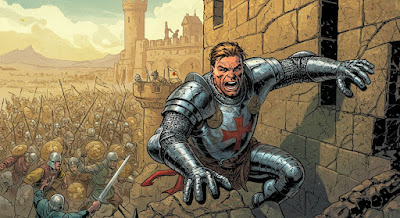
POSTSCRIPT: Whenever I write a scenario for publication, I feel compelled to say again that following a script is not the way to roleplay. A planned set of story events is necessary for novels, gamebooks, movies, and so on, but roleplaying is a unique medium. It can do so much more than traditional narrative forms. The player-characters should have their own reason for arriving at the abbey. They may or may not take an interest in Sir Hubert’s story. In the novella the protagonists have a pressing motive; they desperately want to replace King John, and they think his spies may be onto them so they have a reason to hurry. Even if the PCs hear what Sir Hubert has to say, they might ignore it or chase it up in any one of a dozen ways – they wouldn’t necessary choose to go scooting off to the Holy Land. But needs must, and I know you’ll just take all the above as bunch of suggestions to be used, modified or abandoned as the individual needs of your player group dictate.

If you're looking for more inspiration for Dragon Warriors adventures, Red Ruin Publishing has a marvellous range of solo adventure gamebooks, scenarios, fiction, and of course the Casket of Fays fanzine, all designed to let you enjoy the game's 40th anniversary to the full.