Gamebook store

Showing posts with label aliens. Show all posts

Friday, 28 April 2023

How to make things stranger

This article originally appeared on my Patreon page for 5 January 2022 -- there with a little extra content -- and I'm reprising it here in hopes of enticing a few more of you to come and back me. 

“The chimera was beginning to bore people. Rather than imagining it they turned it into something else. As a beast it was too incoherent; the lion, the goat and the snake do not readily make up a single animal.”

Borges there, writing in The Book of Imaginary Beings, and he’s dead right. I never quite embraced the Greek myths as a kid because of all those monsters with the forelimbs of animal X and the hindquarters of animal Y. Even as a kid I thought they should have tried harder. The Norse myths came steeped in really dark and dreamlike elements, which I loved and that’s probably why Legend turned out the way it did.

This came up in a recent episode of The Good Friends of Jackson Elias, my second favourite fantasy gaming podcast. The chaps were talking about Robert E Howard’s short story “The Tower of the Elephant”, and I got to thinking about how almost every illustration of Yag-Kosha just plonks an elephant’s head onto a man’s body. You can almost hear the scratch of the pen as the artist carefully copied a picture from a zoology book.

But here’s how Yag-Kosha is described in the story:

“Conan stared at the wide flaring ears, the curling proboscis, on either side of which stood white tusks tipped with round golden balls. [...] This then, was the reason for the name, the Tower of the Elephant, for the head of the thing was much like that of the beasts described by the Shemitish wanderer.”

Yag-Kosha is an extraterrestrial. While REH was no doubt inspired by the mythology of Ganesha, I think he had something stranger and more original in mind. A body with two arms and two legs, and head that has protuberant teeth or horns and a long, prehensile snout – of course to Conan it looks like an elephant-headed man, but that’s no excuse for artists to be so literal.

One of the worst offenders is the illustration by J M Wilcox from the March 1933 edition of Weird Tales:

No better is Ernie Chan’s depiction from The Savage Sword of Conan. Somewhere there’s a photo of an elephant’s head that looks exactly like this:


Likewise this uninspired mix-n-match. The artist evidently just couldn't be bothered:


On the other hand, Cary Nord put some real thought into his version (the header for this post). And here’s a properly alien one I found online (artist unknown):

The takeaway is that we all find our inspiration in the familiar, but when transmuting that lead into fantasy gold it pays off to hide your sources. And, along with that, always to look for a new angle on familiar material. For instance, vampires that seem to have been whisked off the set of a Hammer horror movie will probably not give your players a genuine shudder, but investing a little work in dirtying them up, or adding an outré spin on the concept, can yield a very memorable encounter.

Incidentally Scott is right on the money about both Conan’s physique and the need for realism to ground fantasy fiction -- but those are subjects for another post.

Friday, 12 November 2021

A devil's bargain

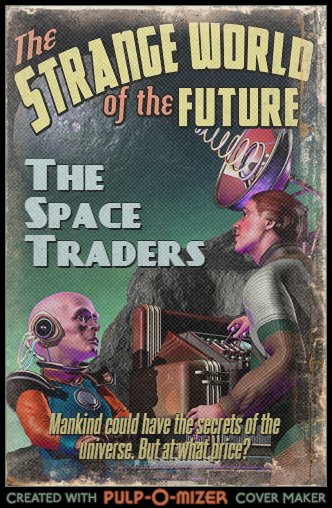
Image by Pulp-O-Mizer
Not many fantasy stories are more often cited as thought experiments in moral philosophy than as fiction. I’m thinking of “The Space Traders” by American lawyer Derrick Bell. In a nutshell: super-powerful beings arrive on Earth and offer the United States money, energy and technological advances if all the non-black people agree to hand over all the black people to the angels/devils/aliens.

The Trolley Problem it ain’t. We can’t know what other people will do when faced with an ethical question. It’s hard enough to predict what we’d do ourselves; look at all the people who are convinced they’d have stood up to the Nazis if they lived in 1930s Germany. Derrick Bell takes a misanthropic view -- in his story there’s a referendum and the black Americans are handed over. If Germany had held a referendum in 1940, would the majority have voted to exterminate the Jews? They certainly colluded with that policy, but it was framed in a way that allowed the average citizen to tell himself that he didn’t actually know what was going on. Being confronted with the stark truth and voting on it – morally pulling the trigger, so to speak – would be a different story. We hope.

And the Jews had been demonized in Nazi propaganda for years. Posters claimed they’d betrayed the country, hoarded gold, spread disease – all sorts of conspiracy nonsense, and (as now) there are always idiots who’ll believe it. But for citizens to turn against a group of fellow citizens out of a clear blue sky – whites against blacks, or blacks against whites, even given the dire racial history of the Confederacy -- would be a whole other matter, surely? We cling to the hope humanity is better than its worst moments.

And yet… Islamic State threw gay men off rooftops and then stoned them if they survived that. The people who flocked to join IS presumably condoned it. Even so, it’s not the same as voting within a normal society to murder a group of people. IS was a self-selected band of extremists; we’d expect them to behave like rabid fanatics.

It seems like it might be easier to turn on a subgroup if belonging to that subgroup is a matter of choice rather than an accident of birth. The English in Tudor times might have voted to round up Catholics, if voting had been a thing. The Khmer Rouge, in common with many populist movements, hated intellectuals and was happy to persecute them. Crusades and holy wars throughout history have been all about exterminating people who don’t believe in your big guy in the sky.

Derrick Bell’s story would be more interesting if, instead of making his fictional citizens outright monsters, he’d presented them with a choice that was more honestly and credibly tempting. “We want all your incarcerated criminals,” the aliens/angels could have said. “No harm will come to them but we’re taking them away from Earth.” Even without the offer of extraterrestrial super-tech, getting rid of those inmates immediately saves the US about a hundred billion dollars. Tempting yet?

It’s still an absolutely appalling scenario. With no idea of what fate those exiles are going to face, a vote to hand them over is heinous self-interest and nothing more. However, until very recently a referendum on capital punishment in the UK would have voted in favour of sending some criminals to their death. That’s a lot worse than being banished to space. As a society we don’t make serious efforts to address the root causes of crime, nor to rehabilitate the criminals we have. In a sense we’re already consigning them to exile from humanity, and we’re not even getting fusion power in return.


How might this sort of ethical Gordian Knot be presented in a roleplaying scenario? An example from our Last Fleet game: the war has been going badly for the fleet, and the Corax offer a deal. Humans can live in peace, but they will be settled on one world and they have to give up all their technology. Effectively it would be a return to a primitive Eden. The Corax undertake to watch over the human planet, ensuring no disease or asteroid impact would ever be an existential threat -- but also to make sure we never develop science that could get us off the planet. The deal in a sense is that the Corax are offering to become humanity's gods. Immediately it gets interesting because some will want to take the deal ("We get to live. Our descendants will know peace, not endless war.") but others will bitterly oppose it ("So the human race becomes the pets in a Corax zoo?") If it's presented as a genuine and tempting option, it could cue a lot of gutsy inter-party conflict. I should add that in our game the Corax were not interdimensional fungi (wtftm) but creations of humanity ourselves. A war against your own rebel children is obviously more interesting than one against a genuinely alien Other.

Or it could be a bargain like the one Clark Ashton Smith postulates in his story "Seedling of Mars". The alien's offer ends up dividing humanity into two warring camps -- which might well have been the intention all along.

Going back to "The Space Traders" idea, the choice needn't hinge on an entire racial or ideological subgroup. People in the millions are abstract. What if it's a single individual? You can have all these wonderful things: free energy, unlimited resources, miraculous medicine, nobody goes hungry… and in return you give us one person. One human being for the lives of billions yet to be born.

What would you do?