Gamebook store

Showing posts with label science fiction. Show all posts

Friday, 5 June 2026

A waste of a great concept

In 1975, Empire of the Petal Throne introduced roleplaying gamers to the world of Tekumel, a beautifully detailed fantasy setting that was the first of its kind to feature non-Caucasian characters in a society nothing like the usual Graeco-Roman or medieval world. In fact it was the first ever society of any kind to appear in a roleplaying game, D&D and its imitators up to that point being just "a medieval Wild West" whose society consisted of nothing but a shop to spend your loot in.

Tekumel’s creator, M.A.R. Barker, drew on inspiration from South-East Asia, the Middle East, China and Pre-Columbian civilizations without his world actually being like any of those cultures. The result was something very different from other RPGs – and from most American or European fantasy literature. What made Barker's creation so revolutionary in 1975 was its vision of entire civilizations that didn't look, think, or act like variations on medieval Europe. Barker’s greatest gift to the fantasy genre was showing us that other worlds could be genuinely other. That lesson feels more important now than ever. Paul Mason gives a taste of what I’m talking about here.

That’s not how Tekumel gamers (a small and dwindling group) usually get to approach the setting, though. For example, Bethorm is the name of one of many Tekumel-set RPGs that have appeared in the half-century since EPT. It’s also the Tsolyani word for a pocket dimension, apparently. But why do the Tsolyani have a word for "pocket dimension"? Why do they even have the concept? It can hardly be something an ordinary citizen would use in everyday life, after all.

Consider the real world. "Galaxy" was the Middle English word for the Milky Way. Nobody knew until the 1920s that we lived in one galaxy and that there are trillions of others. Nobody knew until the 1950s that the universe is billions of light-years across. We don't even now have single words for dark matter and dark energy, and they are observable (in the first case, anyway), so I'm stumped as to how even educated Tsolyani ended up coining a word for "pocket dimension".

One argument is that the Tekumel setting incudes “learning spheres” – find one, give it a twist, and you’re an instant expert in whatever was originally programmed into it. So if learning spheres are common, that means the technological know-how of yore need never have been lost. Tekumel would be like the world in Zelazny's Lord of Light, where most people think that gods and demons and magic are real, but the select few know that's all just a way of explaining science to the uneducated. And if you spoke to those select few they would know all about quantum theory, atoms, cybernetics, etc.

(There's actually a real-life equivalent of this, incidentally. When William Kamkwamba wanted to build a dynamo in his village in Malawi, he told the locals he needed to collect old bits of machinery "to do some magic" because he knew that's how they would interpret what he was doing.)

The trouble is, we’re told that learning spheres are used up when activated. And they were constructed at least 30,000 years before the present day. So I don’t think they’d be a significant factor in the education of the Tsolyani, certainly not to the extent of making the concept of pocket dimensions commonplace.

This opens up the question of how much magic is there in "real" Tekumel. I imagine a world where priests do a lot of rituals before and during a battle, and those rituals have a real effect on morale, and many soldiers will swear blind they saw miraculous things like lightning bolts, but in fact that's mostly in the mind. So this would be a low-fantasy world with no more magic than Westeros, not a pulp sci-fi setting with spells like phaser-blasts. I do realize this would be unpopular with Tekumel enthusiasts, but after all they are an endangered species. My Tekumel doesn't consist of characters discussing abstruse cosmic concepts like bethorms.

What would Tekumel look like if it were contemporary SF/fantasy rather than 1950s-influenced Planet Stories, a bit like the way Battlestar Galactica was rebooted? Most Tekumel fans seem to prefer the space opera version, a genre that was repopularized by Lucas in the '70s after all. They play games in which the rich culture of Tsolyanu, Livyanu and the other states is all but irrelevant. Instead player-characters gad about between bethorms encountering alien/human multidimensional politics and yammering about warp drive and gravity engines, while Barker's invented societies, so marvellously different from our modern world, are flattened into the same sci-fi mush you’ll see in a dozen fungible entertainment franchises. 

It makes no sense. Barker was a linguist and anthropologist and he describes wonderfully strange civilizations which he brings to life in minute detail. That's where Tekumel shines. He wasn't a scientist and his science fiction ideas are a dime a dozen. His SF is also typically mid-20th century Western in flavour, whereas the cultures he created don't resemble any historical setting, most especially not any Western one. Not that setting alone is enough to deliver a compelling story, especially not in an era of BookTok, celeb book clubs, and dopy romantasy sagas. You need characters you care about. But the setting is the environment they move in, and if it's off-the-peg then the situations are too. Lizzie and Mr Darcy's relationship means nothing outside the special context of Regency culture and socioeconomics. Jane Austen even starts the novel with an ironic statement about that.

If I were to reboot Tekumel, I’d throw out the “Doc” Smith space opera stuff and make it more about everyday life. Much less magic and much, much, much less whizzy technology. The Eyes wouldn’t have standard names; they’d be too rare for that. There wouldn’t be an internet of telepaths reliably sending messages across thousands of miles overnight. There’d be no thousand-year-old plans hatched in “pocket dimensions”, no routine encounters with robots and gadget-wielding aliens. I’d strip it all back to what really is unique and wonderful: the cultures that Barker created. As we look toward the future of fantasy gaming and fiction, his example reminds us of the beauty of diversity. The most memorable worlds aren't built on clever mechanics or exotic technologies. They're built on the patient work of imagining how people actually live, love, struggle, and die in societies radically different from our own. That's the kind of magic that never gets old.

Friday, 27 February 2026

How to game the Kessel Run

In this RPG-a-minute episode of Improvised Radio Theatre With Dice (about 27 minutes in) Roger and Michael propose a Traveler-style SF concept:

"There is a starship at planet A, you have to get it to planet Z. You are being hired to do this. You're being paid a basic stipend, and fuel and maintenance or whatever, but any money you can make along the way, that's fine, you can keep it."

It's Wagon Train to the stars – and why not? Or you could set it aboard a sea-going vessel in ancient, medieval or early modern times. Or make it about delivering a truck cross-country in a campaign modelled on Damnation Alley. There’s plenty of scope for developing picaresque adventures of the week as you go.

But that’s only half the potential. A good story arises in the tension between what you want to do and what you’re allowed to do. Consider how many Star Trek episodes are built around solving a problem in spite of the Prime Directive. So I’d suggest presenting the player-characters with their contractual terms of employment:

INTERSTELLAR DELIVERY CONTRACT

Base Compensation: 50,000 credits upon successful delivery

Time-Performance Clause:

  • On-time bonus (delivery within 365-400 standard days): Additional 25,000 credits
  • Early delivery bonus (under 365 days): 100 credits per day early, capped at 10,000 credits
  • Late penalties:
    • Days 401-500: Lose 200 credits per day from base pay
    • Days 501-600: Lose 500 credits per day
    • Days 600-700: Contract void, crew liable for ship's full value
    • Day 700+: The ship is deemed stolen and arrest warrants will be issued for all crew, who will be liable for the ship’s full value plus damages of up to 100x that

Fuel and Consumables Accountability:

  • Crew receives fuel allowance calculated at 120% of direct route requirements
  • Excess fuel costs deducted from final payment
  • Documented emergency detours exempt from fuel penalties

Permitted Commerce Provisions:

  • Crew may conduct trade using up to 30% of cargo capacity
  • Passenger transport permitted in designated quarters only
  • All commerce profits belong to pilot
  • Ship modifications for commerce prohibited without written approval

Route Deviation Clause:

  • Minor deviations (adding less than 30 days) permitted without penalty
  • Must log all stops with legitimate commercial/maintenance justification
  • Employer reserves right to audit ship's navigation logs

Performance Bond:

  • Crew posts 10,000 credit bond, returned upon successful delivery
  • Bond forfeited if ship arrives with unreported damage or illegal modifications

Maintenance Requirements:

  • Designated captain responsible for routine maintenance costs
  • Major repairs (over 5,000 credits) reimbursable if properly documented
  • Ship must pass inspection upon delivery or crew liable for repair costs

Any new crew member or passenger who travels outside the star system in which they came aboard is required to be a signatory to these articles and will be treated as a crew member for all legal purposes. It is the responsibility of the designated captain or their appointed representative among the ship’s company to ensure this is done, or risk a financial penalty to be determined by the courts.

This legal framework makes significant detours financially painful while still allowing the characters flexibility for interesting adventures along the established trade routes.

Now let’s consider the possible loopholes. That’s where things could get interesting – if the characters think of them:

  • The Maintenance Gambit: They could claim extensive "preventive maintenance" is needed at conveniently profitable trade hubs. Who's to say the ship doesn't need a full diagnostic after passing through that nebula? Maintenance stops are explicitly allowed, and if they befriend/bribe the right mechanics to provide documentation.
  • The 400-Day Sweet Spot: They lose the 25,000 credit time bonus if they take over 400 days, but penalties are only 200 credits/day after that. So days 401-425 cost them just 200 credits each against the time bonus they've already lost. If they can make more than 200 credits profit per day on those stops, they’re ahead.
  • Creative Fuel Accounting: "Documented emergency detours" are exempt from fuel penalties. Pirates spotted on scanners? Better take the long way around. Stellar phenomena? Navigation hazard. Build up a file of sensor logs showing various "threats" that necessitated course changes.
  • The Passenger Shuffle: "Designated quarters only" – but what if passengers are willing to pay premium rates to hot-bunk or squeeze extra people in? The contract doesn't specify maximum passenger density, just which quarters they can use.
  • The Cargo Hustle: That's 30% of cargo capacity, not 30% of cargo value. They could fill it with incredibly dense, high-value items. Also, who's measuring? Is it by volume? Mass? If they claim some cargo areas are "inaccessible due to maintenance," does that reduce the total capacity and therefore increase their effective percentage?
  • The Reimbursable Repair Scheme: Major repairs over 5,000 credits are reimbursable. What if they have a "catastrophic failure" requiring expensive repairs at a station where they just happen to have excellent trade connections? Or where the repair shop owner owes them a favour and inflates the invoice?
  • The Navigation Log Edit: "Employer reserves right to audit" – but that's not automatic. They might not bother if the ship arrives in decent condition. And navigation logs can be tricky things: cosmic radiation, system glitches, all sorts of unfortunate data corruption...

The real beauty is combining these. Take 399 days for the journey (just under the penalty), claim you rushed to make it on time despite multiple "emergency detours" and "critical maintenance", arrive with documentation for everything, and walk away with base pay plus bonus plus a year's worth of side profits.

But those are still just plot-based exploits. More interesting still is if the contract includes ethics clauses that could constrain the characters’ ability to turn a profit. As a real-world example, some Shell negotiators in the 1990s were setting up business links in the former Soviet Union. They met with officials who proposed a scheme that would divert funds provided by the state. The officials would become rich and Shell would get a kickback. The latter had to explain that they were bound by ethical standards that didn’t permit that kind of skulduggery. Presumably the ex-Soviet officials found another company to deal with, became oligarchs, and later bought football teams or palaces on the Black Sea, but the point is the Shell guys’ hands were tied by their own company's ethical protocols. Something similar in the spaceship contract terms could pay story dividends later.

Friday, 2 May 2025

A feeling of overwhelming awe

One of my favourite places in the mid-1960s was the London Planetarium in Baker Street. In fact that’s not strictly accurate. My favourite place was, as always, the inside of my own head. The Planetarium was just a good way to get there.

The auditorium was nearly twenty metres across and in the centre was the giant ant-like shape of a Zeiss Mark IV projector. As the lights dimmed, the cosmos was thrown against the dome and on wings of the imagination you could soar among the stars.

It never failed to cause a tingling at the back of my neck. "Do they chill the room when the show starts?" I asked my father. They didn’t have to. The sensation of cold I felt was awe at the immensity of space, a delicious sensation on the cusp between excitement, curiosity, and fear.

H.P. Lovecraft must have felt those same emotions. He talked about that “mixed wonder and oppression which the sensitive imagination experiences upon scaling itself and its restrictions against the vast and provocative abyss of the unknown.” I wouldn’t call it oppression myself. Even to say fear isn’t right. I was eager to launch myself into that abyss; I loved the daunting face of the unknown, the mind-staggering distances between stars and galaxies. I didn’t then and don’t now subscribe to any religious views – they would only have diminished and cheapened the experience. The uncaring blankness of the universe was exactly what attracted me and instilled that awe.

Lovecraft called it the chief emotion in his psychology, and in that respect we’re kindred spirits. So it’s surprising that, until now, only one of my books could really be said to be Lovecraftian, and that's Heart of Ice.

I’ve run Lovecraftian roleplaying games, though never really a devotee of Call of Cthulhu. Investigation is only the most superficial element of HPL’s tales, and there is always the risk with any investigative scenario that it will fall into the old-fashioned whodunit pattern in which some enormity disrupts the status quo, the investigator solves it, and normal order is restored.

That’s not intrinsic to CoC, but it’s a template that players may expect. A better form of mystery that offers scant comfort is noir. There the transgression is revealed in greater and greater depth as the layers are peeled back. The investigator is unable to stop, like unwrapping the bandages over a suppurating wound, and there is no denouement in which order can ever be restored and people made safe because the safeness was an illusion to begin with. The world is not set right, the problem is not really fixed, but the investigator is fundamentally changed by his or her experiences, and it is that journey to face up to a reality that gives no consolation that makes for a kind of bleak heroism, just as Lovecraft’s cosmic fiction should.

“In general, we should forget all about the popular hack conventions of cheap writing and try to make our story a perfect slice of actual life except where the one chosen marvel is concerned. We should work as if we were staging a hoax and trying to get our extravagant lie accepted as literal truth.”
– H.P. Lovecraft, Some Notes on Interplanetary Fiction

So when Paweł Dziemski, the creator of Storm Weavers, proposed that he and I should collaborate on a Lovecraftian horror gamebook and app, my only thought was why had I left it so long? I’ll have more to reveal about our project in the weeks ahead, but for now I’ll just leave you with the title: Whispers Beyond The Stars. We’ve aimed to make it a truly cosmic horror adventure, and we hope that HPL would approve.

Thursday, 23 January 2025

This again?

'You should read some history, sonny boy. Read about the Black Shirts and the Gestapo and concentration camps.'

'That's not the same thing as Lisa Treadgold. Hitler was a fiend. Lisa's just a very beautiful woman with strong opinions. Do you mind her being so beautiful?' Timothy asked innocently.

These words made Fanny so angry she stopped the car. 'Listen, dumbo,' she said, glaring. 'I realize I'm no oil painting, and I'm not rich, and I'm not famous, and no one wants my autograph--'

'And you smoke too much,' Timothy said cheekily, trying to make her smile. Really, he was quite afraid of her at that moment. She looked fierce.

'And I smoke too much,' Fanny agreed. 'But there's one thing I'll tell you, and it's this. Learn to be frightened. When you see some magic-type person, a public person, hogging the media to talk about bringing back the birch and hanging, it's time to get a little nervous. Because the person who gets beaten or hanged might turn out to be someone you know. You with me so far?'

Timothy said, 'Okay so far.'

'But when that sort of person talks about action groups and banded together brotherhoods of citizens and vigilantes, get terrified. Because the person who gets dragged away in the middle of the night for a flogging might turn out to be you. Yes, you. Simply because you're a decent, normal, pleasant, dim human being. The sort of person who just happens to get in the way of the bully boys and bully girls. Do you understand, Timothy?'

Nicholas Fisk's novel You Remember Me! was originally published in 1986 but has been forgotten where other kids/YA fantasies, less uncompromising, have endured. Too bad. In it, a TV star founds a right-wing populist political movement with promises to make the country great again. A generation raised on stories like that might not be making the mistake of putting people like this in power -- because, once they have it, they intend to hold onto it, and to do so they will uncaringly wreck the democratic institutions and regulations that have taken generations to set up.

Narcissists and plutocrats served by a coterie of sycophants and compliant dopes insincerely pandering to the electorate's sense of inadequacy with crude slogans... it's a stuck record and you'd think people would be fed up to the back teeth of it, but it seems that politics, like entertainment, just consists of the same old clichés endlessly recycled.

I'm not delusional; I realize there's no going back to 'normality' now. Western democracy is in its end-of-the-republic phase, authoritarian regimes are thriving, and the world is cooking its own goose. Still, track down a copy of Mr Fisk's book if you can find one. Or at least listen to the hosts of the Backlisted podcast discuss it with author Sam Leith. Or watch Asif Kapadia's new movie 2073. Too grim? Hey, it's less disheartening than watching the news

More about Elon Musk tomorrow, I'm sorry to say.

Friday, 29 March 2024

Maps of the mind

Martin Noutch, author of the wonderful Steam Highwayman books, is a true scholar of the craft of gamebook writing. One of the reasons his own books are so good might be because he has thoroughly analyzed the works of other writers in the field. The shoulders of giants and all that.

So that you can benefit from his studies too, Martin recently posted his story maps of the Fabled Lands books. Looking at those prompted me to dig out some of the maps I used to plan the books. Astonished that I still have this stuff after 30 years? I'm working on that hoarding obsession.


Trust me when I say that you haven't seen the full possibility of storytelling married to open world gamebooks until you've played the Steam Highwayman series.


And if you like the idea of steam-powered vehicles and picaresque adventures in an early 19th century setting (or style thereof), I recommend Keith Roberts' seminal SF novel Pavane. (It is SF, incidentally, and not steampunk, which is really a branch of fantasy because physics, but I don't want to give any spoilers. Read it and see.)

Friday, 18 August 2023

Likeability is overrated

I've said it before: in fiction (but not in life) likeability is overrated. Here's author Robert J Sawyer on one of the Five Things You Need To Write Compelling Science Fiction and Fantasy Stories:

'An interesting character. Not necessarily a likeable one, not even necessarily a relatable one, but an interesting one. The best example of a complex main character in all of science fiction is Robinette Broadhead in Frederik Pohl’s Hugo and Nebula Award-winning Gateway, which is told as flashbacks during Broadhead’s psychoanalytic sessions with a computerized shrink. He’s not at all likeable, but, wow, is he ever fascinating.'

It also applies to player-characters in games. Players can be too worried that others will judge them personally by the characters they choose to play. Screw that. There's nothing more boring than a game populated by decent people, however much we'd like real life to be like that. Make your characters interesting, and never mind if they're nice.

Some more thoughts from me on that here and here. But you're always having to put up with what I think, so if you're pressed for time look at Mr Sawyer's advice. Like Pohl, he too has won the Hugo and Nebula Awards. He says, 'I was born to write for [the Star Trek] franchise!' and I concur. I would love to see his take on the ST universe.

Friday, 12 November 2021

A devil's bargain

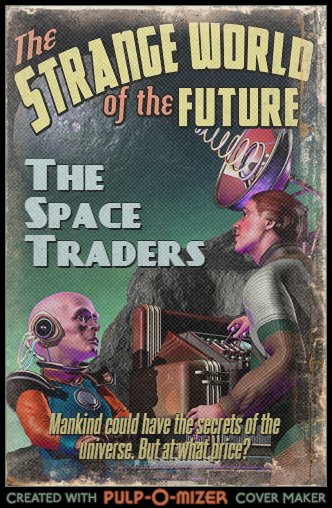
Image by Pulp-O-Mizer
Not many fantasy stories are more often cited as thought experiments in moral philosophy than as fiction. I’m thinking of “The Space Traders” by American lawyer Derrick Bell. In a nutshell: super-powerful beings arrive on Earth and offer the United States money, energy and technological advances if all the non-black people agree to hand over all the black people to the angels/devils/aliens.

The Trolley Problem it ain’t. We can’t know what other people will do when faced with an ethical question. It’s hard enough to predict what we’d do ourselves; look at all the people who are convinced they’d have stood up to the Nazis if they lived in 1930s Germany. Derrick Bell takes a misanthropic view -- in his story there’s a referendum and the black Americans are handed over. If Germany had held a referendum in 1940, would the majority have voted to exterminate the Jews? They certainly colluded with that policy, but it was framed in a way that allowed the average citizen to tell himself that he didn’t actually know what was going on. Being confronted with the stark truth and voting on it – morally pulling the trigger, so to speak – would be a different story. We hope.

And the Jews had been demonized in Nazi propaganda for years. Posters claimed they’d betrayed the country, hoarded gold, spread disease – all sorts of conspiracy nonsense, and (as now) there are always idiots who’ll believe it. But for citizens to turn against a group of fellow citizens out of a clear blue sky – whites against blacks, or blacks against whites, even given the dire racial history of the Confederacy -- would be a whole other matter, surely? We cling to the hope humanity is better than its worst moments.

And yet… Islamic State threw gay men off rooftops and then stoned them if they survived that. The people who flocked to join IS presumably condoned it. Even so, it’s not the same as voting within a normal society to murder a group of people. IS was a self-selected band of extremists; we’d expect them to behave like rabid fanatics.

It seems like it might be easier to turn on a subgroup if belonging to that subgroup is a matter of choice rather than an accident of birth. The English in Tudor times might have voted to round up Catholics, if voting had been a thing. The Khmer Rouge, in common with many populist movements, hated intellectuals and was happy to persecute them. Crusades and holy wars throughout history have been all about exterminating people who don’t believe in your big guy in the sky.

Derrick Bell’s story would be more interesting if, instead of making his fictional citizens outright monsters, he’d presented them with a choice that was more honestly and credibly tempting. “We want all your incarcerated criminals,” the aliens/angels could have said. “No harm will come to them but we’re taking them away from Earth.” Even without the offer of extraterrestrial super-tech, getting rid of those inmates immediately saves the US about a hundred billion dollars. Tempting yet?

It’s still an absolutely appalling scenario. With no idea of what fate those exiles are going to face, a vote to hand them over is heinous self-interest and nothing more. However, until very recently a referendum on capital punishment in the UK would have voted in favour of sending some criminals to their death. That’s a lot worse than being banished to space. As a society we don’t make serious efforts to address the root causes of crime, nor to rehabilitate the criminals we have. In a sense we’re already consigning them to exile from humanity, and we’re not even getting fusion power in return.


How might this sort of ethical Gordian Knot be presented in a roleplaying scenario? An example from our Last Fleet game: the war has been going badly for the fleet, and the Corax offer a deal. Humans can live in peace, but they will be settled on one world and they have to give up all their technology. Effectively it would be a return to a primitive Eden. The Corax undertake to watch over the human planet, ensuring no disease or asteroid impact would ever be an existential threat -- but also to make sure we never develop science that could get us off the planet. The deal in a sense is that the Corax are offering to become humanity's gods. Immediately it gets interesting because some will want to take the deal ("We get to live. Our descendants will know peace, not endless war.") but others will bitterly oppose it ("So the human race becomes the pets in a Corax zoo?") If it's presented as a genuine and tempting option, it could cue a lot of gutsy inter-party conflict. I should add that in our game the Corax were not interdimensional fungi (wtftm) but creations of humanity ourselves. A war against your own rebel children is obviously more interesting than one against a genuinely alien Other.

Or it could be a bargain like the one Clark Ashton Smith postulates in his story "Seedling of Mars". The alien's offer ends up dividing humanity into two warring camps -- which might well have been the intention all along.

Going back to "The Space Traders" idea, the choice needn't hinge on an entire racial or ideological subgroup. People in the millions are abstract. What if it's a single individual? You can have all these wonderful things: free energy, unlimited resources, miraculous medicine, nobody goes hungry… and in return you give us one person. One human being for the lives of billions yet to be born.

What would you do?

Wednesday, 27 January 2021

The mutants


I don't often cross-post to my personal blog, but this month I'm talking about Daleks -- with some side detours into SF writing in general -- so that might be of interest even if you're not a comics fan.

More science here on Friday. Not fiction, this time, but fact. I'll be talking about big balls of wibbly-wobbly, timey-wimey stuff. Set your dematerialization circuit.

Thursday, 19 November 2020

Dish of the day


I've posted before about the genesis of the Starship Captain books (The Wrong Side of the Galaxy and A Galaxy Too Far). The first book began in the style I would have enjoyed when I was eleven, but fifty years on publishing is a very different world. Some of the material I wrote ended up on the cutting room floor and Jamie rewrote much of the rest. The finished book is about 20% mine in terms of text, but hardly mine at all in tone.

Here's an example of a chapter from my version of the book. Skip right to it now if you don't want spoilers. Taking inspiration from the thought that being a food animal for humans is a winning evolutionary strategy (where would pigs, cows and chickens be today if we didn't rear them to eat?) I wondered how an alien politician might act to preserve his species in the face of an all-conquering genocidal civilization. The Leptira are that civilization, here described as "insectoid" -- another thing that would have annoyed 11-year-old me but that is standard practice in modern sci-fi. Don't judge Poltro too harshly, will you? What else can he do to save his people? It isn't so crazy that turkeys might vote for Christmas, after all, if the alternative is extinction.


A Hard Bargain

“Sir, are you feeling all right?” said the applicant, his young face scrubbed and shining with concern.

“I’m fine, thank you,” said Poltro.

It was a lie. Being aboard a Leptira flagship was enough to give anyone a terminal case of the jitters, but the main reason he was feeling peaky was the two litres of insect poison he’d forced himself to drink that morning. He pulled out a silk handkerchief and dabbed at his pudgy face. Was the room spinning? They were in orbit, of course, but this seemed worse. I mustn’t pass out, he told himself. That really would be the end of the world.

Poltro had an antitoxin to neutralize the poison, but that was back on his bedside table, about forty kilometres straight down. He could hardly bring the antitoxin to the meeting in case the Leptira searched him, but he didn’t think he’d need to. Everything would have been fine if they’d stayed on schedule – by now he’d be on the shuttle home. Except that the ambassador had already kept them waiting almost an hour. Poltro should have anticipated that. By now the stuff was really working its way into his bloodstream and, although it was meant to be fatal only to insects, he was getting to feel as if somebody had put all his internal organs in a smoothie blender.

“Ugh.” Poltro clapped his hand over his mouth. Between the effects of the poison and guilt at what he was about to do, it was a struggle not to throw up all over the ambassador’s waiting room.

“Are you sure you’re okay?” said the applicant, fidgeting on the seat next to him. “Only you’re sweating rather a lot – ”

“They keep it too hot in here,” Poltro shot back.

“ – and the sweat looks sort of… well, green.”

Poltro didn’t look at him. He didn’t want to see the look in the applicant’s eyes – eagerness, honesty, decency. That’s why he’d kept everything so coldly businesslike up till now. Getting to know the fellow would only make it harder.

“A new mineral supplement I’ve been taking,” he said. “It’s good for the liver.” He didn’t add that unless he got the antitoxin quite soon, he’d probably need to buy a new liver.

He could feel the applicant’s relief. “Oh, I haven’t heard of that one. I’ve got a whole range of vitamin and mineral – 

The door to the ambassador’s office hissed open and a Leptira official in stiff grey-and-orange robes emerged holding a slate. It scanned the list of names and appointments with eyes as unreadable as lumps of polished coal.

There was no-one else in the waiting room. Finally the wretched creature looked up at them.

“Senator Poltro Gnaktagurr,” it declared in a scratchy voice that sounded like an off-key tune played on an instrument stringed with raw nerve endings.

Poltro winced. Typical Leptira disdain for local customs. As a member of a noble family, most of the letters in his name were silent. It was supposed to be pronounced just “Nak”, like somebody starting to say “no” but hiccupping instead. Still, what was the point of correcting it? Most of the young people of his own planet could hardly be bothered with the old customs, and when you had dealings with the Leptira, your name was whatever they chose to call you.

 “I’m here.” He got slowly to his feet, shrugging off a helping hand from the young applicant.

The ambassador’s office wasn’t quite as big as a throne room, it only seemed that way because of being built across three levels of a converted docking bay. Poltro traced a fresh dampness in the air to a stream that gave off a soft relaxing murmur as it ran down from the carpeted upper area through a garden of heavily over-scented flowers from Leptira’s purple moon to a replica beach. The white sand of the beach area had been raked into the careful geometric patterns that the Leptira loved to create and then destroy. Beyond that, a view of Poltro’s home planet of Mondress filled three-quarters of the vibroglass window that looked out into space.

Despite himself, Poltro was impressed. He could easily imagine the Leptira sitting on that beach with cold drinks and a plate of bar snacks at the end of a long day, gazing out of the window and discussing the planet they intended to destroy.

It didn’t surprise him that a Mondressan ambassador like himself wasn’t considered important enough to merit a meeting on the garden or sand levels. The Leptira ambassador sat waiting directly in front of them at a transparent desk inside which luminous eels swam sluggishly. Behind him – or her, or it – stood half a dozen other officials, all wearing the distinctively hexagonal-patterned clothing, armour and weaponry of the Leptira diplomatic corps. There were no other chairs.

“Your Excellency,” Poltro bowed and then held out his hand, confident that the ambassador wouldn’t shake it.

To his surprise, however, the ambassador got up and came around the desk. A feeler reached out to stroke his fingers. Poltro felt the briefest touch of buzzsaw-sharp bristles, like a horse flicking at flies with its tail, then the ambassador drew his arm away. Perhaps he sensed the poison in Poltro’s blood, or perhaps it was just natural rudeness.

“So this is your applicant,” said the ambassador, fixing all his eyes on the young man.

“Pleased to meet you, Excellency.” The applicant extended his hand and the ambassador took it in both sets of feelers, stroking it with the careful attention of a gourmet judging the ripeness of a piece of fruit.

“Mmm,” buzzed the ambassador in satisfaction, and looked at Poltro as if to say, “Ah, so you didn’t put any nasty poison in this one.”

Poltro was feeling sick again. He just wanted to get the whole business over with. “Show His Excellency your résumé,” he told the applicant.

The ambassador stared at the folder that was offered to him, then waved over one of the officials, who snatched it from the applicant’s hand. Laboriously – because Leptira diplomats were given more training in warfare than in foreign languages – it read out the list of accomplishments.

The ambassador gave an impatient flick of his antennae. “So you can type, manage a database and you know how to file a report in octupilicate…”

“I also have a degree in Interstellar Relations,” said the applicant, looking hurt.

“I’m more interested in – what would you call it on your planet, Poltro?”

“The inner man?”

“Precisely. This position calls for a well-rounded individual.”

“Well,” said the applicant, his enthusiasm kicking up a gear, “my hobbies include painting miniature  – 

“I’m sure that’s marvellous,” interrupted the ambassador. “Those miniature whatevers don’t paint themselves. But a healthy mind requires a healthy body.”

The applicant looked to Poltro for reassurance. It was beginning to dawn on him that the interview wasn’t going the way anybody would expect for a secretarial position.

“His Excellency just wants to be sure that you are in proper physical condition for this job,” said Poltro hurriedly. “It’s not just pattering fingers on a keypad and lifting the phone, you know. There could be travel – to the galactic main, even to the Hub.”

He turned away to look at the aquarium desk so that he wouldn’t have to see the gleam of excitement in the young man’s eyes.

“That’s a coincidence, the senator and I were just talking about vitamin supplements,” the applicant told the ambassador. “I’m quite a health nut, I’m afraid. Exercise and a good diet are hobbies of mine too.”

“Don’t apologize,” said the ambassador. “That’s exactly what we like to hear.” He took the folder from the official and went so far as to glance at the cover. “You don’t smoke, drink, mash or steep, I take it?”

“Mash? Steep?” The applicant hesitated for a moment, puzzled at the bad habits of far-off worlds, but soldiered on through. “Er, no, I don’t do any of those things.”

“There’s only one more question,” said the ambassador. “You’re not, I trust, a vegetarian..?”

“I suppose I ought to be,” laughed the applicant, “but I just love meat too much.”

“Mmm.” The ambassador looked up. “Me too.”

Poltro couldn’t take any more of this. “If that’s settled, Excellency, I expect we should be getting out of your way.”

“Oh, you can go, Poltro,” said the ambassador. “I was thinking that Mr –  he looked again at the résumé – “Mr Kolvubar here – 

“It’s pronounced ‘Kolbar’, actually,” said the applicant. Everybody ignored him.

“I’m so impressed with Mr Kolvubar,” said the ambassador, “that I’d like to keep him for lunch.”

Poltro was boarding the shuttle back down to Mondress when his phone beeped.

“Ambassador!” He forced a smile into his voice. “Everything satisfactory, I hope?”

There was a sound that might have been a belch. “Oh yes. I’d go so far as to say your sample exceeded all our expectations, Poltro. I believe we have a deal.”

As the shuttle nosed out of spacedock, Mondress appeared in the porthole, a sun-blazing jewel of clean blue seas and greenly wooded continents. Yet already there were brown scars of deforestation visible. And there in the darker zone where night had fallen, Poltro could make out the dull fiery gleam of Leptira factories, huge disfiguring patches, spreading daily from coast to coast. “Where’s the harm in economic development?” people had been saying. “Let’s face it, Mondress is a backwater. We should be flattered that the Leptira wish to invest in our world.”

Poltro knew what “economic development” by the Leptira really meant. Was everybody else blind? Why did he alone have to save – ?

“Are you still there?” snapped the voice on the phone.

“Yes.” Poltro shook his head. “That’s… marvellous news, Your Excellency.”

“Of course it is. So we’re going to be putting in a larger order next time.”

In between the waves of nausea, Poltro felt both elation and despair. He knew what was coming, but he had to ask. “A larger order?”

“Yes. Shall we say: your entire species?”


Friday, 14 August 2020

Summoned by She


How do you get your players into an adventure? The standard fallback used to be “a man rushes into the pub…” I confess I’ve used it myself, with variations. In gamebooks, you want to get through the set-up fast because the player isn’t getting to make any choices. That’s not so important in a roleplaying game, where just talking in character is as much fun as agency. So over time I’ve allowed the lead-in to an adventure to become a session in itself – the equivalent in comics of decompressed storytelling.

Here’s an example from our Immortal Spartans game. The meta-campaign was Tim Harford’s brainchild to allow multiple referees to run a series of linked campaigns – think Highlander, only Spartan not Scots. In the campaign I ran the characters were based in Constantinople in 877 AD, so at this point they’d been alive for well over a thousand years. In all that time they had encountered only three other immortals like themselves: Enkidu, a deranged being called the Etruscan, and Hiya (= She), originally from Arabia but now ruler of a remote civilization in central Africa.

And then…


HIYA’S INVITATION
20 Ἡραῖος (October), 6386 Anno Mundi.  The evening of the races. The Spartans are having dinner at their waterfront mansion (see cutaway above) when their major-domo comes to say that a vessel is approaching the dock. At this time of night their harbour gate should be shut, so it is surprising news.

The boat is a small single-masted schooner under oars, with a crew of a couple of dozen tall, well-proportioned, handsome men and women. All seem to be Africans. The captain gives his name as Yoruba, and he greets them respectfully with his eyes downcast.  He is a servant of “She Who Must Be Obeyed” and he presents them with a document from her. The document at first appears to consist only of a hieroglyphic eye-symbol, but Ganymedes’s eyes* reveal writing:

“Just a little experiment in optics. Yoruba will bring you to me. Please come at once. – Hiya”

Hiya’s island
Hiya’s palace is on Spoon Island, which is located between the islands of Fortress Island and Saddlebag Island about 12 miles south-east of Constantinople. It is the second-smallest of the Princes' Islands, with an area of 0.006 km2 (0.0023 sq mi).

They are met at the quay by an old African major-domo (whose name is Gotali) and some torchbearers. All keep their eyes on the ground as they address the Spartans, saying they will conduct them to their audience with the Goddess.

They are led by woodland paths strung with lanterns towards a palace through whose open colonnaded windows they see many artworks of antiquity. It seems more a museum than a home, and they are led right along the terrace (an Egyptian mosaic) and across a wide lawn towards a grotto encircled by trees with a fountain in the middle.

The servants silently draw back into the shadows. A light appears in the fountain and there is a suppressed intake of breath from some of the servants. The light grows brighter, then suddenly seems eclipsed so that the centre of the fountain is a block of shadow surrounded by a bright nimbus.

Then they see Hiya’s face appear in a blaze of light across the trees, a flickering image that is sometimes huge and distant, then flickers to lie across the paving stones or the bushes nearer at hand. Her voice comes from all around, as if the night itself was speaking.

Hiya says she is allying with the Tulunid government in Egypt to attack the Abbasid Caliphate. She is providing ten thousand men whom she is currently teleporting to Sinai. She has forty ships with arms and armour here in “Byzantium” (as she refers to it) ready to sail.

The plan is that at the same time the Kingdom of Galicia and the County of Barcelona (under Guifré the Hairy) will attack the Emirate of Cordoba and incite an insurrection to drive the Muslim rulers out of Spain. Hiya expects that after the initial attack, the Pope’s alliance in Italy will send troops to support the Spanish Christians. The Caliph meanwhile will be replaced by Yaqub ibn Ishaq al-Kindi **, an elderly philosopher of the House ofWisdom with radical ideas.

She doesn’t expect the Caliphate to fall immediately. This could be the start of a campaign spanning years or decades. But she is confident that with the Spartans in command they can change the course of history. Hiya’s (very) long term goal is to unify Christianity, Islam and Judaism in a largely ceremonial religion allowing freedom of science and art and without the innate sexism of the Abrahamic faiths. She recognizes that her final goal is still at least a century off, but the first phase is the overthrow the Abbasids.

She wants the Spartans to take the fleet, supply her troops in Syria, then accompany them as commanders in the advance on Baghdad. The fleet will sail in ten days, on 30 October.


This gave some interesting scope for roleplaying in several different ways. First you have to realize that the player-characters had known Hiya for almost a century, and acknowledged her as another immortal like themselves. They saw her as a potential ally. The way she chose to communicate with them, in a display almost stage-managed to portray her as the goddess her subjects believed her to be, therefore raised eyebrows and even hackles. She presented it as merely experimenting with a new and unreliable technology, but the way it came across to some of the characters was as if she was pulling rank, especially after the mysterious way she’d summoned them to the island.

Some of the group excused her, knowing that she (sorry, She) had probably been too absorbed in her various political plans and scientific experiments to consider a little matter like hurt feelings – in modern terms we might put her “on the spectrum”. But that was enough to plant a little seed of disagreement among them. This is how Eidolon, one of the player-characters, described the encounter in his write-up:
“Our servant arrives to tell us of a boat in our private harbour, having passed what should be the closed gates of the harbour walls. We descend prepared for battle, but with relief it is evident that Hiya has sent emissaries to invite us to her counsel. Heading out on their small ship, we pause briefly to discipline the indolent sentries who allowed the ship ingress while they gamed at dice. I make an example of one, that the others may know that discipline is life.

“The ship takes us to a tiny island, where Hiya greets us in shadowy form, her face hanging as upon the wind, flickering at times in a breeze, her words carried to us across the airs of continents. She tells us of her plan. She would enlist our help as generals to lead her army, assembled and ready, against the Abassid Caliphate. Allied with the Tulunid rebels, her forty thousand Africans would smash the centres of the Abassids and, on the back of this display of divine displeasure at their rule, allow her to install a Tulamid reformist at the heart of the Islamic empire.

“Thus far, her plan seems bold. As she develops her intentions fully, she reveals the goal of fracturing all of Western civilization, bringing down the extant Abrahamic faith authorities and liberating all from shackles of class and gender. Moments after this revelation, her far-speaking magics*** fail and we are left darkling, to discuss our reply. Our concerns are several, our views divergent. Firstly, that this plan is revealed at such a late stage to us. Secondly, that learning may be lost in times of war. Thirdly, that the centres of civilization which will be swept up into this maelstrom of conflict already shelter some of the more enlightened views on the protections and entitlements for women and slaves, when compared with the Northern barbarians and the Bulgars. Fourthly, the danger that centuries of war will disrupt trade and set much that is valuable ablaze.”
Then, when they returned home, they received an urgent message that required them to travel to Northern Europe without delay. They were already undecided whether to help Hiya with her hundred-year-plan, and now they had the dilemma of having to choose whether to participate in a military plan many of them felt had been foisted on them, or to deal with the threat to their mortal agents in Britain and in doing so risk making an enemy of She Who Must Be Obeyed.

Hard choices, eh. That’s what a good adventure is all about.


* Ganymedes (one of the player-characters) was blinded under torture as a captive in Persepolis in 479 BC, but by this time had replaced his eyes with prosthetic devices of unknown origin.
**Al-Kindi is still alive in this timeline, thanks to Hiya’s intervention.
*** The campaign is actually science fictional, but to the player-characters (if not to the much more logical Hiya) that ancient and probably alien technology was indistinguishable from magic.