Gamebook store

Showing posts with label the Nazis. Show all posts

Friday, 25 March 2022

Pollution by association


So today I thought I’d have a go at defending J K Rowling…

Only kidding. I’ve already got morons on forums yapping that I’m a Nazi. Next thing they’d be saying I’m a Muggle sympathizer.

(For the record, if you want to insult me, take your pick from: socialist, humanist, agnostic, internationalist. Old-style leftie, obviously, not one of these new ones that hate freedom of speech. I guess Remoaner is a bit out of date, but still available if you prefer old-school slurs. Theresa May called me "a citizen of nowhere", but that's more of a badge of honour than an effective insult. Still, facts don't matter to the sort of people who bandy these accusations around.)

Recently I read The Three-Body Problem by Liu Cixin. I didn’t like it much (review here) but the opening couple of chapters, set at the height of the Cultural Revolution, should be required reading for everybody who is going to be allowed to wield a keyboard online. I know that some people hate having to, you know, actually pay for books, so here's that bit free courtesy of the publisher.

Only a few years ago, we might have imagined in the West that we’d abandoned blasphemy thinking for Enlightenment values. Well, that light’s flickering. You know how denunciation works – fail to condemn and, bang, you’re guilty too. And if you’re interested in that (you should be; we desperately need to vaccinate our minds against it) the book you should definitely read is Darkness At Noon. Or, failing that, at least watch that TNG episode with the lights. Oh, and The Crucible, because nowadays it's not just the right who see witches everywhere.

Comments are back, but after yesterday got as shouty as Yale Law School let's try to revert to the more sedately ivied ambiance of St Aldred's common room. (I guess you can add "elitist" to that insult list.)

Thursday, 24 March 2022

Was Professor M A R Barker a Nazi?


No, of course he wasn't a Nazi*. But if you were unlucky enough to get caught in the stampede of denunciation this week you might have got that impression. For example, there was this statement by the Tekumel Foundation:

“What Professor Barker did was wrong and forever tarnished his creative and academic legacy. As stewards of the world of Tekumel, we reject and repudiate Serpent’s Walk and everything it stands for and all other anti-Semitic activity Professor Barker was involved with.”

Or have a look at this. Suddenly he's as friendless as Kevin Spacey. 

It ought to go without saying that I am not in any way defending Nazism, which is a wholly toxic ideology directly opposed to everything I personally hold dear. The tyrannical methods of the Nazis are criminally monstrous and their beliefs are harmful and stupid. The great strength of the human race is its diversity; there are no master races, no inferior breeds. So if Barker was a Nazi then he was a fool. And it seems that he was indeed a fool -- that particular kind of too-clever-for-his-own-good fool that makes ordinary idiots seem quite harmless. But being a fool doesn't make him a Nazi, and what follows are my reasons for thinking that he actually imagined he was just using the Nazis, or whatever white supremacists these days call themselves. If so, he was fatally misguided. He didn't understand, as Von Papen didn't, that the Nazi creed is so poisonous that there is no way to control it other than direct opposition. OK, that being clear, let's go on...

Though not a Christian (or at any rate not a religious one) I’m always reluctant to cast the first stone. Others must make up their own minds, and I respect the Tekumel Foundation people and others for  stating what they believe, but I am far from convinced by the closet Nazi theory. Barker's novel wasn't a dark secret kept hidden from public view. He openly mentioned Serpent’s Walk to me and others in his correspondence in the 1980s. He was touting it around publishers (legitimate ones at that time, not the toxic publishers who came later) and I have seen the following letter that he sent about it to a major British publisher at the time:

“I do have a novel that is unsold and unwanted by anybody. This is what I call my ‘Nazi novel’. I did not show it to the Wollheims both because they don't do this sort of book and also because they are Jewish and would be terribly offended -- and they are nice people. I started out to write a ‘near-future’ thriller: young mercenary is hired to steal cannisters of germ warfare from an American stockpile in the 2040 A.D. period. This is used by a fearful Israeli government and various cronies to destroy the Soviet Union; the Soviets get in a retaliatory strike with germ warfare of their own, however, and take out many US, British, etc. cities. Out in India, where the young mercenary is employed, the descendants of the Nazi SS and other ‘refugees’ are quietly biding their time, building up economic resources for a come-back. With the presidency and vice-presidency of the United States open after the deaths of their incumbents, the Secretary of State takes over -- an old, reconstructed racist. He invites the Nazi movement to help in running the US. The mercenary hero, who is not a Nazi, is an employee of the Indian chemical company ‘front’ for the Nazis and gets into the situation as a sort of military expert for them. The Nazis manage to gain access to a giant computer with independent ideas, and they use this machine to rewrite Mein Kampf using every sales pitch and advertising trick in the book. The hero initially loves and marries an Indian girl, but later falls for a Nazi girl who is helping with publicity. The plot thickens, and various major events occur. The book ends with the Nazis taking over much of Western civilisation, and with our hero being chosen ‘Second Führer’ and riding into the stadium to the ‘Sieg Heils!’ of the masses.

“The only people I can imagine enjoying this book would be skinheads and Sir Oswald Mosley. It would probably create as much fuss as Rushdie's Satanic Verses, and could not be published under my own name. Both the author and the publisher would become the target of many rude remarks, letter-bombs, hand grenades, and visits from Mossad. I mentioned this book just to show you that I am not completely dead -- yet. Still alive and working. I don't expect you to want to publish it. Nobody will. I cannot even sell it to the Neo-Nazi presses here; they would not accept the idea of an Indian girl marrying the hero.”

(Just to be clear, because a lot of people have not understood: that's a short extract from a longer letter that Barker sent to a British publisher with whom I put him in touch to talk about Tekumel novels. SS-GB had come out ten years earlier and Fatherland, another alt-history about Nazi victory, was only a few years away, so maybe he thought the British were obsessed with the War or something. Neither the  publisher nor I wanted to hear about his alt-history novel, and in fact found it a pretty unpleasant subject, but he wasn't the only one peddling that kind of story back then.)

So what is going on here? Some people have discovered that Barker’s father, Loris, was a fascist and they have gleefully concluded that means the Professor was as well. But Jeff Berry has pointed out that the Professor didn’t have a good relationship with his father and abhorred his views:

“It's my perception – aided by my reading through Phil's letter files, after he passed away – that Phil was playing one of his involved pranks on Loris Barker, his associates and their descendants.”

We have clear evidence that Prof Barker was anti-racist in his younger days, so the conclusion that he later became a Nazi sympathiser needs to be approached with some scepticism. He wrote an alt-history novel with a US Nazi main character, and got the notion of doing it as a literary hoax under a pseudonym. Sort of L Ron Hubbard style only with politics rather than religion. We don’t assume Philip K Dick was a Nazi because he wrote The Man in the High Castle (actually, some people probably do). We don’t imagine that Thomas Harris is a serial killer, that Nabokov was a paedophile, or that Timur Vermes thinks Hitler was a good guy. Authors create characters – even the voice of the author is a character specific to the story they are telling. When they use a pseudonym, they’re signalling that even more strongly. Barker went further. I think he was creating a spoof writer who he could sell as a real person, enjoying the notion that if actual neo-Nazis bought into it he could shock them by revealing his own personal circumstances (an American convert to Islam married to a non-white woman).

Some have discovered that Professor Barker may have been listed on the editorial advisory board of The Journal of Historical Review, a Holocaust-denying magazine. Denial of the Holocaust is a monstrous lie, and to promote Holocaust denial is clearly anti-Semitic. But we still need evidence that Barker denied the Holocaust. A screenshot of the contents page of one issue in the early '90s (when he was actively trying to sell the novel) lists a “Phillip Barker, Ph.D”. Was that the Professor? It might well have been, but let’s not conclude that he’s more evil than Sauron just yet. I was a consulting editor on White Dwarf in the ‘80s – that doesn’t mean I agreed with their editorial or commercial policies. More to the point, if “Phillip Barker” submitted a letter or article to back up the credentials of “Randolph D Calverhall” (the author of Serpent’s Walk) that’s very likely just part of the cover story supporting his literary hoax.

And why do that as “Phillip Barker”? The Professor was Phil to his friends, but used his Islamic name professionally. Given its politics and readership, The Journal of Historical Review would presumably not have had anything to do with “Muhammad Abd-al-Rahman Barker, Ph.D”. To get his novel published by the Nazi press, he went in undercover. Just to be clear, that action is absolutely indefensible. It's what the Tekumel Foundation's statement quoted above is about. But a lot of people have jumped from there to assuming he was guilty of holding actual Nazi beliefs. It's what mobs do, especially when the immediate impulse to outrage stops them from considering all the facts of a case. We don't have any statement from Barker to support the notion that he was anti-Semitic. We do have statements that indicate he was anti-racist. We also know from his friends' testimony that he could be an arrogant prick. So I think that he wrote an unpleasant novel, and that he made the stupid and appalling decision to cosy up to a Nazi society to get it published rather than (as he should have) chucking the manuscript in a bin, but I suspect that in his arrogance he imagined he was craftily exploiting the Nazis. I don't see that any of that establishes him as having Nazi beliefs.

I accept I could be wrong, and if shown definitive evidence I'll change my opinion. People do change their political opinions as they get older (HPL had veered sharply to the left economically and seemed to be becoming marginally less racially prejudiced before his death) and we do know that Barker in later life had become cranky and embittered. In particular, if I see any statement from Barker that he denied the existence of the Holocaust then that destroys any possibility of a defence. Then guilt is clear. But to tar Barker as a Nazi, it's not enough to cite multiple pieces of "evidence" that all tie back to the novel, because if Serpent's Walk was indeed designed as a literary hoax then all of those collapse at the same time. To conclude that Prof Barker was anti-Semitic, we need separate and incontrovertible facts. For example, he ran roleplaying games twice a week for several decades. In all that time did he ever express anti-Semitic views to his players? Obviously not; they had no inkling of it. Other than Dave Arneson and a few others, Jeff Berry probably knew him better than any of his other gamers and is thus a reliable character witness. Mr Berry doesn't think it likely that Barker secretly harboured such views. Our only "evidence" is a novel, for which Mr Berry gives a credible explanation. As Barker deplored his father's political views, and his father was a fascist and anti-Semite, isn't the balance of probability that Barker was opposed to racism and fascism rather than the reverse?

While I think that all books should be available for anyone who wants to read them, I don't recommend you bother with Barker's. He was a terrible novelist, and if Serpent's Walk was intended as political satire then I don't doubt he'll have done it ineptly with wooden characters and laborious prose. Instead, if you are interested in fiction that shines a light on the Nazis, check out Christopher Isherwood, Djuna Barnes or Irmgard Keun.

None of this has anything to do with Tekumel, incidentally. Only an infantile mind mixes up the art and the artist. Even if Barker had been pro-Nazi, it would not have the slightest bearing on games played in the world of Tekumel. But I really don’t think he was pro-Nazi. It’s just one of those firestorms of public outrage that the internet loves: what do facts matter? Here's a mob, they think; let's join it. My own impression from over a decade of correspondence was that Barker's politics were, if anything, progressive rather than right-wing. For example, does this sound like the statement of a white supremacist?

"The lack of interest in South Asia and the Middle East here [in the US] is astounding. We [ie his university department] cover a third of the human race, yet the Regents voted to close us down."

That’s just one of dozens of comments in letters over the years that expressed his delight in human diversity. If Professor Barker was a Nazi, he certainly hid it well. And remember:

Honi soit qui mal y pense.

If Barker really embraced Nazi ideas in old age, that would be sad indeed given how outspoken he was in support of inclusivity when younger. Let us try to remember him from views such as those below, expressed in a letter to Startling Stories in March 1951. This reflects the Phil Barker I corresponded with in the late 1970s and early '80s, a very civilized and idealistic man and the creator of the most original and different fantasy setting in Western gaming. At the time he wrote to Startling Stories, Barker was 22 years old and already developing the world of Tekumel, which should not be tainted by his actions -- or supposed opinions -- half a century later. 


*
 To be clear, I’m being emphatic for rhetorical effect. I’ve been wrong often enough to know that I know nothing with absolute certainly. My reason in this case for being as close to sure as it’s possible to be is that for Barker to have secretly been a Nazi he would have had to keep up his pretence of progressive anti-racism to friends, family, players, colleagues and correspondents – to everybody – for decades on end, making many statements in support of diversity while inwardly harbouring the opposite opinion. That isn’t impossible. Spies and undercover cops can keep up a lie for years, but even they don’t make it their whole life. It would take a very remarkable kind of mental discipline for Barker never to blurt out how he really felt, particularly strange in a country that protects freedom of speech. In the US, if you’re a Nazi there’s nothing to stop you telling people about it. You can think Barker was really a Nazi pretending to be anti-racist, or you can think his real self was the anti-racist but he portrayed himself to a neo-Nazi group as sympathetic to their views in order to get his novel published. The latter is also indefensible – I don’t make any excuse for him if it’s true – but the former is less probable. Given reasonable doubt, I find him not guilty – which, of course, is not the same as saying he’s innocent.

Friday, 12 November 2021

A devil's bargain

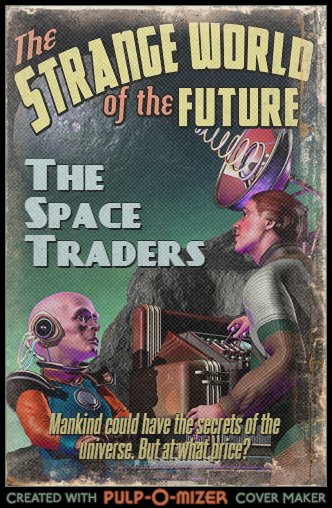
Image by Pulp-O-Mizer
Not many fantasy stories are more often cited as thought experiments in moral philosophy than as fiction. I’m thinking of “The Space Traders” by American lawyer Derrick Bell. In a nutshell: super-powerful beings arrive on Earth and offer the United States money, energy and technological advances if all the non-black people agree to hand over all the black people to the angels/devils/aliens.

The Trolley Problem it ain’t. We can’t know what other people will do when faced with an ethical question. It’s hard enough to predict what we’d do ourselves; look at all the people who are convinced they’d have stood up to the Nazis if they lived in 1930s Germany. Derrick Bell takes a misanthropic view -- in his story there’s a referendum and the black Americans are handed over. If Germany had held a referendum in 1940, would the majority have voted to exterminate the Jews? They certainly colluded with that policy, but it was framed in a way that allowed the average citizen to tell himself that he didn’t actually know what was going on. Being confronted with the stark truth and voting on it – morally pulling the trigger, so to speak – would be a different story. We hope.

And the Jews had been demonized in Nazi propaganda for years. Posters claimed they’d betrayed the country, hoarded gold, spread disease – all sorts of conspiracy nonsense, and (as now) there are always idiots who’ll believe it. But for citizens to turn against a group of fellow citizens out of a clear blue sky – whites against blacks, or blacks against whites, even given the dire racial history of the Confederacy -- would be a whole other matter, surely? We cling to the hope humanity is better than its worst moments.

And yet… Islamic State threw gay men off rooftops and then stoned them if they survived that. The people who flocked to join IS presumably condoned it. Even so, it’s not the same as voting within a normal society to murder a group of people. IS was a self-selected band of extremists; we’d expect them to behave like rabid fanatics.

It seems like it might be easier to turn on a subgroup if belonging to that subgroup is a matter of choice rather than an accident of birth. The English in Tudor times might have voted to round up Catholics, if voting had been a thing. The Khmer Rouge, in common with many populist movements, hated intellectuals and was happy to persecute them. Crusades and holy wars throughout history have been all about exterminating people who don’t believe in your big guy in the sky.

Derrick Bell’s story would be more interesting if, instead of making his fictional citizens outright monsters, he’d presented them with a choice that was more honestly and credibly tempting. “We want all your incarcerated criminals,” the aliens/angels could have said. “No harm will come to them but we’re taking them away from Earth.” Even without the offer of extraterrestrial super-tech, getting rid of those inmates immediately saves the US about a hundred billion dollars. Tempting yet?

It’s still an absolutely appalling scenario. With no idea of what fate those exiles are going to face, a vote to hand them over is heinous self-interest and nothing more. However, until very recently a referendum on capital punishment in the UK would have voted in favour of sending some criminals to their death. That’s a lot worse than being banished to space. As a society we don’t make serious efforts to address the root causes of crime, nor to rehabilitate the criminals we have. In a sense we’re already consigning them to exile from humanity, and we’re not even getting fusion power in return.


How might this sort of ethical Gordian Knot be presented in a roleplaying scenario? An example from our Last Fleet game: the war has been going badly for the fleet, and the Corax offer a deal. Humans can live in peace, but they will be settled on one world and they have to give up all their technology. Effectively it would be a return to a primitive Eden. The Corax undertake to watch over the human planet, ensuring no disease or asteroid impact would ever be an existential threat -- but also to make sure we never develop science that could get us off the planet. The deal in a sense is that the Corax are offering to become humanity's gods. Immediately it gets interesting because some will want to take the deal ("We get to live. Our descendants will know peace, not endless war.") but others will bitterly oppose it ("So the human race becomes the pets in a Corax zoo?") If it's presented as a genuine and tempting option, it could cue a lot of gutsy inter-party conflict. I should add that in our game the Corax were not interdimensional fungi (wtftm) but creations of humanity ourselves. A war against your own rebel children is obviously more interesting than one against a genuinely alien Other.

Or it could be a bargain like the one Clark Ashton Smith postulates in his story "Seedling of Mars". The alien's offer ends up dividing humanity into two warring camps -- which might well have been the intention all along.

Going back to "The Space Traders" idea, the choice needn't hinge on an entire racial or ideological subgroup. People in the millions are abstract. What if it's a single individual? You can have all these wonderful things: free energy, unlimited resources, miraculous medicine, nobody goes hungry… and in return you give us one person. One human being for the lives of billions yet to be born.

What would you do?