Gamebook store

Showing posts with label humour. Show all posts

Sunday, 2 June 2024

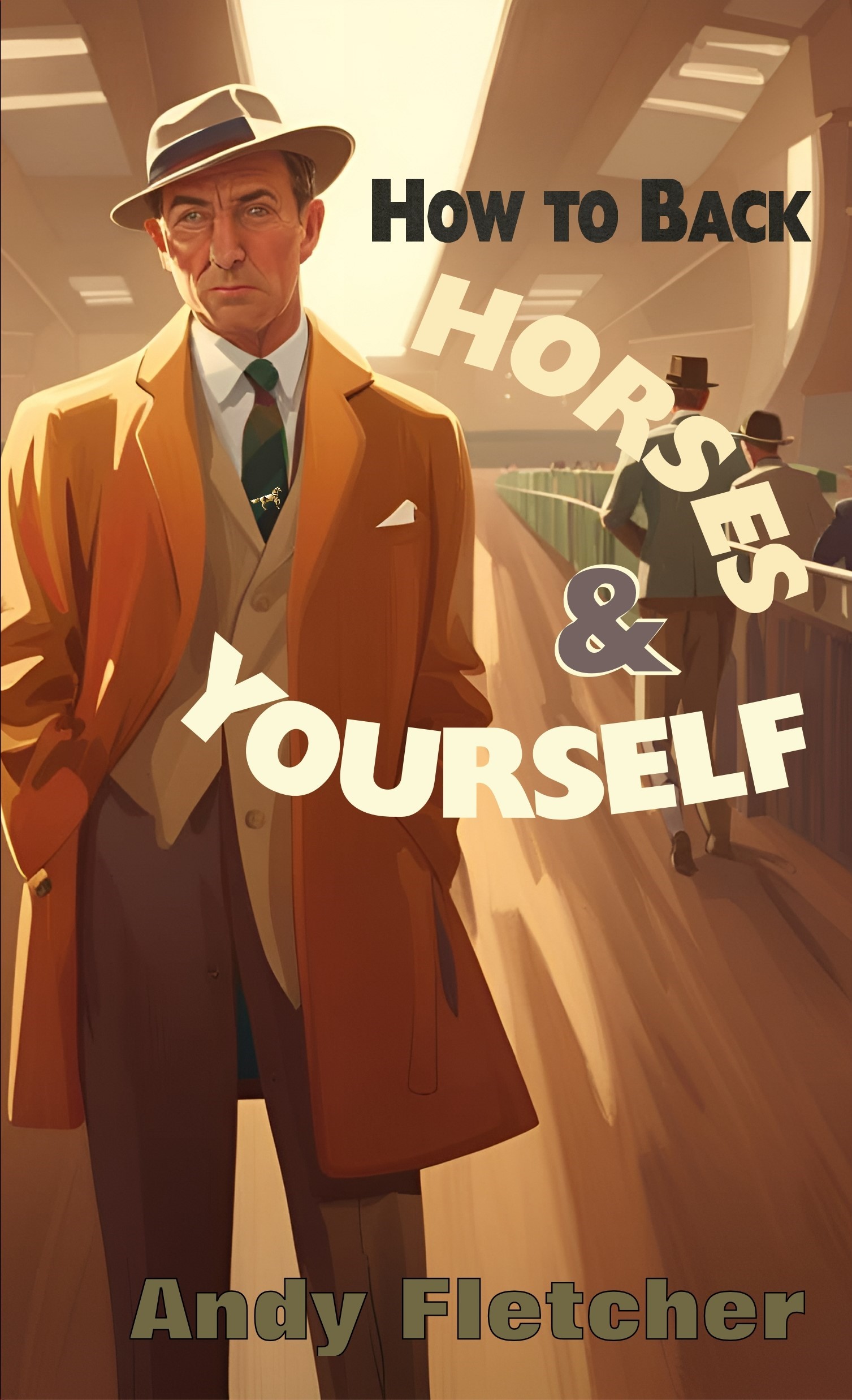
How To Back Horses & Yourself

Friend of the blog Andy Fletcher will need no introduction to anyone who follows the comments around here. He can be relied on to contribute to any discussion with wit and wisdom, so it's no surprise that his book How To Back Horses & Yourself is a thoroughly enjoyable read that will half the time have you laughing out loud and the rest of the time scribbling notes to remind yourself of all the brilliant insights.

Andy has walked the walk, having had considerably more success picking winners than most bookies have had picking their ties. That said, personally I'd give good money to have a tiepin like the one on the cover, if only because it would please my granddad, who was a great one for the horses. He'd claim not to understand my maths homework and then he'd reel off the statistics for a series of races at a speed that would have left Red Rum in the dust.

Andy has kindly given permission for a little taster of the book. This is one of the appendices, so it doesn't convey the full value of the book's contents but it does show you that our man has the gift to entertain.

Omens and Auguries 

I read somewhere that every book requires a backstory. This is a somewhat self-indulgent one, where I drone on about how my love of fantasy adventure gamebooks and a children’s book series played a part in my book’s creation. So, if you’re only interested in horse racing, I suggest you leave now, no hard feelings. Please just remember to shut the door on the way out.

SLAM! I must admit, I wasn’t expecting that many to leave. Still, we’ve cut the wheat from the chaff so to speak. Quality not quantity as they say. It would seem like it’s just you and I left then dear reader. (Stop trying to write the afterword like Stephen King and get on with it you vile polyp, otherwise prepare for pain! - The Warlock). Gulp! Right you are, oh splendid one!

Blimey, his temper hasn’t improved much this last 40 years or so, has it? That is of course assuming you remember ‘Warlock’ magazine from the mid-1980s, and perhaps more specifically, Jamie Thomson’s ‘Omens and Auguries’ column, which I absolutely loved. (Right, you were warned, prepare to spend eternity dealing with auditors you putrid maggot! - The Warlock). No, anything but that oh mighty one! You’ll find this next bit really interesting I promise!

Phew, I think we’re ok for now. ‘Warlock’ magazine supplemented the ‘Fighting Fantasy’ adventure gamebooks that were so popular in that era. However, it was Jamie Thomson’s gamebooks that were my favourites. (What was that gamebook bilge called which Thomson and his old crony Mark Smith peddled back in the day? The Day of the Toga and Kestrel, that’s it! - The Warlock). Erm, I think you mean ‘The Way of the Tiger’ and ‘Falcon’, oh supreme one.

Being a fan of ‘Monkey’, Bruce Lee and ninja films, it was no surprise that ‘The Way of the Tiger’ were my favourite gamebooks. Undertaking the ‘Teeth of Tiger’ throw was certainly not advisable unless in the vicinity of a bouncy castle. Some of my GCSE artwork were ninjas ripped off from the books. When the artwork didn’t get graded, the school told me my work had vanished. The irony.

‘Golden Dragon’ by Dave Morris and Oliver Johnson was another favourite series, though even the fabled WHSmith book ordering counter couldn’t find ‘Crypt of the Vampire’. I roamed across the Midlands for months trying to locate it. A few years later, I bartered my entire magazine collection with someone at school who owned a copy. (WHAT?! - The Warlock). Erm, except ‘Warlock’ of course your greatness.

On a nostalgic internet browse in 2011 many years later, I stumbled across a book called ‘The Dark Lord’ by Jamie Thomson. I wondered whether it could be the same Jamie Thomson, favourite author from childhood? It was, and I was pleasantly surprised when Dave Morris, author of the ‘Golden Dragon’ gamebooks, replied to a remark I’d made on a comments page about it.

Doubtless I wasn’t within the intended age readership range, but the Dark Lord book was brilliant. The humour a throw-back to the author’s ‘Warlock’ column. (Pah, that piffling Dark Lord is no match for me, I could destroy the pipsqueak with my eyes shut! - The Warlock). Oh, I totally agree your wonderfulness.

In 2012, my wife and I went on honeymoon to Sorrento and the only book I took with me was The Dark Lord sequel, ‘A Fiend in Need’. We encountered weather of biblical proportions. Having several gripes with the travel firm Thomson, I had a flash of inspiration to write a book, comprised of increasingly unreasonable complaint letters to them, working title ‘Dear Thomson’. It would be based upon real events, with the irony of only having the Dark Lord book to read. I made notes, but writing a book was too much like hard work.

A few years later, much to my delight, I had another comments conversation with Dave Morris, that led to me discovering he has a blog, ‘Fabled Lands’, which I have continued to read. I also rediscovered his excellent ‘Virtual Reality/Critical IF’ and ‘Bloodsword’ series. (Spare me your sycophantic gibbering about that lickspittle’s drivel! - The Warlock). Of course, brilliantness.

Years later, I mentioned ‘Dear Thomson’ on the Fabled Lands blog. After words of encouragement from Dave, an abridged version of ‘Dear Thomson’ felt the need to expunge itself from my system over the course of a few days, enabling me to sharpen the pencil as it were for the main event of ‘How to Back Horses’. I sent ‘Dear Thomson’ to Dave, who gave me some kind feedback and useful writing advice. I quite like ‘Dear Thomson’, so have left it here for prosperity.

See, that was a really interesting story wasn’t it your appendixness? (Not in the slightest. On the subject of Thomson, he’ll feel my wraith when I find out which rock he’s crawled under, and… hang on, what did you just call me, you snivelling little worm? - The Warlock). Gulp! Erm, just a slip of the tongue oh wonderous one. Anyway, you can’t just go around punishing people anymore, things have changed in the last 40 years! (Yes, I’d heard they’d banned smoking in most places, but we’ll see about that! - The Warlock).

ZZAP! SIZZLE! ‘ARRRGHHHHH!’


How To Back Horses & Yourself by Andy Fletcher is now on sale from Amazon, and for one week only you can get it at half price. Don't miss your chance to back a winner.

Wednesday, 8 February 2023

Plug in to comedy and adventure

Looking for a story you can really immerse yourself in? How about Meta: Game On, an hilarious new novel by Xander Black? This audio drama treat is expertly recounted by the mithril-tongued Rob Rackstraw, master of a thousand voices, who may well be channelling the likes of Brian Blessed, Eartha Kitt, Stephen Fry and the Emperor Palpatine. 

Really, you don't want to miss the comedy-adventure of the next Swinging Sixties - 2060s, that is. Grab it right now, before they demolish Earth to make way for a hyperspace freeway.

The year 2065: The streets are abandoned, shops are empty, parks are silent. But is that really much of a surprise when you can connect to the Cybernet?

Everyone can turn on, log in, and drop out.

Cyrus, a failed physicist, and dropout game designer Everett are on the cusp of their big breakthrough into the meta ranks of Neverborn, the world’s most popular game.

But when several high-profile avatars disappear and their human counterparts are found dead, Cyrus and Everett find themselves under suspicion. They must clear their names and unravel the deeper mysteries of Brith and the Neverborn. In doing so, they will uncover a dark secret that threatens not only the game-world, but the safety of their physical realm.


Thursday, 3 February 2022

Two styles of gamebook design

A few people have asked about the differences between my Vulcanverse books (The Hammer of the Sun and The Pillars of the Sky) and Jamie's (The Houses of the Dead and The Wild Woods). When we wrote the Fabled Lands series our styles were pretty similar, so you can't always spot where I (or in several cases Tim Harford) wrote parts of Jamie's books. 

Nearly thirty years on, we write very differently and I'd be surprised if somebody playing the Vulcanverse books couldn't tell which of us wrote what. It would be hard nowadays for Jamie and me to split a book down the middle, as we did with The Keep of the Lich Lord, and not have readers spot the join.

On a trivial level, I notice that Jamie will put things like, "if you have codeword X, read on," so you get to see in the same section various alternative outcomes that you shouldn't really know. Of course, that only matters if you cheat by reading on when you don't have the relevant codeword. Here's an example from The Wild Woods:

On the other hand, I plan the logic diagram as if it were to be handed to a coder, separating each step in the process into its own section. In an example like the one above, I'd split those filters (the codeword, the title, the tickbox) into separate sections, like so:

One advantage of that is it's a lot easier to bug-check the book. If the Vulcanverse gamebooks are ever turned into a CRPG, in mine those logic gates are already fully planned. Jamie's approach uses up fewer numbered sections, and means less page-flipping for the reader, but it can lead to some very long chunks of text.

Jamie uses a lot more codewords; I use a lot more tickboxes. That's because tickboxes are fine for any non-global change, and so I tried to limit the number of times the player would need to refer to the codeword list (codewords being necessary for something that changes the world in more than one location). Neither approach is wrong; it's just a stylistic choice. And some people have told me that the "elegant logic" argument doesn't persuade them in favour of tickboxes because they don't like writing in their books.

Another difference is that Jamie's Vulcanverse books are much more comedic (as you'd expect of the winner of the Roald Dahl Award) so he'll have gods and other mythological figures talking in modern slang. No less a talent than Joss Whedon did the same thing with the Greek gods in his (unproduced) Wonder Woman script, and it's the entirety of Taika Waititi's approach to his Thor movies. Which is not to say that my own Vulcanverse books are without humour, but it's more character-humour in my case, so a bit like Thor: Ragnarok compared to the first Thor movie. Take your pick, or better still enjoy both.

Also, I do a lot more with companions in the Vulcanverse books than Jamie does. Instead of companions, he tends to have more localized character-based stories -- the insolent butler, the orphan you have to return to his uncle, the sick child whose father is destroying the woods, and so on. The trade-off is between highly focused mini-narratives and the more general interactions you get with companions, of whom only Loutro (in The Hammer of the Sun; I picture him played by Toby Jones, incidentally) is guaranteed to get a full character arc.

And there are differences too in the way we construct our books; Jamie tends to have fewer and longer sections. Still, just as you get different styles between the writers on a TV show, hopefully the variety only goes to enhance the whole.

Friday, 21 September 2018

I asked for ice, but this is ridiculous


I knew if I waited long enough Brexit would give me something to laugh about, and this video is worth the price of -- admission isn't the right word, I guess. The opposite.

If you've been curious about my and Jamie's new gamebook Can You Brexit Without Breaking Britain? now is your chance to try it out as a free online PDF. (Oh, and incidentally if you need to backtrack you can use Alt + left arrow in a PDF just like the Back button in a browser. That's for PCs. There are options for other devices but you don't need me to tell you about those; you've got the internet after all.)

Share the PDF if you like. This book took us a year to write and, although I'm aware most gamebook readers would rather we'd done something with goblins, I think it's kind of important. Possibly the most worthwhile book we've written, in fact. With just six months to go before the UK and the EU part company, we now just want as many people as possible to get the chance to play it. And don't be put off by the sheer mind-crushing horror of Britain's current political fubar. Can You Brexit? may not be quite as laugh-out-loud as the Titanic video, but we've done our best to inject it with plenty of humour along with all the informative stuff.

And the print book is still on sale for another six months if digital gaming just doesn't do it for you:


And finally, as the newscasters used to say, there's this too. Oh, I can see Brexit is going to usher in a whole new era of deliciously bitter satire:

Friday, 27 April 2018

Two heads are better


Gilbert and Sullivan. Lennon and McCartney. Lee and Ditko… In many successful creative partnerships you can perceive two quite different impulses at work, impulses which might be expected to pull in opposite directions and tear the project apart but in fact the result ends up being something greater than either might have achieved on their own.

It's the underlying principle of the Hegelian dialectic. Start with thesis, move on to antithesis, and in the fusion of those you might make something original and meaningful. (Luck plays a part too, but I don't think Hegel covered that.)

Thesis and antithesis is pretty much how Can You Brexit? came about. While sketching out the planned structure of the book, I'd only dimly considered what the style and tone of the writing would be. I wrote an opening that was surreal rather than laugh-out-loud funny -- more Theatre of Cruelty than Spitting Image -- and I envisaged the pinch points in the narrative being increasingly disturbing episodes between sections that would be largely informative.

But then when Jamie Thomson came in as co-author, he reminded me of something I should never have forgotten: if you want to keep people's attention you need to entertain them. Jamie rewrote the opening with the sort of comedy flair that gets audiences laughing helplessly at the best political satires. Where I'd have gone New Statesman, he took it in the direction of Private Eye.

You might think these two different sensibilities could not coexist. On the one hand a serious analysis of political and economic reality, on the other a fast-paced and funny narrative with twists and turns to keep you on the edge of your seat. They mesh because we each share some of the other's approach Jamie can drill down into political detail with just as much rigour as me. And when we write a script, I come up with as many of the gags as he does. It's just that each of us takes the champion role for one of those two things That's what makes the difference between creative conflict and creative cohesion.

Comedy doesn't mean a work of art can't be serious; it just stops it being sombre. Something can be thought-provoking without becoming dry and boring. When you can get people laughing you're waking their minds up too. So a reader who you are entertaining with the writer's whole orchestra, everything from intellect through passion to humour, is a reader who'll give you their full attention. That's a lesson more politicians could do with learning.

Talking of which, if you live in the United Kingdom you'll know we have local elections coming up next week. Brexit remains the issue that will probably have the greatest impact on the country over the rest of my life, so I'll be voting on the basis of what the parties have to say about that. But whatever criteria you use, do go and vote. If nothing else, it's how we earn the right to have a grumble.


Also available from Amazon in Italy, Germany, France, Australia, Spain, Netherlands -- oh, and just about anywhere.

Friday, 10 November 2017

How to stop your RPG sessions turning into Thor: Ragnarok

I’m glad it’s not just me. In this episode of the Improvised Radio Theatre With Dice podcast, Messrs Cule and Bell-West talk about how irritating it is when players break out of character for jokes and facetious banter.

Most definitely I’m not against joking at the table. In-character humour is not only essential and lots of fun, it’s pretty much the Turing Test of roleplaying. If you can see things from inside your character enough to crack a joke like him or her, you’re doing it right.

That's like the first Thor movie. All the humour there was great because it came from character. Later the film-makers saw that they’d get more tweetage if all the characters spoke like Joss Whedon was writing their lines – which in many cases he was. What even Joss forgot was that flip, high-school comedy shtick made sense for Buffy and the Scooby gang because they were high-schoolers. Coming from Thor or Captain America it’s just dumb. If it were a roleplaying game not a movie, that would be their players just not bothering.

But what do you do? Michael Cule asks if you should bang on the table. But you have enough on your mind running the game without taking on the role of kindergarten teacher as well, and as Roger Bell-West points out, once the suspension of disbelief is broken it's a bit late to get it back. Maybe instead we need to look at why players might want to break character. It means either they’re bored or else they’re embarrassed by the make-believe and need an escape. Listen to the podcast, it’s all discussed there.

Maybe part of the problem is the trend in modern drama for every character to behave like a teenager with ADHD. And maybe that is caused by the tweetability of 21st century life. People talk all the way through movies, TV shows and roleplaying games now because they’re accustomed to providing the world with a streaming commentary of their entire lives. Sitting still and concentrating on one thing for a chunk of time measured in hours must seem like Swamp Thing waiting for a judgement from the Parliament of Trees. I’m a lot less connected than the average person (you should see my cellphone) which may be why I’m mostly happy to stay in character for the evening.

Incidentally I'm not discussing this because my own players are offenders. We do have a lot of humour in most sessions, but it's almost always in character and we don't, thank goodness, have one of the compulsive comedians Mr Cule describes in his groups. That said, I've noticed that when side discussions spring up between a couple of players, time was they'd be talking about something in the game (very often in character, too) whereas these days it will likely be something they're watching on TV or saw on Facebook. Attention spans are rotting away the world over, or so the anecdotal evidence goes.

Cnut couldn’t stop the tide. All you can do is make your games more engaging so that players don’t feel the need to step out of character and make jokes. Throw in more outrageous surprises, and be less forgiving if players were nattering and missed what just happened. Or you could have NPCs react to all those funny meme references as if the character really said them out loud. A little time with the Inquisition (or your world’s local equivalent) is a surefire cure for compulsive hilarity.

And if that doesn't work, switch to playing boardgames, where there's no suspension of disbelief to break. In which case, here's just the thing.

Thursday, 2 October 2014

The Wrong Side of the Galaxy


I still call him Gazza Greene, because that's what he was called in the early drafts, but now publishers feel it's safe to have another Harry as hero of a bestselling kids' series. So here comes Harry Greene, Starship Captain, kidnapped by aliens on his birthday, and then those aliens get attacked by another lot of (much nastier) aliens, and Harry ends up on the far side of the galaxy - in fact, a little way out beyond the Small Magellanic Cloud, which is really way too far from home when your tea's getting cold.

Alone but for a super-devious Cugelian alien, two cloned royal princesses who finish each other's sentences, and a senile ship's computer, Harry has to try to get home while dodging super-nasty aliens who are after the Galactical Imperial Crown Jewels. Before the first book is over, Harry will have acquired at least two arch-enemies and he'll have become a mum. (You'll have to read the book. Trust me, it all makes sense.)


This is proper SF, this, and not just another fantasy story masquerading as sci-fi. There are no mysterious prophecies, no magic monsters that can't see you if you hold your nose, no dangers that can be dealt with by believing in sugar plums, no hand-waving bamboozling ways out of a predicament. It's for kids, not idiots. It's by Jamie (of course) and I have to say that it's not just a side-splitting comedy that's the funniest thing since Douglas Adams, it's also a rollercoaster SF page-turner with some really wonderful alien worlds and creatures to enjoy along the way.

The Wrong Side of the Galaxy, the first in the Starship Captain trilogy, is out now in UK paperback. (Oh, I just realized we should have called the character Gordon Greene. Then we could have had, "Gordon's alive!" Darn. Talk about l'esprit de l'escalier...)

Friday, 26 September 2014

Blood Sword redux: Doomwalk (part 3)

The final part of the Doomwalk designer's notes today, and as far as literary influences are concerned, the most obvious nods throughout the Blood Sword series are, of course, to Jack Vance. Those faltyns, for example: close cousins to the sandestins that were forever vexing Rhialto and the other sorcerers of Old Earth. I’m sure Shimrod in the Lyonesse books would know to be wary of a deal like this:
The faltyn flits through the streets, eventually leading you out of the north gate of the city along a rough track into the hills. There you see a jewelled door set in the side of a massive boulder. ‘What you seek lies beyond that door,’ says the faltyn. ‘As agreed, you will experience neither difficulty nor danger in obtaining it.’ With these words, it vanishes.
Why ‘faltyn’, incidentally? Doctor Strange fans, don't all shout at once. And how about this moment from Doomwalk for a typically Vancean way to get from A to B:
As soon as you have closed the cage door, the creature reaches down to seize an iron ring attached to the top and then launches itself into the sky. Despite its bulk and the burden of carrying you, it rises swiftly on its huge black wings. You are flung to and fro in the cage, but you manage to fight back your nausea until it has gained enough altitude to glide on the air currents.
(The picture here is from Pelgrane Press's superb Dying Earth RPG. Don't even read on until you've bought a copy.)

Now, I ought to warn you there are a few songs in this book. Not too many; don’t get alarmed, I didn’t go full Tolkien or anything. But you get a burst of the 14th century poem “Dou way, Robyn”, the Trickster gets to con some wights into thinking summer’s come to the underworld by singing a few lines paraphrased from Henry Howard, Earl of Surrey, and a character greets his lover’s cruel rejection with a lament penned by Sir Thomas Wyatt. Blimey, you not only get heads rolling and demons ripping out guts, you get bloomin’ culture as well, eh?

The bridge that Modgud guards (or Móðguðr, if you must), which you need to cross to get from the nasty region of Sheol to the really nasty, is from Norse myth. You knew that. But the reason I included a covered bridge in the first place is because Roy Thomas and Gene Colan sent Karen Page across just such a bridge when I was at an impressionable age, and Gene the Dean was my first love in comics, so I had to build in a reference to his work somewhere.

But, raking over all these old influences and homages, I’m completely stumped by where these two oddities sprang from:
Forewarned that something inhabits the hill, you make use of the cover afforded by some thorn bushes to approach the summit unnoticed. Two odd creatures wait there beside an enormous treasure chest. One is a giant bat with crimson antlers sprouting from its head. The other is a dog the size of a warhorse, with white fur and a long beard flowing from its chin.
The Horned Bat and the Bearded Dog seem to be genuine originals and, my earlier reference to Afghan Black aside, I have no idea what chimerical vacuum spawned them. I know that I specifically didn’t want an illustration of them because I was trying for something like the encounters you get in dreams: elusive, ill-defined. Funny and creepy and odd at the same time. Are they characters animated by Disney or by Švankmajer? Would the movie be directed by Burton or by Spielberg? I know which version I see in my mind's eye, but reading is democratic. Having bought the book, how you choose to visualize it is up to you.

Just in case you're thinking this all sounds like serious stuff, let me assure you that there's a good lacing of humour through all the Blood Sword books, even when you're slogging through hell or counting down the minutes till Doomsday. Case in point: the talking boat figurehead whose conversation is limited to weather forecasts and continual re-estimates of arrival time. That example is unusual, in fact, because mostly I don't go for humour that pokes fun at fantasy tropes - too easy a target. Instead I take my cue from Vance, who always remembers that however desperate the situation - and often precisely because it's desperate - human beings will find something to laugh about. So next time you get on the wrong side of a bargain with a faltyn, try to see the funny side.

In the next "Making of Blood Sword" I'll be looking at the writing of the fifth and final book in the series, The Walls of Spyte - otherwise known as "The One Where They Blow Up the Universe". But that's still a month or so away. Next week we'll have Jamie's latest series and after that some really big Way of the Tiger news. Don't miss.

Thursday, 20 September 2012

Sky scraping

Big news tomorrow. Yes, it's this big, but the picture is a clue in another way too. Can't say more - too excited. Drop by tomorrow, when I'll have had a cuppa to steady my nerves.