Gamebook store

Thursday, 9 February 2023

Seen in the smoke

Why put the Oracle into a gamebook? Simple. I was hired to write for the Vulcanverse series, and the background they'd chosen was Greek myth. My personal preference in fantasy is for original settings like Tekumel, but the Greek angle made it easy. I just had to arm myself with a copy of Graves and figure out which stories to use in the books.

In fact there was another reason I wanted to do something with the Oracle. I'll come to that later.

The sixty-four thousand drachma question: how to use oracles in a gamebook? Prophecies are tricky enough in roleplaying games, where you have a bit of latitude in interpretation and you can if need be nudge events in line with what's supposed to happen.

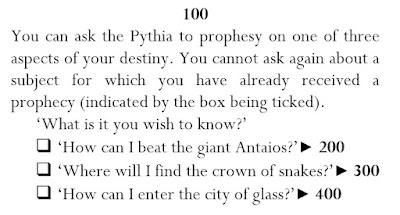
Here's the way I planned to do it. You can request a prophecy on one of several tasks. First you must pay a lava gem to be admitted to see the Pythia, then:


Each answer sets a definite outcome to a challenge – two good, one bad. Once that’s set it cannot be changed. For example, take the bad prophecy. The Pythia says you will fall to Antaios, and if you've been given that prophecy then when you meet him he will certainly overcome you without the usual combat choices. (Though maybe there’d be a last chance to reverse the defeat, ie you are overcome but might still escape.)


If you meet Antaios after you've already seen the Pythia, and so  have the codeword DoneAntaios, then the prophecy will come true with your inevitable defeat. But if you meet Antaios before you've visited the Pythia and been given the codeword by her then you get the usual “unfated” encounter, meaning that you have a chance to defeat him. Without the prophecy, your fate is in your own hands. Then at the end of that encounter you'll get the codeword DoneAntaios which ensures the Pythia can’t give you a prophecy about something that's already happened.

That's the bad outcome. The other two questions, about the crown of snakes and the city of glass, would be answered with prophecies that guaranteed success -- assuming you visit the Pythia before undertaking those quests. (The player shouldn't know in advance which question will get a bad prophecy and which will get good outcomes, of course.)

The other reason for putting an Oracle into the Vulcanverse books is that they are open world adventures. My original idea for those (see Cities of Gold & Glory, for example) was that players could define their own goals. That's what my role-playing campaigns tend to be like. If a PC decides they want to climb the highest mountain in each of the kingdoms, for example, they can just go and do it. If there are pre-planned quests you have to come across them, not be handed them. But many gamebook fans and players of traditional D&D are accustomed to being given an objective at the start. "Your mission, should you choose to accept..." 

The Oracle is a way of giving players a choice. Want an assigned quest? Go to the Oracle -- but she might doom you to failure before you've even begun. Or you can go looking for your own adventures, disdaining any sense that destiny controls you; be the captain of your own fate. In the Vulcanverse, the choice is yours.

Wednesday, 8 February 2023

Plug in to comedy and adventure

Looking for a story you can really immerse yourself in? How about Meta: Game On, an hilarious new novel by Xander Black? This audio drama treat is expertly recounted by the mithril-tongued Rob Rackstraw, master of a thousand voices, who may well be channelling the likes of Brian Blessed, Eartha Kitt, Stephen Fry and the Emperor Palpatine. 

Really, you don't want to miss the comedy-adventure of the next Swinging Sixties - 2060s, that is. Grab it right now, before they demolish Earth to make way for a hyperspace freeway.

The year 2065: The streets are abandoned, shops are empty, parks are silent. But is that really much of a surprise when you can connect to the Cybernet?

Everyone can turn on, log in, and drop out.

Cyrus, a failed physicist, and dropout game designer Everett are on the cusp of their big breakthrough into the meta ranks of Neverborn, the world’s most popular game.

But when several high-profile avatars disappear and their human counterparts are found dead, Cyrus and Everett find themselves under suspicion. They must clear their names and unravel the deeper mysteries of Brith and the Neverborn. In doing so, they will uncover a dark secret that threatens not only the game-world, but the safety of their physical realm.


Monday, 6 February 2023

Ohnoitshimagain

If you can stand another interview with me about gamebooks, roleplaying games, comics, and so forth -- and if you haven't heard it all already -- then here I am talking to the good folks at Refugio Seguro, aka Safe Haven. (Non-Spanish speakers could use Google Translate, but if you scroll down you'll find they have given the full interview in English too.)

Thursday, 2 February 2023

Keeping those wounds green


It wasn't long ago we were talking about the Interregnum, the period between the establishment of the Commonwealth after the execution of Charles I and the collapse of the British republic and the coronation of Charles II. I'd like to know more, but it's usually glossed over in the textbooks.

Serendipity has lent a hand in the form of Act of Oblivion, the latest novel by author Robert Harris, who is my guilty pleasure in between reading proper writers like Vladimir Nabokov and Hilary Mantel. The novel begins with the hunt for the men who signed Charles I's death warrant, but there are plenty of flashbacks to the Civil War and the period under Cromwell.

I usually say that in good fiction there are no heroes or villains, but in this book Harris takes it a step further. Everyone in Act of Oblivion is both hero and villain, in a sense -- or we could just say that they are human and therefore flawed, complicated, and fascinating. He also does a good job of taking us into the mindset of 17th century characters without sacrificing relatability. Always a strong storyteller, here he's on top form with a compelling subject.


Thursday, 26 January 2023

Chaos is your friend

If I had one roleplaying rule that I’d put on a Post-It, it would be: don’t get comfortable. You should always be pushing the game away from the status quo. And that applies to the players as well as the referee.

Campaigns can fall into a lazy story-of-the-week pattern. It’s especially a risk with campaigns built around a party of characters with one common goal – we’re superheroes who protect the world, we’re occult investigators in ‘30s New York, we’re legionaries guarding the frontiers of the empire. If any major event collides with that and breaks the party into pieces, the temptation can be to see it as a temporary aberration that needs to be fixed so that everything goes back to the way it was.

It’s how TV shows used to be before cable. Everything more or less reset so that you could watch episodes in any order. Even with their season arcs providing a loose developing narrative, early Buffy or X Files stories amounted to: “Here are our familiar friends doing their familiar things.” Cosy for fireside viewing, that.

What set me thinking about this was a session in a Last Fleet campaign I played in. The ragtag fleet (this is a Battlestar Galactica type deal) was in need of fuel so a ship was sent to scout out a nearby system with a gas giant and a colonized rocky planet with a refinery. The scout ship found trouble: the satellite network around the colony planet had been destroyed, there was no response from either the refinery or the mining station orbiting the gas giant, and the scout ship came under fire from a cloaked alien fighter. Oh, and they encountered a prison ship with about a hundred detainees in coldsleep.

The damage to the scout ship made it impossible to report back to the fleet, which jumped into the system only to be immediately hit by multiple cloaked attackers. The original scout ship tried to make an emergency landing on the planet. As they descended they saw an immense refugee camp, miles across, presumably housing the colonists who had survived whatever destroyed the satellite network. The scout ship broke up on crash-landing in the desert outside the camp. The pilot (Lt Lightshere) was injured and two other characters, the fleet’s chief scientist (Dr Corax) and a persuasive politician (Mr Coronov), were forced to bail out.

Immediately the characters went into reset-the-status-quo mode: “Get a recovery ship down there. Pick up Lightshere and take him to sick bay. Find Corax and get him to the bridge. We need to figure out a weakness in the enemy’s attack plan.”

By making stories all about solve-the-plot, games tend to steer us in this kind of track. In that context the Ace Pilot's injuries are just seen as an inconvenience, lost hit points that must be quickly fixed by autodoc so he can go back to doing what he usually does. The Brilliant Scientist back on the bridge would set up another by-the-numbers moment: “I’ve analyzed their attack and there is a weakness.” “Good, now that Lightshere is patched up he can lead the squadron. Coronov, you speak to the fleet and reassure everyone…”

But here’s another way to go. Maybe the Ace Pilot's injuries aren’t simple broken bones so much as loss of memory and/or internal injuries. So he wanders into the refugee city not knowing what’s happened, or alternatively is found unconscious by scavengers from the city and taken back there for treatment. The Brilliant Scientist and the Persuasive Politician might not even be with him – they bailed out before impact, so they could be a mile away on the far side of the camp, possibly not even together.

The party is already split. I’m saying you don’t have to fight that. When the story veers off course, keep upping the ante. Pour on the chaos. Let it find a new equilibrium.

This way the characters are thrown into a whole new scenario that could lead anywhere but the cosily familiar. The Brilliant Scientist and the Persuasive Politician might become involved in the refugees’ plight, or be struggling to survive out in the desert. The Ace Pilot might not even know who he is, or that he has internal bleeding that requires expert medical attention within a given time (a doom clock is a common feature of the Last Fleet).

Meanwhile, the away team sent down to the planet to search for them doesn’t have the near-magical tech of anything like tricorders, so they’d be faced with a ramshackle tent city and miles of desert. What are they going to do? Talk to the refugees? Threaten them? Round them up? They’d have to Seek Out the missing player-characters (that’s a move in the Last Fleet rules, hence it's in bold). There won’t even be a single refugee leadership, probably; rather a bunch of factions whose squabbling mirrors the fleet itself.

Imagine it in a TV show. The audience, thrust far outside their comfort zone and with all the characters facing unexpected jeopardy, would be biting their collective nails to the quick. You know this would be better than getting everybody back to the fleet without further mishaps.

This is not a point about railroading, incidentally. It has nothing to do with what the referee originally had planned. The whole principle behind Powered by the Apocalypse games is that everybody is "playing to find out what happens". So it's not particularly the referee's responsibility to decide how the narrative deals with those missing and injured characters. Whether to skip over those details or how to incorporate them is decided by the whole group. What I'm advocating is the notion that when circumstances veer off into the unknown, the players (including the referee) are missing an opportunity if they just struggle to bring everything back to the template they're used to.

If your players are willing to embrace the “interesting chaos” that emerges from a session and run with it, they’ll find the story spinning off in directions that nobody anticipated, and that will provide much more variety than if everyone struggles to block those emergent improvisations and pull the adventure back on course.

The example I’m giving here would entail a lot of scene-hopping. That doesn’t have to mean the players spending a lot of time as passive observers. The situation is tense enough that each group of players – Scientist and Politician in the desert, wounded Ace Pilot in the tent city, the other pilots in their fighters, the bridge crew on the battlestar – can be getting on with their own thing while the referee flits between them. It’s perfect for breakout rooms on Zoom or Discord, but even in real-life gaming there’s always the kitchen or the back yard.

I find there’s a lot to be learned from games like The Last Fleet even though I fight shy of metagaming and authored narratives. The fact is that nothing in Powered by the Apocalypse mechanics obliges you to consciously craft a story rather than let it happen, just as in drama you can write a script in advance but you can equally well wing it on the night. I have other gripes about PbtA mechanics (everything is a special case; making rules story-based rather than skills-based hampers in-the-moment improv; etc) but I can’t agree with one of my players who said of PbtA, “I think you’re working very hard to sell an only slightly dead parrot.” Let’s be more open-minded than that!

Friday, 20 January 2023

One sing-song to rule them all

Nothing punctures the dignity of a Dark Lord faster than banishing him to the world of mortals in the body of a 12-year-old kid. That's what happened to Dirk Lloyd, as fans of Jamie's hilarious books will know. And now, as part of his relentless struggle to claim back his powers, Dirk is appearing in a stage musical -- for a limited run to begin with, but Broadway beckons.

The show is written and produced by Kevin Murphy, creator of Reefer Madness and Heathers: The Musical and one of the lead writers on Desperate Housewives. He knows his diminuendo from his demisemiquavers. You can book tickets for the London premiere here.

Equally exciting, issue 8 of the superb Casket of Fays is out today. And by the generosity of the seelie folks at Red Ruin Publishing it's free. What are you waiting for?

Friday, 13 January 2023

The sting

On this episode of his podcast Cautionary Tales, Tim Harford gives a gripping account of the literary hoax involving Howard Hughes's alleged autobiography.

Fascinating as the story about Clifford Hughes is, even more interesting are the techniques he used to dupe respected publishers and experienced bankers so that they bought into his deception. That's what a good con trick is all about: storytelling.

I discovered how true that was years ago when Oliver Johnson gave me a book on confidence trickery that his publishing firm had just released. 'I've read it cover to cover,' he said, 'so you won't be able to dupe me.'

Aha, there's a challenge. A few weeks later, in our Tekumel game, Oliver's character had some legal problem and was invited to the Palace of the Realm in Jakalla to meet an official. He entered as a fellow in fine robes was descending from the uppermost tier of one of the bureaucratic pyramids. 'Let's go to lunch,' suggested the official. They agreed a fee for making the legal problem go away. A few days later, when Oliver returned to the Palace of the Realm to check that everything was going smoothly, he met the real official of that name. The other man had simply put on some expensive robes, waited around the upper tiers until Oliver's character arrived, then walked down to introduce himself, collected a fat bribe, and disappeared.

'I can't believe I fell for it!' said Oliver after the game. He even went on to name the con trick I'd used.

I'm sure that it can be very unpleasant to be on the receiving end of a real-life con, but we have a sympathy for con men in stories that we don't have for murderers and drug dealers. Perhaps part of it is the sense that the con man (or woman) has to believe in their own story, at least a little. They need to be part dreamer.

I had a first-hand taste of something like this last year, when I was catfished into agreeing to go to a games meeting that didn't happen. A guy had got in touch about roleplaying; he spent months emailing me about comic books, SF, games and other mutual interests, and then proposed collaborating on a concept for a major gaming franchise. I was dubious because I know that major franchises don't buy in story concepts, but my guy claimed he'd booked a meeting with the senior execs at a famous videogames company and I thought it couldn't hurt to go along. Also, the story concept he had come up with was brilliantly original. Even if I didn't get hired to work on it, I'd want to play the game. 'I'll send a car for you,' he said. Figuring that the car was maybe 50% likely to show up, I put on a clean shirt that day but didn't make any special plans.

You guessed it. Of course the car didn't turn up, there was no meeting with any game execs, and I never heard from the fellow again. This was the (slightly) surprising but (very) inevitable ending I'd half expected; the only disappointment was that the payoff had to be so low-key. I would never get to meet the guy who set up the con, nor even know his real name, so there was no big reveal, no dramatic denouement. I couldn't even shake his hand and say, as Oliver did to me after that Tekumel game, 'Ya got me!'

On the other hand, that's part of the beauty of it. In all such stories, it's the victim of the con who must supply their own epiphany. 

'The end of all our exploring will be to arrive where we started and know the place for the first time.'

That's how I run my roleplaying games too, after all. I'm not telling a story, I'm just setting things up so the players can find their own story.

So I had a Zen kind of lesson and it cost me nothing. Plus I got to hear the pitch for a genuinely interesting story. (I won't say anything about it here in case my catfisher actually uses it in some form for a comic or novel or something.) That's probably as benevolent as con tricks get in real life, and it reminded me what effective story elements they make. If you're stuck for an idea for your next game, take a look at some of these and have some fun with them.