Gamebook store

Showing posts with label Edizioni Librarsi. Show all posts

Friday, 3 July 2026

Comicon in Bergamo

Last weekend I was at Comicon in Bergamo as a guest of the festival organizers and my Italian publisher, Edizioni Librarsi. Jamie Thomson and I joined in a panel discussion (pictured above) on AI, technology and gamebooks, chaired by Francesco Di Lazzaro, and we sat in on a talk on gamebook design by Marco Zamanni

Our colleague on the panel was Gianmario ("The Teacher") Marelli and our superpowered translator was Giulia Brugnetti. Jamie was more sanguine about AI learning to write well, while I and Gianmario think (because good writing is a multi-faceted skill that doesn't lend itself to reinforcement learning, or even particularly well to supervised learning) that it's better used for the grunt work of writing to free the author's time for the actual creative part. Think of yourself as the manager/writer and the AI as your assistant.

For his design lecture, Marco used the interesting example of a gamebook based on Italo Calvino's The Cloven Viscount, a magic realist fable in which a character is literally split into two selves by a cannonball. The choices could emphasize the polarization of attitudes, whether the player wants to be purely "good" or utterly "evil", though when you repress half of your nature it has the habit of surfacing catastrophically. Alternatively you might concentrate on unifying the two selves. Not that Marco was suggesting anybody should actually vandalize Calvino's story by turning it into a gamebook, you understand, but it's an interesting thought experiment.

While at the con I met up with Valentino Sergi, who headed the design team on Blood Sword 5e, and he's hopeful there will be news about a 5.5e version soon. We also got to talk to author Alex Calvi, who translated a couple of my books for Librarsi. We all agreed that nobody could replace Russ Nicholson but that Marco Sada would be a great artist for any future Fabled Lands books. Oh, and on the subject of FL, Jamie blurted out the news that he's begun work on Into the Underworld, the 12th book, so that was a bit of a scoop.

The cosplayers at the convention showed great stamina, walking around in some heavy-looking costumes in temperatures nudging 38°, and Jamie and I signed a lot of books. Flying by RyanAir was hell, given the heatwave and delays of up to three hours each way, but (as Stevenson should have said) it is better to arrive than to travel without hope.

Wednesday, 9 April 2025

No BS

As sure as men walked on the Moon, we now have incontrovertible evidence that the English edition of Blood Sword 5e exists. One of my gaming pals sent me this photo of the pack he just received. Others in our roleplaying group confirmed they also got their copies, and I'm hoping at least one of them will try running the campaign for their kids.

As to whether the book will be available to non-Kickstarter backers -- well, yes, that would make sense, 5e reputedly being a popular choice of rules, and it's a beautiful volume with detailed spells like Fairy Stride, Pillar of Salt, and (of course) Summon Faltyn, along with monastic orders, character backstories and birthmarks, guilds, blood feats, monsters, rules for magic items, colour maps of places like Crescentium, Sheol and Spyte -- along with lots of Russ Nicholson's best work, all on glossy high-quality art paper, and of course the whole Blood Sword saga converted to a 5e campaign.

It really is a labour of love by the creative team involved, and what I find most interesting is seeing a version of the lands of Legend that draws solely on the Blood Sword books and not on Dragon Warriors. This high-fantasy Legend is a very different place from the world of DW and Jewelspider, but no less brilliantly conceived and inspiring for that. I'm awed, flattered and humbled by the care Valentino Sergi and his team have put into every aspect of the design. In the ongoing absence of new official DW material, Legend players could do worse than embark on a Blood Sword 5e campaign.

How to buy a copy? You could try contacting the publishers, Tambù, but I suspect after two and a half years they've got other priorities. Maybe they'll license a paperback edition if enough people ask. For those who want to roleplay in the Blood Sword universe but simply can't get the 5e book, Oliver Whawell has converted the encounters to Dragon Warriors rules. Download those here:


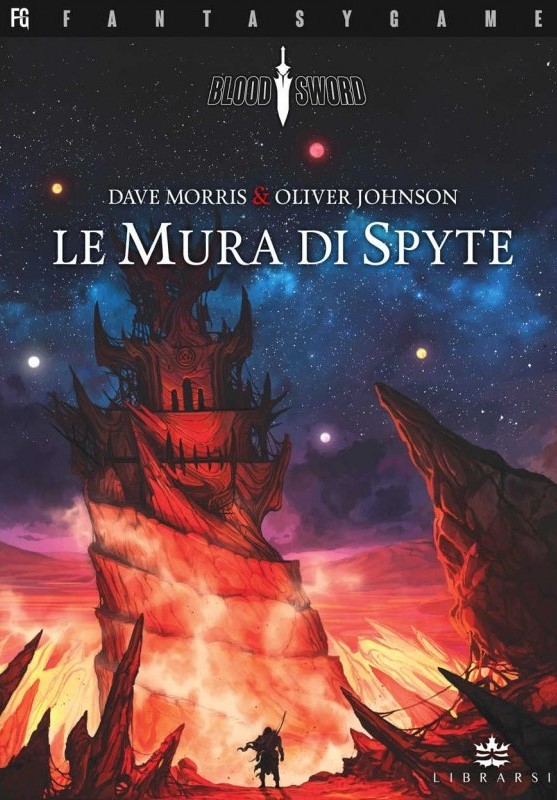
My backers on Patreon got to see how I'd have written that final book, a more flashback-heavy, character-focused version that would probably be a better fit for a roleplaying campaign than the dungeon crawl that actually got published. And talking of book 5, Edizioni Librarsi have just published an all-new edition (based on my revised text of 2019) with a gorgeous Mattia Simone cover showing the Ghosts of the Magi in ominous conjunction on the last night of the world. (The hopes and fears of all the years...)


If you need maps of Legend, there's a wealth of cartographic treasures freely available on Lee Barklam's site The Cobwebbed Forest. And there will be some truly scrumptious maps in the forthcoming Blood Sword CRPG -- but now I'm getting ahead of myself. More news on that to come. Oh, and if all the above is like a coded message in Cabbandari and you're asking what Blood Sword even is, here's a podcast review by Mr H J Doom to get started.

Thursday, 3 November 2022

Bellissimo Blood Sword


I'm just back from Lucca Comics & Games, the biggest fair of its kind in Europe. Over a quarter of a million people cram into the streets of a medieval town which (within the walls) normally has a population of a tenth that number.

I was there as guest of Tambù, the publishers of the Blood Sword 5e roleplaying game. It is a beautiful 500+ page colour hardback -- bellissimo is the only word for it -- that integrates Russ Nicholson's original illustrations alongside all-new paintings and maps of Crescentium, Spyte, and so on. The book contains all the rules as well as scenarios that parallel the Blood Sword saga from the books, only with a new ending based on my notes for how I'd like it to have all tied up.

There are too many people for me to mention them all by name, but it was a particular delight to meet up with Claudio di Vincenzo, publisher of Fabled Lands and Blood Sword in Italy, and Davide Lo Presti and his top-rate team at Tambù. In the photos above I'm with Andrea Rossi (writer of the Old School rules for Blood Sword), Valentino Sergi (who directed the 5e book), and Mauro Longo.

The theme of the festival this year was "hope", and it gave me hope to see so many people all celebrating their enthusiasms, being free to express themselves with joy and friendliness. The heave and press of the crowd were the sort of thing you'd expect going into a football stadium, everybody dressed in the costumes of their own favourite comics or games characters, but there was no trouble of any kind. This is how the human race can and should live.

Good company, wonderful people, a welcoming crowd, a magnificent city, and the unsurpassed beauty and cuisine of Tuscany -- what's not to like? And, as the icing on the cake, my Critical IF book I Misteri di Baghdad (in English that's Once Upon A Time in Arabia) won the Best Foreign Gamebook award.

Even better than any award, I came back bearing a bottle of Puglia wine presented to me by the very kind, generous and entirely lovely Suemia Biafore. It's my wedding anniversary this weekend so my wife and I will be uncorking that and releasing the genie of Italy. The first wish will be to return one day to Lucca, next time hopefully for a longer stay.

Wednesday, 3 June 2020

Ella è quanto de ben pò far natura


Edizioni Librarsi have announced the third book in the Blood Sword series, L'Artiglio del Demone. And how about that cover art? I wish the books could have gone out with such magnificent cover paintings back in the day. It almost makes me want to write the whole saga up as a Jewelspider adventure -- and then I could finally cap it all with the finale it deserves. Well, once I've got the Jewelspider rules published, and Tetsubo, and Abraxas, and Λ, it'll be the very next thing on the list.

Friday, 30 August 2019

Yakety yak

A little while ago, I was asked by my Italian publishers to do an interview for Tom's Hardware. Then it occurred to me that some of the answers might be interesting to readers of this blog, so if you don't speak Italian here's the meat of it:

Dave, in Italy, you’re known especially for the Blood sword series. Since those books were originally published a lot of time has passed. How do you think gamebooks have evolved? What was the market like in the ‘80s and how is it different today?
It was totally different. Gamebooks were a huge craze among what we now call “middle grade” kids (roughly 9-12 years old) and you pretty much only had to walk into a publisher with an idea to get offered a contract. Gamebooks would sell hundreds of thousands of copies. I think it was because kids were ready for videogames but those were still quite expensive and the graphics were quite primitive. So gamebooks filled a gap.
Blood Sword was the first multiplayer gamebook. How did you transform a solitary experience like a gamebook into a shared game?
Oliver Johnson and I always start the planning process for one of our gamebooks by thinking about events we’ve used in our roleplaying games, so multiplayer comes naturally to us. I was also aware when we wrote Blood Sword that a lot of the readers would be people who already played Dragon Warriors (set in the same fantasy universe) which meant that they probably would have gaming friends who they wanted to share the adventure with. We made sure that every character type has a chance to shine, and if you are playing it as a team there are some sections that only one character gets to read. We find that a dash of secrecy and competitiveness adds an edge to any roleplaying game.
Recently you ran a Kickstarter campaign for a new edition of Blood Sword 5 The Walls of Spyte. Why that book in particular?
I’d already edited the rest of the series for re-release in 2014, but when I got to the fifth book I found that the work needed to make it playable was more than the other four books put together. There were parts of the flowchart that simply didn’t link up. If I’d left it till I had time to revise The Walls of Spyte then none of the books would have got back in print, so I published the first four and put book five aside. I kept meaning to return to it but there was so much work involved that I couldn’t justify it as something to do in my spare time. The Kickstarter provided the funds needed to do it properly.
What should a gamebook have today to be current? Do you think that classic forking-path stories are still enough, or should gamebooks dare to try something new?
I’m always interested in something new. In my Frankenstein digital gamebook, the focus is not on solving “the problem of the plot” but on your relationship with Victor Frankenstein, the narrator. The variables are things like Trust, Hubris and Alienation. If you give Victor bad advice, he loses trust in you and that affects whether he’ll listen to your suggestions in future.

Recently I wrote Fright Tonight, which is billed as an interactive drama for the Amazon Echo, but it’s effectively still a branching-path gamebook in terms of structure. I’ll be releasing that as a Kindle book later this year, and one of the things that makes it different is there are no stats, no character sheet, no dice. You just answer yes or no to the characters’ questions. Trust me, it’s as gripping as any gamebook I wrote back in the ‘80s and ‘90s.
Some say we are living through a renaissance of gamebooks. What do you think about that? In a world dominated by videogames and mobile games, do you think is there any space for gamebooks? What kind of appeal can they have for new, especially young, players?
Fewer people are reading books these days, and on average those people read fewer books per year, so it looks as if gamebooks will have to come up with some new tricks. For one thing, there’s not really a lot of point doing more fantasy quest-style gamebooks. Computer games do the same thing and they do it better. Gamebooks have traditionally tackled stories from a problem-solving angle. That’s natural given the menu of choices structure, but again it’s not enough to entice somebody away from a computer game or a movie, or even playing Fortnite on their phone. So how do we write gamebooks that offer the reader something they can’t get elsewhere?

One clue to the answer comes from looking at how television drama competes with cinema. Even the most lavish TV show can’t match the budget of a Hollywood blockbuster, so it has to play to its strengths. A 13-hour TV drama has a lot more room to explore character complexity than a 2-hour movie, with the result that if you sit down to watch Mission Impossible after The Americans, or Warcraft after Game of Thrones, it’s like going from a novel to a newspaper cartoon. Gamebooks can do something similar, involving the reader in difficult moral choices and options that will change other characters’ opinion of them. Modern audiences in all media expect this emotional depth. As a medium, gamebooks have to grow up.
You have written scores of books; gamebooks, novels, comics, and RPGs in your career. What have been the most difficult things to write? And of which are you particularly proud?
Most difficult was my recent gamebook Can You Brexit? as I had to research all of the details of immigration, free movement, defence, policing, trade, and a dozen other things – and then make them both amusing and comprehensible to the reader. Of all my gamebooks I’m most proud of Heart of Ice, just because it came out exactly how I wanted it. You can’t always count on that as there’s a tension between delivering the sense of real freedom of choice while (in old-style gamebooks) keeping it all down to about 500 sections or less. Heart of Ice was loosely based on an old roleplaying campaign of mine and many of my players’ characters were the inspiration for the player’s rivals in the adventure. To keep myself interested while writing, I changed the setting from the fantasy world of Tekumel, which it had been in my campaign, to 23rd century Earth. That gave me a story structure to work from while still having plenty of scope to improvise details as I worked.

The work I am most pleased with overall, though, is my comic book epic Mirabilis – Year of Wonders. I care passionately about the characters, it’s exactly the blend of funny, scary, mysterious and thrilling that I was aiming for, and I think the artwork (by Leo Hartas, Martin McKenna and Nikos Koutsis) is beautiful. Unfortunately the project ground to a halt about a third of the way through for want of a publisher. In Britain, sadly, there’s not much of a market for comic books.
Is there a book you wish you had written?
I’d like to have done more Dragon Warriors books. There were originally supposed to be twelve books in the series, but the publishers messed up the distribution and then cancelled the series after six books. Oliver and I still use the setting for some of our own roleplaying games, and we’re thinking of releasing the Jewelspider RPG, which is a much more modern, freewheeling set of rules. And instead of all those polyhedral dice it just uses two six-siders.

My biggest regret, though, is not having been able to continue Mirabilis. Leo and I planned it as four seasons, but when I was halfway through season two the money ran out. It costs a lot to pay for all that art! I have the whole story blocked out and I love the characters, so maybe I’ll return to it as a prose novel – but that will be a shame, as I think it really works best as a comic book.
How did you get involved in gaming? What do you like so much about games?
That’s a very good question. I think it’s because I get to exercise my imagination and my analytic mind at the same time. It’s the same reason I design games and write fiction – you’re having to be creative and flexible while at the same time solving problems. And because they are all sorts of different problems I have to think on my feet, which I enjoy. It’s why I prefer real-time strategy games to turn-based, because of the adrenaline. In roleplaying games you’re constantly improvising, whether you’re playing in the game or running it, and I get fired up by that. Also there’s the social aspect of gaming. I like hanging out with my friends, and most of them are gamers. It’s just a shame that my wife isn’t into games, because if she did I’d happily play a boardgame most evenings.
What are your favourite games?
In face-to-face roleplaying: Empire of the Petal Throne, and other rules and spin-offs set in MAR Barker’s world of Tekumel. I like it so much I designed a set of rules myself for it, called Tirikelu, that are available free online. Recently I’ve also enjoyed Gregor Vuga’s Sagas of the Icelanders, which is an Apocalypse World variant.

As for videogames, I like What Remains of Edith Finch, Return of the Obra Din, Inside, Kingdom Come: Deliverance, The Witcher, This War of Mine, The Talos Principle – oh, too many to mention. Lately I’ve been getting into VR games as I’m doing some design work on one. My favourite computer game of all time: Outcast. That’s twenty years old and I still go back to it.
Do you still get time to play? What are you playing at the moment?
I host a roleplaying session every two weeks, and my group also try to fit in four weekend specials each year. It’s not like the old days when we could game several times a week, but everybody used to live nearby back then and none of us had families.

We’re currently playing an investigative campaign set in the 1890s. We use GURPS 4th edition for that, quite a crunchy set of rules but much better than 3rd edition. I recently wrote some chapters for the Lyonesse RPG, which uses a d100 system, but I probably won’t play it – even though Oliver and I are both devoted Jack Vance fans – because tonally the setting isn’t very different from our own world, Legend, and we really need to test out the Jewelspider system for that.
Is there a game (or even a setting) you haven't written yet but you definitely want to try?
I’d like to have a crack at a complete reboot of the world of Tekumel. As originally conceived it belonged to a style of pulp sci-fi of the mid-20th century. That’s not something that today’s players can really get into, yet behind the game lies Professor Barker’s concept of a “real” Tekumel. I think there’s a better way to present it to the current generation of roleplayers that strips away the slightly cheesy pulp style and makes it feel more solid.
Any advice for someone who would like a writing career?
I’d say, “Do you have a Plan B?” Harrison Ford trained as a carpenter, remember, so that he had something to fall back on if the acting didn’t pan out. These days, millions of books are being published every year – most of them self-published – so it’s very hard to get noticed.

If that doesn’t put you off, OK, write your book. Send it out to agents. While they’re looking at it, start writing the next book. If an agent or editor says that something in your story doesn’t work then you should listen to them. On the other hand, if they tell you how to change the book, be more sceptical – other people know if a story doesn’t grab them, but they can’t write the book your way.

Hopefully your agent will get more than one publisher interested. If they do, there may be a bidding war, which is the only way you’ll get a fair price for your work. Pay attention to contracts. What is the publisher agreeing to do, and what happens to your rights if the book isn’t successful?

Read. You already read? Read more. Read really good authors: Hemingway, Calvino, Austen, Nabokov, Fitzgerald, Chekhov, Dickens, Eco. Don’t only read your favourite genres or authors. Think about what effect the author was striving for and how they achieved it. Always be learning.

They say, “Never give up,” but I’ll say, “Don’t reinforce failure.” If you try one thing and it doesn’t work, try something else. Short stories, novels, flash fiction, poetry, theatre. Mix genres. Ignore genres. The point is that entertainment is a fashion-driven industry, and there’s no point in plugging away at one thing if the public aren’t buying it. I know a couple of great writers – we’re talking about award winners, best-sellers in their day – whose books are not getting publishing offers these days because fashions have changed and their style of fiction is out of favour. No writer should ever try to chase fashions – you have to give the readers or viewers or players something they didn’t even know they wanted. But, at the same time, be aware of whether you’ve set up your stall in right place to get noticed.
Last question: is there any secret project you’re currently working on and can share with us?
There’s the world of Abraxas that Jamie and I devised for a massively multiplayer game we were set to work on at Eidos Interactive in 1999. Eidos closed down internal development so we never got to do the game, but I like the setting, which is science fantasy in the tradition of Edgar Rice Burroughs and Leigh Brackett. So I’m going to release that as an RPG using a variant of my Tirikelu rules. I’ve commissioned a great cover by Tancred Dyke-Wells, so now it’s just a case of me finding a spare couple of months to write it.

I also want to do a gamebook (probably digital; think 80 Days rather than Tin Man Games) based in the village of Crossgate from my Dragon Warriors campaign. This would be an open world gamebook where you can have various NPC companions and your experience of the adventure is different depending on which of them is with you. There would be multiple side-quests that you can pick up in more than one location using a sort of object-oriented approach to the story rather than the usual procedural gamebook design. (Apologies to my coder friends; I’m using these terms very loosely!) The working title for that is Winter’s Rage, but it’s another project that will have to wait for me to free up some leisure time to work on it.

The Jewelspider RPG is likely to happen much sooner, mainly because it’s very light on rules so most of it will be adventures and background for the world of Legend. And I have a science fiction setting called Earthwrecked that I ran as a roleplaying campaign and that I really should dust off and write up.

Tuesday, 9 July 2019

Lasciate ogne speranza


Edizioni Librarsi, who are the publishers of the Italian editions of Blood Sword and Fabled Lands, have revealed Mattia Simone's breathtaking cover for Cuore di Ghiaccio (aka Heart of Ice, as if you didn't know).
At last you see a streak of dark rubble against the dazzling skyline. You fear it might just be a line of hills or even a trick of the light, but as you approach on quickened footsteps it is possible to make out the details of brooding towers, empty palaces and gargantuan snow-bound walls. You have arrived at the lost city of Du-En.
You can find the English edition here or, if you're so hard up that you can't toss a few shekels to a starving writer, why not try Benjamin Fox's online version here? (And if you enjoy it, and can find the time to write an Amazon review, it all helps.)