Gamebook store

Showing posts with label Blood Sword 5e. Show all posts

Friday, 25 September 2026

A game of wits and wiles

Since Blood Sword was first released almost four decades ago, I wouldn't mind betting that plenty of GMs have used elements of the books in their roleplaying games -- the meteor stalker from book 2, to take just one example. Even so, it wasn't until Tambù's Blood Sword 5e and Prime Games' CRPG adaptation that the whole saga got converted into a detailed campaign.

Dungeons & Dragons is pretty much as good a choice of system as Dragon Warriors, given the relatively high-fantasy variant of Legend on display in Blood Sword. I recently heard from someone who is running a Blood Sword campaign and had to prepare the encounter with the elves from The Kingdom of Wyrd. (You can play through that sequence from the gamebook here and read an excerpt from the novelization here.)

In Blood Sword 5e the checkers game is handled by a series of Intelligence checks if the PCs play fair, and Dexterity (Sleight of Hand) or Charisma (Deception) checks against the elves' Wisdom (Perception) if the PCs try to cheat. The GM wanted to make it less abstract and thought that it might be worth playing it out at the table using chess, not draughts. But, he added: "One of the players is very good at chess and would have no difficulty beating me. So how do I set up a chess game that might reflect the in-game challenge of beating the elf lord? One possibility is that I nakedly cheat, moving pieces illegally until they figure out a workaround. But perhaps there's a better way."

Naturally I began by asking Claude:

The GM could et up an actual chess position, but every few moves, have the elf-king invoke 'ancient rules' that change the game:

    • "Ah, but in the unseelie variant, bishops may leap once per game."
    • "Did I not mention? When the moon is full, as it is tonight, pawns may move backwards."
    • "Of course, in the endgame, my king gains the knight's move."

The players must figure out they need to either bind him to standard rules through a magical contract or else distract him from invoking new rules.

I liked that because it is potentially both funny and hair-pullingly frustrating for the players. It's also quite Vancean, as Claude seems to have realized from the dialogue samples it provided.

As an alternative human-created solution, and inspired by Amarillo Slim's trick for beating a tennis champ, I suggested ways to throw the chess whizz off his/her game. It made sense that the elf lord would propose a game using medieval chess rules, for example. More simply, given that the GM perhaps didn't have time to familiarize himself with a completely different set of rules, he could make it a game of cylindrical chess -- that is, any piece that moves off the left side of the board appears on the corresponding square on the right side, and vice versa. To make it more of a surprise, the elf lord wouldn't tell the player-characters that was the variant they were playing until the first time he needed to move a piece in that way.

Another option is to reflect the elf lord's illusions by having the PC play blind chess while the GM gets to see the whole board.

What did my correspondent do? After the game he reported back: "In the end I decided that the elf lord's cheating would be represented by brazenly illegal moves. The PCs confronted him when one of these moves placed two bishops on the white squares, a situation that obviously could never arise in normal play, and he conceded his queen in penance. As the game built to a climax, the character playing the chess game, who was a sorcerer, simply made his own shamelessly illegal move to deliver checkmate, and that felt dramatically right (the mortal sorcerer has his own tricks, after all) even if a bit more D&D than Legend."

I do like how the player picked up the improvisational aspect and ran with it, but if I were running the game myself I'd be dubious about interrupting the session with a full chess game, so it might be better to fast-forward to a classic endgame and play on from there. Or maybe you have a better idea -- in which case, let's hear it!

Friday, 3 July 2026

Comicon in Bergamo

Last weekend I was at Comicon in Bergamo as a guest of the festival organizers and my Italian publisher, Edizioni Librarsi. Jamie Thomson and I joined in a panel discussion (pictured above) on AI, technology and gamebooks, chaired by Francesco Di Lazzaro, and we sat in on a talk on gamebook design by Marco Zamanni. 

Our colleague on the panel was Gianmario ("The Teacher") Marelli and our superpowered translator was Giulia Brugnetti. Jamie was more sanguine about AI learning to write well, while I and Gianmario think (because good writing is a multi-faceted skill that doesn't lend itself to reinforcement learning, or even particularly well to supervised learning) that it's better used for the grunt work of writing to free the author's time for the actual creative part. Think of yourself as the manager/writer and the AI as your assistant.

For his design lecture, Marco used the interesting example of a gamebook based on Italo Calvino's The Cloven Viscount, a magic realist fable in which a character is literally split into two selves by a cannonball. The choices could emphasize the polarization of attitudes, whether the player wants to be purely "good" or utterly "evil", though when you repress half of your nature it has the habit of surfacing catastrophically. Alternatively you might concentrate on unifying the two selves. Not that Marco was suggesting anybody should actually vandalize Calvino's story by turning it into a gamebook, you understand, but it's an interesting thought experiment.

While at the con I met up with Valentino Sergi, who headed the design team on Blood Sword 5e, and he's hopeful there will be news about a 5.5e version soon. We also got to talk to author Alex Calvi, who translated a couple of my books for Librarsi. We all agreed that nobody could replace Russ Nicholson but that Marco Sada would be a great artist for any future Fabled Lands books. Oh, and on the subject of FL, Jamie blurted out the news that he's begun work on Into the Underworld, the 12th book, so that was a bit of a scoop.

The cosplayers at the convention showed great stamina, walking around in some heavy-looking costumes in temperatures nudging 38°, and Jamie and I signed a lot of books. Flying by RyanAir was hell, given the heatwave and delays of up to three hours each way, but (as Stevenson should have said) it is better to arrive than to travel without hope.

Thursday, 16 October 2025

A toolkit for open-world gamebook design

The earliest true gamebook (with rules, that is, and disregarding mere multiple-choice texts) was probably Steve Jackson's Death Test in 1978. That allowed players to backtrack and visit the same location multiple times, but throughout the 1980s the main evolution of gamebooks detoured down a different branch with series like Fighting Fantasy, where the arrow of narrative time pointed in one direction. It wasn't until 1995 that the first open-world gamebooks appeared -- followed by silence until, decades later, series like Steam Highwayman and Legendary Kingdoms took up the torch. Finally it seems that open-world gamebooks might be becoming the dominant form.

I have been sent a succinct and comprehensive toolkit for open-world design that would-be gamebook writers will find very useful. Not just would-be writers, either; I've been doing this since the last millennium and even I found it had some handy tips. You can find that toolkit here. The author prefers to be known only as Ruth, so I will respect her anonymity, though it can only be a matter of time before her own open-world gamebook series appears.

In the Vulcanverse books, when I used what Ruth calls Local Changes, typically I'd include another entry:

So you’d arrive at the location and be presented with the situation that could lead to a change. If you complete that correctly you’re told to turn to the original location and tick the box. Then you get a one-off scene that explains the change and assigns any relevant keywords. If you return to the location subsequently you go to X*A which is the location in its changed state.

Regarding keywords, it’s worth differentiating (and incidentally I say this with 20/20 hindsight) between keywords used as logic flags to denote that an event occurred (“a tidal wave hit the city”) and keywords used to indicate a current state (“the city is in ruins”). In Vulcanverse I could have used keywords and titles respectively for those two functions. I didn’t, which meant that sometimes I’d remove a keyword that was no longer applicable, only to realize later that I’d still like to know if the player had originally had that keyword. Eg if I complete a quest for the king and so he makes me the court champion, even if later on I lose the court champion keyword I still need to have the keyword that says I did the quest. (I'll discuss flags and states in more detail in a future post.)

Regarding rules mechanics generally, I keep promising that next time I’ll create an object-oriented rule set so that I could keep track of, say:

  • having one’s face stolen by a mujina
  • getting cursed by a fairy to have a donkey’s head
  • acquiring blue skin
  • being body-swapped into another form

Variously those conditions could mean:

  • You’re not recognized by somebody who should know you
  • You’re mistaken for someone else
  • You are treated differently from other people (potentially in several different ways)

In Fabled Lands I ended up filtering for all those statuses every time I asked the player to check them, whereas if they had been properly organized I could simply have asked, “If you have a status that is listed as transformative and uncanny, go to X”.

Similarly with equipment, where it is useful to have a generic way of identifying whether something can be used as a weapon, or has a blade, or reflects like a mirror, or is made of iron, and so on – rather than having to list the items for each applicable function (such as “if you have the polished shield, the silver mirror, the jade looking-glass…”). Ruth's Multi-Function Item tool covers that one, and could be extended to keywords describing the character’s current status to solve problems like the altered-face one above.

Vulcanverse also used the Current Location feature, a box on your adventure sheet where you record a section number that you are routed to after the current subquest you're on is complete. This allows for encounters to happen at different points around the world, for instance when you're acting as go-between carrying love tokens from Eros to Psyche in The Hammer of the Sun. The Current Location can be used for a lot of things, a common example being when you have a wandering NPC whom the player has to meet up with from time to time, because the different stages of the player's dealings with the NPC don't have to be tied to the geography of the world. You just tell the player to record a Current Location number when the subquest is triggered, then when the next part of their interaction with the NPC (or whatever) is done, you send them back to the Current Location and they resume their travels.

I was going to compile a list of gamebook design resources, but they are many and scattered far and wide. Here are a few to get started. If you know of any others, link to them in the comments.


And while we're on the subject of gamebooks, the Blood Sword 5e hardcover book has just been released in the UK and US. You can buy it at Orc's Nest or from GMS Tabletop Games. The book is a complete 5e roleplaying campaign based on the gamebooks and features some absolutely top-notch design, writing, artwork and production. If you're starting to think about Christmas presents, it's the perfect gift for the avid gamer in your life. Just be aware: they're going to need a bigger stocking.

Wednesday, 9 April 2025

No BS

As sure as men walked on the Moon, we now have incontrovertible evidence that the English edition of Blood Sword 5e exists. One of my gaming pals sent me this photo of the pack he just received. Others in our roleplaying group confirmed they also got their copies, and I'm hoping at least one of them will try running the campaign for their kids.

As to whether the book will be available to non-Kickstarter backers -- well, yes, that would make sense, 5e reputedly being a popular choice of rules, and it's a beautiful volume with detailed spells like Fairy Stride, Pillar of Salt, and (of course) Summon Faltyn, along with monastic orders, character backstories and birthmarks, guilds, blood feats, monsters, rules for magic items, colour maps of places like Crescentium, Sheol and Spyte -- along with lots of Russ Nicholson's best work, all on glossy high-quality art paper, and of course the whole Blood Sword saga converted to a 5e campaign.

It really is a labour of love by the creative team involved, and what I find most interesting is seeing a version of the lands of Legend that draws solely on the Blood Sword books and not on Dragon Warriors. This high-fantasy Legend is a very different place from the world of DW and Jewelspider, but no less brilliantly conceived and inspiring for that. I'm awed, flattered and humbled by the care Valentino Sergi and his team have put into every aspect of the design. In the ongoing absence of new official DW material, Legend players could do worse than embark on a Blood Sword 5e campaign.

How to buy a copy? You could try contacting the publishers, Tambù, but I suspect after two and a half years they've got other priorities. Maybe they'll license a paperback edition if enough people ask. For those who want to roleplay in the Blood Sword universe but simply can't get the 5e book, Oliver Whawell has converted the encounters to Dragon Warriors rules. Download those here:


My backers on Patreon got to see how I'd have written that final book, a more flashback-heavy, character-focused version that would probably be a better fit for a roleplaying campaign than the dungeon crawl that actually got published. And talking of book 5, Edizioni Librarsi have just published an all-new edition (based on my revised text of 2019) with a gorgeous Mattia Simone cover showing the Ghosts of the Magi in ominous conjunction on the last night of the world. (The hopes and fears of all the years...)


If you need maps of Legend, there's a wealth of cartographic treasures freely available on Lee Barklam's site The Cobwebbed Forest. And there will be some truly scrumptious maps in the forthcoming Blood Sword CRPG -- but now I'm getting ahead of myself. More news on that to come. Oh, and if all the above is like a coded message in Cabbandari and you're asking what Blood Sword even is, here's a podcast review by Mr H J Doom to get started.

Wednesday, 20 November 2024

5e adventures in the world of Dragon Warriors

I got a tip-off a couple of months back that the English edition of Blood Sword 5e would shortly see the light of day, and here's news on Kickstarter that the books are being printed.

I don't know whether it will be possible to buy a copy if you weren't one of the original backers, though I'm hoping so because I want to finally read it! If and when I find out more I'll post it here.

While we're all waiting, there's always the five Blood Sword gamebooks and the tactical maps book to while away the time.

Now all we need is The Cursed King to be released and it'll be a veritable autumn windfall for Legend gamers.

Friday, 26 July 2024

The Sage and the Enchanter: Dragon Warriors rules for Blood Sword characters

Next year is the 40th anniversary of Dragon Warriors, and two years after that the 40th anniversary of the first Blood Sword book. I don't know if that accounts for the upsurge in interest in how to combine the two, which began when Tambù used the Blood Sword gamebooks as the basis for a 5e campaign. Some players grumbled that the 5e ethic wasn't a good fit for Legend, but I have always thought that the Legend of the Blood Sword books is tonally different from Dragon Warriors. One is epic fantasy, the other regular low(ish) fantasy -- and the Legend of the Jewelspider RPG will be low fantasy nudging towards realism. And in any case, there's no reason why Blood Sword 5e should be the same style as Dragon Warriors, any more than the TV version of Fargo has to exactly follow the plot of the Coen Brothers' movie.

(I realize at this point that somebody will ask me when Blood Sword 5e will be published in English. Sorry, I don't know. I'm told it's on the way, and the Italian edition is a luxurious masterpiece worthy of Gucci so I'm hoping to hold the English version eventually.)

All this preamble is to say that today we have a special contribution by regular correspondent Stanley Barnes, who has converted the Sage and Enchanter from Blood Sword into DW character professions. Thus, with thanks to Stanley and without further ado, here are those conversions. If you do have a go at putting these characters into your Legend game, come back and tell us about it.

Friday, 3 May 2024

Blood Sword to Dragon Warriors - part 5

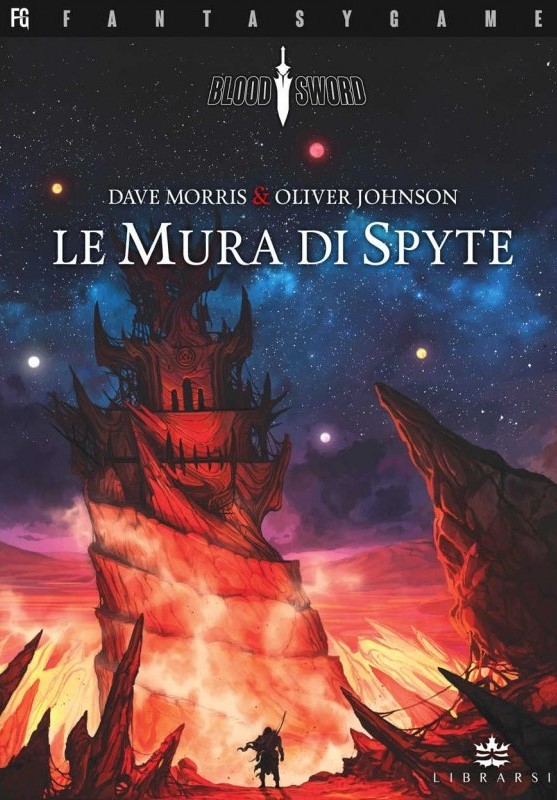
The Walls of Spyte is the last installment in Oliver Whawell's series of rules conversions from Blood Sword to Dragon Warriors rules. The stat blocks are available in PDF form here.

I had a lot less to do with the writing of the fifth book than the rest of the series. Oliver Johnson was supposed to write it, but ran out of time. Luckily Jamie Thomson was on hand to step in, but necessarily it was a rush job so he didn't have time to read the earlier Blood Sword books. I came in right at the end to tie up the last 40 sections or so.

Patreon backers can see how I'd have liked the series finale to pan out. Tambù's Blood Sword 5e campaign and rulebook drew on those notes, and I have a feeling so will Prime Games' forthcoming CRPG.

Various player-characters guest starred in the Blood Sword books, in a manner of speaking. This time it was the turn of Zaraqeb (Zara in the book) and Karunaz, who were played in my and Steve Foster's Empire of the Petal Throne campaign by Gail Baker and Paul Mason. The original PCs weren't a lot like their gamebook incarnations, incidentally. The real Zaraqeb wasn't a sorceress and wasn't that nasty; the real Karunaz was neither posh nor noble, though he was a much more interesting kind of hero because of that.

Friday, 9 February 2024

Blood Sword to Dragon Warriors - part 1

Last time I mentioned Oliver Whawell's conversion of Blood Sword stat blocks to Dragon Warriors rules, which Oliver has kindly agreed to share with readers of this blog. There's a lot of great work there, so I'll be running it in installments. To get the ball rolling, here's The Battlepits of Krarth.

The original books might be useful if you're thinking of running Blood Sword as a DW roleplaying campaign. You can get those here:

In the US

DRAGON WARRIORS


BLOOD SWORD

The Battlepits of Krarth on Amazon and on Barnes & Noble
The Kingdom of Wyrd on Amazon and on Barnes & Noble
The Demon's Claw on Amazon and on Barnes & Noble
Doomwalk on Amazon and on Barnes & Noble
The Walls of Spyte on Amazon and on Barnes & Noble
Blood Sword Battle Boards on Amazon

In the UK

DRAGON WARRIORS

BLOOD SWORD

The Battlepits of Krarth on Blackwell's, Waterstones and Amazon
The Kingdom of Wyrd on Blackwell's, Waterstones and Amazon
The Demon's Claw on Blackwell's, Waterstones and Amazon
The Walls of Spyte on Blackwell's, Waterstones and Amazon
Blood Sword Battle Boards on Amazon

Italian gamers won't need to use Dragon Warriors as all the work has been done for you by Valentino Sergi and Daniele Fusetto in their magnificent Blood Sword 5e book, published by Tambù. It turns the whole gamebook saga into a Dungeons & Dragons campaign, and it truly is a thing of beauty.

And if you aren't familiar with the Blood Sword series and you're looking for a taster, Raphael Perry did a playthrough of book 1 on YouTube along with this very interesting strategy analysis:

Friday, 8 December 2023

Monsters, Aliens, and Holes in the Ground

If you're looking for a last-minute Christmas present for a friend who's interested in the history and cultural context of roleplaying games, MIT Press have just released Monsters, Aliens, and Holes in the Ground: A Guide to Tabletop Roleplaying Games from D&D to Mothership by Stu Horvath. (Now on sale from Amazon US, Barnes & Noble, Amazon UK and Blackwell's.)

It's not the kind of roleplaying analysis you tend to get here on the FL blog. What I like about playing RPGs is thinking and behaving as people unlike myself, and what interests me about roleplaying as an art form is that RPGs provide a medium for creating multi-person emergent narratives that are very different from old storytelling media with their three-act structures and whatnot.

This book comes at roleplaying from a whole other angle: the social history of the hobby along with a thorough analysis of its evolution. Gamebooks are discussed too. Be advised that Mr Horvath admits to not being fully comprehensive in his coverage; there are, indeed, holes in this ground. Empire of the Petal Throne, a big early release from TSR and a major event in original worldbuilding, is omitted because of accusations that M A R Barker held clandestine antisemitic beliefs. I have no tolerance for antisemitism myself, most especially not in view of the appalling rise in hate crime against Jews that we've seen in the wake of Hamas's terrorist atrocities on 7 October, but it is nonsensical to write EPT out of roleplaying history on that account. The art is not the artist, and the book is supposed to be a history of the hobby, not a teenager's diary. It would be like omitting Patricia Highsmith's novels from a book about the crime genre on the grounds of her antisemitism and prejudice against Black people (with the difference that Highsmith openly expressed such views). At least, thankfully, Call of Cthulhu is covered here, possibly not so much because the Cthulhu Mythos has had multiple contributors as because HPL's legacy is simply too influential to ignore.


Anyway, those are quibbles -- and frankly, while I was a big fan of Tekumel back in the day, I concede that Barker poisoned his own reputation by signing a deal with a neo-Nazi publisher (we won't get back into the unanswerable question of whether he was actually a sympathizer or just foolishly imagined he was playing them) and consequently if the rest of his work is going to get cancelled as collateral damage, knee-jerk though such reasoning usually is, Barker only has himself to blame. (Game designer Pauli Kidd makes some good points about the ensuing debate here. And if you are interested in how Empire of the Petal Throne fits into roleplaying history, here's a quick overview by Juhana Pettersson.) Meanwhile there are lots of other great roleplaying games to talk about, most of them written by unarguably decent and right-thinking folks, and Mr Horvath's well-researched and in-depth survey of the field should give you hours of interesting reading while you wait for the turkey to finish roasting.

The book does come with a pretty weighty price tag, but it sounds like it's worth it. A friend who bought a copy (he's much richer than I am) commented:

"The book is entirely commendable as an exhaustive archive save for the glaring omission of EPT. It’s a coffee table compendium and a fine gift."

I do have to point out, though, that on Christmas morning for just about the same money you could be unwrapping four Vulcanverse books or the whole Blood Sword series. Sadly there's no chance now of getting the Blood Sword 5e book this Christmas, which would have been my dream come true, but hopefully by next year... (Possibly. Maybe. Who's got the wishbone?) In the meantime let's all try and stay on Santa's Nice list.