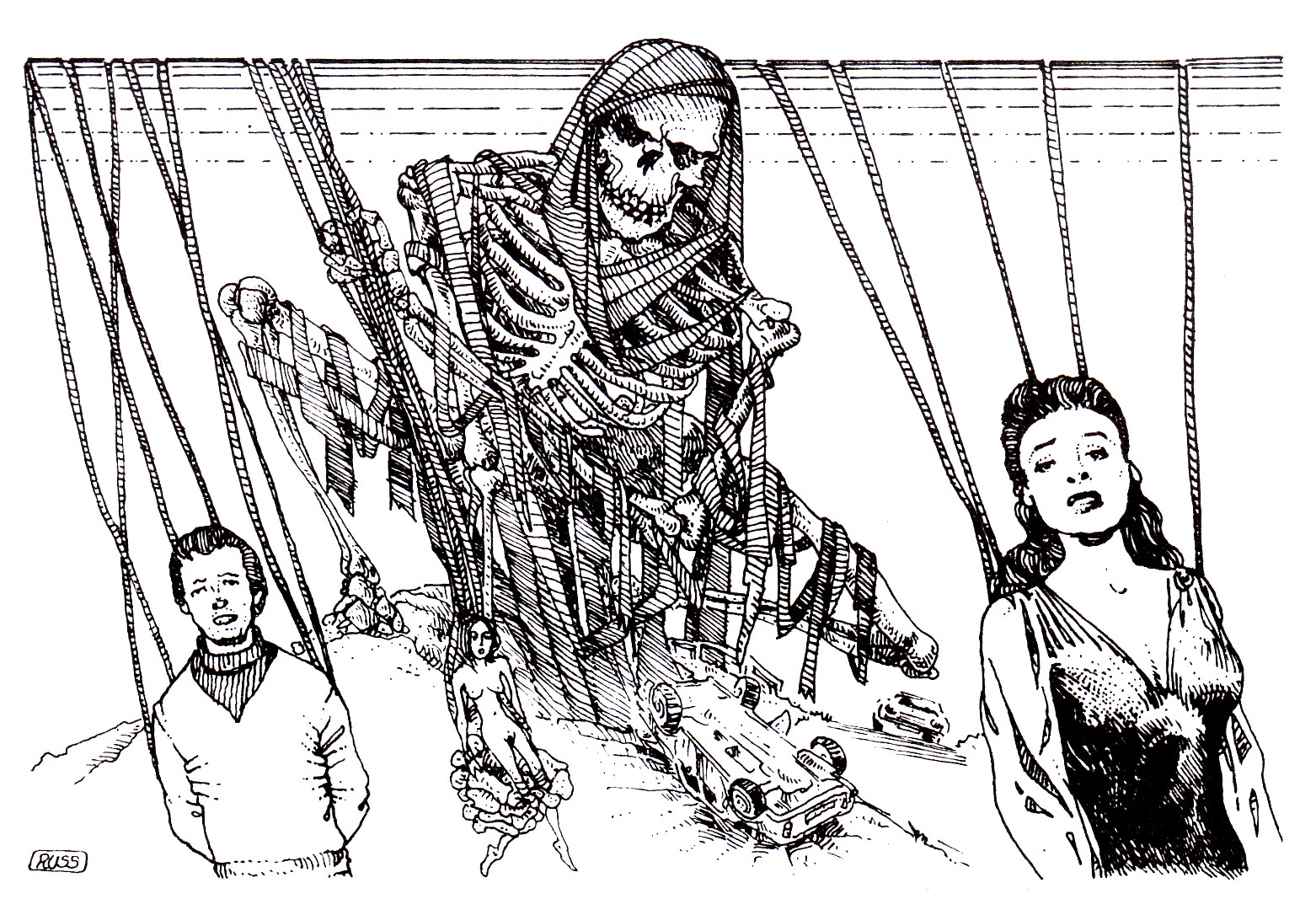
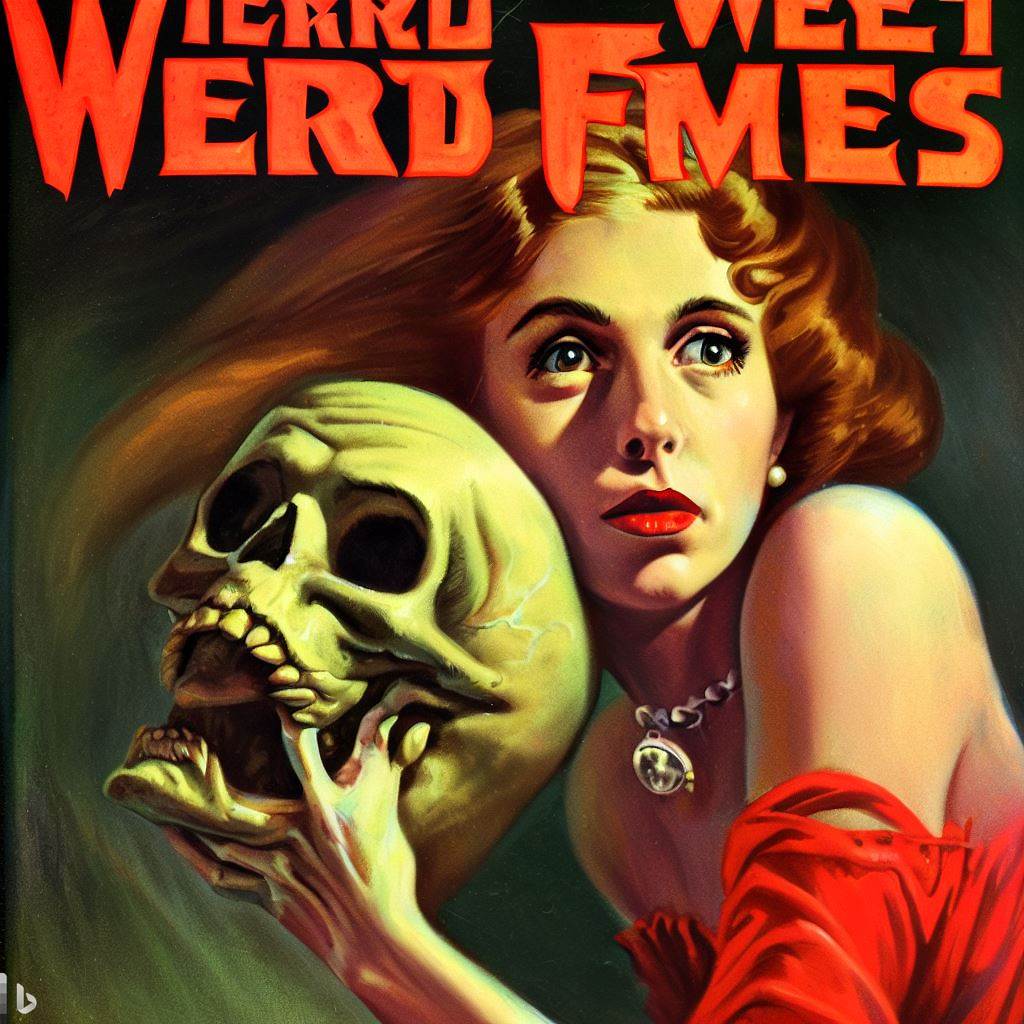
The first of the Fabled Lands Chapbooks series was Headcases, in which I referred jokingly to my predilection for flying head monsters. Well, I thought at the time it was a joke, but now I think I might have a serious problem. Two recent scenario books in the series, Oliver Johnson's It's Mostly Been Forgot and my own "The Honey Trap" (in Wizards of Tamor) both feature flying heads, and I just edited an old Questworld scenario by the two of us, One Night in Deliverance, and found that among the critters was an early form of the Dragon Warriors skullghast. (Though, to be fair, those Questworld skullghasts weren't quite just flying heads, they had a sort of ethereal body too.)
The only solution to my head obsession might be to go cold turkey -- or cold feet, rather. In my next scenario I'll try to include some disembodied lower extremities, and not a bonce in sight. I've been there before too, in this letter to the gentlemen of the Royal Mythological Society from Mirabilis: Year of Wonders -- but so far the heads are still way ahead in my oeuvre while the feet are trailing with that sole entry.
Fans of the work of English fantasy author John Whitbourn won't want to miss the chance to lay their hands on The Ghosts and Scholars Book of Landscape Figures. This is a hand-numbered limited edition hardcover featuring a selection of weird tales involving chalk giants and other ancient entities slumbering in the hills. Mr Whitbourn's contribution may (so he threatens) be his last short story. We must hope that's not so, but collectors will want to snap up their copy just in case. Forget about NFTs and crypto; give it a year or two and these books will be worth more than their weight in Saxon gold.
As for prehistoric (or sometimes more recent) chalk figures -- abiding through the centuries, they evoke a sense of the numinous even in a thoroughgoing materialist like me. They can be variously seen as guardians of the sacred, warnings to intruders, or just marks left by those lived before us to say, "We were here!" In the hands of these skilled writers they lie across the threshold where folk horror and psychogeography meet. I haven't been able to resist using them in my own work, both in the Dragon Warriors scenario "Wayland's Smithy" and, more frivolously, in this letter to the Royal Mythological Society in Mirabilis, the comic I created with Leo Hartas and Martin McKenna.
With Christmas coming up, I feel I should suggest a few presents. Christmas Eve is the perfect time for weird tales, and they don't come any better than John Whitbourn's Binscombe Tales -- the perfect blend of eeriness, wit, charm and chills. But don't overlook the same author's novel Babylondon, which I sometimes categorize as Doctor Who meets A Matter of Life & Death:
"1780, The Gordon Riots: London is on fire and in the hands of the mob. Babylon rises from the Infernal depths to replace England’s capital and rule forever. Enter the enigmatic Cavaliere, sent to sort things out, armed only with a swordstick—and frightfully good manners."
Also recommended is his short story collection Altered Englands, "where traditional ghost stories rub shoulders with alternate histories, science fiction, fantasy, and tales of the supernatural. Expect blood to be chilled, pulses to quicken, and wry smiles to be raised.
Includes the concluding—and revelatory—story from the Binscombe Tales series, ‘England Expects!’"
Also imbued with the magic we expect of the season is Roz Morris's delightful short novel Lifeform Three, in which a robot and an animal together remind the humans of the future what really matters in life. Roz also wrote a charming and quirky travel memoir, Not Quite Lost, in which the Morrises explore odd corners of the UK; think Bill Bryson with more focus on the lives and eccentricities of the people met. Of course, I'm not impartial.
Another timeless classic guaranteed to bring thrills and laughs: Jamie Thomson's Dark Lord novels. Supposedly for kids but loved just as much by grown-ups, the series makes ideal reading for Christmas.
If you're not into fiction, regular readers will remember that I have previously praised Andy Fletcher's memoir-cum-life-guide How To Back Horses & Yourself. As I put it in my Amazon review, reading it is like going for a pint with somebody who is expert in their subject and is also a dazzling raconteur who can be funny and insightful while telling you all the ins and outs of their subject.
There's nothing Christmassy about Fights in Tight Spaces, but it is a fun little game that Jamie and I have been enjoying recently, and if you're too lazy to do any shopping it has the advantage that you can just download it. It reminds me a little of the classic boardgame Gunslinger, given that your tactical moves are played in the form of cards with an action point cost (though in Gunslinger you choose the round's cards rather than having them dealt randomly and most cards can be played in more than one way). The developer is currently polishing a follow-up called Knights in Tight Spaces, which I can see myself losing many hours to.
Or what about a gamebook? Some of the best available are Martin Noutch's Steam Highwayman series, rich with enough period atmosphere, innovative fantasy, exhilarating adventure, and vivid characters to draw comparison with Dickens. Playing these is like diving into your own Christmas Day movie.
Possibly the ultimate in depth of both setting and gameplay is Expeditionary Company. This series is complex but rewards the care and attention you'll put into every detail, even down to the NPC guards you'll pick to defend your caravans: some of the NPCs are arrogant and hard to get along with but consummate fighters, others have valuable skills like healing, survival, tracking and trading. There's a huge range of downloadable extras you can find here. What would be even more perfect to turn Expeditionary Company into a Christmas gift would be if there was a boardgame adaptation (maybe a Kickstarter for 2025 there?) but with a little imagination you'll find the gamebooks are all you'll need to carry you off into a whole other world of fabulous adventures.
Another innovative gamebook is In the Ashes by Pablo Aguilera. I say gamebook, but this really is a solo RPG with a fascinating admixture of boardgame elements. I intend to talk more about both this and Expeditionary Company when I get time to analyze them in detail, but suffice it to say that In the Ashes is a physically gorgeous artefact that would make an ideal Christmas present.
Or for something visual that's both disturbing and charming at the same time, let me recommend Ryan Lovelock's brilliant Kadath Express. Ryan has provided a free digital version (hit the link) for you to try online, but consider splashing out for the hardback because it really makes a gorgeous gift.
For roleplaying into the New Year, I like the look of Postmortem Studios' Wightchester: Prison City of the Damned. It's sort of the horror reversal of Mirabilis (see below) as the comet of 1666 causes the dead to rise from their graves. The rising is worst in England, where the dead from the plague and the recent Civil War overwhelm the city of Whitchester, which is subsequently sealed up tight and walled off, becoming Wightchester. The city is now a prison for criminals tasked with reclaiming it and facing certain death from the undead should they fail. (And for further ideas to keep the campaign going once Whitchester is purged of zombies, you could do worse than plunder the imagination of Pat Mills in his comic Defoe: 1666.)
If you're looking for books of mine (and bless you, if so) then the ones I'd most recommend for Christmas are Mirabilis: Year of Wondersvolume one and volume two. And if comics are not your thing, the Edwardian fantasy of the Mirabilis universe is also on show in A Minotaur at the Savoy, a collection of quirky vignettes. Or if it's a virtual stocking you're looking to fill, try the online version of Heart of Ice generously coded by Benjamin Fox.
And for viewing on Christmas Eve and Christmas Day, here are a few things I've enjoyed over the years while recovering between bouts of turkey and pudding. Wine may also have been involved.
Finally, a freebie: my pulp-era SF pastiche "Cubic Capacity". It's not specifically set at this time of year but it has got a lacing of whimsy such as readers used to find in Unknown, which seems appropriate to the season, and being free it counts as a gift. I was 15 years old when I wrote the story and I'm not sure I could do it any better today. A ghost of Christmas Past, then.
With the nights drawing in and Halloween approaching, it's time to think about reading matter for that snug little nook by the pub fireside. You're going to want a bit of fantasy, a bit of whimsy, some dry humour to wash down with a good pint, and just the occasional gust of spooky chill to make you appreciate the warmth indoors.
One of my favourites of my own books is A Minotaur at the Savoy. If that cuts no ice, let me just add that it's one of Jamie's favourites too, and he (along with Freya Hartas) won the Roald Dahl humour prize. You get fifty vignettes in the urbane fantasy genre in the form of correspondence to the Royal Mythological Society in the year 1901 -- when, as the cognoscenti know, a green comet stirred everything up by dissolving the boundary between the real and the imaginary. And that's no bull.
Previously documented incidents from the Year of Wonders include:
2010. Leo Hartas and I had tickets to the London Book Fair. We weren't expecting much to come of it. If an author steps onto a publisher's stand at the LBF, they look at you like they want to call RentoKil. But we had just published our comic Mirabilis: Year of Wonders on iPad and we were hopeful of showing it to other writers and artists at least.
Fate smiled on us, though. A volcano erupted in Iceland, disrupting air travel, which thinned out the crowds at the LBF. Deprived of the international reps to do deals with, UK publishers had nothing better to do with their time than hold their noses and talk to the authors. (Oh, you thought they'd welcome the opportunity, seeing as we're the people whose work pays their salaries? Ha ha.)
Still, Leo and I thought we had something pretty interesting to show them. We knew they'd have zero interest in the creative content of our Mirabilis app, but there were features they should be taking note of. "Look at how you can buy each issue of the comic in the app," we said. "Those could be the latest titles in your book list. There are share buttons, and if the user signs up they'll get told about new titles in any series they're following."
The publisher's eyes scanned the crowds behind us, probably wondering where that exterminator had got to. "We are publishers, not booksellers," she told us with infinite disdain.
"But this would give you a direct relationship with your customers. You can find out what they like. Sell directly to them. Push additional content like author interviews. Let them know about upcoming releases. All within the app."
She turned away, visibly sickened by having to talk to tradesmen. Mama would never have had to stoop so low. "It is not our business to have a direct relationship with our readers. Publishers do not need 'apps'."
Fast forward only six or seven years and every publisher by then employed bright-eyed tech advisers. "What we want as publishers," they would tell you loftily, "is a direct relationship with our customers."
Too bad they didn't get on that bandwagon when it was setting off. Perhaps if Leo and I had worn suits and pretended scorn for the saps who wrote and drew the comic, the publishers at the 2010 LBF might have listened. But probably not. It's an unchanging trait of British publishers that they will completely refuse to embrace any new trend till it's already passed them by. (A few years earlier, discussing ebooks with another publisher, they'd asked us where they would sell "the discs" with the ebooks on.)
It’s impossible to imagine the Fabled Lands without the involvement of Russ Nicholson, who died this month. His filler drawings are my favourites, little vignettes necessary for gamebook layout so that options don’t spill over a page, but also perfect for evoking the ambience of each book’s setting. He always put something extra into all the pictures: comic book style inserts, fragments of unknown scripts, characterful onlookers in the background of a scene, a thousand touches that convey personality, colour, humour and reality.
For some reason we had a struggle getting the Pan Macmillan art director to let us use Russ for the world maps. They had a different illustrator lined up but, as you can see by comparing the first four FL books with the last three, Russ’s cartography was streets (and forests, and mountains) ahead. In FL book 3 they printed the two halves of their map the wrong way round, at which point they admitted that maybe we’d been right all along and Russ should handle it.
I put a personal tribute to Russ on my Patreon page (unlocked) and I asked other members of the Fabled Lands team to contribute their memories. Here’s Paul Gresty:
“I first met Russ in 2010, when I was his interpreter at a gaming event in Paris. He’d illustrated many, many books that I owned and loved, and I was incredibly excited to spend a weekend with him. Throughout that event, Russ was interesting, and kind, and humble; whenever a fan of his work asked him to sign a book, Russ also took the time to draw an illustration in there, too.
“At some point that weekend I asked Russ if he’d sign a copy of Citadel of Chaos for me. I was expecting a signature, and perhaps a quick sketch. Instead, Russ took the book back to his hotel room so that he could spend some time on a picture. When he returned the book to me the next day he’d drawn a phenomenal illustration (an axe-wielding warrior and a dragon) right across the book’s copyright and title pages – and he actually apologised that it wasn’t as good as he’d hoped. The paper in the book wasn’t ideal for ink drawing, he explained; the ink had bled on the page a little. I guess that’s an artist term. Bleeding ink or not, I was overjoyed with the illustration.
“I’m happy and grateful that I was able to work with Russ after that, and to meet him in person a few more times. He was a creative powerhouse, and a joy to be around. Incidentally, it was Russ who introduced me to the Fabled Lands books, showing me a book that somebody had brought for him to sign. He (correctly) told me I’d enjoy reading them.”
“A sad loss indeed, both personally and professionally. I remember meeting him in our White Dwarf offices a few times way back when, just a nice guy and so talented. Iconic game book and WD illustrator. I guess the ink blot story is my favourite. He was doing a Fabled Lands map and blotted it by accident. Me and Dave immediately came up with 'The Hole in the World' so it looked like it was deliberate. Well, I think we did, maybe it was Dave or Russ that came up with it, I can't remember. Anyway, there were quite a few things that we added to the stories and the lore that came from Russ; he inspired us too.”
At first I wasn't sure about Jamie’s recollection there because Russ's world map for FL didn't appear in print until books 5 and 6, so how come he drew the Hole in the World before anyone else? It's probable that he drew his own version of the world map right from the outset in order to have a context for the regional maps in each book. It's typical of Russ's boundless enthusiasm for and professional pride in his work that he'd do that even without a commission from the publisher. He improved every idea we gave him. He was our Jack Kirby, our Billy Preston, the Eno to our Roxy Music. As film directors value a great cinematographer, we valued Russ – as a good friend as well as a collaborator. He won’t just be missed, he’s irreplaceable.
He leaves behind his partner Jacqui. His wife, I should say, as they had planned to get married while Russ was in hospital, only he got moved to another ward which couldn’t accommodate a bedside ceremony. Had he come home I’ve no doubt they would have had the wedding then, but sadly he died in hospital. Fans will remember him fondly, friends with love, but the real wrenching loss is Jacqui’s.
However, as long as we have Russ’s art we can still see the expression of his personality. In that sense he’s with us always. Here is a small selection of illustrations by him that you might not have come across before.
Two more sample pages for The DFC, this time for the John Blake strip:
A test page for Mirabilis, because in the early days we thought Leo and Martin would be too busy on the gazetteer book to handle the comic strip chores as well:
Layout page for “Rich and Strange”, one of several Mirabilis standalone stories I wrote to run in The Guardiannewspaper:
(Only one story, “A Wrong Turning”, was ever fully illustrated, and that by Martin McKenna whose loss we also mourn.)
A rough that Russ prepared for A Town Through Time, a project we pitched without success to publishers in the late ‘90s:
You can see how much on-spec work an artist has to produce in order to nab a few paying gigs. And this is just the tip of the iceberg. Here's another -- Russ's drawings for the Conquerors game.
If you were interested in recent posts (here and here) on AI artwork, I've been tinkering with it to complete my Mirabilis comic book and you can also hop over to the Wrong blog for some unsettling machine-made images in the tradition of Weird Tales. Which is a sort of segue into tomorrow's post. See you then.
When I'm writing a scenario for publication (such as this one) I'll sometimes cast the incidental NPC roles by saying which actor might play them. It's a shorthand way of conveying the idea of the character without having to describe their personality in the scenario.
My wife goes one further. When writing her novels she picks real faces that she can visualize as the characters. That could work when designing roleplaying scenarios too.
And a further evolution: Unreal Person lets you generate faces that don't exist. (The one above on the right really shouldn't.) Or you can use something like Nightcafe for non-modern images like this medieval apothecary:
You do have to let the art lead you where it will, though. There's not yet much hope of getting the AI to draw exactly what you want, as my experiments on the Mirabilis blog show. Still, the field of generative AI has reached escape velocity now. It's only a matter of time.
Happy New Year! I expect you've had more than enough of Vulcanverse to be getting on with, so here's a link to the comics I swiped that panel from. I'm just amazed that the artist (Richard E Jennings) predicted more than half a century ago what Jamie's study would look like.
Also, as I'm endlessly optimistic, here are links to my Mirabilis: Year of Wonderscomic with Leo Hartas and Martin McKenna. If you're ever going to read Mirabilis, New Year is the time ('cause that's when the story starts) and at least it earned more reviews than the Vulcanverse books managed.
Mirabilis, my fantasy graphic epic with Leo Hartas and the late Martin McKenna, originally appeared in The DFC, a short-lived forerunner of The Phoenix comic. A friend of mine read it on the sleeper train out of Moscow as he was travelling home just before Christmas -- pretty much the perfectly immersive experience.
You can read Mirabilis online here and dive into the background here and here and here. As you can probably tell, it was a labour of love and if I could finish it I would, only the world doesn't owe me a living. (Sadly.)
As part of the very extensive world-building for Mirabilis, I wrote the correspondence of the Royal Mythological Society in a little booklet called A Minotaur At The Savoy. So that's fifty whimsical vignettes of green comety weirdness that, if you're starting to think about gifts, would fit quite neatly into a stocking. But then, I would say that.
The stories range from a mysterious giant hand found in a wood in Yorkshire to the best way to deal with a dragon that's taken a shine to the gold reserves of Fort Knox, and although it's hard to pick one that can be described as typical, this will give you a taste of what to expect:
Dear human savants
Following a motion of no confidence in the prime minister, I find that my Martian Party has enough seats in the House of Commons to form a new government in coalition with the Liberal Unionists. The only sticking point is that, as you may know, my prospective allies are committed to a very specific agenda. Their three-point plan entails establishing a minimum wage, giving women the vote, and maintaining the unity of the British Isles - whereas the Martian Party is pledged to subjugate the planet Earth, replace corn with red weed as the staple carbohydrate dietary supplement, and ship a million slaves to the helium mines of Phobos.
As a compromise, I have agreed to defer mass enslavement for the term of the current Parliament, concentrating instead on domestic transport policy as an area of common ground on which our two parties can agree. For example, to alleviate the growing problem of “rush hour” congestion at the major London rail terminuses, we propose loading commuters onto massive catapults which will fling them across the city to land in collection nets near to their place of work. We estimate this would save at least seventy thousand man-months of labour per year. However, some of our advisors believe that it will not be a popular measure and could lose us votes at the next election. What do you counsel?
Yours, the Right Honourable Xangovar the Merciless, OBE, c/o the Palace of Westminster
Prof Bromfield replies:It would be very popular with small boys. Unfortunately, they don’t have the vote. Might be a better world if they did, if you ask me.
Dr Clattercut: Oh yes. Because resolving international disputes with conkers matches is obviously the way to go. Pulling girls’ pigtails when they demand enfranchisement. Declaring the whole of January a national tobogganing holiday. Making marbles the official currency of the Bank of England…
Prof Bromfield: You think you’re being wittily scathing, Clattercut, but in fact you’re just proving my point. So that’s what I’d suggest, Mr – er, Xangovar: shake up the Cabinet a little. Bring in some schoolboys and artists and poets and whatnot. Be more radical with your reforms, if anything. This is the Year of Wonders, so what’s wrong with sprinkling a bit of magic on the tired old machinery of politics? Trust me, the electorate will thank you for it.
Dr Clattercut: Those that land in the nets, anyway.
Have a great Samhain/Halloween! And if you're looking for strange stories in a very different vein from Mirabilis, don't forget to take a look at the Binscombe Tales.
A previous guest on the Fictoplasm podcast was my wife Roz Morris so to balance things out I guess Ralph just had to ask me. Tune in here for our long discussion which takes in Brexit (鎖国), Tetsubo (鉄棒), my planned Sparta RPG (Λ), Mirabilis (☄), Frankenstein (🧠), Tirikelu (₸), and of course Jewelspider (💎🕷 or 宝石クモ, take your pick). We also talk about politics, gamebook design, the Congo, Nazis, Sagas of the Icelanders, and roleplaying in soon-to-be-sunken lands from Abraxas to Lyonesse but I've got no kanji or other symbols for those.
Jamie mentioned after listening to the podcast that I came across a bit like Tony Blair at times. Apparently he meant because of my vocal inflection rather than my politics. I suggested we might do a regular Fabled Lands podcast. (Jamie would be the Gordon Brown of the partnership, presumably.) So far I haven't been able to convince him, but maybe if there's enough demand...
Dramatic irony occurs when the viewer or reader of a story knows more than the characters. It can be an effective way of making you connect with the story (“Look behind you!”) though if sustained for too long it tends to distance you from the characters (“Doesn’t that numbskull realise the danger?”) and then you've got the opposite effect.
A less immediate form of dramatic irony might plant a seed that will build over time. For example, in the Marvel Cinematic Universe we learn about Thanos’s behind-the-scenes involvement long before the Avengers even know his name. That doesn’t create emotional distance because for most of the saga he’s not the problem they have to face right away. He’s an oncoming storm, but it’s his proxies and allies who present the immediate threat.
Most film and television dramas aren't like first-person novels. There are scenes that don't feature any of the protagonists -- like those early tease moments with Thanos, for example. But when you're telling an interactive story, jumping away from our heroes to another viewpoint gets tricky. The characters expect us to advise and guide them, and the story really only works if we pick a side. (Even if that side might change.) We form a bond with our viewpoint character and that tends to frame how we expect to see events in the story -- not first-person, exactly, but close third. Under those conditions can dramatic irony serve any useful purpose?
An example: in the opening episode of Mirabilis, I cut within the first three pages between Jack Ember and Estelle Meadowvane, both lead characters, and inserted a scene (above) in which we see series baddie the Kind Gentleman in his true devilish form. The Kind Gentleman closes a web of dangers and intrigues around Jack’s life, but it’s nearly two episodes – that’s 50 pages – before they meet face to face. If we’d been interacting with Jack all that time, and knew what we know in the comic, and hadn’t warned him then he’d legitimately want to know why.
Well, let’s think about how we would interact with Jack and Estelle in an interactive version of Mirabilis. We wouldn’t want to do a lot of head-hopping, because interactivity favours a close relationship with one character, so probably you’d let the reader/viewer choose which of our heroes to follow each episode. The more the reader sticks to the same viewpoint character, the more they'll bond with them – but at the expense of not knowing everything the other one has been up to.
What kind of interaction would this be? The “Bandersnatch” episode of Black Mirrorreportedly entailed shooting more than five hours of story content. If you’re working in a medium where extra scenes cost money (anything but radio or prose, basically) then you’ll want to steer clear of that Choose Your Own Adventure model – oh, and don’t call it CYOA unless you want to get sued.
Luckily there are more rewarding ways to interact with characters than telling them what to do next. You can chat to them, get them to reveal their backstory (cf Lost), find out how they feel about each other, make subtle hints about what they should say or how they should behave that will influence other characters’ attitude towards them over time. These are the kind of subtle nudges and inputs that we get from interacting with people in real life.
To make that model of interactivity work, you’d have most backstory strands only accessible when cued by something that happens in the story. Jack, thrown in prison, talks about how he used books to escape loneliness and poverty as a child – and that leads him to a realisation that feeds into the plot. In the interactive version, there might be several breakthrough moments when you could get him to talk about that, and several different eureka plot developments as possible outcomes.
So the plot as it is in the comic remains largely unaffected by the player's choices. That's not only to avoid drawing the thousands of extra panels needed for a diverging story, but also because interacting with plot is not what's really interesting. The linear surface story is fine as it is. The interactivity can instead be about exploring interiority, discovering more about the character, and building a closer relationship with them so that they start to share their hopes and fears.
In other words, we can't (and don't want to) change the plot, but we can enrich it with foreshadowing. For instance, maybe Jack confides in the player that, "If anything were to happen to Estelle I'd die." When Estelle is captured by the Big Bad, that moment will now land with even more impact. And, yes, you could do that in a linear story too: Jack just tells somebody else how much Estelle means to him. But in the interactive version it’s a shared secret. It’s something you earned from your relationship with the character. Maybe you even encouraged him in those feelings, and because of that he’s now more vulnerable. Now you’re not just watching the story; you’re part of it. And that's what interactive storytelling is all about.
A little while ago, I was asked by my Italian publishers to do an interview for Tom's Hardware. Then it occurred to me that some of the answers might be interesting to readers of this blog, so if you don't speak Italian here's the meat of it: Dave, in Italy, you’re known especially for the Blood sword series. Since those books were originally published a lot of time has passed. How do you think gamebooks have evolved? What was the market like in the ‘80s and how is it different today?
It was totally different. Gamebooks were a huge craze among what we now call “middle grade” kids (roughly 9-12 years old) and you pretty much only had to walk into a publisher with an idea to get offered a contract. Gamebooks would sell hundreds of thousands of copies. I think it was because kids were ready for videogames but those were still quite expensive and the graphics were quite primitive. So gamebooks filled a gap.
Blood Sword was the first multiplayer gamebook. How did you transform a solitary experience like a gamebook into a shared game?
Oliver Johnson and I always start the planning process for one of our gamebooks by thinking about events we’ve used in our roleplaying games, so multiplayer comes naturally to us. I was also aware when we wrote Blood Sword that a lot of the readers would be people who already played Dragon Warriors (set in the same fantasy universe) which meant that they probably would have gaming friends who they wanted to share the adventure with. We made sure that every character type has a chance to shine, and if you are playing it as a team there are some sections that only one character gets to read. We find that a dash of secrecy and competitiveness adds an edge to any roleplaying game.
Recently you ran a Kickstarter campaign for a new edition of Blood Sword 5 The Walls of Spyte. Why that book in particular?
I’d already edited the rest of the series for re-release in 2014, but when I got to the fifth book I found that the work needed to make it playable was more than the other four books put together. There were parts of the flowchart that simply didn’t link up. If I’d left it till I had time to revise The Walls of Spyte then none of the books would have got back in print, so I published the first four and put book five aside. I kept meaning to return to it but there was so much work involved that I couldn’t justify it as something to do in my spare time. The Kickstarter provided the funds needed to do it properly.
What should a gamebook have today to be current? Do you think that classic forking-path stories are still enough, or should gamebooks dare to try something new?
I’m always interested in something new. In my Frankenstein digital gamebook, the focus is not on solving “the problem of the plot” but on your relationship with Victor Frankenstein, the narrator. The variables are things like Trust, Hubris and Alienation. If you give Victor bad advice, he loses trust in you and that affects whether he’ll listen to your suggestions in future.
Recently I wrote Fright Tonight, which is billed as an interactive drama for the Amazon Echo, but it’s effectively still a branching-path gamebook in terms of structure. I’ll be releasing that as a Kindle book later this year, and one of the things that makes it different is there are no stats, no character sheet, no dice. You just answer yes or no to the characters’ questions. Trust me, it’s as gripping as any gamebook I wrote back in the ‘80s and ‘90s.
Some say we are living through a renaissance of gamebooks. What do you think about that? In a world dominated by videogames and mobile games, do you think is there any space for gamebooks? What kind of appeal can they have for new, especially young, players?
Fewer people are reading books these days, and on average those people read fewer books per year, so it looks as if gamebooks will have to come up with some new tricks. For one thing, there’s not really a lot of point doing more fantasy quest-style gamebooks. Computer games do the same thing and they do it better. Gamebooks have traditionally tackled stories from a problem-solving angle. That’s natural given the menu of choices structure, but again it’s not enough to entice somebody away from a computer game or a movie, or even playing Fortnite on their phone. So how do we write gamebooks that offer the reader something they can’t get elsewhere?
One clue to the answer comes from looking at how television drama competes with cinema. Even the most lavish TV show can’t match the budget of a Hollywood blockbuster, so it has to play to its strengths. A 13-hour TV drama has a lot more room to explore character complexity than a 2-hour movie, with the result that if you sit down to watch Mission Impossible after The Americans, or Warcraft after Game of Thrones, it’s like going from a novel to a newspaper cartoon. Gamebooks can do something similar, involving the reader in difficult moral choices and options that will change other characters’ opinion of them. Modern audiences in all media expect this emotional depth. As a medium, gamebooks have to grow up.
You have written scores of books; gamebooks, novels, comics, and RPGs in your career. What have been the most difficult things to write? And of which are you particularly proud?
Most difficult was my recent gamebook Can You Brexit?as I had to research all of the details of immigration, free movement, defence, policing, trade, and a dozen other things – and then make them both amusing and comprehensible to the reader.
Of all my gamebooks I’m most proud of Heart of Ice, just because it came out exactly how I wanted it. You can’t always count on that as there’s a tension between delivering the sense of real freedom of choice while (in old-style gamebooks) keeping it all down to about 500 sections or less. Heart of Ice was loosely based on an old roleplaying campaign of mine and many of my players’ characters were the inspiration for the player’s rivals in the adventure. To keep myself interested while writing, I changed the setting from the fantasy world of Tekumel, which it had been in my campaign, to 23rd century Earth. That gave me a story structure to work from while still having plenty of scope to improvise details as I worked.
The work I am most pleased with overall, though, is my comic book epic Mirabilis – Year of Wonders. I care passionately about the characters, it’s exactly the blend of funny, scary, mysterious and thrilling that I was aiming for, and I think the artwork (by Leo Hartas, Martin McKenna and Nikos Koutsis) is beautiful. Unfortunately the project ground to a halt about a third of the way through for want of a publisher. In Britain, sadly, there’s not much of a market for comic books.
Is there a book you wish you had written?
I’d like to have done more Dragon Warriors books. There were originally supposed to be twelve books in the series, but the publishers messed up the distribution and then cancelled the series after six books. Oliver and I still use the setting for some of our own roleplaying games, and we’re thinking of releasing the Jewelspider RPG, which is a much more modern, freewheeling set of rules. And instead of all those polyhedral dice it just uses two six-siders.
My biggest regret, though, is not having been able to continue Mirabilis. Leo and I planned it as four seasons, but when I was halfway through season two the money ran out. It costs a lot to pay for all that art! I have the whole story blocked out and I love the characters, so maybe I’ll return to it as a prose novel – but that will be a shame, as I think it really works best as a comic book.
How did you get involved in gaming? What do you like so much about games?
That’s a very good question. I think it’s because I get to exercise my imagination and my analytic mind at the same time. It’s the same reason I design games and write fiction – you’re having to be creative and flexible while at the same time solving problems. And because they are all sorts of different problems I have to think on my feet, which I enjoy. It’s why I prefer real-time strategy games to turn-based, because of the adrenaline. In roleplaying games you’re constantly improvising, whether you’re playing in the game or running it, and I get fired up by that. Also there’s the social aspect of gaming. I like hanging out with my friends, and most of them are gamers. It’s just a shame that my wife isn’t into games, because if she did I’d happily play a boardgame most evenings.
What are your favourite games?
In face-to-face roleplaying: Empire of the Petal Throne, and other rules and spin-offs set in MAR Barker’s world of Tekumel. I like it so much I designed a set of rules myself for it, called Tirikelu, that are available free online. Recently I’ve also enjoyed Gregor Vuga’s Sagas of the Icelanders, which is an Apocalypse World variant.
As for videogames, I like What Remains of Edith Finch, Return of the Obra Din, Inside, Kingdom Come: Deliverance, The Witcher, This War of Mine, The Talos Principle – oh, too many to mention. Lately I’ve been getting into VR games as I’m doing some design work on one. My favourite computer game of all time: Outcast. That’s twenty years old and I still go back to it.
Do you still get time to play? What are you playing at the moment?
I host a roleplaying session every two weeks, and my group also try to fit in four weekend specials each year. It’s not like the old days when we could game several times a week, but everybody used to live nearby back then and none of us had families.
We’re currently playing an investigative campaign set in the 1890s. We use GURPS 4th edition for that, quite a crunchy set of rules but much better than 3rd edition. I recently wrote some chapters for the Lyonesse RPG, which uses a d100 system, but I probably won’t play it – even though Oliver and I are both devoted Jack Vance fans – because tonally the setting isn’t very different from our own world, Legend, and we really need to test out the Jewelspider system for that.
Is there a game (or even a setting) you haven't written yet but you definitely want to try?
I’d like to have a crack at a complete reboot of the world of Tekumel. As originally conceived it belonged to a style of pulp sci-fi of the mid-20th century. That’s not something that today’s players can really get into, yet behind the game lies Professor Barker’s concept of a “real” Tekumel. I think there’s a better way to present it to the current generation of roleplayers that strips away the slightly cheesy pulp style and makes it feel more solid.
Any advice for someone who would like a writing career?
I’d say, “Do you have a Plan B?” Harrison Ford trained as a carpenter, remember, so that he had something to fall back on if the acting didn’t pan out. These days, millions of books are being published every year – most of them self-published – so it’s very hard to get noticed.
If that doesn’t put you off, OK, write your book. Send it out to agents. While they’re looking at it, start writing the next book. If an agent or editor says that something in your story doesn’t work then you should listen to them. On the other hand, if they tell you how to change the book, be more sceptical – other people know if a story doesn’t grab them, but they can’t write the book your way.
Hopefully your agent will get more than one publisher interested. If they do, there may be a bidding war, which is the only way you’ll get a fair price for your work. Pay attention to contracts. What is the publisher agreeing to do, and what happens to your rights if the book isn’t successful?
Read. You already read? Read more. Read really good authors: Hemingway, Calvino, Austen, Nabokov, Fitzgerald, Chekhov, Dickens, Eco. Don’t only read your favourite genres or authors. Think about what effect the author was striving for and how they achieved it. Always be learning.
They say, “Never give up,” but I’ll say, “Don’t reinforce failure.” If you try one thing and it doesn’t work, try something else. Short stories, novels, flash fiction, poetry, theatre. Mix genres. Ignore genres. The point is that entertainment is a fashion-driven industry, and there’s no point in plugging away at one thing if the public aren’t buying it. I know a couple of great writers – we’re talking about award winners, best-sellers in their day – whose books are not getting publishing offers these days because fashions have changed and their style of fiction is out of favour. No writer should ever try to chase fashions – you have to give the readers or viewers or players something they didn’t even know they wanted. But, at the same time, be aware of whether you’ve set up your stall in right place to get noticed.
Last question: is there any secret project you’re currently working on and can share with us?
There’s the world of Abraxas that Jamie and I devised for a massively multiplayer game we were set to work on at Eidos Interactive in 1999. Eidos closed down internal development so we never got to do the game, but I like the setting, which is science fantasy in the tradition of Edgar Rice Burroughs and Leigh Brackett. So I’m going to release that as an RPG using a variant of my Tirikelu rules. I’ve commissioned a great cover by Tancred Dyke-Wells, so now it’s just a case of me finding a spare couple of months to write it.
I also want to do a gamebook (probably digital; think 80 Days rather than Tin Man Games) based in the village of Crossgate from my Dragon Warriors campaign. This would be an open world gamebook where you can have various NPC companions and your experience of the adventure is different depending on which of them is with you. There would be multiple side-quests that you can pick up in more than one location using a sort of object-oriented approach to the story rather than the usual procedural gamebook design. (Apologies to my coder friends; I’m using these terms very loosely!) The working title for that is Winter’s Rage, but it’s another project that will have to wait for me to free up some leisure time to work on it.
The Jewelspider RPG is likely to happen much sooner, mainly because it’s very light on rules so most of it will be adventures and background for the world of Legend. And I have a science fiction setting called Earthwrecked that I ran as a roleplaying campaign and that I really should dust off and write up.