Gamebook store

Showing posts with label The Cobwebbed Forest. Show all posts

Saturday, 20 December 2025

Spanning a sea of cloud

To give AI art generators some chance to redeem themselves after last time, here's an image of the Rathurbosk that I managed to coax out of ChatGPT (animated below by DeeVid). I've never cared much for that dully realistic trad fantasy style, but at least the AI managed to get a sense of the scale, though still not close to the sense of wonder that even a rough sketch by Leo Hartas conveys. Looks like the best human artists aren't going to be replaced anytime soon.

The setting and environs of the Rathurbosk have a numinous seasonal feel, and if you want to make use of that then Damian May has an excellent adventure seed for you; "Captain of the Gouge" gets right down into the chasm for another angle on Legend's most miraculous bridge. Whether you're spending the holiday period high or low, hot or cold, busy or quiet -- have a good one.

Friday, 18 April 2025

Credit where it's due

Originally published in 1985, Dragon Warriors returned in 2008 in a deluxe hardback edition. Here is my foreword to that volume:

As Dragon Warriors is coming up to its quarter century, it’s now almost as venerable as those classic original role-playing games—Dungeons & Dragons, RuneQuest, Traveller—in whose company it was once a cheeky whippersnapper.

Those who enjoy Dragon Warriors respond to something unique about it. Which sets us to wondering: what is the essence of Dragon Warriors? Most certainly that essence doesn’t lie in armour bypass rolls or other game mechanics. Indeed, the best Legend campaigns we’ve played in have used the GURPS system. And the rules mean nothing to those who live in the Dragon Warriors world, for whom ‘mystic’ and ‘warlock’ and ‘sorcerer’ are all interchangeable shorthand for a guy you really should steer well clear of.

So, is DW then defined by the world of Legend? We think not. Some of the great role-playing games are completely identified with an entire fantasy sub-creation. Tekumel and Glorantha spring to mind. The world of Legend, on the other hand, was always intended to be this world—only skewed.

Some parts are closer to the 10th century, others to the 14th, but the point was always to create a backdrop that would be recognizably and convincingly medieval. It was never about creating a place that was alien and strange. The familiarity of Legend is what gives players freedom to create their own stories there.

Not rules nor setting details, then. From a personal perspective, the important thing for us has always been the flavour. That, for us, is the essence of Dragon Warriors. Our aim was to put something dark, spooky and magical back into fantasy role-playing. Loathing the medieval Disneyland of Dungeons & Dragons, with its theme-park taverns, comedy dwarves and cannon-fodder profusion of monsters, we made Legend as vividly dreamlike as the Middle Ages seem in stories, a place dripping with a European folktale sensibility. The flavour of what fantasy ought to be.

In Legend, faerie creatures are as amoral as cats and as heartless as children. A goblin in the rafters can spoil a whole night’s sleep, while a troll under the bridge ahead is reason to change your travel plans. And these creatures are rare. Walking into a tavern in Legend and finding an elf at the bar would be like strolling into your real-life local and seeing a polar bear.

This is a world in which human emotion is just as strong as magic. The scenario ‘A Box of Old Bones’, which originally appeared in White Dwarf magazine in 1985 and which is bound to re-emerge before long, makes it clear that the miracles associated with holy relics are sufficiently rare and vaguely manifested that a fake relic can go unnoticed for years, getting by on the strength of its placebo effect and the willingness of clergy and believers to collude in seeing evidence where they want to see it. Our rule was never to evoke magic if a non-supernatural plot point would do.

Fantasy games like D&D—or, these days, World of Warcraft—belong to the George Lucas or Chris Columbus branch of role-playing. Dragon Warriors would be a movie by Guillermo del Toro or Tim Burton. In literary terms, if D&D is Eragon, then DW is Jonathan Strange & Mr Norrell. Now that the righteous passion of youth is mellowed somewhat, we see that neither approach is right or wrong. Fantasy has room for all flavours. Take your pick.

Turning now to thanks, regrets, and reminiscences… Dragon Warriors owes its existence to Ian Livingstone and Steve Jackson, whose brainwave was to see that role-playing could be smuggled into bookshops. We were never that interested in solo gamebooks, but as soon as we saw the first Fighting Fantasy book we started planning the pitch for Dragon Warriors.

The game system too owes a debt to Livingstone and Jackson, interestingly enough. We had self-published a little RPG called Mortal Combat in the late 1970s. This came to the attention of Games Workshop, with whom we discussed a UK rival to D&D. Workshop’s working title for this was ‘Adventure’. The deal never happened, but it gave us an excuse to focus our role-playing sessions towards creating a set of rules and a world (in fact, several worlds) that ultimately evolved into Dragon Warriors.

With hindsight, there are things we would do differently. Oliver always argued strenuously against polyhedral dice, but Dave resisted a pure d6-based system—wrongly, as he now admits. As the whole point of Dragon Warriors was to be accessible to everybody, the low price-point of the books was pretty much invalidated when you had to go searching for twelve-sided dice. Democratization of the dice supply would also have helped to break the authority of the GamesMaster—a term we abhor, preferring ‘umpire’ or ‘referee’ as more indicative of the group story-creation that we feel good roleplaying should be.

Philippa Dickinson, our editor at Transworld, recognized that role-playing broke the normal publishing rules about age groups. That’s why the original DW books showed no sign of being targeted at 11-15 year olds, even though those were almost certainly our main market. We played it ourselves, after all, and our friends—and we were twentysomethings, as I hope were many of those who bought the books first time round.

Completists may wonder what other DW books are out there. We used Legend as the setting for our Blood Sword series of gamebooks (Knight Books, 1987-88), where we elaborated the end-of-time storyline that hangs over the world as the year 1000 approaches. Later, some of the story threads in Blood Sword were used for three novellas called The Chronicles of the Magi (Hodder, 1997). We’re still not sure if we consider Blood Sword to be canonical— or whether the year 1000 would really pass in Legend with much hysteria, and not a little magical mischief, but maybe sans the direct intervention of God Almighty. The flavour of DW can be grim and horrific as well as whimsical, but such grimness is usually on a personal level. A character’s soul can be in peril, lives can be threatened by treachery, individuals can be torn by loyalties and inner conflicts. And yet, in a Legend campaign, it is not usually the fate of the world that hangs in the balance. Not merely the fate of the world, at any rate.

At the risk of evoking comparison with Robert E Howard’s estate, whose discovery of new stories seems almost to have dwarfed Howard’s output while alive, there was also an entire world of DW rules and adventures, much more extensive than in the original six books. This is the Invaders & Ancients book, which was to have been incorporated into Chaosium’s Questworld project. When that deal failed to come about, we reworked the material into a massive sourcebook, called Ophis, that would have comprised some of DW books 7-12.

If you’re interested, a little glimpse of that continent of Ophis features in Shadowline: The Art of Iain McCaig (Insight, 2008). But that is all there is, alas, as in those days we did our work in nonelectronic form. The manuscript may have taken the train to Dumfries or been used to lay the cornerstone of a church or used to light a fire on an especially cold winter’s night—all those fates that the one and only copies of things are wont to suffer. But, like life, the loss is what makes the rest of it so precious.

For the resurrection of Dragon Warriors we particularly want to thank James Wallis, who needs no introduction as one of the great luminaries of gaming. We are honoured that Dragon Warriors is appearing as one of the first publications of Magnum Opus Press, and grateful to James for lavishing such attention to make it a truly mouth-watering edition. We also must thank Ian Sturrock for editing, revising and improving our original material into a new edition for a new era of gaming.

And we are most grateful to have such excellent companions in our ongoing exploration of Legend— in particular Steve Foster and Tim Harford. Steve has been with us from the very beginning, designed Mortal Combat and in fact originated several of the most colourful characters of the Dragon Warriors world including Tobias of the Knights Capellar and arch-wizard Cynewulf Magister. Tim has woven some of the eeriest, most exciting and most affecting campaigns of Ellesland and enhanced it immeasurably with his ideas. Along with them, we are privileged to have adventured with Aaron Fortune, Paul Gilham, Frazer Payne and Tim Savin—heroes of Legend, dear friends, stalwarts all.

Returning to it another seventeen years on, what would I add? First I'd have to reiterate my thanks to James Wallis. He had the idea of bringing Dragon Warriors back, assembled the very best team of writers, artists and editors for the job, and produced a stunningly beautiful series of books. Without him, DW would probably still be languishing in semi-oblivion.

I'm grateful to Lee Barklam for keeping the flame alight with his Cobwebbed Forest site, where you can find maps, scenarios, source material and links to other DW resources. Likewise profound and profuse thanks to Shaun Hately not only for The Library of Hiabuor but also for his contributions to DW lore as a writer. Along those lines, Red Ruin Publishing have continued James Wallis's work as a labour of love, producing Casket of Fays (not fey, please note; one is a noun, the other an adjective) and a number of fine scenarios and solo books (of which The Horned Ram by Paul Partington is the latest).

And I mustn't miss out the folks at Alkonost, who are not only bringing Dragon Warriors back in a French edition (Les Terres de Légende, that is) but are also publishing two all-new volumes. With more focus on the social and political aspects of the game than on old-style dungeon bashes, we can really say Alkonost are ushering DW into the 21st century.

Published game sessions, both audio and video, have helped spread awareness of Dragon Warriors, and I'm particularly indebted to Grim Jim Desborough and Roger Bell-West for making their games available online.

It would be remiss of me not to thank the artists who have brought Legend to life. I'm convinced that Jon Hodgson has visited Legend often; his illustrations seem to have come direct from my and Oliver's dreams. In the early days we benefited from the work of Bob Harvey, Leo Hartas, Russ Nicholson and Alan Craddock. And here is an especially beautiful map of Legend by Patrick Crusiau. There are many others, and we salute them all.

Wednesday, 9 April 2025

No BS

As sure as men walked on the Moon, we now have incontrovertible evidence that the English edition of Blood Sword 5e exists. One of my gaming pals sent me this photo of the pack he just received. Others in our roleplaying group confirmed they also got their copies, and I'm hoping at least one of them will try running the campaign for their kids.

As to whether the book will be available to non-Kickstarter backers -- well, yes, that would make sense, 5e reputedly being a popular choice of rules, and it's a beautiful volume with detailed spells like Fairy Stride, Pillar of Salt, and (of course) Summon Faltyn, along with monastic orders, character backstories and birthmarks, guilds, blood feats, monsters, rules for magic items, colour maps of places like Crescentium, Sheol and Spyte -- along with lots of Russ Nicholson's best work, all on glossy high-quality art paper, and of course the whole Blood Sword saga converted to a 5e campaign.

It really is a labour of love by the creative team involved, and what I find most interesting is seeing a version of the lands of Legend that draws solely on the Blood Sword books and not on Dragon Warriors. This high-fantasy Legend is a very different place from the world of DW and Jewelspider, but no less brilliantly conceived and inspiring for that. I'm awed, flattered and humbled by the care Valentino Sergi and his team have put into every aspect of the design. In the ongoing absence of new official DW material, Legend players could do worse than embark on a Blood Sword 5e campaign.

How to buy a copy? You could try contacting the publishers, Tambù, but I suspect after two and a half years they've got other priorities. Maybe they'll license a paperback edition if enough people ask. For those who want to roleplay in the Blood Sword universe but simply can't get the 5e book, Oliver Whawell has converted the encounters to Dragon Warriors rules. Download those here:


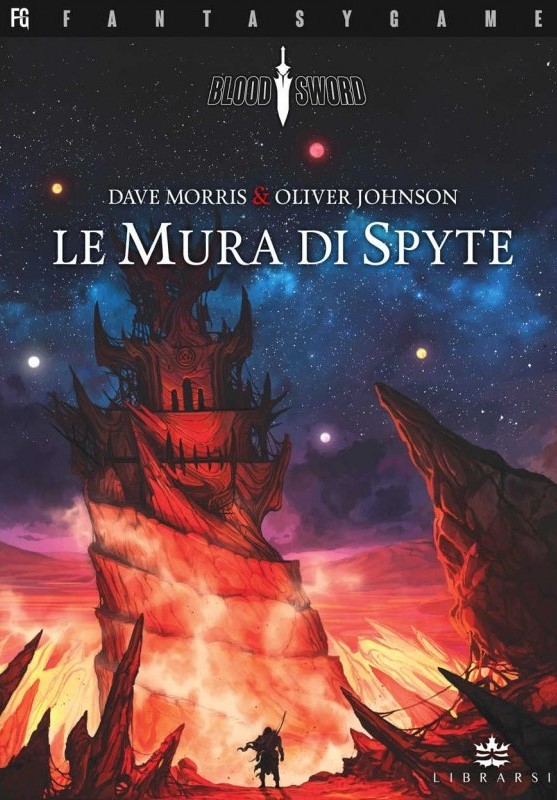
My backers on Patreon got to see how I'd have written that final book, a more flashback-heavy, character-focused version that would probably be a better fit for a roleplaying campaign than the dungeon crawl that actually got published. And talking of book 5, Edizioni Librarsi have just published an all-new edition (based on my revised text of 2019) with a gorgeous Mattia Simone cover showing the Ghosts of the Magi in ominous conjunction on the last night of the world. (The hopes and fears of all the years...)


If you need maps of Legend, there's a wealth of cartographic treasures freely available on Lee Barklam's site The Cobwebbed Forest. And there will be some truly scrumptious maps in the forthcoming Blood Sword CRPG -- but now I'm getting ahead of myself. More news on that to come. Oh, and if all the above is like a coded message in Cabbandari and you're asking what Blood Sword even is, here's a podcast review by Mr H J Doom to get started.

Friday, 22 December 2023

Bring me pine logs hither

If you're going to have a seasonal roleplaying game there's not a lot of time left. No time to plan? For that last-minute gaming session, what could be more useful than this list of Legend adventures compiled by Lee Barklam on the Cobwebbed Forest website?

If gaming is off the table, you can read write-ups of our roleplaying campaigns in two books available exclusively to Patreon backers until Twelfth Night. I talked about these books in a post a while back, and here's your chance to get hold of them. I realize it might seem a little mercenary to mention Patreon in the season of giving, but you only need to subscribe for one month and you'll not only get the two RPG write-up books but the noughth draft of the Jewelspider rules as well as my Knightmare novels and a bunch of articles and adventure scenarios set in the world of Legend.

And to go with all that, Grim Jim Desborough has the Dragon Warriors stats for a number of weird and wonderful Yule monsters on the Postmortem Games site. (While you're there, why not buy a copy of Wightchester -- the very thing M R James would have been playing on Christmas Eve if he'd known about RPGs.)

Talking of Christmas Eve, I'll see you then...

Wednesday, 17 May 2023

Fay day

A new issue of Casket of Fays is always cause for great gladness. Issue 9's highlights are too many to list but they include an interview with Lee Barklam of The Cobwebbed Forest. Lee is a man after my own heart, as this comment shows:

"Combat – and magic – is likely the last resort for embattled adventurers, and I place more emphasis on ensuring the lands in which the characters adventure feel genuinely strange, dangerous, and exciting."

That's exactly what I'm trying to do with the Jewelspider RPG, but Lee is way ahead of me with his homebrew rules. He also once played a sorcerer who didn't cast a single spell in the whole adventure, which is exactly as it should be.

The issue also contains new creatures, weapons, rules, a great piece on heraldry, an industrial-scale gibbet, a much-needed system for balanced character generation, and a Q&A with me that I'd entirely forgotten. (Luckily I still agree with myself on most points.)

Did I mention it's free? What are you waiting for?

As well as those in the Casket, there's another Fay celebrating today - the magician Fay Presto, whose birthday it is. I've only met her a couple of times; each time she was mingling with the guests at publishing parties and performing magic literally under our noses. Close-up magic like that I find much more impressive than the million-dollar illusions like making the Eiffel Tower disappear. (I even managed to make Salisbury Cathedral vanish myself once; big deal.) Her tricks are real wizardry and she's one of Britain's best-loved conjurers. So happy birthday, Fay.

Friday, 24 April 2015

The Hollow Men - a Legend scenario using GURPS


My roleplaying group's days of being able to game two or three times a week are unfortunately long gone. Children, spouses and office hours will do that. But we still get together once a fortnight for our traditional Thursday night games, and also four times a year for Sunday specials. The latter sit outside of our regular campaigns and are often an excuse to revisit old characters.

I mentioned this to Lee Barklam, keeper of the Cobwebbed Forest, and he asked permission to adapt last year's spring special, "The Hollow Men", as a Dragon Warriors scenario. That involved quite a lot of work, as (a) we use GURPS 4e, not DW, and (b) my typical scenario notes would fit on the back of a cereal packet. You can download Lee's thorough reworking/buffing-up of "The Hollow Men" here and some other Legend adventures here.

I'm posting the original (scrappy, non-DW) version of the scenario here as a reminder that roleplaying as actually practised doesn't conform to the tight structure of a published scenario. A real scenario should never be a script to force the players through; it should merely be a set of notions that you and they can start from to improvise the shared story that emerges from the game session. But when we're writing scenarios for publication, we're making something that's intended to be read rather than played. It's designed to show the referee one way that the game might go. So in that sense it's more like a short story - and, as you'll see, Lee has done a brilliant job of bringing the settings to life with rich descriptive text and evocative details. Anyway, compare the two versions and drop a comment at the end if you like.

OK, some background to the adventure. I’ve been privileged to join in some superb Legend roleplaying games over the years. It’s hard to pick a favourite, but if we’re going by popular demand from the players it would have to be Tim Harford’s Iron Men campaign. Tim is the master of creating a foundational concept to bond the player-characters together, a formula that he then stirs up by lobbing in an unexpected inciting incident that changes everything.

Here’s how Tim introduced the campaign:

“It is the end of days. The seers and the signs agree that the world is exhaling its last breath before the fall of eternal night. The last struggles of greed-blinded lords plough the land while the people drift confounded through the crumbling rituals of their lives.

“It is a good time to be a mercenary.”

The Company of Bronze was commanded by Pieter de Fleur and was one of the largest and most successful mercenary groups in Ellesland. Yet the company was almost entirely wiped out in a massacre, the sole survivors being the player characters, who had been absent on another mission that day.

Rootless, the characters wandered until they hit on the idea of exploiting their connection to the company by forming a small band called the Iron Men, on the principle that adversity had forged them into something stronger.

And meanwhile: an Axe Age, a Sword Age, as storm clouds gather for the world’s ending.


THE ATTACK ON APPLEFORD MANOR

The characters are in the army of Baron Verlaine of Trefell, who is fighting an insurrection by his younger son Keele working in concert with a Cornumbrian lord called Pengarth.

On the day of the big battle they are sent to a small hamlet with a stream running through it. The manor house that overlooks Appleford is fortified, and could provide a bolt-hole for a sizable part of Keele’s forces even if Verlaine’s army can carry the day.

The characters have waded upstream to avoid patrols of Keele’s men. Advancing through the orchard, they get to within 250 yards of the manor. The only cover that can get them right up to the walls are the graves in the churchyard. The church itself stands about 100 yards from the wall, then they have to get stealthy.
(I based the manor layout on Stokesay Castle, shown here.)


A familiar face
As they are attacking the walls, they will see one of the defenders is Gorshin, who was supposed to be on sentry duty the night the Company of Bronze was wiped out in a surprise attack. One of the player-characters was present as Pieter de Fleur instructed Gorshin to hand-pick the sentries, just before Pieter ordered Joseph Lynch and his friends out on the scouting mission that spared them from the massacre.

As the battle for the manor begins in earnest, Gorshin, recognizing his former comrades, jumps on a horse and rides off.


The enemy
The manor's garrison comprises two Cornumbrian captains and ten men-at-arms. (Eleven until Gorshin took off.)


Pursuing Gorshin
The player-characters are under the command of Turvatelle de l’Abîme, who will not take kindly to anybody charging off after Gorshin in the middle of the battle. To do so would count as desertion, punishable by death if they are caught. If they ride off after the manor has been taken, there'll be a fine to pay later (assuming they return) but that's all.


A Tracking roll (-1 per hour that they delay pursuit) will reveal Gorshin’s destination to be the town of Axbridge.


THE SPRING FESTIVAL IN AXBRIDGE

Axbridge is medium-sized town. The characters arrive to find the spring festival in full swing. Because of the approach of the year 1000, the celebrations are tinged with a note of hysteric abandon.


Events at the festival include:
  • The Jacks-in-the-Green (dancers) who go around whacking people with padded sticks
  • The passion players (they’re doing the judgement of Sodom and Gomorrah).
  • The procession of giants (local characters called Millstone and Hobbler, represented by large costumes operated from within).
  • Bear-baiting
  • Cock fights (you can place a bet)
  • Wrestling
  • Jugglers, etc
  • Puppet show (the story of St Millais grabbing Old Nick and drowning him in a pond that’s been said to boil ever since) 
Take on the champ
The current wrestling champion is Bors Jellybones (so called because he reduces other people’s bones to jelly), a Cornumbrian giant with a thicket of golden hair and a face like a badly made stone wall. He suffers from overpowering body odour – or rather, his opponents suffer from it; roll HT each round or you're at -1 to attack.

Taverns
  • The Nonesuch
  • The Sheaf of Barley
  • The Old Mustard (Gorshin is hiding out here)
  • The Three Legged Mare
  • The Hangwell
Finding Gorshin
To save his skin, Gorshin offers to tell all about the night the Company of Bronze were ambushed. He was on sentry duty, but an officer called Brother Lowring came round with some other mercenaries and told Gorshin to make himself scarce. Gorshin says he was given a silver florin to go off to the nearest tavern.

IQ roll at -3 to recall there was no tavern within ten miles of where the company was camped that night.

If pressed, Gorshin admits he was in cahoots with Brother Lowring, though he claims it was under duress. He was led off across the stream and they watched as a surprise attack was launched and, without sentries, the company was wiped out.

The truth: Gorshin is still Lowring’s henchman, and is supposed to get supplies from the apothecary here in Axbridge to take back to Tallowden. If Gorshin is killed, a scrip for the apothecary, whose name is Dr Banders, is found on him.

The apothecary
Dr Banders has been making up prescriptions of a liver potion for Gorshin for the last year or more. Gorshin arrives every six weeks and collects enough for six or seven heavy drinkers (the medicine is supposed to ease digestive ailments). This last trip the batch wasn’t ready, so Banders told Gorshin to come back in a fortnight’s time.

Presumably Gorshin figured on earning some extra cash moonlighting for Keele in that time. Being from this area originally, he met a friend called Ambrose who was already in Keele’s employ.

Rumours
Of Tarrowden they are told: “You could say it’s disputed land. Neither Albion nor Cornumbria wants it.”


JOURNEY TO TARROWDEN

The route to Tarrowden lies across the Coronach Marsh. The land rises up to a wild landscape often shrouded in fog and drizzle. It’s not too bad going as long as you stick to the old road, but finding Tarrowden is very hard unless you have a local guide.

Each time characters venture off the road without a guide, roll d6. On a 1-3 they end up in a dead end hemmed about with quagmire. To get back to the road requires a Tracking or Survival (Swamp) roll.

In thick fog or rain, there is a chance of being attacked by swamp goblins. These have Stealth 19 (Stealth 14 vs a sorcerer) and will try to pick off stragglers and haul them down into waterlogged hollows where they will drown.

Initially the goblins attack with skill 15. Typically four or five will leap up and attack at once from all directions around the target. If they get surprise, remember the target can only defend (at -4) and must roll IQ, IQ+1, IQ+2, etc to snap out of it and act normally.

If a goblin’s attack succeeds, it grapples the target. Treat each goblin as ST 10 and on each subsequent round match total strength versus the target’s. On a failure, the target is pulled down into the water.
Drowning: You can survive HT rounds, then lose one fatigue per round. This assumes the character specified they were taking a breath. If not, make a Swimming roll to get your breath, otherwise deduct the number you missed by from the rounds before you start to lose fatigue. A character who is submerged hasn’t only got to worry about drowning, though. The cold water saps ST at the rate of d6-1 per round (armour protects at half value). Therefore the character’s fatigue is likely to be reduced by the time they start losing fatigue anyway.
Once submerged, a character is partly hidden by the goblins’ magical stealth no matter how much they fight back. Treat as Stealth 16 (11 v sorcerers) and remember to allow for poor visibility.

If overcome, the character will be stripped of all they own and then left unconscious on the path.

Sunken lane
Leading down off the moors to the west is a very steep hill that leads into a sunken lane overhung with dank trees. This part isn’t so steep but it’s dark and eerily silent.

The lane emerges at the head of fields that descend towards Tarrowden.

THE VILLAGE OF TARROWDEN

Jammed at the bottom of a wedge of land that slopes down between two heavy growths of ancient forest. There is a church, a manor, and a few cottages.

The fields
Last year’s crop was obviously left to rot. The whole hillside is a mass of tangled, rank vegetation in which dark rat-like forms root and scurry.

Nearer to the cottages there are some furlongs at the edge of the lowest field that have been ploughed and sown. They are obviously not the best plots, but are the ones typically allowed for villagers’ private use.

Scarecrows
These have a baleful appearance. There are three of them. On close inspection they can be seen to be cured human skins that have been stuffed with straw and roughly stitched up.

The truth: they are people who came snooping after the treasure and whom Lowring and his men drowned in the mere, then left them here as a warning. The cottagers don’t go near them.

The cottagers
There are a dozen households here:

They say that they don’t dare touch the crops because they belong to the lord, and he stopped taking an interest in the fief a year or so back.

The church
There is no priest. “Well, there is.” “But he run away.” “Father Wissell his name was.” “Might still be.”

In the church, astute characters may notice carved wood panels on the pulpit that show St Millais drowning the Devil in a mere.

But there’s more. Returning to the village, St Millais discovers men drinking and wenching with the gold the Devil gave them, so he takes them to the mere and makes them throw the gold in. The inscription reads: Redde Caesari quae sunt Caesaris.

The cottagers will freely volunteer their belief that the mere is the Old Kettle.

The manor house
This stands deserted. The cottagers say the lord moved out of it last summer and they have hardly seen him since – “Only that Gorshin that runs and fixes for him.”

The lord of the fief
This is the original fief of “Brother Lowring”, who has no religious rank but acquired the nickname because of his silent mien, which among mercenaries suggested a priest-like introspection.

Lowring abandoned his rather impoverished fief to become a mercenary, but returned here when he needed to lie low after accepting a payment to betray the Company of Bronze, of which he was a senior officer.

He brought with him five accomplices. In the woods, looking for a place to hide their loot, they found an old Cornumbrian drinking hall and, nearby, a pool known to the locals as the Old Kettle.


THE ANCIENT HALL

Off in the woods is a long, lichen-spotted stone wall overhung with a low moss-covered roof. It is so deep-set into the bank, weathered and overgrown that you could easily miss it.

Roll Survival (Woods) to notice the trees around it are not quite so old, ie a hundred years at most.

This is the old Cornumbrian hall which was the nucleus of the original settlement. Lowring and his henchmen moved here after discovering the treasure in the Old Kettle.

The treasure in the hall amounts to 2000 crowns (about a million farthings). If you dare take it.

The Old Kettle
A mere that, every evening, froths and bubbles. At other times it is so icy cold as to sap the strength in moments, but when boiling up it can be swum in. One of Lowring’s men discovered this and dived down, returning with gold coins. They have been hoarding the coins they retrieved in the old hall ever since, finally moving into the hall, ruinous and inhospitable though it is, so as to be nearer to the Old Kettle.

Lowring and his men soon discovered that each dive made them feel ill, particularly with liver pains, but greed kept them going. Gorshin was sent to Axbridge regularly to fetch medicines from the apothecary.

The real cause of the pain
Lowring and his five men (Ulfar, Olbeck, Quintus, Guston, and Fyfe) are infected with hellion flukes. These are eating them away inside. They still think they are normal men, but the truth is they are mere shells – and inside the shells are devils.

The hellions 
At first they fight in human form:


If struck for more than 4 points (after armour) their skin splits, releasing a gout of flame. The character who injured them must drop his weapon or take 1d3 burn damage (no armour). There is a chance (10% for ordinary weapons, 1% if magical) that the weapon will be destroyed, but in any case any edged weapon loses 1 from damage until an armourer can fix it.

After being hit, the hellion’s outer skin burns away and you know have something much nastier to deal with:


The reason for the massacre
The story behind this is that the Company of Bronze were in the employ of Baron Grisaille, and as part of an “arms limitation” deal with Montombre, and to avoid paying them, he agreed to arrange the massacre as a two-birds-with-one-stone solution.