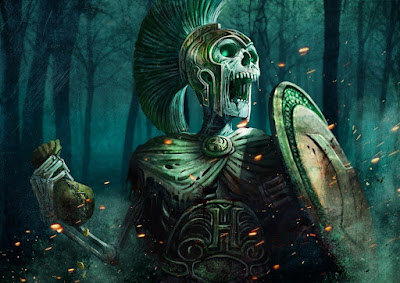
IMMERSIVE WORLDS #1: THE ODYSSEY
The Adventure
You start as the Greek adventurer Odysseus, thrown into perilous quests and looked down on from the heavens by wrathful gods . You will find yourself faced with the reality of terrible mythical monsters brought to life. You will be faced with navigating the treacherous waters of the Gulf of Charybdis, resisting the Sirens’ call and toppling the mighty Cyclops? Will you emerge victorious to become a hero of legend?
Odyssey is part role playing game and part survival adventure. You lead a hand picked band of adventurers on a series of quests set by the gods or found amongst the eerie inlets and abandoned temples of a hundred Aegean islands. You will have to assess the skills of your comrades, choosing the right man for different tasks, and decide on equipment and strategy.
The Game
As Odysseus, you are faced with the day-to-day decisions of a sea captain of ancient Greece. You decide where to sail your galley, surviving natural hazards, avoiding sea monsters, and battling pirates. When you make landfall you can send ahead scouts who report back with visual images of their sightings. You equip and prepare a shore party, carefully picking the skills the situation requires from exploration, survival, combat, stealth, communication, combat and prophecy.
At the heart of the game are the richly detailed and eternally popular stories of the Greek myths, brought to life for a modern audience. Where previous generations have only read about these times, now it’s possible to experience them in a virtual recreation of the past that will enthral, involve and educate.
Game book, book game.
Immersive play brings a completely new concept to learning.
The game transports you to ancient Greece as though travelling back in time, and the book is the guide you would take with you on such a trip. You will learn about history, metallurgy, archaeology, mineralogy, military tactics, music, geology, geography, languages, literature, mythology, nature, society, religion, sports, seafaring, meteorology and survival skills.
However, this is not mere theoretical knowledge. Thanks to the virtual world you are exploring, these are things you will need to know. You will use everything you have learned in the book to find success in your adventures. Read how you can use the stars to navigate or how an alloy works to create stronger metals, then see the effects when you apply your knowledge in the game. No other entertainment title uses the fun, thrills and challenges of game play to stimulate learning in such an innovative way.
Immersive - Put the facts into action.
Design
Visuals for the book will be taken from the game, allowing seamless integration between the two. Current game technology can deliver lavish, rich and detailed imagery including 3D maps, aerial views of the major city-states, cutaways of buildings, ships, etc. and beautiful images of the characters. Because everything will be modelled in 3D we will have complete flexibility to choose the best angles, poses and views for the book.
The text of Homer’s Odyssey will run as a narrative thread throughout the book written in a fresh modern style. This is “the past in the present tense” as we see what it is like to really live in the eastern Mediterranean in 1190 BC. The world is presented just as it would have seemed to a Greek of Homer’s day looking back on those times.
Other information will appear in boxouts or as annotations to illustrations, maps and diagrams. Information will be described wherever possible in terms relevant to the game. For example, a cutaway of a galley would be annotated with its sailing speed in different weathers, its ramming speed, armour rating, cargo capacity, durability and operational range. Seeing these stats at work in the game will give the reader a real sense of the comparative strengths and weaknesses of different units, characters and even economic and political systems.
The Oracle
An example of how the book and the game work together.
In the game the player can consult the Oracle, which in simplistic terms supplies game hints. The Oracle creates short stories that prophesize events so that you, Odysseus, can plan accordingly. You can use it without reading the book but will learn the hard way that what it says is ambiguous. However, once you read about it in the book you will understand how to correctly interpret its information and make good use of its predictions. Along the way you will have learned about the importance of prophecy in ancient Greece and how information can be interpreted in many different ways.

CONTENTS
Coming to Life
Step into the sandals of your alter ego, Odysseus, and pick your crew from the colourful mix of 12th century BC Mediterranean seafarers standing before you on the dockside.
Gear
Learn about ancient forging, metalworking and blade sharpening at the armourer so you can pick the best weapons and armour .
Skills
How different skills can be used and combined for different tasks.
Combat
On the beach near Troy, before setting out for Ithaka, you can practice the martial arts of spear, swordplay, wrestling, and pankration.
Deities
Choose your god. An Achaean hero’s relationship with the gods is all important affecting the whole course of your life. Odysseus begins with Athena as a friend and Poseidon as an enemy.
Crew
How to carefully select a dependable, loyal crew with the right mix of skills to accompany you on your adventures.

The Achaean World
Map reading and navigation
See Mycenaean Greece through the eyes of Homer long before the classical ideas of philosophy and democracy. Find out how to use the unreliable fragments of stories and myth to build a map of Ancient Greece.
Narrative thread: Episodes taken from The Iliad.
The Achaeans
The known cities of Achaean (or Mycenaean) Greece.
Culture & history
How to navigate the, clans, customs and traditions of a typical city-state.
Exploration
Find out how you can profit from your adventures by exploration and trade.
Diplomacy
How to use diplomacy to manipulate relationships between kings and ultimately, entire states.
The prince of Ithaka
Odysseus himself – your persona in the game and the one through whose eyes you will explore the Achaean world. 3D cutaway of an Achaean royal palace.

“Troy Once Was”
The background to The Odyssey, the game world.
The Achaean states united to topple the magnificent civilization of Troy, a tale of both the grandeur and the horrors of war.
Narrative thread: Further excerpts from the later books of The Iliad.
The topless towers of Ilium
Troy, real and imagined. 3D models show Troy as it may really have been, and as it is in the game through the filter of Homer’s imagination.
How the war started
Investigate the origins of the war and the abduction of Helen of Sparta.
Army life
Experience the food and living conditions of the typical Greek infantryman. Who these people were (aristocrats and gentry, not lower classes).
The battlefield
Military theory as it is currently applied in the 12th century BC. Find out in the game how to use chariots, battle formations and the early Greek phalanx.
The siege
Inside Troy as the war goes on.
The fury of Achilles
The greatest sulk of all time. The feud between Achilles and Agamemnon brings tragedy to the Achaean forces.
Funeral rites
Understanding the Achaean obsession with honour, even in death.
Fall of a civilization
The sacking of Troy.
The aftermath
The once-glorious endeavour dissolves into bickering, vengeance and jealousy among the Greek heroes.
The adventure begins
You, Odysseus, set sail. You are destined not to return home for many years.

Gods & Heroes
Playing with superpowers
Old stories, recounted over generations in the form of epic songs, have transformed historical war-leaders into semi-divine heroes. To the Achaeans these legends aren’t fiction, they’re the way things really happened.
Narrative thread: Odysseus and his men arrive on Calypso’s island.
Mount Olympus
Visit the home of the gods. How they can interfere with your life and how you can manipulate their power
The family of the gods
Learning about Zeus and the other Olympians. Their strengths and weakness and how their unashamed behaviour sets the standard for Greek kings.
What lies beneath
The underworld. The chthonians, or Earth-deities (Hades, Hecate, the Furies), are vestiges of an earlier, animistic religion.
Heroic ancestors
Glorious traditions of Jason, Perseus, Theseus and others. A sketch of their adventures gives hints of what to expect in the game.
Challenges to single combat
Codes of behaviour that regulate the morality of the battlefield. No hero can afford to lose face by refusing a challenge from someone of equal status. Handling challenges in the game.
Consulting the Oracle
Prophecy and its importance in the Achaean world-view. Using the Oracle in the game to find clues about your future.
Rituals of worship
Sacrifices, priests and prayers. How Achaeans worshipped the gods and how you can gain favour with an individual God. Accompanying 3D cutaways of a temple of Apollo.
The Twelve Tasks of Heracles
The archetypal adventure hero. Tips for approaching your own tasks.
Patron deities
Many heroes have divine patrons (Odysseus’s is Athena) but being watched over by a god is often a mixed blessing.
Wrath of the gods
Greek gods are given to sulks, rages and petty jealousies that would be outrageous for a two-year-old. Getting on the wrong side of a god can launch you into a series of incredible adventures – if you survive.
Mystery cults
Special adventures infiltrating mystery cults. Secret ceremonies form a bond between cultists that can drive them into a state of ecstasy – witness the Bacchantes tearing Orpheus limb from limb.
“Across the Wine-Dark Sea”
Adventure on the open sea
Greece is a land united by the sea. Three thousand years before James T Kirk, Odysseus was part of a great tradition of “seeking out new worlds and new civilizations”.
Narrative thread: King Aeolus and the bag containing the world’s winds.
Seafaring
Navigation is primitive at this time, making it risky to lose sight of land. (Although, with Poseidon as an enemy, you may not get a choice.) Speeds and effective ranges under sail and oar.
Ship types
Statistics of small sailing ships, galleys and penteconters, illustrated with in-game 3D models.
Naval combat
Use of bows, javelins, fire-pots, ramming and boarding.
The sailing season
Sea captains almost never put to sea in winter – unless brave or foolhardy. What weather you can expect; how to read and use the prevailing winds, tides and currents.
Life on board
Food and living conditions on board a typical Homeric galley.
Ports of call
Protocols for arrival in a new port, acquiring supplies, etc.
Shipbuilding and repairs
Maintenance of your vessel is paramount if you hope to make the long journey back home to Ithaka.
The City State
Small kingdoms are unified around a patron god and a small urban centre (the polis) which is home to the aristocracy and gentry of Achaean civilization. Familiar names in Odysseus’ world include Thebes, Sparta and Athens.
Narrative thread: The assembly on Ithaka, the suitors ambush Telemachus.
City layout
The principal zones of a “typical” city-state, using a full 3D map of Athens as a basis. City based adventures and quests.
Government
The royal family and the aristocratic assembly. Sidebars detail how this evolved into the Athenian model of citizenship and democracy.
Social classes
Status from slave through to nobleman – and how the true picture is never that simple (some slaves being more influential than some freeborn men). Explaining character levels in the game.
The family
Tribe, clan and family. 3D illustrations look inside an Achaean townhouse.
Daily life
The economy, markets, pastimes, early drama. Using shops you buy weapons and resupply your ship.
Architecture
Assembly halls and other city buildings, both as they may really have been and as Homer’s audience visualized them.
Law
The laws of the Achaeans overlap with religion, creating a complex web of “right” behaviour that as a cunning hero like Odysseus you can twist to your advantage.
Crime & punishment
Judgement by peers, by royal decree, by ordeal and by contest. Punishments, both mortal and divine. Exile and blood-price.
The Panoply of War
Strategy and tactics
A hero’s most prized possessions are his arms and armour. Treasured items have been handed down from ancient ancestors and are thought to carry the favour of the gods.
Narrative thread: Imprisoned by the Cyclops.
Weapon technology
Iron weapons are rare (only the Hittites at this time can work iron) and regarded as magical. Tables compare the toughness of different weapon types.
Melee weapons
The shortsword, sword and spear. Also the unarmed combat skills or pankration (= “all-powers”).
Ranged weapons
The sling, bow, javelin and discus.
Shipboard weapons
Naphtha sprays, ballistae and rams.
Armour
Different types of armour and shield, comparing weights and effectiveness.
Equipment costs and fabrication.

Contest of Champions
Competition and prizes
The Ancient Greeks love festivals and contests, and these two pursuits come together in the Games. The Games are an opportunity to let off steam, to honour the gods, and at the same time gain glory and wealth.
Narrative thread: Odysseus is a guest at the games of the Phaiakians.
Greek festivals
Each of the great city-states has its annual Games, part-competition and part-religious ceremony.
Sports
The athletic ideals of the Ancient Greeks have their basis in warfare. As a war hero, you, Odysseus, are expected to excel. In The Odyssey Book VIII: Euryalos says, “You do not strike me as an athlete” – a challenge which angers Odysseus and stings him into action.
Wagers & prizes
How to wager treasure on the outcome and still come out on top.
Winning glory & status
Flashback to Book XXIII of The Iliad as an illustration of how the Games became contests for wealth and power.

Other Lands, Other Peoples
Exploration in the ancient world.
The Ancients Greeks discovered several other lands populated by new cultures strange to them. Some became allies and trading partners, others became enemies.
Narrative thread: Odysseus’ experiences among the Lotus-Eaters and the Laistrygonians.
The etiquette of strangers
Hospitality is governed by elaborate rules, including guest-gifts and safe conduct, and the gods punish those who fail to obey.
Commerce
How trade is handled in a barter economy and using it to survive in alien cultures.
Sung with the voices of gods
Honour and glory are the real coinage of the day. Bards, inspired by the spirit of gods, publicize the reputation of their patrons. The game records your adventures and sets them down in stories you can print out and keep.
Diplomacy
Rules governing the delicate balance between the promise of alliance and the threat of war. Ambassadors (proxenoi) are not sent out, but are natives of the city-state in which they live who have family and business ties to the state whose interests they represent.
Plunder & the spoils of victory
How booty should be divided to repay the loyalty of your crew – and how royal prerogative will sometimes allow you to get around that.
Stealth & trickery
An overview of the career of Odysseus, “the man of many wiles”, provides the player with a master class in cunning.
Amazons & warrior women
The role of women in the society of Achaean aristocratic warriors.
Beyond the Hellenic world
Sequel adventures amongst the Egyptians, Thracians, Hittites, Babylonians and the Kingdom of Solomon.
In the Wilderness
Survival
Beyond the outlying fields of the city-states, the countryside is seen as a primordial, dangerous place.
Narrative thread: Odysseus passes Skylla, is becalmed, then shipwrecked.
Wildlife
To survive in open country you need to know about plants and animals.
Weather effects
The game engine evokes a believable world by simulating details of the environment. Rain spatters in puddles and corrodes your armour; cold shows in billows of breath and blue, pinched skin; sun will give you a tan.
Natural hazards
Earthquakes, plague, sandstorms, floods and lava flows can all impede the adventurer’s progress. This is the Bronze Age equivalent of outdoor survival tips.
Travellers
Universal rules of communication. How to talk to the barbarians of the hinterland.
Ruins
The remnants of older civilizations are shunned and thought to be the home of ghosts. You’ll visit the ivy-grown labyrinth of Knossos, Santorini’s mossy wreck, and the rubble that is all that’s left of Troy.
The Forests of the Night
Adventures at the edge of terror.
Greek mythology is filled with stories of witches, monsters and strange beasts.
Narrative thread: The voyage to the land of the dead.
Creation myths
The Titans and the birth of Zeus.
The underworld
Chthonic gods predate the Hellenic pantheon and were probably worshipped by the original inhabitants of the region before the arrival of the Achaean aristocratic class.
Into the labyrinth
The story of Theseus and the Minotaur, with both in-game 3D screenshots and modern archaeological images of Knossos.
Darwin’s worst nightmare
The whole menagerie of lesser Greek myths, including Stymphalian birds, Diomedean horses, the Nemean lion, harpies, hydras and chimeras and tips on how to defeat them.
The eyes that fossilize
Perseus and Medusa.
Omens and divination
Omens are all around. Lightning, clouds, wind, comets and flocks of birds are all interpreted as the gods giving us clues as to what is to come.
The first stirrings of philosophy
The early myths reflected the Greek obsession with making sense of the world, applying names to the constellations and beginning to query the forces behind natural processes.
The End of All Exploring
At last Poseidon tires of trying to break Odysseus’s spirit and allows him to reach home. Athena visits him in a dream and tells him to disguise himself as a beggar. He gets inside the palace, kills his wife’s suitors, and reclaims his throne.

Epilogue: What the future will remember of these times
A final cut scene in the underworld shows the slain heroes of Troy learning of Odysseus’s exploits from Amphimedon and the other ghosts of Penelope’s suitors, whom Odysseus has killed:
As when bats in the depths of a vast cave flitter and gibber,When one of them has fallen from his place on the ceiling,
So they went gibbering with Hermes leading them.
Along mouldering pathways they descended,
Past the gates of the Sun and the country of dreams,
And presently arrived in the meadow of asphodel
That is the dwelling place of the dead.
There they met the soul of Achilles, son of Peleus,
And the souls of all the Danaans, with Agamemnon sorrowing.
And first of these to speak was the soul of Agamemnon:
Amphimedon, what befell you, that you come under the dark earth?”
In game: we fade from the story into a fast succession of images of relics from that era as we know them today, in the 21st century. The foundations of a Mycenaean palace, corroded fragments of armour, a reconstructed chariot, bits of pottery showing epic scenes. That was the life of Odysseus that we have just lived, but with the colouring of myth stripped away.
We look towards the peak of Mount Olympus. As the sun rises behind the summit, a blaze of dazzling light washes all the images away. It is the light of the imagination that has inspired poets, artists and scientists since Greek times. And slowly it all fades away.