Gamebook store

Showing posts with label politics. Show all posts

Thursday, 3 September 2026

The art of the possible

Political games are in fashion. It might have something to do with the rapid turnaround of prime ministers now that British politics functions like a reality TV show. No 10: Full Confidence is outselling Monopoly Go in the UK Apple game charts. There's also Fantasy Parliament, a browser game that lets you simulate party politics, and UK Politics Simulator is on the way.

Where was all this interest a decade ago? That's when I released Can You Brexit? Ancient history now, but all the issues dealt with there are still in play. You can buy the book or play the browser version free.

Thursday, 23 January 2025

This again?

'You should read some history, sonny boy. Read about the Black Shirts and the Gestapo and concentration camps.'

'That's not the same thing as Lisa Treadgold. Hitler was a fiend. Lisa's just a very beautiful woman with strong opinions. Do you mind her being so beautiful?' Timothy asked innocently.

These words made Fanny so angry she stopped the car. 'Listen, dumbo,' she said, glaring. 'I realize I'm no oil painting, and I'm not rich, and I'm not famous, and no one wants my autograph--'

'And you smoke too much,' Timothy said cheekily, trying to make her smile. Really, he was quite afraid of her at that moment. She looked fierce.

'And I smoke too much,' Fanny agreed. 'But there's one thing I'll tell you, and it's this. Learn to be frightened. When you see some magic-type person, a public person, hogging the media to talk about bringing back the birch and hanging, it's time to get a little nervous. Because the person who gets beaten or hanged might turn out to be someone you know. You with me so far?'

Timothy said, 'Okay so far.'

'But when that sort of person talks about action groups and banded together brotherhoods of citizens and vigilantes, get terrified. Because the person who gets dragged away in the middle of the night for a flogging might turn out to be you. Yes, you. Simply because you're a decent, normal, pleasant, dim human being. The sort of person who just happens to get in the way of the bully boys and bully girls. Do you understand, Timothy?'

Nicholas Fisk's novel You Remember Me! was originally published in 1986 but has been forgotten where other kids/YA fantasies, less uncompromising, have endured. Too bad. In it, a TV star founds a right-wing populist political movement with promises to make the country great again. A generation raised on stories like that might not be making the mistake of putting people like this in power -- because, once they have it, they intend to hold onto it, and to do so they will uncaringly wreck the democratic institutions and regulations that have taken generations to set up.

Narcissists and plutocrats served by a coterie of sycophants and compliant dopes insincerely pandering to the electorate's sense of inadequacy with crude slogans... it's a stuck record and you'd think people would be fed up to the back teeth of it, but it seems that politics, like entertainment, just consists of the same old clichés endlessly recycled.

I'm not delusional; I realize there's no going back to 'normality' now. Western democracy is in its end-of-the-republic phase, authoritarian regimes are thriving, and the world is cooking its own goose. Still, track down a copy of Mr Fisk's book if you can find one. Or at least listen to the hosts of the Backlisted podcast discuss it with author Sam Leith. Or watch Asif Kapadia's new movie 2073. Too grim? Hey, it's less disheartening than watching the news

More about Elon Musk tomorrow, I'm sorry to say.

Wednesday, 30 October 2024

Not long now


A couple of years ago I ran a post about Can It Happen Here?, my proposal (well, mine and Sinclair Lewis's) for a gamebook of the US election. In the end I decided it would be easier to just see what happens and then watch the news from the relative safety of the British Isles. 

In any case, writing about US politics from the European side of the Atlantic is strangely like looking backwards to an earlier model of government. Must be the US's written constitution, which effectively took the concept of the monarch and made it an elected post, setting that in stone for the next 235 years, whereas in Britain (which does have a constitution, incidentally; it's just not in a single document) the monarch has been free to evolve into a useful figurehead with no direct power, government is carried out by a team of people who must debate and reach consensus, and sovereignty resides with Parliament. But perhaps I'm only saying all that because the (possibly) future Veep has been so snotty about the UK.

At the other extreme there's the alarming option of "unitary executive theory" (aka dictatorship) which is best avoided whichever candidate gets elected. Once you let go of democracy it's very hard to get it back.
"A dangerous ambition more often lurks behind the specious mask of zeal for the rights of the people than under the forbidden appearance of zeal for the firmness and efficiency of government. History will teach us that the former has been found a much more certain road to the introduction of despotism than the latter, and that of those men who have overturned the liberties of republics, the greatest number have begun their career by paying an obsequious court to the people; commencing demagogues, and ending tyrants." 
- Alexander Hamilton, The Federalist Papers #1.

Anyway, America, good luck; the world holds its breath for your decision next week. If you need some inspirational reading here are five novels that are no doubt far better than anything I'd have written. And here's some equally disturbing fiction about another possible future.

(Image by Diliff under CC BY-SA 3.0 licence.)

Friday, 21 June 2024

Silver linings

Eight years ago almost to the day, a referendum in the United Kingdom voted 52/48 to leave the European Union. Regular readers cannot fail to have noticed that I was one of the 48% (nowadays more like 63%). I didn't imagine I could know in advance whether the eventual outcome would be good or bad, but I do know that extreme perturbations to complex systems (like modern societies, for example) can have highly unpredictable results. Unless the current state of such a system is catastrophically bad to the point of imminent failure, it never makes sense to make revolutionary changes rather than gradual ones. There were indeed British communities where people figured their situation literally couldn't get any worse. I couldn't even start to get my head around such thinking until I watched this, given that median wealth in the UK is twenty times the median wealth globally, though I tried to keep my own preferences (some would call them prejudices) out of the way enough to ensure that Can You Brexit was an even-handed look at the pros and cons.

I strive for an open mind on all issues, so it's only right to admit now that it's not all been bad news since the referendum. Admittedly the UK is considerably poorer as a result of leaving the EU's single market -- unnecessarily so, too, as the Norway model was an oft-touted Brexit plan among the more moderate of the Leave campaigners. But there are upsides. Immigration into the UK has increased since the Brexit vote and, contrary to the beliefs of the ship-'em-to-Rwanda mob, those immigrants are integrating well into British life and bring valuable skills, energy and culture. New citizens are also now coming from a wider diversity of backgrounds rather than just Europe. So that is good news, albeit the opposite of what most of the people voting Leave actually wanted.

By the 2010s the UK had long been in need of a way to break the old political mold. The main parties stood for fossilized versions of the socioeconomic classes of a century ago, not today's class structure, but Britain's first-past-the-post voting system prevented any reconfiguration of the parties to fit modern UK society. The Brexit vote had the effect of radically shaking up what the main parties stand for. The electorate would have done better to switch to an instant-runoff voting system when they had the chance in 2011, but that became another of history's missed opportunities. (See also the US Presidential election of 2000.)

Also, Britain seems to be escaping the trend towards nationalist populism (indeed, let's just call it fascism) that's surging across Europe. The British Isles have always been stony ground for fascists, and the Britain First party (whose leader has publicly supported lynch mobs) are faring no better among voters than Oswald Mosley's lot used to. Meanwhile, although the slightly less toxic Reform Party has been climbing a bit in the polls, that rise is largely matched by the decline in the Conservative Party's fortunes. Between them, Britain First and Reform are effectively Britain's far-right Tea Party/MAGA movement, liable to get noisily vexed about any measure that's even halfway sensible, informed, decent or rational. The greatest shame about their electoral alliance is that it's sullying the good Whig name of Reform, but eventually their supporters will get absorbed back into the Tories where their reactionary stridency will be dulled to a general grumble of dissatisfied resentment at the modern world. The example of Poland shows what harm can be done to the mechanism of state once you let people like the PiS stick their finger on the scales, but that threat seems far greater in many EU countries (and across the Atlantic, sadly) than in the UK.

Europe needs to worry about defence, of course, and while I preferred the days when Churchill could sell the concept of the Declaration of Union, post-Brexit Britain at least didn't vacillate in supporting Ukraine against Putin's invasion. It might make more sense to have a truly united European front, especially if Ukraine falls and Putin starts hoovering up the former Soviet states, and given that the next US President (and maybe the next French government) might be more pro-Putin than pro-NATO, but there's little sign that the EU as a whole is more alert to that threat than Britain is.

In another eight years, will I say that the Leave vote was a good idea? Steady on there. I'd still prefer my Enlightenment dream, but that might be one to put alongside the Mars colonies and controlled fusion for everybody and the von Neumann probes equipped with strong AI. At this point I'll settle for a world with fewer despots and more equality, and if getting that means distracting populists with some shiny trinkets like Brexit then so it goes.
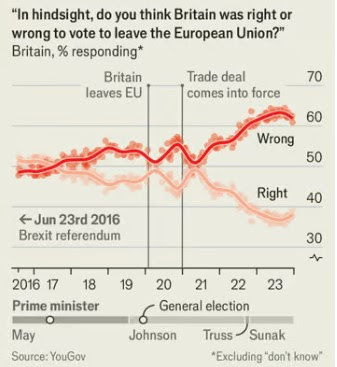

Cambridge Econometrics analysis of the effects of Brexit (PDF)
Post Factum analysis of the pros and cons of Brexit as of summer 2024

Tuesday, 12 September 2023

When countries go bonkers

It's been seven years since the United Kingdom narrowly voted to leave the European Union, of which it had been a leading member since 1973. This is usually nowadays referred to as Britain's Brexity McBrexitface moment.

What happened next? Those who subscribe to the idea that stories emerge as a series of dominoes falling in a cascade of events will have been interested and sometimes surprised - but not very surprised. It was obvious that Britain's ruling party would drift ever rightwards, colonizing the appeal-to-worst-natures territory staked out by the crackpot "UK Independence Party". Also obvious was that in trying to implement a bad idea with no plan, the Conservatives would suffer continual upheavals, internecine struggles, and desperate intrigues culminating in the blackly comical farce of a government led Boris Johnson followed by the utter madness of Liz Truss's ideological cloud-cuckoo land. As Laura Kuenssberg of the BBC puts it in an in-depth retrospective analysis:

"Her spectacular crash and burn was the logical end point, perhaps, of six years of chaos when the Conservatives so often turned in on themselves - and turned on each other."

Nobody likes a smart aleck, so I won't say told you so, but a lot of that crazed political backstabbing is right there in Can You Brexit (Without Breaking Britain)? There's also the opportunity to see if a better solution might have been found -- probably, indeed, the kind of solution Britain will now stagger towards over the next decade via a series of patches and ad hoc agreements that leave it only slightly worse off than if the whole sorry nonsense had never happened. 

Brexit didn't have to be bungled. It would have been perfectly legitimate to interpret the referendum result as an endorsement of the kind of "soft" Brexit that had been peddled to the electorate by Brexit advocates like Michael Gove, who during the referendum campaign proposed an EEA model such as Norway and Iceland enjoy that would have kept Britain in the Single Market. Instead the ERG cadre of self-proclaimed "Spartans" warped the ruling party, making dedication to their extreme version of Brexit a test of ideological purity. And that's why the party ended up in the hands of a succession of incompetents, malcontents, chancers, nutcases and idiots until finally lurching back towards its current attempt to look like grown-up government.

Given that other once-serious governments might shortly be jumping into the moronic inferno of populism, gamers from all around the world might want to take a look at this book to see if there are lessons to be learned. See if you can navigate the storms of political infighting to deliver a solution to Brexit that actually works in the interests of the people of Britain rather than the string of ex-Prime Ministers now collecting a few hundred grand each time they get up and give an after-dinner speech. It's possible, but it takes a more responsible hand on the rudder than any of the UK's leading politicians were willing to apply.

Thursday, 3 November 2022

Can it happen?

In 1935, Nobel-prize-winning author Sinclair Lewis dashed out his novel It Can't Happen Here in six weeks to warn Americans about the threat of populism to democracy. Right after seeing footage of the Capitol insurrection, and noticing that Lewis's work came out of copyright last year, I thought I should have a crack at an interactive reworking of his book: Can It Happen Here? Not that a gamebook will save US democracy in 2024, but as John Stuart Mill put it:

"Let not anyone pacify his conscience by the delusion that he can do no harm if he takes no part, and forms no opinion. Bad men need nothing more to compass their ends, than that good men should look on and do nothing."

Good intentions can only take you so far. I spent a year researching and writing Can You Brexit? and that was on just one issue in the politics of the country where I live. I was heartened by the thought that Armando Iannucci, a fellow Brit, created Veep. If he can get his head around the US political system, why not me? Iannucci did have an HBO development budget, admittedly, while I have only spare time and access to Google, but I still meant to have a go. But then I got offered some actual paid jobs. So much for the spare time. Also, I'm still smarting from UK publishers turning down Can You Brexit? and then later saying that, oh, they should have taken it after all. 


The best way to pitch it would not be as a full-on Choose Your Own Adventure style book with micro-decisions every page or so, I think, but something more like Professor John Buckley's The Armchair General: Can You Defeat The Nazis? There you get presented with complete scenarios and you only need to make choices at about a dozen key points in the book. That ensures it isn't lumped into the niche gamebook market but instead counts as counterfactual history, which appeals to a much bigger readership. But even so it would be a hard struggle to get publishers to accept it. An editor might wreck their career by championing an odd book that flops, so they stick to safe bets. It could be a waste of a year or more of work.

In short, I can't be bothered to go through that again, and it would be particularly painful to hear from some editor at Simon & Schuster in 2028 that maybe if they had run with Can It Happen Here? then voting wouldn't have been suspended by Donald the First.


On top of all that, MCU shows and movies of late have shown how preachiness can really louse up a good story, so maybe I should stick to entertainment and let Western Union handle the messages. Anyway, here's the pitch. You decide...

Can It Happen Here?

The Plot Against America. The Man in the High Castle. The Handmaid’s Tale…

Is it any coincidence that over the last few years there’s been a surge of popular interest in stories that show the fragility of modern democracy? That highlight the ever-present threat of dictatorship? That pitch freedom head-to-head against tyranny?

In 1935, concerned at the rise of intolerance and political extremism, Sinclair Lewis wrote It Can’t Happen Here as a warning to American voters. He described the meteoric rise to power of a political outsider, a demagogue called Buzz Windrip who stands for office on a populist platform of anti-immigration, hatemongering, nationalist fervor and a return to a mythical better past. As President, Windrip soon begins installing his own family and loyalists into key positions with a view to subverting the institutions of democracy and turning America into an autocratic state.

Nearly a century later the book is as chilling and relevant as ever, but it can be hard for today’s readers to look past the creaky ‘30s period detail and really grasp the instant urgency of Lewis’s message. How do we package that message in a way that will make it compelling and contemporary?

Can It Happen Here is an interactive novel. Readers are probably familiar with interactivity from Choose Your Own Adventure books, but since those came on the scene the boundary between games and linear fiction has blurred. Black Mirror and Unbreakable Kimmy Schmidt both featured interactive episodes, and interactive dramas such as Tell Me Why and Twin Mirror are now being released episodically like TV shows.

Can It Happen Here is a true interactive novel, an update/reboot of Lewis’s original with a sweeping story and a wide cast of characters. The reader will be in the Oval Office, an aghast observer as President Windrip tears up the rulebook of decent behavior. Will you take a stand? Try to curb the President’s excesses? Be the voice in his ear nudging him towards moderation and sanity?

Or will you be the angel of his worst nature? Advising him to spread lies, insult his rivals, fire the good officials and instal his own family and loyalists in key positions until America becomes his personal fiefdom? Resistance or complicity? Integrity or personal power? Clean conscience or guilt? You can go either way.

In alternating chapters we are thrust into situations that vividly depict the consequences of the President’s actions. You’ll be called on to advise a journalist who’s thinking of running an exposé of Windrip’s business dealings. You’ll follow a family that’s being pulled apart and herded into an internment camp. You’ll be the conscience of a TV reporter who’s been asked to spread what she knows to be misinformation. You’ll be a defense secretary asked to order US troops to break up protests. You’ll be there in the midst of the riots, fighting for either freedom or for fascism.

You get to decide. Your moral choices make the difference. Every decision has effects that will change people’s lives. Unlike a game, there’s no win or lose. Whether each reader’s outcome feels like a victory is up to them – and it’s something that readers will debate passionately with their friends.

When you close the book will you think, ‘I did my best to protect liberty’? Will you think, ‘Strong leadership is what we need right now’? Will you feel good or bad about your decisions and the part you played?

Will you think: ‘Anyway, it can’t happen here… Can it?’


How it works

We have a big story to tell, and the way we do that is a bit like World War Z, where we see the impact of events on the lives of a range of very different characters. Throughout the story we’ll keep returning to the President, and the reader gets to be one of his advisers – for good or ill. And those decisions you make in the White House unfold as real consequences. Deny the pandemic and you’ll see a family losing loved ones. Rail against immigrants and there will be bloody race violence. Spread conspiracy theories and you’ll be fueling a firestorm of hatred and ignorance that will consume lives.

Alternatively you can be the voice of reason, mitigating Windrip’s worst autocratic instincts. You can’t make him, like a miracle, just disappear – but you can be the bulwark of basic tenets of American democracy so that there is a hope of light after the long night of his presidency.

The book keeps track of your choices using keywords. There are a dozen of these, listed in the front of the book, and you tick them off when one of your decisions makes a seismic and long-lasting difference.

So, say that you encourage President Windrip to give a speech whipping up his supporters to a pitch of violence. You’d tick the keyword ANONYMOUS that means in a later scene a group of armed Windrip voters kidnap a state governor. But if you tone the speech down, or limit the President’s access to Twitter, you might get a different keyword, say DIALOGUE, that means an informant tells the FBI about the kidnap plot and they turn up in the nick of time.

A similar approach is used in The Walking Dead video games. Those comprise a connected sequence of episodes. The choices in each episode don’t always have immediate and obvious effects, but each episode acts as a spotlight on the wider theme and all those choices feed into the larger narrative and have their payoff there.

So whether you are a US senator being pressured to compromise your principles, a homeowner who has to decide whether to speak up about the internment of a neighbor, or whatever – each of these glimpses of Windrip’s America will play out in their own way, but the final chapters will depend on the choices you made in all the others. If you don't stand up for your neighbors it means a majority of Americans also looked the other way, and in those small decisions freedom is won or lost.

Throughout the book, the point is: when you make a choice you have to live with it. The people who suffer because of the President’s trammeling of the law are not a faceless and indefinable “other” – they are going to be characters who you meet and get to know, so that the effect of your choices really matters.


Wednesday, 11 November 2020

POTUS 46

The whole world (even the Murdoch media, surprisingly, although not this rogues' gallery of global bad guys) is breathing a sigh of relief now the US election is over. How inspiring it is to watch the machinery of one of the leading democracies in action.

Now that we no longer have to watch that nail-biting count, here's a reminder of a time when the contest really was close -- in electoral college terms, that is; the popular vote was another matter -- and how the rival candidates conducted themselves then. And here's how a more recent race for governor went down.

And now a word from President-Elect Biden. Nice to think the word "presidential" can now revert to its original meaning, rather than being a synonym for toddlers' temper tantrums.

Friday, 30 October 2020

Time for a new deal


Well, it's that election. The one that affects everybody in the world -- especially in the Western world. I'm not going to say anything about it because, after all, what's left to say? And in any case, like most of the people whose lives will be changed by the result, I don't get a vote. So I'll pass the mic to US citizen and onetime conservative H P Lovecraft, writing here to Catherine L Moore in 1936. It gives a hint of how HPL's experiences towards the end of his life changed his political views from the reactionary periwigged libertarianism usually associated with him. There's hope for us all, however deplorable.


Friday, 7 August 2020

The art of the possible


It was a pleasure and a privilege to be invited by Ralph Lovegrove onto his Fictoplasm podcast recently. Normally the structure of an episode involves Ralph reviewing a novel and then considering how it might inspire roleplaying games. Particularly recommended: Nineteen Eighty-Four, Mythago Wood, The Tremor of Forgery, The Chronicles of Prydain, Kill the Dead, The Eclipse of the Century, Lyonesse, and Elric of Melnibone. Talking of that last one, Ralph is currently embarking on a marathon read-though of Moorcock classics, so stay tuned.


A previous guest on the Fictoplasm podcast was my wife Roz Morris so to balance things out I guess Ralph just had to ask me. Tune in here for our long discussion which takes in Brexit (鎖国), Tetsubo (鉄棒), my planned Sparta RPG (Λ), Mirabilis (), Frankenstein (🧠), Tirikelu (₸), and of course Jewelspider (💎🕷 or 宝石クモ, take your pick). We also talk about politics, gamebook design, the Congo, Nazis, Sagas of the Icelanders, and roleplaying in soon-to-be-sunken lands from Abraxas to Lyonesse but I've got no kanji or other symbols for those.

Jamie mentioned after listening to the podcast that I came across a bit like Tony Blair at times. Apparently he meant because of my vocal inflection rather than my politics. I suggested we might do a regular Fabled Lands podcast. (Jamie would be the Gordon Brown of the partnership, presumably.) So far I haven't been able to convince him, but maybe if there's enough demand...

Friday, 17 July 2020

Stories that resonate


The film director Brian De Palma once gave a vivid description of how resonance works in storytelling. He likened different elements of the story to charged rods. When they get to just the right separation – CRACK! – you get a spark that illuminates the narrative. Too far apart and the discharge doesn’t happen. Too near and you get a closed circuit that never charges up in the first place.


One of the best uses of resonance in games is in Grim Fandango. The 1930s style of the setting allows a pseudo-Art Deco motif in the office block where the hero works, which is the headquarters of the Department of Death. Real-world Art Deco was influenced by Egyptian art, making it an excellent metaphor for the afterlife which is the setting of the game. In Grim Fandango, that Art Deco style comes with a spin, though, in that the decorative images used are not Egyptian but Aztec – which pulls us back to the origins of the Day of the Dead festival in pre-Columbian myth.

The 1930s trope also works well with Grim Fandango’s noirish private-eye slant and the slightly shabby elegance familiar to anyone who has ever visited a Mexican town like Morelia or Oaxaca. The game begins in the city of El Marrow, which looks like a sleepy burg that time has passed by. Indeed, this impression is accentuated by styling the world of the living, which the hero briefly visits, on Richard Hamilton's brashly colourful Pop Art paintings of the 1950s. (Life is to afterlife as the urban USA is to rural Mexico? That's resonance.)

Resonance can be used with varying degrees of subtlety. The least overt involves repeated images that defy instant critical analysis and so work on a very deep level. Examples of this kind of resonance – which we may call motifs – are hats in Miller's Crossing, water and the lack of it in Chinatown, and the use of discordant sounds and background noise in Touch of Evil.

More obvious are symbols that visually express the subtext. Hitchcock's thrillers often embody a sense of inevitability or danger by using shadows that seem to form a web or the bars of a cage. Orson Welles' Touch of Evil is set on the border between the USA and Mexico, and the story concerns a moral border: the grey area between the two lead characters, played by Welles and Charlton Heston. Those are more overt forms of resonance because they operate at the mind's liminal threshold.


Least subtle of all is resonance that simply swipes its whole scenario from another story or from the real world. I haven’t seen the new Picard series and know nothing about it apart from the screenshot that suggests Jean-Luc is now hanging out with Elrond. But a review mentioned that it deals with the refugees displaced by the destruction of the planet Romulus (what is it with Star Trek writers and blowing up planets?) and the notion that a less progressive administration at Starfleet is shirking their responsibility to help them.

Now, I have no quarrel with Star Trek being political. It always was; that was the whole point of it. The question here is whether it’s the kind of Roddenberrian allegorical scenario that fires us up with interesting ideas about timeless philosophical or political issues, or whether you’ll watch it and say, “Oh, so it’s a story about Trump.” The former is one of Mr De Palma’s lightning flashes: it’s alive! The latter fizzles out, its energy draining away in worthy obviousness.

I’m not sure if I’ll ever find out. There’s way too much TV these days to keep track of, and after seven seasons of TNG and Grabthar knows how many movies I don’t really feel the need for yet more Picard. But if you liked the show and can convince me it’s not from Western Union – well, okay then. Make it so.


Wednesday, 10 June 2020

"I don't read Twitter. I only write on it."


A guest post by George Orwell today. This was originally written in February 1944:


When Sir Walter Raleigh was imprisoned in the Tower of London, he occupied himself with writing a history of the world. He had finished the first volume and was at work on the second when there was a scuffle between some workmen beneath the window of his cell, and one of the men was killed. In spite of diligent enquiries, and in spite of the fact that he had actually seen the thing happen, Sir Walter was never able to discover what the quarrel was about; whereupon, so it is said -- and if the story is not true it certainly ought to be -- he burned what he had written and abandoned his project.

This story has come into my head I do not know how many times during the past ten years, but always with the reflection that Raleigh was probably wrong. Allowing for all the difficulties of research at that date, and the special difficulty of conducting research in prison, he could probably have produced a world history which had some resemblance to the real course of events. Up to a fairly recent date, the major events recorded in the history books probably happened. It is probably true that the battle of Hastings was fought in 1066, that Columbus discovered America, that Henry VIII had six wives, and so on. A certain degree of truthfulness was possible so long as it was admitted that a fact may be true even if you don't like it. Even as late as the last war it was possible for the Encyclopedia Britannica, for instance, to compile its articles on the various campaigns partly from German sources. Some of the facts -- the casualty figures, for instance -- were regarded as neutral and in substance accepted by everybody. No such thing would be possible now. A Nazi and a non-Nazi version of the present war would have no resemblance to one another, and which of them finally gets into the history books will be decided not by evidential methods but on the battlefield.

During the Spanish civil war I found myself feeling very strongly that a true history of this war never would or could be written. Accurate figures, objective accounts of what was happening, simply did not exist. And if I felt that even in 1937, when the Spanish Government was still in being, and the lies which the various Republican factions were telling about each other and about the enemy were relatively small ones, how does the case stand now? Even if Franco is overthrown, what kind of records will the future historian have to go upon? And if Franco or anyone at all resembling him remains in power, the history of the war will consist quite largely of "facts" which millions of people now living know to be lies. One of these "facts," for instance, is that there was a considerable Russian army in Spain. There exists the most abundant evidence that there was no such army. Yet if Franco remains in power, and if Fascism in general survives, that Russian army will go into the history books and future school children will believe in it. So for practical purposes the lie will have become truth.

This kind of thing is happening all the time. Out of the milions of instances which must be available, I will choose one which happens to be verifiable. During part of 1941 and 1942, when the Luftwaffe was busy in Russia, the German radio regaled its home audiences with stories of devestating air raids on London. Now, we are aware that those raids did not happen. But what use would our knowledge be if the Germans conquered Britain? For the purposes of a future historian, did those raids happen, or didn't they? The answer is: If Hitler survives, they happened, and if he falls they didn't happen. So with innumerable other events of the past ten or twenty years. Is the Protocols of the Elders of Zion a genuine document? Did Trotsky plot with the Nazis? How many German aeroplanes were shot down in the Battle of Britain? Does Europe welcome the New Order? In no case do you get one answer which is universally accepted because it is true: in each case you get a number of totally incompatible answers, one of which is finally adopted as the result of a physical struggle. History is written by the winners.

In the last analysis our only claim to victory is that if we win the war we shall tell fewer lies about it than our adversaries. The really frightening thing about totalitarianism is not that it commits "atrocities" but that it attacks the concept of objective truth; it claims to control the past as well as the future. In spite of all the lying and self-righteousness that war encourages, I do not honestly think it can be said that that habit of mind is growing in Britain. Taking one thing with another, I should say that the press is slightly freer than it was before the war. I know out of my own experience that you can print things now which you couldn't print ten years ago. War resisters have probably been less maltreated in this war than in the last one, and the expression of unpopular opinion in public is certainly safer. There is some hope, therefore, that the liberal habit of mind, which thinks of truth as something outside yourself, something to be discovered, and not as something you can make up as you go along, will survive. But I still don't envy the future historian's job. Is it not a strange commentary on our time that even the casualties in the present war cannot be estimated within several millions?

* * *

Big, shameless lies have their beginnings in mealy-mouthed evasion of the kind exhibited by Marco Rubio and others here. Seventy-six years on, Orwell would hang his head in despair.

Thursday, 16 April 2020

Mi amore chicka ferdy


The hot news today (well, it's been a bit quiet) is that Britain's prime minister, Bojo the Clown, has been watching his favourite movie. Take a guess. Darkest Hour? Churchill? No, it's The Lord of the Rings trilogy. It reminded me of a prophetic scene in Can You Brexit? where PM is relaxing with a spot of high fantasy escapism:


Johnson's choice of viewing comes as no surprise when you realize that his childhood ambition (ie just before he was made leader of the Nasti Party) was to be world king. And he made it, almost, because whenever he's on TV the name Cnut springs to mind. But let's not be too hard on him; there are far less qualified wannabe world kings out there.

There's little point in trying to flog Can You Brexit? now, I guess. People think that the pandemic has made the whole question of Brexit irrelevant. So I'll just say that Spanish Flu didn't negate the consequences of World War 1, and point out that if you want to give a non-fantasy, halfling-free gamebook a go, it's still on sale and you can also play it for free here using the character sheet here. Bonus points if you can salvage Britain's national health service from the current crisis. Come to that, bonus points if you can salvage Britain.


Anyway, enough of Lord of the Rings and of UK politics. Be here on Friday when we're off on a one-shot roleplaying adventure set in a whole other fantasy land. You won't want to miss "The Only Way Is Narnia".

Friday, 24 January 2020

The sacred power of reason


At the end of this month, British government departments will stop using the word "Brexit", on the grounds that Brexit is over and done with from January 31st. It won't be, of course -- the negotiations and patches will take years, the consequences last for decades -- but we're in Ingsoc territory now. The Ministry of Truth doesn't even want talk of "negotiations" (ignorance is strength) as that would make the British people realize that the hard part is only just beginning.

As I write this, in a deliciously ironic touch given that the Leave campaign repeatedly complained about the "unelected" officials of the EU, the prime minister has been on holiday in the Caribbean for 40% of his total time in office and his special adviser Dominic Cummings (unelected boss of government strategy) is looking to hire uneducated cranks to bypass the UK civil service and carry on Cummings's favourite pastime of playing with fire without knowing that fire is hot. It's a strategy that hasn't been tried since Stalin, so what could possibly go wrong?
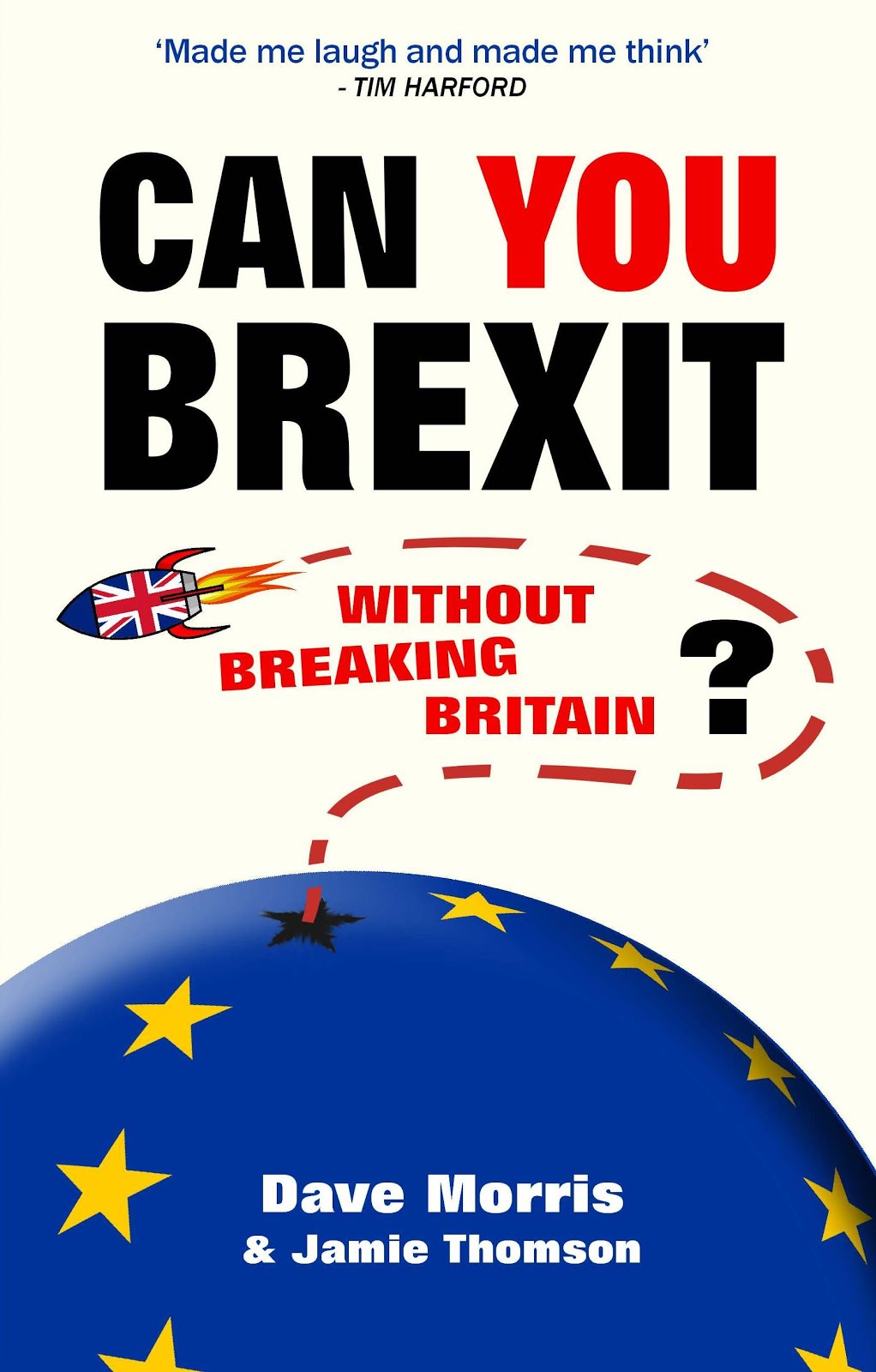
Jamie and I are wondering whether we now need to prove our patriotism by issuing a new edition of our last gamebook: Can You Do The Thing Previously Known As Brexit? But maybe that tumbril has already trundled. I do wish we had indulged some of our original plans for the book. In the first draft it opened on a crashing plane. You woke up in the cockpit but had no recollection of how to fly the thing. That established a framing narrative to which you'd return throughout the book, with increasingly surreal (or possibly increasingly lucid) episodes such as:
  • Remainers hiding in priest holes in Elizabethan times. 
  • The mutineers on Pitcairn island having “done away with the experts”. 
  • Conversations with the Number 10 cat.
  • Facts trying to escape across the English Channel in rubber dinghies.
And concluding with the prime minister (ie you, the reader) watching the trial of Orestes from The Eumenides, only in this version the Furies win the vote by 13 to 12 thanks to blatant lies yelled out by the Chorus.

"Too wacky," Jamie said, and at the time I agreed. That was before reality, out of its head on drugs, came charging up from behind, shoved reason into a ditch, and ran off laughing. Now even Armando Iannucci has given up on satire ("politics feels fictional enough") and for all I know Chris Morris might very well be thinking of applying to become one of Cummings's galley slaves. (Spoiler: he'll be disqualified on the grounds of having a university degree and being sane. Too bad, as if he worked in Downing Street he's just the chap to pull off a metaphorical Calò.)


If you'd like to wind back to an earlier era when Brexit was still about how to negotiate a rational relationship with the European Union that would reflect the electorate's narrow preference for withdrawal, you can try your hand at that in the book. Future generations will marvel that logic and facts ever played any part in the process, given the political maelstrom that actually ensued. Now, if you'll excuse me, I have to send my CV off to Mekonta.


Also available from Amazon in Italy, Germany, France, Australia, Spain, Netherlands and anywhere that books aren't burned. And talking of the Furies vs Athena:


ADDENDUM (January 31): Professor Chris Grey has written a summary of how we got to this point. Only of historical interest now, at least until Tim Harford turns it all into one of his Cautionary Tales in 10 or 15 years' time...

Friday, 2 March 2018

Are you trying to run a country?

People keep asking when Jamie and I are going to write another gamebook, and after twenty-two years we finally have. It’s called Can You Brexit (Without Breaking Britain)? and the story begins on the day in 2017 that the UK gave notice of its intention to quit the European Union.

You play the Prime Minister and you have two years (played out over four six-monthly “game turns”) to negotiate Britain’s future relationship with the union of which it has been a member since 1973. Imagine a divorce settlement after forty-five years of marriage, multiply by a half a billion people, add a poisonous cauldron of political ideology, raise to boiling point with a baying partisan press that's way off to the right of Attila the Hun, and you’ll have some idea of how smoothly those talks are going to go.

In Can You Brexit? there are ten main issues to be negotiated (residency rights for EU citizens living in Britain, security & defence arrangements post-Brexit, the National Health Service, etc) and you only have time to oversee a few of those issues in person; the rest are delegated to your ministers. So you have to manage your time while trying to prevent the four metrics (Authority, Economy, Popularity and Goodwill) from going into a tailspin.

Describing it like that makes it sound dry. It’s not. Think Veep or The Thick of It (or, for older readers, Yes Minister) rather than House of Cards or The West Wing. (Not that those last two are dry either, but you know what I mean.) At the same time, we aimed to make the game part of it informative and factually accurate. Perhaps the best comparison is Private Eye, with its blend of blistering satire, nose-tweaking mischief, and hard-nosed determination to speak truth to power. Jamie did win the 2012 Roald Dahl Funny Prize, after all, so trust me, you'll be entertained as well as informed.

Only hours after our agent sent the manuscript out to publishers he was getting replies that described it as brilliant. One editor phoned up the next day to say she’d read it and thought it was a work of genius. There’s a but. None of London’s top publishers took it – and to explain why an editor’s wild enthusiasm for a book could be shot down so easily by the acquisitions committees that make these decisions I’d have to give you a crash course in how modern publishing works. But here's a typical response that we got a month on:
I loved the idea and I promptly sent it round to all my colleagues. I was particularly taken by the level of effort Dave and Jamie have put into it. Added to which, they write really well (the Yes Minister comparison was a good one). I’m afraid where it foundered for us was the horrible greyness of Brexit itself. The book is very funny but the thought of imagining yourself into running the debacle is enough to make anyone want to hide in a cupboard – so I’m not convinced that the coverage I could definitely see this book getting would lead to proper sales… and I’m afraid they all agreed. So I’m afraid in the end we are going to pass, even though there is something essentially very brilliant about the book. It is a great project that definitely deserves success.
That's publishers these days. Always willing to back something they truly believe in, just so long as there's absolutely no risk attached. Pass me the spittoon. Luckily Jamie and I have our own small publishing imprint, so the fruit of a year’s labour doesn’t have to be cast into a desk drawer. I realize it’s not shotgunning zombies or looting dragon hoards, but if you want to see what a gamebook for grown-ups looks like, this one's for you.

And as an antidote to all those naysayers in publishing, who really just want a TV celeb to offer them a book about cats and Brexit, we got this cheering endorsement from my good friend Tim Harford, author of The Undercover Economist and presenter of BBC Radio's More or Less.
“A wholly original approach to the big question of our times, this book educates, entertains, and also achieves the seemingly impossible feat of making you empathise with Theresa May. It reminded me of Yes Minister: it made me laugh, but then it made me think.”


Also available in France, Germany, Italy, Spain, and Australia. Find more about it on Gamebook News.

Monday, 1 January 2018

Notes from small islands

Happy New Year! Normally I tend to focus on gamebooks and roleplaying around here, but maybe I can squeeze in some news of projects of personal interest now that we're at the tail end of the intercalary days.

I've been trying to continue my Mirabilis comic for some time now, and finally came to the conclusion that if I can't get it to the stage where it's a commercial enterprise that pays for the pencils, inks and colours, I can at least still tell the story. Having a few pages of artwork left before Leo gave up on it, some of which he was able to ink, I began serializing issue #10 ("A Truth That Wounds") on my Patreon page.

Those already-completed pages are running out fast. We'll soon get on to Leo's rough pencils, and after that I'll have to fall back on my own sketches. No joke, that, as you can see from the sample here, but at least the die-hard followers of the story (all dozen of them!) will eventually get to read it.

My main obsession for most of the year has been my new gamebook Can You Brexit? in which you play the prime minister of Britain through two years of negotiations, calamities, and backstabbing starting in March 2017. The book is about 870 sections long, it's now finished bar a final polish, and I'm hoping to get a proper publisher if my agent can find one who isn't too craven to handle it. Enemies of the people and all that. Maybe next year I'll tackle You Are Trump.

My wife Roz has published a book of travel memoirs called Not Quite Lost for which she has been doing loads of BBC interviews throughout December. Banish those mental images of climbing the Kilimanjaro slopes or drinking snakeblood cocktails in New Guinea. These are lyrical, whimsical accounts of our visits to various old follies around Britain, peppered with eccentric encounters à la Bill Bryson. I liked it, though you may not regard me as entirely impartial.

And if you want to hear what Jamie is currently up to, come back on Friday.


Meanwhile, if you're here looking for a gaming fix I got a doozy for ya: James Wallis's long-awaited story-game Alas Vegas is finally on sale. Buy it from DriveThruRPG or Indie Press Revolution. (Unfortunately it's not on Amazon, so if you want a print copy from IPR and you live outside the US, you'll end up paying about $50 in postage.) I'm not usually a big fan of "narrative" RPGs, but any and all original work by Mr Wallis is touched with genius, so I plan to give this a go at our next weekend special.