Gamebook store

Tuesday, 4 April 2023

A place of bones

In its third installment, the Vulcanverse gazetteer reaches Notus, the blisteringly hot realm of drifting dunes, shimmering oases, and ruined temples buried in the sand. Here and here you can read hints about how to survive and find the big quests.

Players have asked about the connection between the Vulcanverse gamebooks (an open world series in the tradition of Fabled Lands) and the Vulcan Forged MMO (an NFT-based world). Well, you don't need to know anything about one to enjoy the other. Seen from an online gamer's perspective, the gamebooks add background lore to the online setting. Ask a gamebook player and they'll likely tell you they haven't tried the online game; after all, there's continuing new content for the Fabled Lands CRPG to play first.

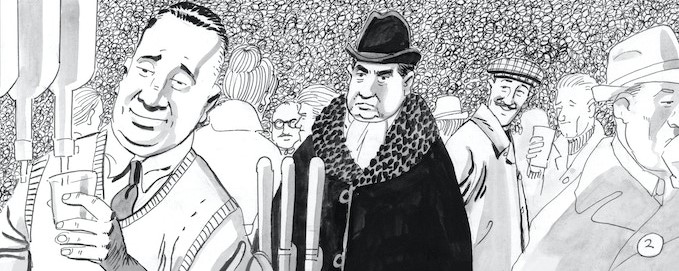
One of my personal favourite locations in The Hammer of the Sun (the book set in Notus) is the strange city of Ostopolis (depicted above). I could have set a whole gamebook there. In fact, seeing as The Hammer of the Sun is over 1700 sections long, the quests in and around Ostopolis probably do make up nearly the whole of one ordinary gamebook.

The city of the Spartoi is a brooding, half-ruined metropolis of black basalt rising from the white desert sand. Did living beings once walk those cracked streets, barter in the now dust-choked marketplace, and cheer their sportsmen in the arena that looms like a giant broken pot against the sky? Now it swarms with the fleshless grinning hordes of the Spartoi. The streets are wide avenues of cracked paving where sand sifts in endlessly shifting threads and lies banked in the gaping doorways. A skeletal dog stirs listlessly in the heat and gazes blankly as you pass.
Drop in for a visit, why don't you?


(Full disclosure: those are paid links to Amazon; as an Amazon Associate, we earn from qualifying purchases. You can bypass the paid links by using our US or UK bookstores, which also give alternatives to shopping at Amazon.)

Friday, 31 March 2023

Character sketch

On the rare occasions when I've played D&D I usually haven't taken it very seriously. In my defence, that was mostly back in the mid-'70s and the way the early books were written I don't think you were meant to take it seriously. I don't mean the rules; we used the latest iteration of those for the Blood Sword RPG and they work brilliantly. But the default fantasy setting of D&D is a bit sub-sub-sub-Tolkien by way of Monty Python, or so it usually seemed to me.

There were exceptions. I ran a Victorian-era investigative campaign (this was years before Call of Cthulhu, never mind Cthulhu by Gaslight) in which the only magic was 1st and 2nd level. That wasn't played for laughs. Also, when I joined in a game of Blood Sword 5e I not only thought it was brilliantly atmospheric, I actually liked the game system, which was several quantum leaps beyond the D&D of fifty years ago.


Anyway, back to 1976. Invited to join a D&D game by Steve Foster, creator of the Mortal Combat rules, I rolled up a Cugel-like knave called Necromageus Knoll, who soon had a reputation for greed, deceit and treachery. Come to think about it, he was three parts Cugel, two parts Zachary Smith, and one part Tricky Dicky.

The other players seemed to find Necromageus Knoll jolly enough that I put him in a comic strip (inexplicably relocated to the Tekumel underworld, hence the reference to 'Eyes') that lasted a week or two until we moved on to other campaigns. I did something similar but more serious a few years later with this authentic Tekumel write-up.

Having come across that Necromageus Knoll strip just recently, and intrigued to see how my visual storytelling had developed between 1976 and 2008 when I came to write Mirabilis: Year of Wonders (long story short: a lot!) I thought I'd share a bit of it here. Don't worry, I won't quit the day job.

Friday, 24 March 2023

Did Stan Lee steal ideas?

It’s the time of year for me to weigh in on a claim that’s causing controversy – not to deny that the claim if true would be outrageous, but to say that I remain unconvinced that it is true. And, in line with recent tradition, the outrage again involves a professor.

This time round it’s the turn of The X-Men, first published by Marvel in July 1963, though with a cover date of September because comics. The Doom Patrol debuted in the June issue (that is, April) of My Greatest Adventure, published by Marvel’s rival DC. The bone of contention is whether Stan Lee was influenced by (ie swiped from) Arnold Drake, the writer of Doom Patrol, in putting Professor Charles Xavier in a wheelchair like the Doom Patrol’s leader.

Drake shrugged it off for years as a coincidence, but after brooding on it for forty years he became convinced it was dirty pool on Stan’s part:

"I didn’t believe so in the beginning because the lead time was so short. Over the years I learned that an awful lot of writers and artists were working surreptitiously between [Marvel and DC]. Therefore from when I first brought the idea into [the DC editor’s] office, it would’ve been easy for someone to walk over and hear that this guy Drake is working on a story about a bunch of reluctant superheroes who are led by a man in a wheelchair. So over the years I began to feel that Stan had more lead time than I realized. He may well have had four, five or even six months."

Now, I’ll put my hand up to being a fan of Marvel from way back. I grew up on those stories. So you might want to take what I have to say with that in mind, but – was Drake completely nuts? First of all, Stan Lee was having to get out more than ten books a month, and he was doing almost all the writing single-handed. Sure, he had “the Marvel method” to help (plot first, then art, then write the script) but even so it’s unlikely he had much time to look through DC’s output, at that time upwards of thirty books a month. And even if Stan had been told about Doom Patrol in January 1963, he wouldn’t have had long to single out that one idea and work it into the new book he was planning with Jack Kirby.

OK, it is just possible an artist came across from DC (it was a 13 minute walk) and mentioned that DC was doing a try-out book with a super-team whose mentor was in a wheelchair. But was that really the standout detail worth swiping? Far more likely that Stan got the inspiration for Professor X from any number of brainy invalid scientists in 1950s sci-fi movies. And in any case there’s a strong story reason for Professor X being in a wheelchair. Stan loved irony, and this character is all about the power of the mind. He’s Nero Wolfe turned up to 11.

In the same year as the quote above, Drake also said:

"Stan Lee and I were working in the same vineyards, and if you do enough of that stuff, sooner or later, you will kind of look like you are imitating each other."

Well, that change of heart is interesting. Maybe Drake had taken a step back to think about where his own ideas came from. If there was any creative borrowing going on, more likely it was in the other direction. Why was Drake creating the Doom Patrol in the first place? Because he understood the appeal of the Fantastic Four. The FF’s first issue was November 1961 – only, you know the score, that means September, so it had been running for thirteen issues by the time Drake sat down and scratched his head about what could be done to counter this new and coming force in comics.

Drake saw that the FF frequently squabbled. And they got their powers from an accident – not mutants like the X-Men, notice. And the coolest members of the team were sort of freaks, the Thing especially. So it’s not much of a stretch (I’m not planning these puns, honest) to think of Robotman as the Thing, Negative Man as the Torch, Elasti-Girl (wait, what?) as Susan Storm and the Chief as Reed.

By 2000, Drake had convinced himself he originated all this:

“That was the thing that made Doom Patrol different, these people hated being superheroes. And they were a little bit self-pitying, just a little bit, and the chief was constantly telling them, ‘Stop crying in your beer.’ That made them something that wasn't around at the time.”

It wasn't around at the time? Really? What about Peter Parker? Ben Grimm? Bruce Banner? Tony Stark? So it’s a little bit rich that a few years later Drake was saying of Stan Lee, ‘He’d take credit for the King James Bible.’

All that said, it’s interesting that these days it’s hard to make a convincing movie about the Fantastic Four, and yet there were four seasons of a Doom Patrol TV show. I didn’t stick with it even for four episodes myself, but it actually feels more modern than the FF -- who were, after all, Stan Lee’s first attempt at making superheroes real and relatable and flawed. As the prototype, perhaps it’s not surprising that the FF have dated – and they were my own least favourite Marvel comic back in the Silver Age, their adventures being too cosmic and out there to appeal alongside the convincing contemporary lives of Tony Stark, Peter Parker, Matt Murdock, et al.

If you're interested in the full fascinating story of how Marvel overtook DC and revolutionized comic book storytelling, try Reed Tucker's book Slugfest and/or Adrian Mackinder's Stan Lee: How Marvel Changed The World.

Wednesday, 22 March 2023

The neutron operation

As a coda to the previous post, I came across an idea for a Doctor Who special that I jotted in my notebook a couple of years ago. I must have still been thinking of the core concept of the Dalek City game, only now as a story:

A later incarnation of the Doctor goes back in time to the original Skaro encounter with the Daleks, figuring that now he’s forewarned as to how significant a threat they are he can destroy them for good. 

The action integrates with the footage from the 1960s version, The Mutants. Instead of achieving his objective, the new Doctor’s “total war” attitude to the Daleks (who incidentally seem unable to distinguish him from the First Doctor who appears in the 1960s scenes) causes them to become fearful and thus pushes them from being warily curious to genocidally paranoid. 

The Daleks prepare a contingency plan. It's solely because of this plan that the Doctor's destruction of their power source at the end of the story doesn’t kill them all – and the surviving Daleks, the really out-there extremists, now know to study the background radiation signal and pick up the Tardis’s dematerialization signature. That leads them from being bound to one planet to being galactic conquerors who eventually challenge the Time Lords.

So in the end the reason that the Daleks are so dangerous is entirely because of the Doctor's actions in trying to wipe them out.

Thursday, 16 March 2023

Dalek City


So here's a blast from the distant past, one of the game design concepts I was spitballing with and/or pitching back in the mid-'90s at Eidos Interactive: Dalek City. It would of course have been a spinoff from the BBC's series Doctor Who. That show was pretty much dead and buried back then, so getting the rights wasn't a complete impossibility. And I was pretty sure Terry Nation, who created the Daleks and had joint control of the rights with the BBC, would be keen to hear any ideas for exploiting them.

"It's set on Skaro, the Dalek planet," I began. "The Daleks have been mutated by nuclear war and can only move about in mechanized travel machines. At the start of the game they pick up power by induction, so they can't leave the city."

"Yep, got it." said the Eidos executive I was explaining this to, who may or may not have been a famous gamebook pioneer. "So you have to get upgrades to let them travel outside the city."

"Well, it's certainly possible for the Daleks to get those upgrades. But you don't play the Daleks in this game."

"What, then?" 

"There are all kinds of threats to the Daleks. Various mutants live in the jungle around the city. Natural disasters like meteor showers can occur. There's another race, the Thals, who are their ancient enemies."

"You play the Thals, then?"

"Not really. You don't play anybody. You can step in and help the Thals if you want. Or you could spawn lots of mutant monsters to overrun the Dalek city."

This at least sounded like familiar territory. "That must cost you resources."

"No, your resources are unrestricted, up to whatever the game engine can handle. You could just send in so many monsters, raiders, and natural disasters that the Daleks would be wiped out right at the start. The point is, say you do that a few times. Then you try something different: sending in just one monster to begin with. The Daleks kill it and take it to their labs. They start researching it. Pretty soon they don't have any trouble dealing with that kind of monster—and what they've learned will help them in other ways, too."

"I see; it's one of these Artificial Life things," he said. (It was more of a growl, really.)

"Well... kind of. The Daleks are prime candidates for A-Life because their psychology is so simple. They're paranoid, inquisitive, power-hungry and they hate everything. And their society is like a type of insect hive. The aim of the game, you see, is whatever you want it to be. You can just observe the Daleks going about their duties, like your own little formicarium. Or you can trash their city and watch the little buggers get stomped. Or you can test them with various threats and see how they learn and develop. It's the cruel-to-be-kind method. Eventually you might find you've nurtured them to the point where they can take anything you throw at them. Played that way, the ultimate aim of the game is to make the Daleks into an opponent you can't beat."

For a long while he said nothing. I almost thought he might be considering it. Then he shook his head. "Players don't like games without a clearly defined objective."

New kinds of interactivity promise a world of possibilities that we have hardly begun to explore. To fully realize those possibilities, though, we have to be prepared to let go some of the control that we have come to expect, both as designers and as players. A quarter of a century on from that meeting, I'd like to think game publishers would be more willing to entertain left-field ideas, though I'm not sure how often that's true!

Wednesday, 15 March 2023

A green thought in a green shade

The tour guide to the Vulcanverse has now reached Arcadia, land of sweeping meadows and enchanted woods. Part 1 looks at the Sacred Way and the outer forest, and part 2 takes the traveller deeper in to see what happened to blight this once-idyllic region and what can be done to restore it.


I'm still working away to finish the final Vulcanverse book, but if you want to start exploring then The Wild Woods is as good a place as any to dive in.

Very nearly an armful

Not many people these days remember Tony Hancock. That's the only explanation for why there hasn't been more backing for this (bio)graphic novel by the stellar-talented team of Stephen Walsh and Keith Page. But there's still one day to go, so if you have heard of Hancock, or even if you haven't, get your credit card out and support The Lad Himself on Kickstarter.


[Added 17 March] Oh but wait... The Kickstarter failed to reach its target, but all is not lost. B7 Comics have announced that they're going ahead with publication anyway and you can pre-order copies here. Even Hancock might muster a cheer at that.