Gamebook store

Showing posts with label graphic novels. Show all posts

Wednesday, 15 March 2023

Very nearly an armful

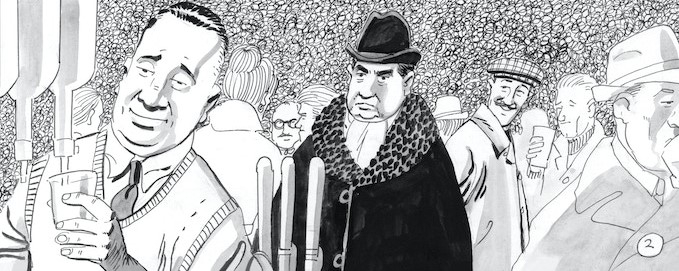
Not many people these days remember Tony Hancock. That's the only explanation for why there hasn't been more backing for this (bio)graphic novel by the stellar-talented team of Stephen Walsh and Keith Page. But there's still one day to go, so if you have heard of Hancock, or even if you haven't, get your credit card out and support The Lad Himself on Kickstarter.


[Added 17 March] Oh but wait... The Kickstarter failed to reach its target, but all is not lost. B7 Comics have announced that they're going ahead with publication anyway and you can pre-order copies here. Even Hancock might muster a cheer at that.

Friday, 16 December 2022

Frame by frame

Russ Nicholson and I tried pitching a graphic novel gamebook to UK publishers in the late 1980s. Little did we know that Delacourt were doing exactly the same thing at about the same time. It probably helped that comics (bandes dessinées) are well-established in France whereas in Britain they are, as my agent says, "not even a cottage industry". La Sphère du Nécromant was by Thierry Cailleteau (writer) and Eric Larnoy (artist) and you can read more about it here. And A J Porfirio is continuing the tradition with the Graphic Novel Adventures series.

Another graphic novel gamebook that I really like is Ryan Lovelock's Kadath Express. This is something really unusual, an interactive sightseeing trip through a world of fantastical weirdness and charm. Full disclosure: Ryan sent me a free copy, but the book is such a thing of beauty that I'd have bought it anyway.

Friday, 10 June 2022

No new thing under the sun

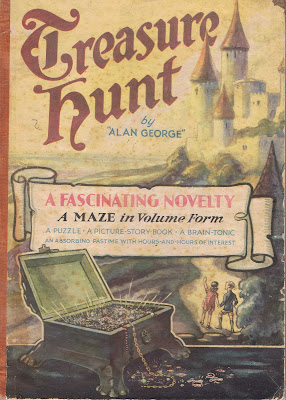
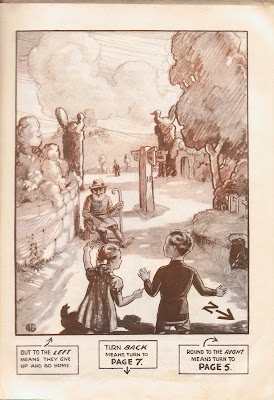
I knew gamebooks dated back much further than Choose Your Own Adventure and Steve Jackson's Melee and Wizard solo games. I used to play educational logic "gamebooks" back in the early 1960s. But it turns out that "Alan George"'s Treasure Hunt not only anticipated all that by a further two decades (it was published in 1940) but also sort of pioneered the graphic novel gamebook genre that I thought Russ Nicholson and I had invented in the early '80s.

Prior to that was Consider the Consequences, a gamebook of life choices, love, marriage and careers by Doris Webster and Mary Alden Hopkins, which came out in 1930 and is now available on the Internet Archive.

Much more up to date is a new(ish) open-world gamebook called Traquelero: A Quest for Happiness, by Othniel Poole. It seems pretty hard to get hold of, which is a shame as the concept sounds fascinating. No dice, no stats, just a character journey to explore. Effectively a walking sim in gamebook form? I'd like to try it and find out.

Wednesday, 22 June 2016

Fantasy and SF books

The book reviews in the last post proved more popular than the role-playing stuff that preceded it. I admit I'm surprised, but we live in an age when politicians and bloggers alike are buffeted by the forces of populism -- interesting times, as the Chinese say. So here are a few more reviews, this time all of genre books so you can see how picky I am. I'll save the best till last.


American Fantastic Tales: Terror and the Uncanny from the 1940's Until NowAmerican Fantastic Tales: Terror and the Uncanny from the 1940's Until Now by Peter Straub
My rating: 3 of 5 stars

Quite a curate's egg. Some of the stories are what I would expect of "the fantastic" - elusive, oblique, unsettling, breathtakingly fanciful, or all of the above. Joe Hill's "Pop Art", for example, in which the narrator remembers his inflatable childhood friend. That's a world in which people just are sometimes inflatable and Hill runs with the idea. But contrast that with Poppy Z Brite's "Pansu", which relentlessly expounds a feeble idea about exorcism; it might as well be one of Ross Rocklynne's problem-solving SF stories, only with made-up stuff in place of clever physics. Or Caitlin Kiernan's "The Long Hall on the Top Floor", which is hardly a story at all but more like a treatment for a formulaic TV series about a drunken, hip-but-bitter psychic investigator; Constantine lite. Or look at the way Jane Rice in "The Refugee" feels obliged to painstakingly lay out the crumbs of plot and evidence to coax us towards the denoument of a rather undistinguished werewolf story.

But then there are gems too. John Collier's "Evening Primose", about the shadow community living in a department store; Tennessee Williams's poignant, spectral "The Mysteries of the Joy Rio"; Truman Capote's inexplicably threatening "Miriam"; John Cheever's "Torch Song"; Shirley Jackson's "The Daemon Lover" (there's the twisty nightmarishness I wanted); Mary Rickert's disturbing and ambiguous examination of grief and guilt in "The Chambered Fruit"; Benjamin Percy's dislocated existential horror "Dial Tone" - these and others make the collection worthwhile.


A Maze of DeathA Maze of Death by Philip K. Dick
My rating: 2 of 5 stars

It shouldn't work, this. It gives every indication of being slapped together with no planning, the characters are opaquely written, the set-up is both contrived and confusing. Yet somehow Dick pulls a workable yarn out of the hat. Maybe that's because the experience of reading it throws you into the same state of fretful bafflement that the characters are experiencing. Or maybe it's simply because, when it comes to paranoid delusions, Dick knows whereof he writes. It's not great but worth reading to see what the brush of genius can do to transform a mess.

Second Foundation (Foundation, #3)Second Foundation by Isaac Asimov
My rating: 3 of 5 stars

This one is more fantasy than SF. A mutant with mind-controlling powers disrupts Asimov's rise-of-empire story. That's fun for a while, but Asimov can't think of a way out so he gives the entire Second Foundation the same powers, and they wave a mental wand and that's it. All sorted. As for what those powers are - we all had them once, apparently, but lost them with the development of language. Oh, Isaac, that's lazy.

Still, it's a good story with at least one compelling character in 14-year-old aspiring novelist Arcadia Darell, a prototype for feisty teen investigators.

There's one slip-up where Asimov puts us inside the head of a character who could not possibly be thinking what he tells us she is because it later turns out she's been on top of the whole situation all along. Isaac, that's careless; you were pantsing it, I suspect.

At the end, having enjoyed the ride, I still had to wonder why Hari Seldon didn't just put the psychologists (who are really kind of psycho-economists) and the physical scientists on the same planet. It would have saved a lot of confusion. That'll be why, then.

Quite a lot of typos in these editions, by the way. You can work out what was meant but it's irritating.


The First Fifteen Lives of Harry AugustThe First Fifteen Lives of Harry August by Claire North
My rating: 3 of 5 stars

Another real curate's egg. I liked the concept, and it takes some getting your head around. To summarize: because in consecutive lifetimes people you met in the previous lifetime remember that as their last lifetime too, it seems that the entire world must reset when every single ouroboran from the dawn of time to the end of the human race has completed one life. Which was kind of fun to think about.

This means that you can send messages forward as far as you like in one instantiation of the world, but you can only send a message back by one generation at a time. Nonetheless, our narrator gets a message that the end of the world is happening sooner than it used to. He soon twigs that it's because of a rogue ouroboran in his own lifetime (1919 to the early 21st century) who is meddling in the old Things That Man Was Not Meant etc.

Now here's the biggest flaw in the book. We are asked to accept that all is for the best in this best of all possible worlds, just as long as ouroborans do nothing to try and improve the human lot. Create antibiotics 50 years early? Why, you fool, there'll be a dotcom crisis in the 1960s and nuclear war before 2020.

[Spoilers here on in...]

There's nothing wrong with SF taking a reactionary view. What would paperback sales be like in Boko Haram territories if it couldn't do that? But the dramatic flaw here is that we are presented with this intriguing, unexplained phenomenon of reincarnation, and one of the characters is trying to build a magic mirror - sorry, quantum mirror - which might well tell him and us what lies behind it all. But he's the bad guy. We're supposed to root instead for the plodding narrator who is doggedly trying to stop him so that dotcom crises and humanitarian disasters can happen when they're supposed to as ordained by - whatever, whoever. Personally I think the story would have worked better if the narrator was trying to cause change and reveal truths rather than putting all the genies back in their bottles.

The author does well at evoking the sense of many different lives lived. Less so at the emotional journey. The narrator's relationship with his real and adoptive fathers interested me far more, but was much more sketchily covered, than his struggle to stop anything different or interesting from ever happening. At one point his nemesis marries the woman he himself loved a dozen lives earlier. The reaction s both too little and too much - "I crawled into the bushes and wept." Dude, it was like 800 years ago. I can pass old flames in the street without going nutso, and that's just a matter of decades.

But then, our hero is an eidetic. Or rather, to use their own terminology, a mnemonic. He remembers everything. Often these eidetics are troublemakers, because they take vaccines and gunpowder back to earlier times. But wait a mo', every message passed back down from the future must do that... Moving on.

The style is rather uncomfortably prosaic and stilted. An attempt to render how somebody born in 1919 would write? Perhaps, but some poetic licence would have made it more tolerable. The ending is a little rushed, the bad guy all but throwing himself onto the pyre. It had the smack of author fatigue to me; time to wrap up and work on something else.

Still, an interesting concept - even if it is never actually explored either emotionally or scientifically. Maybe that will be in the sequel, but 400 pages was quite enough for me.

(Editing anomalies: a "temporarily" that should have been "temporally" and a strange lapse into Chaucerian idiom with "nor in no life". Blame the publisher for those; authors have enough to do thinking this shit up.)
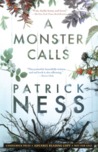

A Monster CallsA Monster Calls by Patrick Ness
My rating: 2 of 5 stars

The story of a 13-year-old boy whose mother has cancer. As with The Boy in the Striped Pyjamas, who would drown this kitten? It's the sort of book publishers absolutely love doing, because they can't always judge literary quality but worthiness is obvious to all. "Brave, compassionate, beautiful..." say the cover quotes; they write themselves. It's the kind of thing that almost has me rooting for the tumour.

It's in the past tense, which makes it almost a collector's item among kids' books these days. The style is...

Well, the style. It is.

That is the style.

A bit like Dr Seuss? That's what I thought too. Okay, it is for kids, but I grew out of Dr Seuss by age 6 or so. After a hundred pages the shallowness of that screenplay-like prose really grates. But it is in the past tense, I give it points for that.

Some light spoilerishness now. The most interesting part to me was the main character's relationship with his tormentor at school. The denouement of that was thoroughly unsatisfying (the author's inspiration simply took an afternoon off) and the aftermath completely unrealistic. I don't think criminal cases involving bodily harm are left for school authorities to adjudicate, for example, nor is prosecution solely dependent on pressing charges.

The monster is okay, but it doesn't have much to do except tell a series of stories that feel like padding - probably because they are. The ending is all tell not show, but it's relentlessly worthy so librarians will love it.

A part of the proceeds from the book do go to charity. But you could always cut out the middleman.
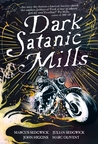

Dark Satanic MillsDark Satanic Mills by Marcus Sedgwick
My rating: 4 of 5 stars

The only graphic novel in my reviews of 2013 (though not, of course, by any means the only comics work I've read this year) this is a quite unsettling approaching-apocalypse story with some of the DNA of Survivors, Quatermass IV and 1984 - along with much that is original and brilliant in its own right.


The White DarknessThe White Darkness by Geraldine McCaughrean
My rating: 3 of 5 stars

This is beautifully written, has an intriguing premise (Captain Oates lives on as the imaginary friend of a 14-year-old girl) and convincingly rounded characters.

You can see there's a but coming, can't you? I found for the first quarter of the book that the story didn't really bite. That bit is like a long set-up that is all put across in wonderful prose, but it lacks the intrigue factor needed to make you keep on reading. It was only when the narrator gets to Antarctica (I'm not giving anything away here) and things start to go wrong that the novel becomes really compelling.

One problem, I decided, was that there is plenty in the set-up that the reader can see but the narrator cannot. This creates a disconnect between us and our protagonist. That's all very well when the narrator is somebody like Charles Pooter. We may not connect with Pooter or even respect him that much, but we do find him endearing. That's comedy. But in a dramatic tale like this, where the narrator is our sole point of contact with a story that is hopefully going to move us (and it does) it is potentially fatal to find that you're distanced from that narrator for a good chunk of the book.

So, overall I recommend this (and my wife btw would give it 5 stars) but you do need to be patient with the slow build-up.


The Battle Of The SunThe Battle Of The Sun by Jeanette Winterson
My rating: 3 of 5 stars

The caveat first: it's a kids' book, so I'm not the intended audience. I'm trying to think back to what books I'd have read at that age. Robert Heinlein's juvenile novels (Red Planet, etc). Dracula. Mike Moorcock's Mars books. Very different.

It's full of inventive ideas and Ms Winterson is obviously enjoying herself, to such an extent that it often feels as if she's making it up as she goes along. That's okay, by the way, as long as you don't drop any plates. And she doesn't.

The style is lush and lyrical, but feels a little repetitive after a while. No doubt that's deliberate (it creates an incantatory feel) so is only a complaint from an adult reader's perspective.

Likewise the perfunctory characterization. It's like a fairytale, so there's no depth or complexity there. A character is brave, or devious, or ruthless, or honest, and motivations are: greed, love, fear. Lacking that, it reads like a role-playing game write-up in which characters are seen doing things but we never really go inside them. I'd have preferred fewer characters with more time given to them, but children now have different expectations from when I was reading Heinlein and Stoker.

Btw I only discovered halfway through that it's sort of a sequel to Ms Winterson's other kids' book, Tanglewreck. I'm not sure that matters - you can read this one on its own - but it was odd.


Riddley WalkerRiddley Walker by Russell Hoban
My rating: 5 of 5 stars

Now that everybody is in such a flappy fuss about Station Eleven (give it three years and you'll have to Google it) this seems like a good time to re-read possibly the greatest work combining narratology, theatrical performance, and post-apocalyptic future history. Hoban said he could never spell properly again after confabulating the narrator's language, but it was worth it.


Titus Groan (Gormenghast, #1)Titus Groan by Mervyn Peake
My rating: 5 of 5 stars

It took me more than 30 years to read this book. After originally abandoning it a few chapters in, I nearly gave up at the same point. There's a whole world and a lot of characters to introduce, and Peake wasn't writing for an audience of TV-weaned YA goldfish. He takes his time but suddenly it pays off. You really know these characters because he has put care into making them individuals. His prose is beautiful and he has the most vivid visual imagination of any author I've come across.

It is, in short, a masterpiece. Normally I reserve 5 stars for books that I feel affect me profoundly and permanently - that "change my life", as all great art should on some level. I regret not coming to Gormenghast a lot sooner. If I'd read it 32 years ago it would have stretched me to create more interesting fantasy worlds in my own books.

(Thanks incidentally to Marcus Sedgwick: it was his superb comparative review of Gormenghast and Lord of the Rings that sent me back to the book after so long. I feel I need to acknowledge that, having just trashed his latest book in another review. And one day maybe I'll read Lord of the Rings.)


Death Is a Lonely Business (Crumley Mysteries, #1)Death Is a Lonely Business by Ray Bradbury
My rating: 5 of 5 stars

A magic realist whodunit in which the young Bradbury is himself the protagonist. Only, being Bradbury, it's never as simple as that. The murderer seems to be more existential than physical, the familiar landscape of LA suddenly far more fantastical than Mordor. The one flaw is that Bradbury, as a writer who notoriously disdained plotting, allows an important character to slip out of the story while two others, introduced later and in whom we are consequently less invested, become more prominent than they really should. But imagine it as a sixtysomething author getting up and just improvising a prose-poem of dread, beauty, loneliness and the desire to connect with others and you can't help but applaud.


Empire of the Petal Throne: The World of TekumelEmpire of the Petal Throne: The World of Tekumel by M.A.R. Barker
My rating: 5 of 5 stars

I've read it more times than I could count and I've spent as much time in Professor Barker's imagination as on the planet Earth. EPT is the most perfect example of the proliferating story threads that Damien Walter describes as one of the chief joys of reading a roleplaying game (http://www.theguardian.com/books/book...). I'm not religious, but if I was this would be my Bible.

View all my reviews

Thursday, 31 October 2013

In his house at R'lyeh

Having mentioned Old Ones, I can't let Halloween pass without recommending I N J Culbard's fabulous graphic novel adaptation of Lovecraft's At the Mountains of Madness. We never got del Toro's long-promised Mountains movie - not yet anyway - but this is the next best thing.

The universe has never seemed a more alien place than it is in Lovecraft's Antarctica, and crucially Culbard adds to the terror of the story by humanizing the tiny, helpless protagonists in the midst of a continent of unknowability. I'm not sure I'd agree with Rachel Cooke's review in The Observer newspaper that draws comparisons with Tintin and Boy's Own. Ms Cooke must have been reading Tintin and the Pit of Eldritch Horror, or else was thinking of all those Old Ones running curio shops and talking in mockney. But hey, she liked it.

While we're on the subject of the Cthulhu mythos, I found that the gamebook/Dungeons and Dragons variant spelling of shoggoth is not as risible as it seems. Well, it is, but it's also slightly supported by canon. (I'm not casting the first stone, me. If I'd known more Romany in the 1980s, at least one country in Legend would have had a different name. And no excuse for that, really, as I had a schoolfriend who called all us Anglo kids "gaujoes"; he could have told me.)

The original Mountains novella is worth a look too, and may be a good place to start if you've never read Lovecraft. There's an excellent article by M Christian that includes some of the illustrations from the  Astounding Stories publication in 1936. Mr Christian notes:
"What’s particularly interesting about At the Mountains of Madness is how it forms a bridge between Lovecraft’s mythology. Before it, his 'horrors from beyond' were more mythological, but with At the Mountains of Madness he instead moves in a more science fiction like direction - a change many other reviewers have called extremely significant for his very long-lasting popularity."
The last word goes to Ech Pi El himself:
"For a second we gasped in admiration of the scene’s unearthly cosmic beauty, and then vague horror began to creep into our souls..."
Brr. Happy Halloween.

Wednesday, 19 September 2012

A shark going forward


I'm used to the idea that most visitors to this blog are really only interested in Fabled Lands news, maybe with a side order of 1990s gamebooks - and hey, I'm not knocking it. It's nice to have your work appreciated, even if it is sixteen-year-old work. But I didn't retire or anything, and naturally I think I'm a better writer now than I was back then, so I hope the hardcore gamebook fans will allow me the occasional indulgence of talking about what I'm working on nowadays.

One such project is of course Frankenstein, which came out earlier this year on iPad and iPhone. I'm right now working with Spirit Entertainment (the new FL app developers) on Kindle and EPUB versions of that, which should be published by Profile Books this autumn. And next year there might even be a print edition - which is not easy, because this is an interactive novel rather than a gamebook, so telling the reader about the characters' degree of alienation or trust is not exactly conducive to the literary experience. But I'll see if I can figure something out.

And then there's my ongoing comics epic Mirabilis: Year of Wonders, created with Leo Hartas and Martin McKenna. This is my labour of love. The work that I would still do if I was stranded on a desert island with no one to read it.

Recently Mirabilis was released on the NOOK and in the iBookstore, but the important scoop du jour is that it's just out on Kindle and for this week only the first two issues are discounted down to - oh, absolutely free. Well, how about that. There's never been a better time to try it out. And if you like it, let me know. Writers are more like cats than sharks, you know. We like to be stroked.

Friday, 20 July 2012

Mirabilis Year of Wonders book 2


Gearing up for the (hopefully) imminent release of Volume 2 of Mirabilis, my ongoing comic book fantasy epic, here is an online preview of the first ten pages. New to the party? In that case, you can see how the story starts with the first 30 pages of Volume 1 online here.

If it's your cuppa, you can still order the gorgeous hardcover edition of Book 1 here and you can pre-order Book 2 here. And the paperback edition is available here.

Sunday, 31 July 2011

Get ready for Dirk Lloyd

If you've been following this blog from the start, you'll know that Dirk Lloyd was the first new concept that we came up with after founding Fabled Lands LLP. By that I mean the company Fabled Lands, not the gamebook series - though Fabled Lands projects (the world, gamebooks, RPG and apps) are all controlled by Fabled Lands the company. Don't worry, it confuses us too.

Anyway, back to Dirk... In a nutshell, it's the story of what happens when the Lord of All Evil is defeated by the forces of good and banished to our world in the body of a 13-year-old kid. Oh, the ignominy! Whoever heard of a dark lord having the crusts trimmed off his peanut butter sandwiches? But even stripped of his powers, Dirk isn't going to take his exile on modern-day Earth lying down. Imagine a novel told from Tom Riddle's point of view - and with a style of crazed humour that will be familiar to anyone who used to enjoy Jamie's hilarious column in the old Warlock magazine.

The first book had a pretty drawn-out development process, as new projects often do. We plotted it in detail, Jamie went away and wrote a first draft, we then completely reworked the storyline, and Jamie wrote another draft before getting a full story analysis from Roz Morris (bestselling author who I had to foresight to marry so as to save the company money) which guided him in polishing it. Would you believe that all took nearly two years? What can I say? Perfection doesn't come overnight. Then the series took another year to sell, and even after that it went through a healthy process of thorough critiquing and editing from our UK publisher, Megan Larkin, at Orchard Books.

And now this lovingly polished jewel of dark brilliance is about to be unveiled to the world. The first book, Dark Lord: The Teenage Years just got a glowing review from Hazel Holmes over on the Chicklish site and you can pre-order it on Amazon. (Just don't look at the product description there as it contains a massive spoiler about the end of the book!) Freya Hartas, daughter of Leo and grand-daughter of John Vernon Lord (how's that for an artistic pedigree?), has produced a clutch of macabre illustrations as unique and tasty as devilled dragon eggs that perfectly complement the dry black humour of the text.

Now that the characters and scenario are all worked out, coming up with new stories is much easier. In fact, Jamie has already written the second book in the series, Dark Lord: A Fiend in Need, and is about to start work on the third, The Dirkest Hour. Orchard are planning a promotional tour, so if you keep an eye on your local bookshop window you may find that Jamie is coming to your town. (Hide the beer and sausages if so.) NBC are developing the Dirk Lloyd TV show. There are plans for apps and gamebooks and bunch of other stuff. And all for you, dear reader; all for you.

The UK books will be out in October with editions in Germany, Spain and the US to follow soon after. So there you have it - Dirk Lloyd is going to conquer our world. There's no use fighting it.

Monday, 20 December 2010

Mirabilis graphic novel app in Top 100 grossing books

I'm cross-posting this from the Mirabilis blog because Leo and I are just too darned excited to keep it under our hats. Mirabilis - Year of Wonders has been in the App Store for four days now, which is pretty fantastic as it is. But the really great news is that we just nudged into the Top 100 grossing ibooks at #99!

You can get the first instalment of the story completely free, then other chapters cost $1.99 each. So it was dizzyingly good news when we rose to #13 in UK iTunes books, but to actually be in the top-grossing charts too shows that new readers are following through with the story after they've been astounded by the fluid interface, easy in-app issue management, eye-popping zoom and page flip (courtesy of demon coder Simon Cook), magical colors (by wizard of the digital rainbow Nikos Koutsis) and stunning art (by maestro of the Wacom tablet Leo Hartas).

And don't feel left out if you don't have an iPad. You can read the first chapter on BookBuzzr or buy the trade paperback on Amazon. Next stop: the Kindle. And in the meantime, if you haven't got the Mirabilis iPad app yet, you can find it here in the USA and here in the UK. Spread the word!

Saturday, 18 December 2010

Mirabilis - Year of Wonders launches on iTunes

My big news this week is that Mirabilis - Year of Wonders launched in the App Store for iPad. You can pick up the reader and issue #1 for free (US here, UK here) and subsequent issues are $1.99 each. We've styled them to be complete facsimile comic books, right down to the cover and letters page.

The zooming, page flipping and navigation is a dream - better, for my money, than you'll see in any other iOS comic book reader. And obviously I'm going to rate the content higher, seeing as it's written by me with pencils and inks by Leo Hartas and colors by Nikos Koutsis. Well hey, don't take my word for it. You can check it out for free.

The app quickly rose in the UK App Store book charts this week, reaching #13 (that's seventeen places above The Walking Dead and just two behind the DC Comics reader) and getting flagged by Apple as "New and Noteworthy". We'll be releasing new issues from February next year, so get iPadded now.

Not to forget print entirely, though, there's also a fabulous trade paperback edition on high-quality silk finish paper stock that you can buy for $19.99 on Amazon. That's volume one, which collects the first four issues, and volume two will be available by January. And UK readers might want to hold out for the large format harback editions that are due out from PrintMedia Productions in the spring - but those are only going to be available in Britain and Ireland.

Tuesday, 30 November 2010

A thing of beauty

This is a cross-post from the Mirabilis Year of Wonders blog, but I feel justified in squeezing a snippet about my personal projects before some more bits of big news from Fabled Lands LLP over the next week or two.

The Mirabilis Year of Wonders e-comic book is going to go live in only a few weeks now. But I just had to share this pic with you because I've been playing the ad hoc build and it really is a dream. Lush magic lantern colors, razor-sharp graphics, and an interface that's as stylish and smooth as an Irish coffee poured by George Clooney. If you're used to struggling with existing comic reader apps, you're going to be blown away by what our resident iOS wizard has conjured up.

Don't wait. Really, you should go direct to your nearest Apple retail store (look here for Apple in the UK or Apple in the US), buy yourself an iPad for Christmas, and you will then be able to get the reader app and the first chapter of Mirabilis free, with the other chapters available via our nifty in-app storefront. The Mirabilis graphic novel on iPad is our way of telling you that the Year of Wonders has arrived.

Thursday, 16 September 2010

Marvels yet to come

Following on from news of the Fabled Lands gamebooks and RPG, I can reveal there has been some early-stage talk about new print editions of both the Blood Sword and Way of the Tiger gamebooks. Now let me stress that it is just in discussion so far - but Oliver and I have already struck a deal with Fabled Lands LLP for Blood Sword, and Min (that's Mark Smith) is ironing out the WotT details with Jamie. Also, fans of WotT might also be interested to hear that, if Min and Jamie can find the right publisher, there's even a possibility (still but a twinkle in the mind's eye at this stage) of an Orb RPG. How cool is that? Cooler than the back of the icebox in Superman's fortress, that's how cool.

On top of that, and now that we're all clear that this is gossip over the washing line, I'm hearing rumours that a new publisher may be about to approach Fabled Lands LLP with a proposal to take over the Dragon Warriors license after Magnum Opus Press bows out early next year. The good news for DW players is that this would ensure a smooth handover, hence an uninterrupted flow of new titles. So cross a finger or two, Legend fans. It ain't over till you see the white of Balor's eye.

Anyway, leaving aside all the scuttlebutt and promises, you might like to hear about a cast iron take-it-to-the bank certainty, which is that my current project Mirabilis (co-produced with Leo Hartas, Martin McKenna and Nikos Koutsis) will be out in the form of two splendid full-color graphic novels in plenty of time for Christmas. Mirabilis is a whole other blend of whimsical fantasy from the swords-n-spells of Legend, Orb and FL. Find out if it's your cup of tea right here.