Gamebook store

Showing posts with label Steve Jackson. Show all posts

Thursday, 16 October 2025

A toolkit for open-world gamebook design

The earliest true gamebook (with rules, that is, and disregarding mere multiple-choice texts) was probably Steve Jackson's Death Test in 1978. That allowed players to backtrack and visit the same location multiple times, but throughout the 1980s the main evolution of gamebooks detoured down a different branch with series like Fighting Fantasy, where the arrow of narrative time pointed in one direction. It wasn't until 1995 that the first open-world gamebooks appeared -- followed by silence until, decades later, series like Steam Highwayman and Legendary Kingdoms took up the torch. Finally it seems that open-world gamebooks might be becoming the dominant form.

I have been sent a succinct and comprehensive toolkit for open-world design that would-be gamebook writers will find very useful. Not just would-be writers, either; I've been doing this since the last millennium and even I found it had some handy tips. You can find that toolkit here. The author prefers to be known only as Ruth, so I will respect her anonymity, though it can only be a matter of time before her own open-world gamebook series appears.

In the Vulcanverse books, when I used what Ruth calls Local Changes, typically I'd include another entry:

So you’d arrive at the location and be presented with the situation that could lead to a change. If you complete that correctly you’re told to turn to the original location and tick the box. Then you get a one-off scene that explains the change and assigns any relevant keywords. If you return to the location subsequently you go to X*A which is the location in its changed state.

Regarding keywords, it’s worth differentiating (and incidentally I say this with 20/20 hindsight) between keywords used as logic flags to denote that an event occurred (“a tidal wave hit the city”) and keywords used to indicate a current state (“the city is in ruins”). In Vulcanverse I could have used keywords and titles respectively for those two functions. I didn’t, which meant that sometimes I’d remove a keyword that was no longer applicable, only to realize later that I’d still like to know if the player had originally had that keyword. Eg if I complete a quest for the king and so he makes me the court champion, even if later on I lose the court champion keyword I still need to have the keyword that says I did the quest. (I'll discuss flags and states in more detail in a future post.)

Regarding rules mechanics generally, I keep promising that next time I’ll create an object-oriented rule set so that I could keep track of, say:

  • having one’s face stolen by a mujina
  • getting cursed by a fairy to have a donkey’s head
  • acquiring blue skin
  • being body-swapped into another form

Variously those conditions could mean:

  • You’re not recognized by somebody who should know you
  • You’re mistaken for someone else
  • You are treated differently from other people (potentially in several different ways)

In Fabled Lands I ended up filtering for all those statuses every time I asked the player to check them, whereas if they had been properly organized I could simply have asked, “If you have a status that is listed as transformative and uncanny, go to X”.

Similarly with equipment, where it is useful to have a generic way of identifying whether something can be used as a weapon, or has a blade, or reflects like a mirror, or is made of iron, and so on – rather than having to list the items for each applicable function (such as “if you have the polished shield, the silver mirror, the jade looking-glass…”). Ruth's Multi-Function Item tool covers that one, and could be extended to keywords describing the character’s current status to solve problems like the altered-face one above.

Vulcanverse also used the Current Location feature, a box on your adventure sheet where you record a section number that you are routed to after the current subquest you're on is complete. This allows for encounters to happen at different points around the world, for instance when you're acting as go-between carrying love tokens from Eros to Psyche in The Hammer of the Sun. The Current Location can be used for a lot of things, a common example being when you have a wandering NPC whom the player has to meet up with from time to time, because the different stages of the player's dealings with the NPC don't have to be tied to the geography of the world. You just tell the player to record a Current Location number when the subquest is triggered, then when the next part of their interaction with the NPC (or whatever) is done, you send them back to the Current Location and they resume their travels.

I was going to compile a list of gamebook design resources, but they are many and scattered far and wide. Here are a few to get started. If you know of any others, link to them in the comments.


And while we're on the subject of gamebooks, the Blood Sword 5e hardcover book has just been released in the UK and US. You can buy it at Orc's Nest or from GMS Tabletop Games. The book is a complete 5e roleplaying campaign based on the gamebooks and features some absolutely top-notch design, writing, artwork and production. If you're starting to think about Christmas presents, it's the perfect gift for the avid gamer in your life. Just be aware: they're going to need a bigger stocking.

Thursday, 8 September 2022

Soldiers Three

H G Wells was a wargamer. Everybody knows that. And when you read something like this (from "With the Main Guard") you could almost believe Rudyard Kipling designed his characters as if they were going into a GURPS campaign:

In the Soldiers Three stories, Mulvaney, the Irishman, is the most interesting. He understands people instinctively and knows how to gin them up and calm them down. He is also subject to bouts of "the black dog", has a drinking problem, and reacts to violence by throwing up, all obvious GURPS disadvantages/quirks. Ortheris, the sharp-as-a-pin Cockney, is small and prickly but a crack shot. Learoyd, the Yorkshireman, is slow but strong. The character sheets write themselves.

The British Raj would make a great setting for a roleplaying campaign. Though I can't see SJG getting around to publishing a sourcebook any time soon, and even Osprey's books of the period seem to be out of stock, here are some weapon stats to get the ball rolling.

We can estimate Ortheris's shooting skill, incidentally. He says he can hit Mulvaney five times out of seven at 800 yards with a slightly substandard rifle. Assume an Accuracy of 4 (1 less than a brand new Lee-Enfield .303). Ortheris can aim for three rounds to get an extra +3 bonus, so he's rolling at +7 in all -- less the range modifier, which is -16. And let's give a +1 to hit Mulvaney because he's a big fellow. So the overall modifiers add up to -8. Ortheris is hitting 71% of the time, so his Guns (Rifle) skill must be 20.

Amazon US

Friday, 10 June 2022

No new thing under the sun

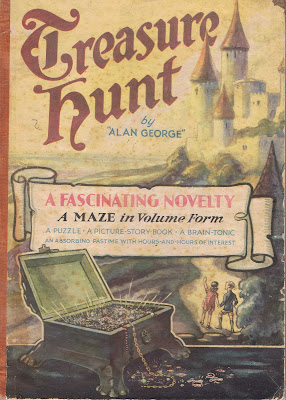
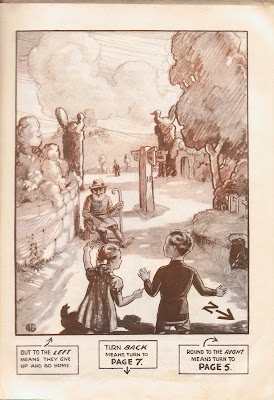
I knew gamebooks dated back much further than Choose Your Own Adventure and Steve Jackson's Melee and Wizard solo games. I used to play educational logic "gamebooks" back in the early 1960s. But it turns out that "Alan George"'s Treasure Hunt not only anticipated all that by a further two decades (it was published in 1940) but also sort of pioneered the graphic novel gamebook genre that I thought Russ Nicholson and I had invented in the early '80s.

Prior to that was Consider the Consequences, a gamebook of life choices, love, marriage and careers by Doris Webster and Mary Alden Hopkins, which came out in 1930 and is now available on the Internet Archive.

Much more up to date is a new(ish) open-world gamebook called Traquelero: A Quest for Happiness, by Othniel Poole. It seems pretty hard to get hold of, which is a shame as the concept sounds fascinating. No dice, no stats, just a character journey to explore. Effectively a walking sim in gamebook form? I'd like to try it and find out.

Friday, 15 January 2016

Duty calls


GURPS 4e is the rule set of choice in my gaming group. I don’t like everything about it (fights take up way too much time without actually feeling terribly exciting) but there’s lots of interesting debate to be had when you shine a light into the obscure nooks and crannies of the system.

Just one example. Characters can take a Duty. This is a disadvantage of variable points value; by taking it you get points to spend on attributes or skills. The more likely a Duty is to apply during a game, the more it’s worth. You get extra points if it’s extremely hazardous (ie you are at constant risk of death) and also if it’s involuntary. An involuntary Duty is one where the character has no choice in the matter. Their actions are coerced by threats to loved ones, mind control, or a curse.

One of the players in our Victorian campaign took a character who was a lieutenant in the Royal Navy. He argued that the Duty should count as involuntary and extremely hazardous:
"Since the penalty for abrogation of this duty is court-martial, punishable possibly by death (and the utter shame and ruin of his entire family and tarnishing of the reputation by association of his circle of friends) I think his duty is pretty much involuntary. 'Enforced by threats to you or your loved ones...' – GURPS 4e page134."
My counter to that was that the whole point about involuntary Duty is it's enforced – the cartel have a gun to your wife's head, the terrorists have strapped a bomb to you, that kind of deal. If you ask a British RN officer in the 1890s why he is carrying out his duties, he's not going to say, "I don't want to, but the British government are holding my life and family honour to ransom." So it's voluntary. The GURPS Compendium explains it pretty well:
Duty (Involuntary; an extra -5 points) Some duties are enforced by threats, threats to loved ones, or by exotic methods of mind control. Such a forced duty can result in difficult decisions or surprising insights for the affected character. An involuntary Duty would not include military service by draft (although service by impressment, as practiced by the British navy of the 18th century, would qualify), nor any other "normal" service. Only cases where life or sanity are directly at stake qualify.
The player disagreed. (When do they not, when character points are at stake?)
"It is involuntary! What you're talking about is Sense of Duty, which makes him feel he wants to do it. But he has no choice, and if he should be given an order with which he disagrees, or is too afraid to carry out, the true nature of the duty is clear. It's not just imprisonment or a broken relationship with his patron he has to deal with afterwards. Plenty of the fellows who sign up for the armed forces will attest to the level of choice they have. If it were WW1 and he were in the army, I don't think you'd try and sustain your case. The overwhelming horror of enforced duty tearing against the survival instinct is pretty well documented."
Sense of Duty is indeed another, quite different character trait in the GURPS rules. It’s mental, not social, and bears on whether you feel you ought to carry out the duty. This is where it gets interesting. Because all duties must have some degree of either voluntary or involuntary internal compulsion. That’s what the extra -5 points for an involuntary Duty is all about. But does the GURPS rulebook insist that all voluntary Duties are accompanied by a Sense of Duty? No. It is perfectly possible to take a voluntary Duty without having a Sense of Duty.

And quite right too. I know people who were in the British armed forces, ordinary squaddies who joined straight from school. If they had failed to do their duty they could in theory have been court-martialled and imprisoned, but I don’t think that was any kind of motivating factor. They did their duty voluntarily and effectively without any overwhelming sense of duty (a typically British mentality!). They were conscientious, but when they got a better offer they quit the services and did that instead.

The acid test for an involuntary Duty would be "can you resign?" In almost all modern armed forces you can. Being press-ganged on a pirate ship or British navy vessel of the mid-18th century are notable exceptions. A Royal Navy lieutenant of the 1890s is not, if you’ll pardon the pun, in the same boat.

It begs another question: why are involuntary Duties worth -5 pts more anyhow? A person who is coerced into doing his duty is less effective than somebody who does it voluntarily. Also, involuntary Duty could be lifted by removing the coercion. "We have your wife and kids safe, sir. You can put down that gun." So you'd think involuntary Duty would be less of a disadvantage, points-wise.

The player had also claimed his Duty as a naval officer to be “extremely hazardous”, which the GURPS 4e rules define thus:
Extremely Hazardous: You are always at risk of death or serious injury when your Duty comes up. There are significant penalties if you refuse to take these risks: dismissal in disgrace, imprisonment, perhaps even death. The GM has the final say as to whether a given Duty is “extremely hazardous” in his campaign.
You can see why that would be worth extra points, at least. And certainly if the lieutenant failed to do his duty he would face the possibility of disgrace, imprisonment or death. (In point of fact, the standard penalty for failure to do one’s duty in the Royal Navy is up to two years’ imprisonment, but that only if the court finds you deliberately at fault.)

But that’s mere plot detail. What interests me about this is the whole question of volition when carrying out a duty. Reading Sassoon on his moral objections to the Great War, or Max Hastings on his various relatives' reactions to fighting at the front shows there's a stew of motivations and conflicts going on there. Did the Twin Towers attackers act voluntarily? If you asked them, they'd probably have said yes, this way lies paradise. But the truth was, how could they back out? To do so would mean not just facing retribution from their al-Qaeda commanders - that's nothing, it probably never crossed their minds - but the much scarier prospect of sweeping away a whole bunch of simplistic beliefs on which their entire identities were built. So I'd say they probably had both involuntary (sic) Duty and Sense of Duty. Humans are wonderfully screwed up pieces of work, aren’t they?

There are a lot of interesting and complex aspects to dutiful behaviour, and we can hardly expect a set of game rules to get to grips with them. But it’s fascinating to come across these questions, discovering all kinds of philosophical and moral matters lurking amid the numbers and mechanics, and the fact that I am continually able to do so is one of the things I love most about role-playing.

Sunday, 7 April 2013

Do gamebooks need dice?

You could start by asking why dice rolls were ever part of gamebooks in the first place. Actually, we need to go a step further back, because dice were not a feature of the first really popular gamebook series, Choose Your Own Adventure. So let’s rewind to the mid-1970s, and the Fantasy Trip solo series which is probably what rules-heavy gamebooks like Fighting Fantasy evolved from. The purpose of books like Death Test by Steve Jackson (the US one) seems to have been to help newbies get the hang of TFT if they didn’t have a group of fellow players. So the whole idea there is to replicate the experience of a face-to-face role-playing game, and dice are just part of that.

Okay, but why are there dice in role-playing games? Because RPGs grew out of tabletop wargaming. And why use dice there? Because sometimes the unexpected happens. Because sometimes the Athenians force the Spartans uphill. Sometimes you hear a click and it’s: “Misfire! Kill the son of a bitch.” (Which, incidentally, I would never have credited if I hadn’t played Avalon Hill’s Gunslinger.) Sometimes a level 1 civilian throws a roof tile and it kills the level 12 general.

I like my RPGs to have dice. Yet I prefer those game sessions where dice are never rolled. Paradox? Schizophrenia? No, it’s the possibility of dice that I think is essential. Much more than a means of showing that the unexpected can occur, and thus ramping up tension, dice are democratic. The umpire (GM if you must) can’t just say, “You’re taken prisoner,” because I can resist arrest, hide, grab a chandelier chain and swing over the guards’ heads – or try, at least. And it won’t be the autocratic authorial whim of the umpire that decides if I succeed or fail, it’ll be the dice, referenced against the skills listed on my character sheet. That’s what stops role-playing games from getting as arbitrary and unfair as the points system at Hogwarts. In the shared storytelling experience that is role-playing, dice are the court of appeal that stops one person from taking over the whole narrative.

Yes, but… in the case of a gamebook, there’s no question about who wears the authorial pants. I can’t just stick a pin in the map and say I’m sailing off to explore the uncharted wastes. I have to take the quest I’m given and stay on the rails that the author has provided. The only function of randomness here, it would seem, is to increase the sense of threat. That single orc or militiaman might kill me, especially if I’m already wounded from an earlier fight. Just have to grit my teeth, roll the dice and see how it turns out.

The risk here is that I might get unlucky and die, and that’s in nobody’s interest. From the gamebook author’s point of view, that makes a very unsatisfying and anti-dramatic story – I climbed the wizard’s tower, snuck past the spider-god, swiped the jewel of power, evaded the poisoned traps, but then got killed in an unlucky fight with a mugger on the way back to my inn. And I’m not happy because I now have to go back and start again – or ignore the bad dice rolls, which is equally unsatisfying as it breaks the spell of immersion. In that case I won, but only by cheating. Suddenly, the jewel of power is starting to look like paste.

Incidentally, notice that the big climactic fights in gamebooks are almost never left to the dice. There’s an item or clever tactic that you have to use. That’s because the author is aware that the flipside of an unlucky death – achieving victory by a sheer fluke – is equally unsatisfying. Think of the final showdown in movies like Galaxy Quest, Kung Fu Panda, or Jack the Giant Slayer. It’s never about a lucky roll.

In M A R Barker’s Adventures on Tekumel gamebooks, unlucky dice rolls rarely spell death. Usually it’s a fate worse than that (for the character), but something much more satisfying (for the player). In non-interactive stories, the perception of coincidence is often the jumping-off point for adventure. Bran Stark’s life might not have been nearly so interesting if he’d taken the stairs. When seat-of-the-pants role-playing gets into this territory, it is better - more thoroughly credible - than any other form of narrative, bar life itself.

But, unlike RPG umpires, gamebook authors can’t allow interesting offshoots from the central story to spawn indefinitely. That’s why we get the ultimate fail: the death paragraph. Not death by attrition, mind you. Be so careless as to let yourself to get down to one hit point, and you deserve to die from the puniest of mantraps. By death para, I mean the choice that will kill you even if you were in perfect health. And that is only put into a gamebook to block off a route the author didn’t want to have to write – so he or she gives you the illusion of choice, only to inflict the ultimate punishment (an authorial raspberry) when you take it.

In the next post, we’ll take a look at what place, if any, randomness has in the modern world of digital gamebooks.

Wednesday, 30 November 2011

Dirty linen

In the spirit of intrepid explorers from Lewis and Clark to Henry Morton Stanley, lately I’ve been delving into that most alarming and hard-to-penetrate of realms, the past. And, sparing no blushes, I’ve unearthed this fragment from the back of my first published work, Mortal Combat, written with Steve Foster and published by Waynflete House, the company I set up with Nick Henfrey in 1979.

The Crypt of Lieberkuen really is a “dungeon bash” of the crudest sort. As my own games almost never involve dungeons, and certainly never of the random monsters-n-puzzles variety, it’s a little surprising to find something like this even among my juvenilia. I think the explanation must be along these lines:
Nick: “You’ll have to put in an adventure. People expect it these days in a new role-playing game.”
Dave: “That’s a whole other book. I’d have to explain the background, the politics, all that stuff.”
Nick: “Seeing as it goes to the printers next week, can’t you just do an underworld? You know, like the scenarios in White Dwarf.”
Dave: [sighs, grumbles, starts typing]
The scenario, such as it is, might best be consigned to the flames, but for a couple of points of mild interest. Anvil, the wizard mentioned here, was the character played by Mark “Min” Smith (below, looking ridiculously young) in my and Steve’s Empire of the Petal Throne campaign. The inspiration (if we can use that term) for the name came from the crypts of Lieberkühn, another name for certain intestinal glands. And – but no, that’s all.

Mortal Combat itself was an excellent game (largely the work of Steve Foster, not me) and it brought us to the attention of Ian Livingstone and Steve Jackson at Games Workshop, who commissioned us to design an RPG called Adventure. So I was about to say there’s the silver lining, but come to think of it, we were never paid a penny and, just as Adventure was finished, GW got the UK RuneQuest licence so they didn’t need a role-playing game of their own. So let’s put this back in its box and never mention it again. I can only plead in my defence, M'lud, that I atoned for these early sins against creativity six years later by designing Dragon Warriors.

If you are looking for a good dungeon-type adventure, let me refer you back one year to Steve Foster's superb seasonal Legend scenario "Freeze Thy Blood Less Coldly". Yes, it's that time of the year again - nearly. Yo ho argh.
THE CRYPT OF LIEBERKUEN (scenario for Mortal Combat)

Background notes on the adventure:

While drinking in a tavern, the players learn of the knight Lieberkuen, an honourable & powerful nobleman who died a hundred years ago and whose wife, Karen (a great sorceress) had built for him a grand tomb with many treasures. She also stocked it with magical guardians of various kinds, to test the mettle and ingenuity of any trying to infiltrate the tomb.

Upon travelling to the tomb (a burial mound out on the moors), they discover the entrance and steps leading down deep into the ground...


Note that in a ten foot wide passageway, characters can fight two abreast, but greater crowding than this makes combat very difficult. Magicians casting spells can stand three abreast. A torch or lantern is needed per group of four people exploring unlit places. Torches burn for one hour; lanterns require refuelling. Torchlight has a range of no more than thirty feet, and counts as "poor light" for missile use (Section 3.093). Doors are usually five feet wide and made of wood banded with metal, or sometimes wholly of metal. If bolted or barred, they may take several kicks to break in (or even several axe-blows), and this alerts beings in the room beyond. Remember to take such things as the position of open doors, direction of spiral stairways, etc, into account during combat. During exploration of some fortress or tomb-complex, characters are assumed to move cautiously, and hence movement is reduced by 25 percent.

1. A stone blocking passage. Will take three men with picks an hour to break it up, assuming average strength. However, if players think to look, they will find a hidden lever which raises it into the tunnel roof.

2. Empty room lit by magical braziers which burn continually; if touched, the braziers flare up to attack the person doing this (treat as Flaming Hand spell). On the wall is this inscription:

The Crypt of Lieberkuen. Take both doors or neither.

Remember that only characters of Learning greater than 12 can read.

3. A Grave Gaunt. If the players get the significance of the inscription in room 2, they will split the party and the others will go around to attack the creature from behind. The Grave Gaunt is using a magic sword (+1).

4. Room with marble floor and velvet tapestries along the east and west walls. The room is lit by torches on the walls. At the table in the middle sits an old man flanked by two warriors. (The old man is A 0, D 0; 7 hp; 1st rank fighter-equivalent; no armour or weapons. The warriors are A 5, D 8; 12 hp; 1st rank fighters; chain-mail, shields, swords.)

The old man says to the characters: "If you wish to gamble, you may. Otherwise leave." He takes out three cups and a gem of obvious value, and places the gem under one of the cups. Those players not wishing to gamble may go through the south door. Although he has no real powers, the old man has an aura of tremendous power and authority.

He explains the deal. He will move the cups around. If the players can guess which cup the gem is under, they get it (it's worth 200 crowns); if not, he takes an item from them – probably a weapon. He will use sleight-of-hand to cheat, and only players of intelligence 15 up will spot this. (They can always attack him, of course. If willing to gamble at all, why not gamble on him being powerless?)

5. The old man's treasure-room (entrance hidden behind tapestries). Contains: 45 crowns, 200 florins, 3 nonmagical shortswords, a flask containing one draught of the Elixir of Bramullin, and an Amulet of Fidelity disguised to look like a Talisman of Norfengu - anyone putting it on after the death of the old man (the owner) will be both the new owner and the victim of the amulet, and thus will be reduced to a mindless automaton until the amulet is removed.

6. Room with three doors, of (looking from east to west) gold, silver and lead. Before the doors floats a ghostly figure which says: "There is a statement on each door, but only one is correct. One at a time, you must choose which door to go through."

The Ghost was a rank 7 fighter in life (A 10, D 12; 14 hp; sword), and if the players try to confer, it will first caution them, and then attack.

The inscriptions are:

GOLD door-- Your goal lies through this door.
SILVER door--Your goal does not lie through this door
LEAD door-- Your goal does not lie beyond the gold door


The Ghost will read these aloud for illiterate characters. The players should pass thru the central, silver door; the others each lead to a Gorgon!

7. Here the players will meet the magician Anvil, coming from the west tunnel. He is short (5' 2" tall) and powerfully built (Strength 19: damage bonus of +6), of 8th rank with A 13, D 13; 17 health points; chainmail, great helm, morning star, crossbow. He has Reaction Speed 15, Intelligence 13, Talent 15; 82 spellpoints; +2 on Physical and Evasion Saving Throws. He wears robes of black velvet, his helmet is silvered, and he has a potion (Essence of Air) in a flask at his belt. He will join a party rather than attack, but he is an untrustworthy ally and may turn on them later.

8. Empty room, except for the body of a goblin which burrowed in from elsewhere and was slain by Anvil.

9. An altar to the patron god (actually a minor demon) of the tomb, covered with treasure. There are 100 crowns, 300 florins, 2 gems, 6 items of jewellery and a scroll of type 6. If any of this is touched, the two giant urns (in the north-west and south-west corners, on either side of the door) burst open and a Revenant (fighter variety) steps from each. They will attack any attempting to steal the treasure.

10. At this intersection, a single torch burns in a bracket on the wall. By it lie 3 dead men, slain by arrows. (See 11.)

11. A party of two bowmen. They have left the torch at the intersection (10) and wait until characters step into the passageway to begin shooting. Since they have no lighted torches with them, return shots are unlikely to hit. Note that the range of torchlight is thirty feet, and they will wait until the players are this far from the torch on the wall before they begin to shoot. (The intelligent thing for the players to do, of course, is remove the torch from the bracket and take it with them.)

The bowmen are 3rd rank; A 7, D 7; 13 health points; hardened leather armour, long bows, swords, shields. One is a sorcerer (Intelligence 16; 15 spellpoints).

12. An iron key, suspended by three thin cords, hangs from the ceiling of this chamber. The key cannot be reached directly, as a sheet of unbreakable glass is interposed just above head height. The cords pass through hooks on the ceiling and down through tiny holes in the glass to empty suits of armour (in the north, south-west and south-east), to which they are tied. The key hangs above another hole, centrally located and just large enough for it to fall through. The locked door in the south has a prominent keyhole.

If an attempt is made to synchronize the cutting of the cords – which are quite thin – it will fail, and the key will swing to one side and fall onto the glass. The best course of action is to untie the cords and steadily lower the key through the hole.

13. The Crypt of Lieberkuen. In an open sarcophagus lies the remarkably well-preserved body of the knight Lieberkuen. He appears to be asleep rather than dead, but his heart is not beating and his body is cold. He wears full battle regalia: chainmail armour (including chainmail helmet) with white surcoat, and magical shield and sword (both +1). Over his form lies a white shroud with runes sewn into it in gold thread.

Anyone donning the shroud will begin to sink into the floor at the rate of three feet per round. If an attempt is made to grab him, he will be found to be intangible. If he removes the shroud, he will solidify in the floor and die. He will continue to sink down for a minute (thirty feet), and then emerge into a second chamber below the first, whereupon he may safely remove the shroud. (Note that the others will remain unaware of what is befalling him; the umpire should send them into another room while he explains the following to the player concerned.)

The chamber in which the player finds himself is unlit. Wan light can be seen from a tunnel to the south. If he follows this, the player will come to another room, where a ghost with the appearance of Lieberkuen confronts him, saying, "You show a bravery I admire, and I reward you with the gift of my earthly prison. Throw yourself into yon pool; no harm will befall you."

If the player jumps into the pool that the ghost indicates, he will find his soul transferred to Lieberkuen's body in the crypt above. He retains his own Reaction Speed, Intelligence, Learning and Talent; but his other characteristics become those of Lieberkuen's body: Strength, Constitution and Looks of 18 (health points thus 27) and all other characteristics of 14.

The other players should be called back in at this point and told that the body is climbing from its sarcophagus. However, it will take 1-3 rounds for the player who has undergone the metempsychosis to gain sufficient control of his new body to speak. If the players panic, they may attack and kill him before he can tell them of their mistake! (If the player concerned is wise, he will lie motionless in the sarcophagus at first, so as not to surprise his companions into such rash action. Note that if the players destroyed Lieberkuen's body before the soul transfer, then the unfortunate fellow who donned the shroud can only appeal to the Gods for help.)

Thursday, 7 October 2010

Mortal Combat

Mortal Combat was a cheap, simple RPG published in 1979 by Waynflete House (my own company, with schoolmate Nick Henfrey). The core design was by Steve Foster. I remember when he unveiled it to our group. We were used to Empire of the Petal Throne (a D&D variant) and Traveller, and what Steve had was something new to us. It had a gritty sense of realistic danger. A trained fighter could despatch one novice easily, for example, but against two or three opponents of even moderate skill he’d be in trouble.

The combat mechanic was simple: attacker rolls 1d20 and adds his Attack score, and must beat his opponent’s Defence score +11. Yes, it could have been tidied up. But it was neat and quick and it worked. Magic was a little more involved, with ingredients and spellpoints, but nothing a bit of playtesting couldn’t fix. Crucially, sorcerers were powerful but not the artillery units they were in other games. They needed a bunch of grogs to protect them.

Over the years, I’ve decided that my three requirements in a set of RPG rules are that they need to be:
Simple
Everyone around the table should get the basics. They need to be able to work out their own character sheet, not require Excel and a mathematical expert to help them.

Quick
Getting sucked into simulation-game details kills the flow of the story. Rather than a system that models every possible combat manoeuvre, I’d rather it did the job on a semi-abstract level and left it to the player to interpret what happened.

Comprehensive
The rules need to be able to cover everything, however vaguely. Anything left undefined is subject to the whim of the umpire (or referee – don’t call them “game master”) and that’s too much power. Though the ideal game is a contract between umpire and players and shouldn’t need constant dice-rolling, players must always have the option of letting the rules decide an outcome.
Mortal Combat succeeded pretty well on the first two counts. It failed totally on the last, because it didn’t make any attempt to cover anything except combat and magic. But it must have had something going for it, because it got some very good reviews and it brought us to the attention of Ian Livingstone and Steve Jackson at Games Workshop. They were looking to do a rival to Dungeons & Dragons, which GW had been printing and distributing under license from TSR. They could see it was only a matter of time before TSR set up their own UK operation, and their magazine White Dwarf gave them the perfect platform to establish their own role-playing game. “Do us something like this,” said Livingstone, waving a copy of Mortal Combat. That's what they were after, that Barton Fink feeling.

They wanted to call it Adventure so that the ads in White Dwarf could read: "Are you ready for... Adventure?" Like a pun, you see? Yeah, well. I got cracking on faith and a handshake. No wait, I never did get even the handshake, come to think of it. But that was a good thing – my naivety saved me from contractual mire. You see, Games Workshop did lose the D&D license, as they’d anticipated, but before I had finished designing the new game (I could never bring myself to call it Adventure) they acquired the RuneQuest license. Adventure was never mentioned again.

I remember saying to Ian Livingstone: “It’s interesting working on a project like this. Just about the time you’re finishing, you see how you should have done it.” That turned out to be prophetic. A few years later, as the gamebook craze took flight (largely thanks to Messrs Livingstone and Jackson) publishers were willing to commission anything with “fantasy” and “role-playing” in the description. I dusted off Adventure, reworked it, and Oliver Johnson and I pitched it to Transworld Publishing, nowadays a division of Random House. And that was how Dragon Warriors came to be.

Thursday, 1 July 2010

7URPS

For our gaming group, GURPS is the role-playing system of choice. We grumble about it from time to time. Combat can be very fiddly, especially when you venture into the maze of special cases involving grappling. As the referee, it's hard to apply commonsense rulings without seeming arbitrary because the rules are so precise, yet they tend to produce absurdities at high skill-levels (in the case of stealth, for example) that risk unbalancing the game if allowed to stand as written.

And yet - it's hugely versatile. (Well: "Generic Universal..." What would you expect?) Steve Jackson and his team have done a heap of work so that you can just get on with your game. It's such a gift to a harassed referee just trying to get the work's adventure ready. Do you want to figure out the relative damage of a Wogdon Dueller or Nock's Volley Gun? Thought not.

For years, the big flaw at the heart of the system was the way it is built on just four stats. This is an evolution from Jackson's earlier Fantasy Trip system, which had its origins in tabletop games. It's simple - but it's a fake simplicity, given the baroque detail layered onto that narrow base. In a nutshell: if you are a great archer, chances are you'll also be a great swordsman and great sneak thief. If you are a great scholar, chances are you'll be sharp-eyed, strong-willed and exceptionally empathic. That's because dexterity (DX) and intelligence (IQ) pretty much drive everything else.

I figured that a little bit of extra detail in the roots of the system would make for more interesting variety between characters without adding any complexity to the game. And so leapt forth 7URPS, a set of quick notes that lets you alter GURPS into a 7-attribute system with the addition of agility (AG), empathy (EQ) and willpower (WL). Take a look for yourself here, and if you think it could be your cup of tea, you can get Frazer Payne's almost magically self-calculating 7URPS character sheet here. A caveat: it will mean nothing to you unless you already have the GURPS rulebook, so go and get that here.

Oh, and the pronunciation? We say "zurps".