Gamebook store

Showing posts with label death. Show all posts

Friday, 20 March 2026

In the mind thou art forever

Following on from last week's post, here's Clark Ashton Smith's verse tribute on the death of H P Lovecraft. It serves as both a farewell and an apotheosis, asserting that Lovecraft’s legacy is as eternal as the cosmic horrors he penned. The same sentiment was expressed by all of Lovecraft's friends -- as Hyman Bradofsky said, "Lovecraft lives on in his work" -- but it was left to the hierophant Klarkash-Ton to weave that thought into a spell:

To Howard Phillips Lovecraft

Lover of hills and fields and towns antique,
How hast thou wandered hence
On ways not found before,
Beyond the dawnward spires of Providence?
Hast thou gone forth to seek
Some older bourn than these—
Some Arkham of the prime and central wizardries?
Or, with familiar felidae,
Dost now some new and secret wood explore,
A little past the senses' farther wall—
Where spring and sunset charm the eternal path
From Earth to ether in dimensions nemoral?
Or has the Silver Key
Opened perchance for thee
Wonders and dreams and worlds ulterior?
Hast thou gone home to Ulthar or to Pnath?
Has the high king who reigns in dim Kadath
Called back his courtly, sage ambassador?
Or darkling Cthulhu sent
The sign which makes thee now a councilor
Within that foundered fortress of the deep
Where the Old Ones stir in sleep
Till mighty temblors shake their slumbering continent?
Lo! in this little interim of days
How far thy feet are sped
Upon the fabulous and mooted ways
Where walk the mythic dead!
For us the grief, for us the mystery. . . .
And yet thou art not gone
Nor given wholly unto dream and dust:
For, even upon
This lonely western hill of Averoigne
Thy flesh had never visited,
I meet some wise and sentient wraith of thee,
Some undeparting presence, gracious and august.
More luminous for thee the vernal grass,
More magically dark the Druid stone,
And in the mind thou art forever shown
As in a magic glass;
And from the spirit's page thy runes can never pass.


Lovecraft would have been touched, but he comforted himself with no delusions about actual life after death. Towards the end of his life, corresponding with friends who were discussing what they would do if given one hour to live, he wrote:

"For my part—as a realist beyond the age of theatricalism and naive beliefs—I feel quite certain that my own known last hour would be spent quite prosaically in writing instructions for the disposition of certain books, manuscripts, heirlooms, & other possessions. Such a task would—in view of the mental stress—take at least an hour—and it would be the most useful thing I could do before dropping off into oblivion. If I did finish ahead of time, I’d probably spend the residual minutes getting a last look at something closely associated with my earliest memories—a picture, a library table, an 1895 Farmer’s Almanack, a small music-box I used to play with at 2½, or some kindred symbol—completing a psychological circle in a spirit half of humour & half of whimsical sentimentality. Then—nothingness, as before Aug. 20, 1890."

Tuesday, 6 January 2026

Come on, baby, take a chance

The sands are trickling away on the preorders for Whispers Beyond The Stars -- just hours left now to reserve your copy. Backers will get the app version delivered right after the campaign ends, with the hardcover edition to follow later in the year. Meanwhile, here's me and Paweł talking about death in gamebooks.

Friday, 26 May 2023

He showed us marvels

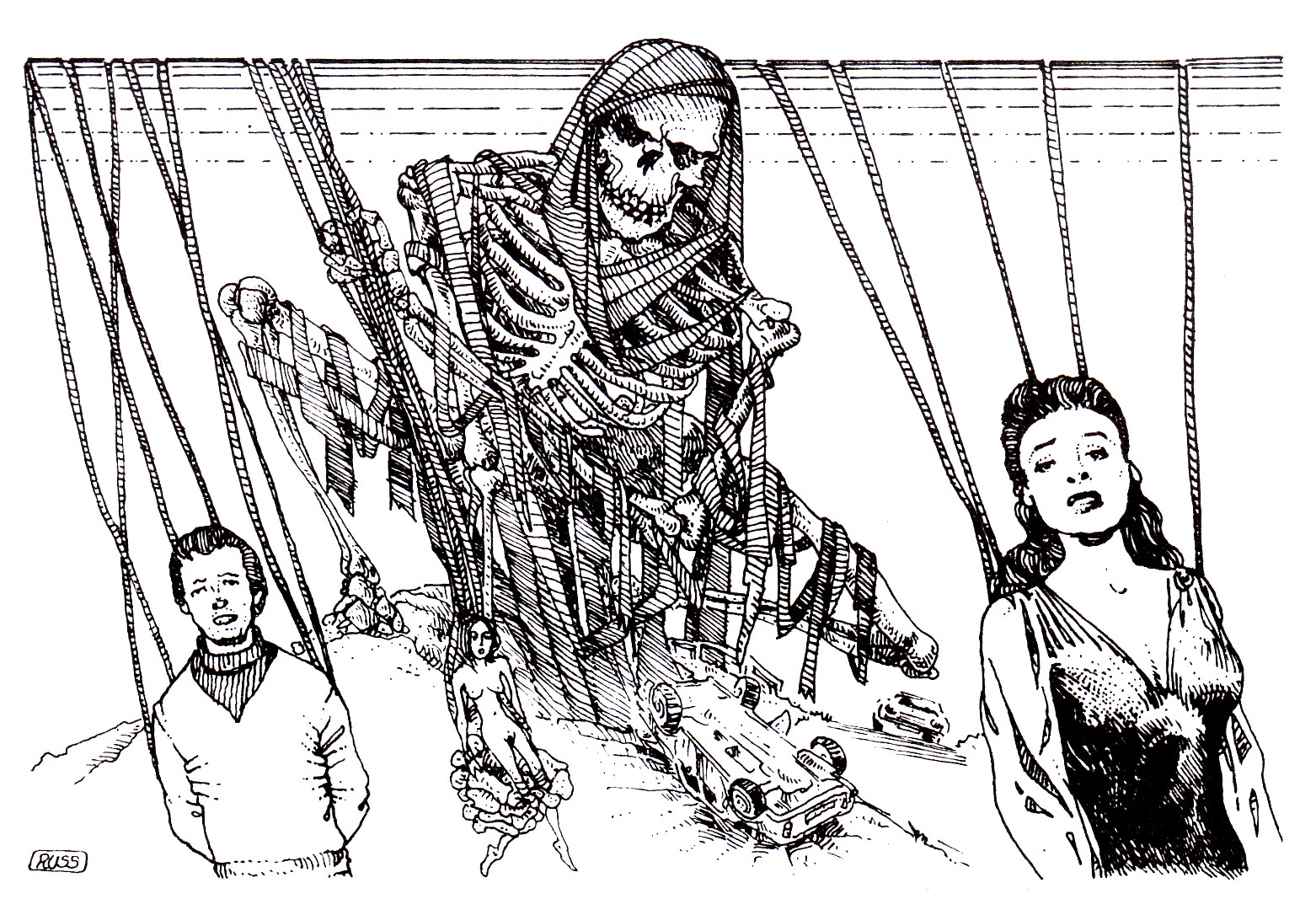
It’s impossible to imagine the Fabled Lands without the involvement of Russ Nicholson, who died this month. His filler drawings are my favourites, little vignettes necessary for gamebook layout so that options don’t spill over a page, but also perfect for evoking the ambience of each book’s setting. He always put something extra into all the pictures: comic book style inserts, fragments of unknown scripts, characterful onlookers in the background of a scene, a thousand touches that convey personality, colour, humour and reality.

For some reason we had a struggle getting the Pan Macmillan art director to let us use Russ for the world maps. They had a different illustrator lined up but, as you can see by comparing the first four FL books with the last three, Russ’s cartography was streets (and forests, and mountains) ahead. In FL book 3 they printed the two halves of their map the wrong way round, at which point they admitted that maybe we’d been right all along and Russ should handle it.

I put a personal tribute to Russ on my Patreon page (unlocked) and I asked other members of the Fabled Lands team to contribute their memories. Here’s Paul Gresty:

“I first met Russ in 2010, when I was his interpreter at a gaming event in Paris. He’d illustrated many, many books that I owned and loved, and I was incredibly excited to spend a weekend with him. Throughout that event, Russ was interesting, and kind, and humble; whenever a fan of his work asked him to sign a book, Russ also took the time to draw an illustration in there, too.

“At some point that weekend I asked Russ if he’d sign a copy of Citadel of Chaos for me. I was expecting a signature, and perhaps a quick sketch. Instead, Russ took the book back to his hotel room so that he could spend some time on a picture. When he returned the book to me the next day he’d drawn a phenomenal illustration (an axe-wielding warrior and a dragon) right across the book’s copyright and title pages – and he actually apologised that it wasn’t as good as he’d hoped. The paper in the book wasn’t ideal for ink drawing, he explained; the ink had bled on the page a little. I guess that’s an artist term. Bleeding ink or not, I was overjoyed with the illustration.

“I’m happy and grateful that I was able to work with Russ after that, and to meet him in person a few more times. He was a creative powerhouse, and a joy to be around. Incidentally, it was Russ who introduced me to the Fabled Lands books, showing me a book that somebody had brought for him to sign. He (correctly) told me I’d enjoy reading them.”

Jamie Thomson adds:

“A sad loss indeed, both personally and professionally. I remember meeting him in our White Dwarf offices a few times way back when, just a nice guy and so talented. Iconic game book and WD illustrator. I guess the ink blot story is my favourite. He was doing a Fabled Lands map and blotted it by accident. Me and Dave immediately came up with 'The Hole in the World' so it looked like it was deliberate. Well, I think we did, maybe it was Dave or Russ that came up with it, I can't remember. Anyway, there were quite a few things that we added to the stories and the lore that came from Russ; he inspired us too.”

At first I wasn't sure about Jamie’s recollection there because Russ's world map for FL didn't appear in print until books 5 and 6, so how come he drew the Hole in the World before anyone else? It's probable that he drew his own version of the world map right from the outset in order to have a context for the regional maps in each book. It's typical of Russ's boundless enthusiasm for and professional pride in his work that he'd do that even without a commission from the publisher. He improved every idea we gave him. He was our Jack Kirby, our Billy Preston, the Eno to our Roxy Music. As film directors value a great cinematographer, we valued Russ – as a good friend as well as a collaborator. He won’t just be missed, he’s irreplaceable.

He leaves behind his partner Jacqui. His wife, I should say, as they had planned to get married while Russ was in hospital, only he got moved to another ward which couldn’t accommodate a bedside ceremony. Had he come home I’ve no doubt they would have had the wedding then, but sadly he died in hospital. Fans will remember him fondly, friends with love, but the real wrenching loss is Jacqui’s.

However, as long as we have Russ’s art we can still see the expression of his personality. In that sense he’s with us always. Here is a small selection of illustrations by him that you might not have come across before.

This from the summer 1978 issue of Fantasy Tales:

This from A Dying Trade:


A sample page Russ did for The DFC:

Two more sample pages for The DFC, this time for the John Blake strip:


A test page for Mirabilis, because in the early days we thought Leo and Martin would be too busy on the gazetteer book to handle the comic strip chores as well:

Layout page for “Rich and Strange”, one of several Mirabilis standalone stories I wrote to run in The Guardian newspaper:

(Only one story, “A Wrong Turning”, was ever fully illustrated, and that by Martin McKenna whose loss we also mourn.)

Part of the layouts for the Camelot Eclipsed comic book (originally The New Knights of Camelot):

Some concept art for Shadow King:


A rough that Russ prepared for A Town Through Time, a project we pitched without success to publishers in the late ‘90s:


You can see how much on-spec work an artist has to produce in order to nab a few paying gigs. And this is just the tip of the iceberg. Here's another -- Russ's drawings for the Conquerors game.

Friday, 19 February 2021

Gamebooks are growing up

Some gamebook news today, and here's one that ought to be of interest to Fabled Lands readers. Apart from the Steam Highwayman series (excellent and highly recommended btw) there haven't been a lot of open world gamebooks, in the sense of giving complete freedom to travel where you want, go back and forth without limit, and pick up whichever quests appeal to your character. But here's a new one called Alba with a post-apocalyptic setting, and it must be doing something right because in fund-raising terms it has far surpassed other print gamebooks (open world or linear) of recent times.

I haven't seen the book myself, but from the Kickstarter page it looks like it has a lot of legacy game elements such as stickers that mark items or locations on the map. (And to think players used to grumble about having to tick boxes in Fabled Lands books back in the day.)

The writing style is of  higher quality than the purple prose of yore, and it looks as if the blocks of prose between choices are longer, making this more of a weighty novelistic experience than a CRPG in book form. Think Telltale Games' The Walking Dead rather than The Witcher. Here's the author, Harley L Truslove, talking about the books.

One obvious difference from old-style gamebooks is that in Alba your character can't die. That's a gripe about FL that we still hear. Somebody on Facebook recently was disgruntled because the skeleton pirates in Over the Blood-Dark Sea had carted them off to a life of undeadtured (sic) servitude with no hope of resurrection:

It used to be that whatever happened to you was part of the story, even when that story ended in tragedy and/or horror. But those were times when PCs in roleplaying games might get killed at the drop of a bascinet, and when we could reasonably expect Bucky to stay dead. We're in different times now, and Jamie and I have taken that on board with our new Vulcanverse gamebooks, which should eventually consist of around a 4000-section adventure in which you cannot die permanently, not even if the Furies and Nemesis team up against you. The worst you'll suffer is being sent to the naughty corner (aka Tartarus) for a brief spell.

I'm being facetious, but the Don't Kill Me players are right. A single-story game (Heart of Ice, say) shouldn't require trying-&-dying till you find an optimum path through. Every time the PC snuffs it in a book like that it's a failure on the writer's part. And even in an open-world gamebook, where death might be the appropriate ending for a given character's story, it can't just be random and unavoidable. Good god, that would be too much like real life.

But it's not just the legacy features and the immunity from death that have propelled Alba to unprecedented success for a print gamebook. The main difference is that it's not the usual hokey old '80s-era D&D kind of fantasy, but instead a vivid, gritty and character-driven narrative in a setting that feels contemporary. (The excerpt is quite well-hidden on the Kickstarter page, but you can download it here.) If Alba was a TV show it'd be a talked-about cable drama, whereas most gamebooks would be a cheaply-animated Saturday morning cartoon that you dimly remembered from your childhood.

In the '80s heyday of CYOA and Fighting Fantasy, gamebooks were hugely successful. Pretty much every series was guaranteed to sell in the tens of thousands per territory. Gamebooks could still matter to a sizeable readership if they moved on from their origin as kids’ books. Interactive stories like The Walking Dead can deal with whether you’ll commit murder to save a friend. Firewatch can tackle loneliness and hope. In games from Assassin's Creed to Bioshock the player is confronted with real feelings and choices more intense than any movie.

And meanwhile gamebooks* are mostly still about which key opens which chest or which item will defeat the Big Bad. Who cares? Crosswords and sudoku already have the puzzle market covered**. It's time for gamebooks to grow up the way that computer games have. That's what makes Alba exceptional. It's about an emotional journey, as all the best stories are. Only connect, that's the way forward.


* Print gamebooks, that is. For some time now Choice of Games have been producing interactive stories with more depth in digital book format, not the least of their titles being The ORPHEUS Ruse, a superbly gripping adventure by our own Paul Gresty.

** Unless you go full-on puzzle book, that is. I'd probably quite enjoy something like Journal 29, but it has stripped out all the story. And Alex Bellos's column in The Guardian satisfies my brain-training needs.

Monday, 2 November 2020

Martin McKenna


Martin McKenna has died at the age of 51, and it's a loss not only to his friends and colleagues but to everyone who appreciates the work of a master craftsman with a matchless imagination. There's too much to say here, just now when the shock is still raw, so I'll pass you over to my wife's newsletter in which she describes how we heard the sad news and an account by Martin himself from happier days.


Friday, 2 December 2016

Joe Dever (1956-2016)

Joe Dever died this week. I'm not greatly familiar with his work, but if you're a fan of gamebooks then you will already know much more than I could say anyway. He wrote what must be the most epic gamebook saga ever, and he was probably the first to use an original and fully detailed campaign setting and an ongoing character across multiple gamebooks. A true pioneer of the medium.

We didn't know each other very well. He wasn't part of the roleplaying social circle that included me, Jamie, Oliver Johnson, Mark Smith, Paul Mason and Steve Williams. Joe and I chatted a couple of times back in the '80s about gamebook ideas, but our paths had never crossed before that at Games Workshop, where he and Gary Chalk were working when they came up with Lone Wolf.

Gamebooks were big business then and every publisher was desperate to have their own series or three. I admired the solid design that Joe and Gary put into the underlying mechanics - the clear rules for where inventory was listed on the character sheet, things like that.

There's a tribute to Joe Dever over on Stuart Lloyd's blog and Paul Gresty has written this fan's-eye view of Joe Dever's work, a heartfelt paean to the priceless gift of fantasy that a good author can bestow.