Gamebook store

Showing posts with label The DFC. Show all posts

Friday, 26 May 2023

He showed us marvels

It’s impossible to imagine the Fabled Lands without the involvement of Russ Nicholson, who died this month. His filler drawings are my favourites, little vignettes necessary for gamebook layout so that options don’t spill over a page, but also perfect for evoking the ambience of each book’s setting. He always put something extra into all the pictures: comic book style inserts, fragments of unknown scripts, characterful onlookers in the background of a scene, a thousand touches that convey personality, colour, humour and reality.

For some reason we had a struggle getting the Pan Macmillan art director to let us use Russ for the world maps. They had a different illustrator lined up but, as you can see by comparing the first four FL books with the last three, Russ’s cartography was streets (and forests, and mountains) ahead. In FL book 3 they printed the two halves of their map the wrong way round, at which point they admitted that maybe we’d been right all along and Russ should handle it.

I put a personal tribute to Russ on my Patreon page (unlocked) and I asked other members of the Fabled Lands team to contribute their memories. Here’s Paul Gresty:

“I first met Russ in 2010, when I was his interpreter at a gaming event in Paris. He’d illustrated many, many books that I owned and loved, and I was incredibly excited to spend a weekend with him. Throughout that event, Russ was interesting, and kind, and humble; whenever a fan of his work asked him to sign a book, Russ also took the time to draw an illustration in there, too.

“At some point that weekend I asked Russ if he’d sign a copy of Citadel of Chaos for me. I was expecting a signature, and perhaps a quick sketch. Instead, Russ took the book back to his hotel room so that he could spend some time on a picture. When he returned the book to me the next day he’d drawn a phenomenal illustration (an axe-wielding warrior and a dragon) right across the book’s copyright and title pages – and he actually apologised that it wasn’t as good as he’d hoped. The paper in the book wasn’t ideal for ink drawing, he explained; the ink had bled on the page a little. I guess that’s an artist term. Bleeding ink or not, I was overjoyed with the illustration.

“I’m happy and grateful that I was able to work with Russ after that, and to meet him in person a few more times. He was a creative powerhouse, and a joy to be around. Incidentally, it was Russ who introduced me to the Fabled Lands books, showing me a book that somebody had brought for him to sign. He (correctly) told me I’d enjoy reading them.”

Jamie Thomson adds:

“A sad loss indeed, both personally and professionally. I remember meeting him in our White Dwarf offices a few times way back when, just a nice guy and so talented. Iconic game book and WD illustrator. I guess the ink blot story is my favourite. He was doing a Fabled Lands map and blotted it by accident. Me and Dave immediately came up with 'The Hole in the World' so it looked like it was deliberate. Well, I think we did, maybe it was Dave or Russ that came up with it, I can't remember. Anyway, there were quite a few things that we added to the stories and the lore that came from Russ; he inspired us too.”

At first I wasn't sure about Jamie’s recollection there because Russ's world map for FL didn't appear in print until books 5 and 6, so how come he drew the Hole in the World before anyone else? It's probable that he drew his own version of the world map right from the outset in order to have a context for the regional maps in each book. It's typical of Russ's boundless enthusiasm for and professional pride in his work that he'd do that even without a commission from the publisher. He improved every idea we gave him. He was our Jack Kirby, our Billy Preston, the Eno to our Roxy Music. As film directors value a great cinematographer, we valued Russ – as a good friend as well as a collaborator. He won’t just be missed, he’s irreplaceable.

He leaves behind his partner Jacqui. His wife, I should say, as they had planned to get married while Russ was in hospital, only he got moved to another ward which couldn’t accommodate a bedside ceremony. Had he come home I’ve no doubt they would have had the wedding then, but sadly he died in hospital. Fans will remember him fondly, friends with love, but the real wrenching loss is Jacqui’s.

However, as long as we have Russ’s art we can still see the expression of his personality. In that sense he’s with us always. Here is a small selection of illustrations by him that you might not have come across before.

This from the summer 1978 issue of Fantasy Tales:
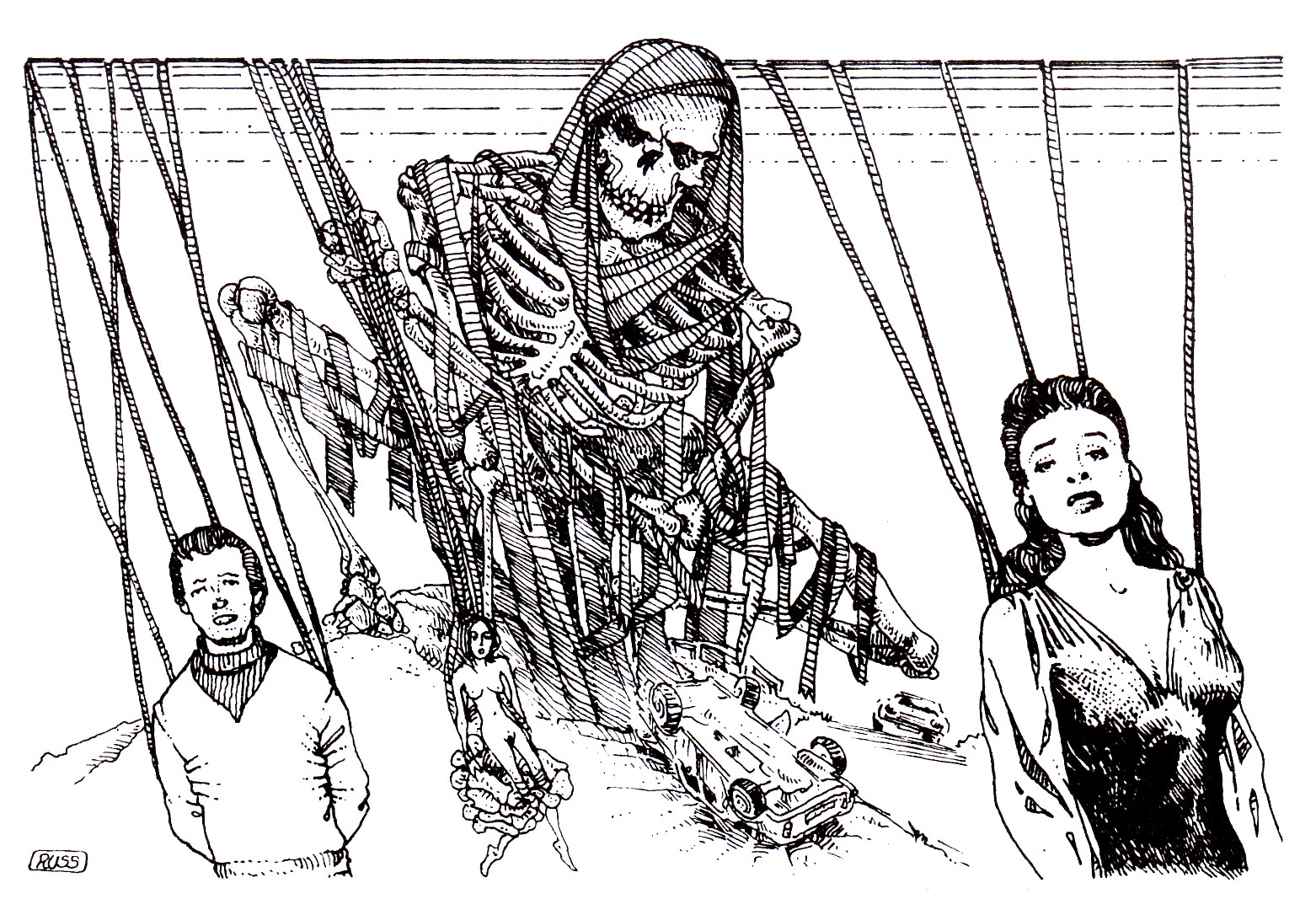
This from A Dying Trade:


A sample page Russ did for The DFC:

Two more sample pages for The DFC, this time for the John Blake strip:


A test page for Mirabilis, because in the early days we thought Leo and Martin would be too busy on the gazetteer book to handle the comic strip chores as well:

Layout page for “Rich and Strange”, one of several Mirabilis standalone stories I wrote to run in The Guardian newspaper:

(Only one story, “A Wrong Turning”, was ever fully illustrated, and that by Martin McKenna whose loss we also mourn.)

Part of the layouts for the Camelot Eclipsed comic book (originally The New Knights of Camelot):

Some concept art for Shadow King:


A rough that Russ prepared for A Town Through Time, a project we pitched without success to publishers in the late ‘90s:


You can see how much on-spec work an artist has to produce in order to nab a few paying gigs. And this is just the tip of the iceberg. Here's another -- Russ's drawings for the Conquerors game.

Friday, 29 October 2021

Commuting by catapult

Mirabilis, my fantasy graphic epic with Leo Hartas and the late Martin McKenna, originally appeared in The DFC, a short-lived forerunner of The Phoenix comic. A friend of mine read it on the sleeper train out of Moscow as he was travelling home just before Christmas -- pretty much the perfectly immersive experience.

You can read Mirabilis online here and dive into the background here and here and here. As you can probably tell, it was a labour of love and if I could finish it I would, only the world doesn't owe me a living. (Sadly.)

As part of the very extensive world-building for Mirabilis, I wrote the correspondence of the Royal Mythological Society in a little booklet called A Minotaur At The Savoy. So that's fifty whimsical vignettes of green comety weirdness that, if you're starting to think about gifts, would fit quite neatly into a stocking. But then, I would say that.

The stories range from a mysterious giant hand found in a wood in Yorkshire to the best way to deal with a dragon that's taken a shine to the gold reserves of Fort Knox, and although it's hard to pick one that can be described as typical, this will give you a taste of what to expect:
Dear human savants 
Following a motion of no confidence in the prime minister, I find that my Martian Party has enough seats in the House of Commons to form a new government in coalition with the Liberal Unionists. The only sticking point is that, as you may know, my prospective allies are committed to a very specific agenda. Their three-point plan entails establishing a minimum wage, giving women the vote, and maintaining the unity of the British Isles - whereas the Martian Party is pledged to subjugate the planet Earth, replace corn with red weed as the staple carbohydrate dietary supplement, and ship a million slaves to the helium mines of Phobos. 
As a compromise, I have agreed to defer mass enslavement for the term of the current Parliament, concentrating instead on domestic transport policy as an area of common ground on which our two parties can agree. For example, to alleviate the growing problem of “rush hour” congestion at the major London rail terminuses, we propose loading commuters onto massive catapults which will fling them across the city to land in collection nets near to their place of work. We estimate this would save at least seventy thousand man-months of labour per year. However, some of our advisors believe that it will not be a popular measure and could lose us votes at the next election. What do you counsel? 
Yours, the Right Honourable Xangovar the Merciless, OBE, c/o the Palace of Westminster
Prof Bromfield replies: It would be very popular with small boys. Unfortunately, they don’t have the vote. Might be a better world if they did, if you ask me. 
Dr Clattercut: Oh yes. Because resolving international disputes with conkers matches is obviously the way to go. Pulling girls’ pigtails when they demand enfranchisement. Declaring the whole of January a national tobogganing holiday. Making marbles the official currency of the Bank of England… 
Prof Bromfield: You think you’re being wittily scathing, Clattercut, but in fact you’re just proving my point. So that’s what I’d suggest, Mr – er, Xangovar: shake up the Cabinet a little. Bring in some schoolboys and artists and poets and whatnot. Be more radical with your reforms, if anything. This is the Year of Wonders, so what’s wrong with sprinkling a bit of magic on the tired old machinery of politics? Trust me, the electorate will thank you for it. 
Dr Clattercut: Those that land in the nets, anyway.


Have a great Samhain/Halloween! And if you're looking for strange stories in a very different vein from Mirabilis, don't forget to take a look at the Binscombe Tales.

Friday, 13 July 2018

Why sharks get jumped

Maybe one reason why I enjoy role-playing campaigns is because I came early to episodic stories. Long before discovering my great love, comic books, I was glued to Doctor Who and big books of Norse myths. The weekly UK comic TV Century 21 (which I collected from the second issue; it was always just “TV21” to me) presented all those Gerry Anderson shows as taking place in one universe, which fuelled the idea that stories don’t have to have an end.

But that’s for kids. The Norse myths mirror the dramas of childhood, where massive fallings-out and reconciliations can happen in the space of a summer’s afternoon and we don’t mind that each morning is a chance to reset the games and interests of the day before.

As we get older, we demand that stories go somewhere. Things must change. And that’s where they can go wrong, because if you’re going to have change you must also have an ending. When a story is forcibly kept going beyond its natural life, the shark is going to be waiting and one day you must jump it. And then we end up wondering what we even saw in that setting and those characters in the first place.

Breaking Bad and The Shield were designed right from the start so that their narrative trajectory would have an end. Likewise the Harry Potter novels. The Sopranos was originally expected to run for a single season, hence the frenzy of plotting in the twelfth and thirteenth episode when commercial success demanded a jolt of boosterspice. I’d rather have had one perfect season myself. A good show should build in its own Hayflick limit.

What goes wrong with an indefinite run? There’s the escalation of dramatic twists. Take Cracker, Jimmy McGovern’s seminal ‘90s TV drama that started so well. After a time, story logic demanded that the danger Fitz and his colleagues tackled would have to strike close to home. But once we’d seen the team sprint to Fitz’s front door once, the next shock twist had to be bigger. One police officer raped another, and then jumped off a roof. Fitz’s family began to be threatened on a regular basis, until finally his son was targeted by a serial killer who strapped him to an electrified bedstead. He was saved from electrocution in the nick of time. If the show had continued, the only place left to go would have been strapping a bomb to the baby’s pram.

Drama isn’t an Escher staircase. You can’t keep upping the threat. But once you succumb to the understandable urge to grab audiences with a big shock, where else can you go? The Doctor has to save the universe every season, and it has to be from a bigger and badder threat, and the personal secrets revealed (or cooked up) have to be ever more profound, ever more earth-shattering. It’s like taking a hit of heroin. You think it’s the answer to everything, but the doses get bigger and eventually you’re going to OD.

But just as toxic as escalating threat is the self-referential archness that creeps into the writing on a long-running series. It’s narrowcasting, as each instalment calls back to events that only the diehard fans remember – and those fans are the ones who wriggle and giggle at every knowing quote, while the rest of us just wonder why the characters are behaving like they’re in a pantomime.

When I began my comic Mirabilis, it was with the intention of telling the story of a single miraculous year. “Everything will change,” was the logline, because it would. Before the green comet appeared, it was the real historical 1901 – no vampires, no steampunk. Then there’s a year of wonders. One year. When the green comet departs, we’re back to the real world.

The first idea was to tell it all in fifty-two episodes, only they couldn’t have been fifty-two of the 5-page instalments that ran in The DFC. Fifty-two full-length comic books, maybe. Then I could tell the story. But it would still reach an end.

“Unless it’s a huge success,” said the publisher, David Fickling. “Then you’ll have to come up with more story.”

“After the comet goes we’re back to a non-fantastic universe, so there’s nothing more to tell.”

“You can just invent a new reason for there to be fantasy, can’t you?” asked Mr Fickling, flinging up his hands.

“Uh-uh.” I can be pretty stubborn in defence of what I see as creative honesty. “The whole point is that on either side of the year of the comet this is the ordinary world. The story is told. It’s over.”

Of course, having an end in sight doesn’t guarantee the writer won’t jump the shark before they get there, but it does at least let them plan out the gear-shifts of surprises and reversals so that they don’t have to start competing with their own ideas to keep the thing moving. And they can be fairly confident that they’ll never get so bored with the characters that they start having them talk with, as it were, repeated winks to the reader.

Have you been disappointed when a favourite TV show, comic book, or series of novels jumped the shark? How would you have fixed the problem? Don't say, "Get a bigger boat."

Friday, 2 September 2016

A fresh start for the Year of Wonders

I resisted Facebook for the longest time. It’s not that I don’t like tech, I just don’t care for people that much. (Only kidding. I like people just fine. It’s the pet photos and soccer chat I wanted to avoid.)

Finally I’ve had to succumb, and the reason is that Leo Hartas and I needed to set up a Facebook page for our comics saga Mirabilis: Year of Wonders (If you need a this-meets-that, try Tintin hunts Fantastic Beasts with a soundtrack by Danny Elfman).

This is part of our big push to get the Mirabilis project moving again. The story was originally serialized in weekly British anthology comic The DFC, published by Random House. When The DFC folded, our story was left unfinished but our rights were tied up in a complicated contractual tangle. It took me months of increasingly desperate negotiation to find a way out of that limbo, made all the more fraught by the fact that none of the people involved in the mess would even return my calls. Luckily I knew Philippa Dickinson, the original publisher of Dragon Warriors and one of the truly nicest people you could hope to work with, who by now had risen to be the head of RH’s children’s publishing division. She pulled strings with the powers that be and got me and Leo our rights back.

Thus unfettered I could stop chewing my nails, but it was still far from plain sailing. We secured a publisher for Mirabilis, but though they did a beautiful job of the production they failed to get copies into any shops. I had to lug a couple of bags stuffed with copies to the Gosh! Comics store in London – if you bought one of those, hang onto it like a Penny Black with Queen Vic in a hipster beard, because they were almost the only copies that ever saw the light of day. The rest, I hear, went astray between the printer (in Bosnia) and the distribution warehouse (in Lancashire) and may now be propping up wobbly café tables somewhere in Germany.

So, back to the drawing board. A comics publisher reached out, but the deal they offered was like a handshake from Don Corleone. We were expected to sign over all rights in perpetuity to them, even though there was no obligation for them to keep the book in print. After the epic struggle with Random House there’s no way Leo and I could accept terms like that. As a creator, all you have is your work. You can't let other people lock you out of it.


What about Random House themselves? Well, Philippa had retired by this point, and the mildest way to put it is that having escaped the clutches of the contract we didn’t really have a lot of friends there. We were in our gulag and, at any other time in history, there we might have stayed. But this is the 21st century, right - with social media and crowdfunding and shit. So Leo and I have spent the last few weeks getting ready for a full and concerted relaunch of this mighty fantasy saga. Our plans include:
  • a Patreon page where aficionados can come and pledge as little as $1 a month to help fund new instalments. Pages of the comic go up there Mondays and Fridays with higher-level backers getting access to backstage blog pieces and other goodies.
  • a new website where everyone can read the comic absolutely free – just a little way behind the paid-up supporters on Patreon, who also get higher-res versions of the art.
  • the aforementioned Facebook page where you can get updates on Mirabilis and any other books, comics, movies or games that we thing might interest you.
  • a Twitter account with daily instalments of the comic.
And we’re toying with the idea of a Kickstarter to fund a Mirabilis gamebook. Or app. Maybe a boardgame. Possibly all three and - I dunno, a roleplaying game too? The Patreon backers may get a say in that. The exciting thing is that it's a community where everyone gets a voice.

Here’s the thing. We could really use your support – which is, after all, the whole point and rationale of what we’re trying to do now. We’re bypassing the publishers and distributors and going straight to the people whose opinion and backing count most. That’s you, we hope. The readers. Already we've got backing from Jason Arnopp, the 21st century's Stephen King, from the Jedi Master of gamebooks Stuart Lloyd, and from musician, artist & game designer Frazer Payne, among others. Good company to be in, and an absolutely priceless vote of confidence when we're starting a new venture like this. Thanks, guys.

If you can spring for a few dollars to actually fund the work, then you’re our BFFs till the sun dies – but even if not, a like on Facebook costs nothing and can really help boost interest. You never know, this could be the beginning of a beautiful friendship.

Friday, 20 July 2012

Mirabilis Year of Wonders book 2


Gearing up for the (hopefully) imminent release of Volume 2 of Mirabilis, my ongoing comic book fantasy epic, here is an online preview of the first ten pages. New to the party? In that case, you can see how the story starts with the first 30 pages of Volume 1 online here.

If it's your cuppa, you can still order the gorgeous hardcover edition of Book 1 here and you can pre-order Book 2 here. And the paperback edition is available here.

Thursday, 10 March 2011

The unforgiving muse

Simon Cornish is an artist, animator, RPG designer and writer who was part of the heady company who originally contributed to the launch of UK comic The DFC, soon to be reborn as The Phoenix.* Which was why we happened to meet up at the official unveiling party at David Fickling Books in Oxford last week.

I haven't played in Simon's role-playing world of Tefr yet, but Leo Hartas is a regular and he tells me great things about it, so next time I head over to the West Country to work with Leo on our Mirabilis comic, I'm hoping to join in a session. Tefr by all accounts is a richly detailed setting with (unusually for RPGs) a real theme and story point to it. Luckily I won't have to just plunge in unawares, as Simon has laid out a wealth of great gaming material on his Tefr website. There you can read about the world, get free ebooks of the rule system, or just marvel at Simon's frickin' awesome maps and artwork.

It makes a big difference that Tefr has been created by a skilled writer and artist. The setting isn't just a backcloth for random escapades, it's a classic story-set up with conflict and a problem for the protagonists to deal with. The hook could be the pitch for a movie or ongoing TV show:

You were born into a strange land, a world steeped in history and shaped by ancient strife, a place where rumours of magic and mythical creatures have the ring of truth to them. You'd rather not get involved in such matters; you want to stay home with your family and friends. But you have a problem; they say there is something wrong with you. You have a god's curse upon you, which makes you different: stronger, harder, scarier. Your family and friends no longer want you near them. Some would even want to harm you. If you don't want to become an outcast, your only choice is to join the Kerowan Guild and follow the only profession allowed to those cursed by the gods: become a sword for hire; expendable and despised, but better the jackal than the hare.
Now, I'd like to say that none of the above has anything to do with the fact that Simon is an old friend and Mirabilis fan and he just gave our comic a nice plug on the Fantasy Faction forum. But if you doubt me, hop over to the Tefr site, grab all those freebies and give it a go. It could be just the jolt your role-playing sessions have been looking for.


(* Well, sort of - the new comic is edited by DFC helmsman Ben Sharpe and published by the irrepressible David Fickling, but in fact it's a whole new fabulous beast and nothing to do with Random House's original venture. Just wanted to be clear about that.)