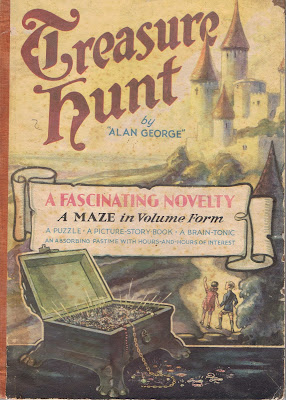
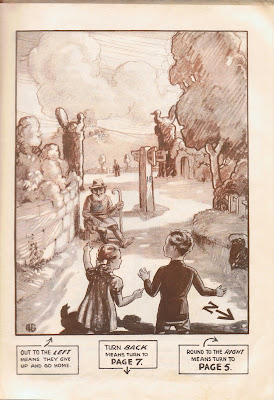
I knew gamebooks dated back much further than Choose Your Own Adventure and Steve Jackson's Melee and Wizard solo games. I used to play educational logic "gamebooks" back in the early 1960s. But it turns out that "Alan George"'s Treasure Hunt not only anticipated all that by a further two decades (it was published in 1940) but also sort of pioneered the graphic novel gamebook genre that I thought Russ Nicholson and I had invented in the early '80s.
Much more up to date is a new(ish) open-world gamebook called Traquelero: A Quest for Happiness, by Othniel Poole. It seems pretty hard to get hold of, which is a shame as the concept sounds fascinating. No dice, no stats, just a character journey to explore. Effectively a walking sim in gamebook form? I'd like to try it and find out.
John Whitbourn remarked to me not so long ago that it was a pity we had to drop the comments on this blog for a while, because without them a spark had gone. I know exactly what he means. One of the main reasons I was a Marvel rather than DC fan was the sense of community that Stan Lee brought to the former, and a big part of that came from the lively exchanges on the letters pages.
But even while comments here were shut down I was still getting some feedback -- some of it bubbling up out of the moronic inferno of social media, and other communications (much more civilized) in real life, in emails, and on my Patreon page. John Jones, gamebook expert, valued consigliere and frequent correspondent, made an interesting point about themes in books and roleplaying games. He was talking about how White Wolf's World of Darkness used settings to convey themes and moods, for example Detroit in the '90s, with its theme of decayed grandeur and loneliness. "Detroit," John went on to explain, "was a city built for two million that at that time had 400,000 people or so living in it."
We discussed the themes of the Vulcanverse books, and John made some interesting observations:
"The Houses of the Dead is a little rough because it was the first book, but even there I can see a theme/mood of indifference. Charon knows the living aren't supposed to be in Hades, but the gods are asleep, so what does it matter? The philosophers debate endlessly at their foodless dinner until your character provides the picnic hamper. One of the Fates will give your character a favour for... a honey cake, because why not?
"The Hammer of the Sun's general theme/mood seems to be withering. Without the waters of the rivers, Iskandria is little more than a largish village. The Amazons are basically a largish bandit gang. Even the Sphinxes of the pyramids mostly just slumber in the heat, too weakened or indifferent to guard their homes, for the most part. Heck, Loutro, who knows the rituals of Tethys, will only accompany the character, not actually do the rituals himself.
"The Wild Woods' theme seems to be ruin, whether through specific actions (suppressing the rivers) or just general neglect. The bridge-nets for the catapult travel system are in disrepair. Fort Blackgate is a ruin, home to a vile giant. The Summer Palace, home of a powerless king, is in bad shape. Even the Great Green Ones are slowly dying, just like the child of the truffle hunter who is unwittingly killing them.
"The Pillars of the Sky's theme seems to be isolation. One of the few surviving minotaurs roams his labyrinth alone. The bosgyns live away from their men. Stuck in their Great Sinkhole city the Gargareans dwell on their own perceived superiority, which allows them to brutally mistreat their captives and attack others as lesser beings. Even Boreas, the north wind himself, is isolated and trapped in a frozen moment of time by the Uroboros Ring."
I like thinking about things like this, and John and I got to talking about the fifth book in the series, Workshop of the Gods. The theme there would be secrets – the hidden social traps, the societies and gangs, scheming individuals weaving plans, and the ultimate secret being: what’s behind the curtain?
Well, that's my notion of it, anyway. The actual answer might turn out to be be completely different from that.
The mood/tone is yet another question. I’m not sure how well my and Jamie's styles mesh these days, and would readers find that jarring if we each wrote half a book? The join might show in both style and theme. Every memorable IP in books, comics, TV, games, you name it, has a unifying theme that is the soul of the story, whether planned or otherwise. Take a look at your own favourites. Even if you haven't consciously dug down into the themes before, you'll probably find they've influenced you profoundly all the same.
At last, the moment we've been waiting for: the full release of the Fabled Lands CRPG on Windows and MacOS. After years of amazing work by Prime Games, this beautiful and immersive game is available for players to plunge into. The launch content includes the whole of the northern continent (FL books 1, 2, 4 and 5) with the Violet Ocean and Akatsurai to follow as downloadable add-ons.
This is the ultimate incarnation of Fabled Lands that Jamie and I dreamed of twenty years ago, when we pitched the FL computer game concept to Eidos as "characters exploring and adventuring across a gloriously coloured map of the world". It's been a long road, but Prime Games have brought that vision to life more vividly than we could ever have hoped.
How do you follow something as fantastic as this? Well, Prime Games still have a way to go with Fabled Lands -- including, perhaps, the southern continent. But as soon as I saw those tactical maps and started hurling some spells around, my first thought was how brilliant it would be to give Blood Sword the same treatment. Who knows?
'Do you remember a guy that's been in such an early song?' asked Bowie. Until reminded by a shout-out from Alexis Kennedy, I'd completely forgotten that in Dragon Warriors book 6 I included some advice on handling passage of time in a roleplaying session:
Very long journeys often mean that a game-time period of many months will be skimmed over in a matter of a few minutes of real-time. However, it is not in the best interests of the game to be too quick about this. A sense of the ludicrous may creep into a game where the GM says something such as, ‘You ride south through Algandy, spend a few days in Ferromaine where you charter a ship, then you sail across the Coradian Sea and down the Gulf of Marazid until you reach the mouth of the Mungoda River after about a month. You find a guide and bearers and make your way inland through thick jungle, finally arriving at the ruined temple Sengool told you about three months after you set out.’
Such an introduction is implausible and does little justice to the adventure that is to follow it. I recommend that you never spend less than half an hour gaming each campaign month. Something of interest must happen in that time. Devise a meeting with officials in Ferromaine – are the player-characters stung for duty tax, or wrongfully arrested by the city guard? Embroil them in a subplot which may take up the whole gaming session (though try not to lose the impetus of the main adventure in doing so). As a last resort, at least throw in a pre-planned but ostensibly random encounter.
One useful trick that allows you to move through game-time at an accelerated rate is by means of a film-like montage. Wait for the players to begin a discussion amongst themselves – a plan of action, an argument over spoils, or whatever – then run them fairly freely through their journey, interjecting briefly sketched events or remarks from NPCs, such as the ship's captain, at intervals to show that time is passing. As in a film, a few minutes’ action can thus be made to seem to cover days or weeks.
It's that montage technique that Alexis and Lottie were talking about, and it's very generous of them to give me the credit for it. I just swiped it from cinema, after all. But which filmmaker came up with it in the first place? It's almost but not quite what Welles uses in the breakfast montage in Citizen Kane. One flash of light but no smoking pistol -- where did he get it from? And who was the first to use it fully? By which I mean carrying on a continuous dialogue through a succession of scenes in which time is passing.
As with most fictive tricks, we can go right back to Shakespeare. He has two clocks, so to speak, running throughout Othello. (No montage there, obviously.) Montage as a cinematic technique predates dialogue, so at some point while cutting an early talkie it must have occurred to the director and/or editor that it would be neat to hold together the montage sequence with one voiceover or dialogue sequence. It's really just an extension of overtonal montage (a sequence of cuts linked by theme) which was well-established in the silent era. When talkies came along, some bright spark must have made the intuitive leap to using the dialogue as the overtonal glue. But who? Lev Kuleshov? Alfred Hitchcock? Don Siegel? In the absence of any further info, I'm going to have to bashfully submit to Mr Kennedy's attribution and call it the Morris Effect.
If you want to experience it in a game, the obvious pick is The Lady Afterwards, now available on Steam. If the story and game design are as gorgeous as the visuals (and Fallen London suggests they will be) then it's a must-have.
I'm filled with envy and admiration for what gamebook author Michael J Ward is doing with the crowdfunding campaign for the DestinyQuest world sourcebook. I couldn't produce such a beautiful-looking book and I certainly couldn't whip up that sort of exciting marketing frenzy.
The book is an illustrated hardback and the campaign goes live on Kickstarter on May 17. It includes:
A detailed history of the world, from its creation by the celestial Fates, to the current End Times of crumbling empires and war-weary kingdoms.
A comprehensive timeline that charts the key events that have shaped the world of Dormus, right up to the present-day narratives of the gamebook series.
An overview of the magic system, detailing the chaotic forces of the Shroud and the effects of its demonic taint, as well as the runic magic of the dwarves and the dangerous arts of elemental sorcery.
Character stories and biographies, exploring some of the key characters who have influenced the DestinyQuest world, including the legendary witchfinder, Eldias Falks, and the enigmatic archmage, Avian Dale.
Descriptions of the main factions that vie for power and influence within the kingdom of Valeron, from the secretive enclaves of the Arcane Hand to the scheming masters of shadow, the Nevarin.
The blurb promises: "Whether you are a fan of the DestinyQuest gamebooks or a referee looking for a new and immersive setting for your homebrew roleplaying campaign, the World Companion promises a wealth of exciting secrets and discoveries – everything you need for the epic adventures ahead."
Even more exciting (in my book, anyway) is that you can now sign up for the Fabled Lands CRPG beta build. That includes the whole of the northern continent and coastal waters -- with more to come.
Lastly, I was at Surrey University this week and somebody mentioned they'd had complaints about the lack of story nudges in an open-world game they had written. It's not just me, then. In days of yore, adventures began with an old guy running into a tavern to hand you a quest, and some players of Vulcanverse were irked to be just left to explore the world and find their own adventures, others were happy to uncover those stories for themselves. So as to cater for the former players I'm making sure that the fifth Vulcanverse book, Workshop of the Gods, has plenty of those proverbial old guys (or equivalent of other age/gender) to guide you on your way. If you prefer to be assigned quests and given plenty of hints, then, just be sure to start your adventures in VV book 5.
The way you choose to roleplay is up to you and your gaming group. Of course it is. But if you’re asking me, I don’t see the point of doing anything if you’re not going to commit to it heart and soul. Roleplaying to me means trying to be somebody else, imagining the reality of their life, and acting as they would. It’s fiction in the moment. And fiction is a parallel reality evoked by imagination that, while the spell lasts, should be taken as seriously as the reality we live in the rest of the time.
The road to Damascus ran through Keble College. It was 1980. I was running a Tekumel campaign and Paul Deacon, playing a pe choi called Keq Yossu, balked after hearing the lead-in to the evening’s adventure. ‘I’m not coming along.’
The others were aghast. ‘But… what are you going to do all evening, in that case?’
‘The whole set-up sounds off to me. You do what you like, but count me out.’ Paul dropped out of character a moment: ‘I’ll help Dave roll for the NPCs.’
It was the first time I’d thought of really getting into the head of a character that way. I admired Paul for it, and I admired him even more when he was proved right a few hours later. The whole party got wiped out. Paul imagined Keq Yossu getting the news back in Jakalla: ‘I did warn them…’
Not long after, in my Medra campaign, Mike Polling’s character Dagronel Kabo-Drasden befriended an NPC who was the sworn enemy of several of the other player-characters. When it came to the crunch, Dagronel sided with the NPC. In the game post-mortem, the other players were indignant. ‘You can’t value friendship with a nonplayer character above your comrades,’ they argued.
Mike pointed out that a roleplaying campaign is a fiction populated by characters. Nobody wears a lanyard saying PLAYER; it isn’t a Westworld style theme park with hosts vs guests. To use Professor Barker’s adage, there are no NPCs. Just characters. It’s only in bad fiction that somebody behaves out of character to ensure the plot goes in a pre-planned direction.
Both Paul and Mike are arts graduates, and it was an eye-opener for this scientist to see them insist on roleplaying as an art form. It was about then I started to eschew underworlds and puzzles. I should’ve known from Columbo that the how and the who are never as interesting as the why. Motivation is what matters. Characters who look at their world and say, ‘This is how it affects me and this is what I must do.’
Without that revelation, heaven knows what Dragon Warriors would have been.
I still come across the old-school approach, but these days it baffles me. A few years back I was playing in an SF campaign set in the Mass Effect universe. One character was a law enforcement agent. Some of the other PCs were rebels or pirates or – look, I don’t know anything about Mass Effect; in Firefly terms most were Browncoats and one was an Alliance officer. When it all kicked off, the agent sided with the local planet’s police and tried to arrest the Johnny Rebs.
Afterwards, one of the players in particular seemed to take it very personally – in real life, that is, not as his character. He went away seething. I asked a friend of his what was the matter. ‘He believes strongly in the players sticking together,’ he said. ‘He’s annoyed that player took the side of the police against the rest of us.’
‘But… what did he expect? The guy was playing a federal agent.’
‘He doesn’t think character should trump party loyalty.’
I honestly don’t know why you’d roleplay if you feel that way. Without commitment to character you might as well be paintballing. If you want PCs to stick up for each other, you have to give them a reason beyond the fact that they're all controlled by people sitting around the same table.
On the other hand, I also care that movies, TV drama and novels maintain integrity to the fiction they’ve created, yet a lot of people seem quite happy to excuse out-of-character swerves that are there to keep the plot on the rails the writer planned. To me that’s just not doing the work. It could explain why when I was a little kid and my school took us all to a Christmas panto it was loathing at first sight.
Everyone’s got their own setting on this dial. An it harm none, do as ye will. But what I want is to plunge right in to the imaginary lives we evoke through roleplaying, convinced there’s something amazing to be found there if just for a few hours we can let go of being ourselves.
Amazon sent me this link to stream The Wheel of Time on Prime Video. I've never even read the books, nor had any inclination to, but maybe that's an unfair prejudice -- although articles like this and moody TV promo shots like the one above only serve to confirm my suspicions. I just always assumed The Wheel of Time was another Tolkien wannabe and that the TV show was a lame attempt to turn a bunch of third-rate fantasy novels into a new Game of Thrones. Any fans of the series want to disabuse me of that notion? I'd settle for anyone who's looked at the books or the show and wants to warn others off.