There is no greater author of English weird tales alive today than John Whitbourn, and "Waiting For A Bus" is perhaps the eeriest of all his short stories. It has won a slew of awards and if you read it on Christmas Eve with the lights turned low, I think you'll see why. And after that, when the goosebumps go down and you can steel yourself to get up from your chair, take a look at the rest of the Binscombe Tales series.
Saturday, 23 December 2023
Strange encounters on Surrey lanes
There is no greater author of English weird tales alive today than John Whitbourn, and "Waiting For A Bus" is perhaps the eeriest of all his short stories. It has won a slew of awards and if you read it on Christmas Eve with the lights turned low, I think you'll see why. And after that, when the goosebumps go down and you can steel yourself to get up from your chair, take a look at the rest of the Binscombe Tales series.
Friday, 22 December 2023
Bring me pine logs hither
If you're going to have a seasonal roleplaying game there's not a lot of time left. No time to plan? For that last-minute gaming session, what could be more useful than this list of Legend adventures compiled by Lee Barklam on the Cobwebbed Forest website?
If gaming is off the table, you can read write-ups of our roleplaying campaigns in two books available exclusively to Patreon backers until Twelfth Night. I talked about these books in a post a while back, and here's your chance to get hold of them. I realize it might seem a little mercenary to mention Patreon in the season of giving, but you only need to subscribe for one month and you'll not only get the two RPG write-up books but the noughth draft of the Jewelspider rules as well as my Knightmare novels and a bunch of articles and adventure scenarios set in the world of Legend.
And to go with all that, Grim Jim Desborough has the Dragon Warriors stats for a number of weird and wonderful Yule monsters on the Postmortem Games site. (While you're there, why not buy a copy of Wightchester -- the very thing M R James would have been playing on Christmas Eve if he'd known about RPGs.)
Talking of Christmas Eve, I'll see you then...
Friday, 15 December 2023
Old liches never die
It's traditional around here to offer a Christmas freebie, and if Tim's magical adventure last time wasn't enough, here's another bauble for you. When Jamie and I revised our Fighting Fantasy gamebook The Keep of the Lich Lord to make it part of the Fabled Lands universe, I had to write a new way into the adventure that connected to FL Book 3, Over the Blood-Dark Sea. If you have the original FF edition, here's your chance to compare them.
One Way To Volunteer
Curious how events can acquire their own momentum. Drinking sherry with some of the scholars of Choronzon College, you happened to refer, with no more than the usual exaggeration, to some of your exploits in uncivilized parts of the world. In a company of explorers or soldiers your remarks would have gathered no special interest. Among scholars whose greatest adventures have been to the height of a rickety ladder in search of an old book, they created quite a stir. As word got around the college, students pressed into the door of the Warden’s study and climbed the ivied walls to listen at the window.
Realizing then the impression you had inadvertently given, you tried to backtrack: ‘I’m no legendary hero. There are many others with far greater experience of these things.’
Too late. The Warden of the college drew you to one side and asked you to attend a meeting the following morning. ‘You may be exactly the one we’re looking for,’ he said. Which are ominous words to take off to bed with you in Dweomer.
And so here you are in the Examination Hall, sitting at a long table made sticky with centuries of wax, in a room whose bluewood panels, dark as a beetle’s back, are feebly aglow in the sunlight that penetrates the high, dusty windows. Along the table with you sit city councillors of the great merchant ports of the mainland, nobles and army officers from Golnir and Sokara, the most venerable scholars of Dweomer, and even a masked ambassador from the secrecy-shrouded land of Uttaku.
And they are looking at you. You return a puzzled frown. ‘Can you repeat the question?’
‘I asked,’ says Admiral Lord Aspenor, who is chairing the meeting, ‘how much you knew of the naval defences of our lands.’
‘Ah.’ You pocket the knife you’ve been using to carve your initials in the side of the table. ‘No more than the average person. That’s not – ’
‘Not your area of expertise,’ puts in your patron, the Warden of Choronzon, who having brought you to the meeting cannot allow himself to lose face now. ‘Quite. An adventurer, you. An explorer. Risk taking. Bold action. Not sitting and talking…’
‘Yes, yes.’ Admiral Lord Aspenor raises a leathery hand. ‘Bold action is what we want, all right. Well, you will certainly know about the Reavers of the Unnumbered Isles. A law unto themselves, those pirates. Almost a rogue state. They even have their own “king”. There’s no formal alliance, but our fleets have always cooperated to hold them off the mainland. Yet each year they grow bolder. Coastal villages are raided for slaves. Merchant cogs are plundered and sunk within sight of port. For centuries Sokara, as the bulwark of civilization —’
A disgruntled murmur flits around the table. Aspenor looks ready to speak sharply, but a wild-haired figure in wizard’s robes leans forward. His quiet voice carries in the high-ceiling room. ‘Sokara’s fleet has often borne the brunt of Reaver attacks. We of Golnir acknowledge that.’
‘With ample contributions from the guilds of Metriciens and Ringhorn,’ puts in a velvet-coated merchant. But the others, having made a token expression of indignation, fall silent. And it’s now that you realize how serious this business must be.
‘Our main fortification to the east is Bloodrise Keep, on Stayng Island,’ says Aspenor. ‘It’s part of the Arrowhead archipelago on the western edge of the Unnumbered Isles. That archipelago is the first line of defence against any massed attack by the Reavers. But we’ve lost contact with the outlying villages and there has been no word from the castellan of the keep in several weeks. After his last report, we’re not exactly surprised.’
You take the scrap of parchment and glance at it:
Bloodrise Keep will shortly fall. The troops I sent to investigate the strange lights in the sky above the village of Menela have now returned. They have marched back to within sight of the walls but refuse to answer signals. A runner sent out came back shivering with dread. He got close enough to see that the men have bloodless faces and that their eyes are staring and blank. In place of their Sokaran battle-standards they now carry ragged black and yellow pennants – the symbol of plague. Even as I write, it is close to dusk and the enemy camp is astir. Troops are massing and people from the villages are also milling about the camp as though hypnotized. I can see a man in tarnished silver armour who appears to be in command. Now he has given the order for his troops to advance, There are too many, and with the small garrison I have left I cannot hope to hold them off for more than a few hours. I will send this report by messenger pigeon and hope it will not be shot down by the enemy’s archers. Now it only remains for me to take up my sword and go out onto the battlements for the last stand. I regret having failed in your service, my lords. I am your dutiful vassal, Braxis, Castellan of Bloodrise Keep.
‘A brave man,’ you say grimly as you hand the report back along the table to Aspenor. ‘Do you have any idea who the silver-armoured warlord might be, and how he took control of Braxis’s troops?’
‘It is all too clear,’ says Aspenor grimly. ‘Plague-standards and tarnished silver armour are the hallmarks of Lord Mortis of Balthor. He was formerly the tyrant of Stayng Island and tried to conquer the southern provinces of our nations. It took the combined strength of Golnir and Sokara to defeat him, for he was a necromancer as well as a warlord, and it is said that he reinforced his army each night with the bodies of fallen foes.’
‘When was this? I’ve never heard of such a war.’
‘Ancient history, that’s why. It all happened two hundred years ago. Mortis died in battle and was buried near the village of Menela, Now it seems that he has returned from the grave to try again.’
You nod. ‘It’s a good thing you’re all here to assemble an expeditionary force. I’ll be very happy to advise.’
‘It’s not so simple,’ says the Admiral. ‘Resources and manpower cannot be summoned out of thin air.’
‘Actually – ’ begins the wild-haired wizard.
Aspenor holds up his hand. ‘Thank you, Doctor Estragon, but I think we’d rather not be beholden to demons, devils or otherworld spirits. Not as long as there are other options.’ He fixes you with a smouldering stare. ‘Here’s where we stand. These wise gentlemen of Dweomer advise me that assassinating Mortis would immediately neutralize his army of undead. Cut off the head, you see. Our combined naval forces are tied up fighting the Reavers. My own country is also having to deal with rebel forces in the north. So, rather than spend weeks mustering and arranging transport for a large body of troops, it makes sense to send one capable individual. Of course, you’ll be on your own.’
‘Yes, right. The thing is, reports of my death-wish may have been exaggerated…’
‘Cold feet?’ mutters the Warden beside you, frowning. ‘Too late for that.’
The others agree. ‘Mortis is even now turning the people of Stayng into undead,’ says one of the guild-masters. ‘Unless it is excised, his evil will eat into our good rich lands like mould in a healthy apple. We have need of a sharp knife.’
‘What if I’m more the blunt instrument type?’ You’re wondering if it would be better just to walk out. To think that an idle boast at a sherry party could get you into something like this.
‘Telling means nothing,’ says the wild-haired Doctor Estragon. ‘You need to see.’
He taps his fingertips together. The slightest of gestures, but a sudden shift in pressure or light tells you that a spell has been cast. The motes of dust, hanging finely in wine-coloured sunbeams, seem to thicken and glow. Is that an image of castle turrets glimmering in the air? The edge of a coastline traced against the rafters? A ripple like the surface of the sea swims dizzyingly across a wall lined with books, making you sway in your chair as you try to focus on things that aren’t there.
‘Close your eyes,’ says Estragon. ‘The dust and sunlight merely comprise a matrix for the illusion. You will see more clearly with the mind.’
Yes. Against your eyelids: a V-shaped line of verdant islands set in an azure sea. You recognize the Arrowhead archipelago. The perspective drops towards the tip of the archipelago, the largest island, which points east to the Unnumbered Isles. In the north-east of the island, a fortress stands on a hillside overlooking Port Borgos. In the conjured light of Estragon’s illusion, the sun streaks across the heavens, falls like a crimson meteor, and thick shadows leap across the walls of Bloodrise Keep like the unfolding legs of a spider. Your view is carried in, closer, closer. A figure stands waiting on the battlements. Under his tarnished silver visor the face is dead white. The eyes –
You sit up with a gasp. The room is empty now apart from you, Aspenor and Estragon. ‘What was that? A dream?’
‘This is now the dream,’ says Estragon. ‘An illusion of your past, before you accepted the mission.’
You start to laugh before you realize that there’s nothing funny. You’d like to get up and leave. Maybe in a moment more.
‘This will help us keep in touch.’ Admiral Lord Aspenor flicks something and it rolls along the table. A silver ring. It comes to rest in front of you, spinning on its edge. The noise irritates you and you snatch up the still-spinning ring and put it on your finger.
‘So you think I’m going,’ you say to him. ‘Just because of a conjuring trick.’
He doesn’t blink. ‘You already have a map of Stayng Island. Also a purse of gold coins, in case you encounter any spies or agents who need paying.’
‘An illusion of the future. And that’s supposed to convince me?’
Estragon shakes his head. ‘What you saw in your head is the reality. This is the illusion now.’
‘What are you talking about?’
‘You’re there. You’ll wake up in a moment and see that you’re on Stayng Island. This conversation is a memory, that’s all.’
‘Really? What if I got up, walked out? Went south to Ankon-Konu and never saw either of you again?’
‘But you didn’t,’ says Aspenor. ‘You undertook the mission. You’re going to assassinate Mortis before he can join forces with the Reavers.’
‘Oh yes? And when did I make that choice?’
Estragon makes a gesture and the sunlight deepens to amber. The room is dissolving. ‘There was never a choice,’ he says. ‘Free will, that is the illusion.’
Aspenor rises from the table. ‘Don’t fail,’ are the last words you remember.
Now turn to 1.
Friday, 8 December 2023
Monsters, Aliens, and Holes in the Ground
If you're looking for a last-minute Christmas present for a friend who's interested in the history and cultural context of roleplaying games, MIT Press have just released Monsters, Aliens, and Holes in the Ground: A Guide to Tabletop Roleplaying Games from D&D to Mothership by Stu Horvath. (Now on sale from Amazon US, Barnes & Noble, Amazon UK and Blackwell's.)
It's not the kind of roleplaying analysis you tend to get here on the FL blog. What I like about playing RPGs is thinking and behaving as people unlike myself, and what interests me about roleplaying as an art form is that RPGs provide a medium for creating multi-person emergent narratives that are very different from old storytelling media with their three-act structures and whatnot.
This book comes at roleplaying from a whole other angle: the social history of the hobby along with a thorough analysis of its evolution. Gamebooks are discussed too. Be advised that Mr Horvath admits to not being fully comprehensive in his coverage; there are, indeed, holes in this ground. Empire of the Petal Throne, a big early release from TSR and a major event in original worldbuilding, is omitted because of accusations that M A R Barker held clandestine antisemitic beliefs. I have no tolerance for antisemitism myself, most especially not in view of the appalling rise in hate crime against Jews that we've seen in the wake of Hamas's terrorist atrocities on 7 October, but it is nonsensical to write EPT out of roleplaying history on that account. The art is not the artist, and the book is supposed to be a history of the hobby, not a teenager's diary. It would be like omitting Patricia Highsmith's novels from a book about the crime genre on the grounds of her antisemitism and prejudice against Black people (with the difference that Highsmith openly expressed such views). At least, thankfully, Call of Cthulhu is covered here, possibly not so much because the Cthulhu Mythos has had multiple contributors as because HPL's legacy is simply too influential to ignore.
Anyway, those are quibbles -- and frankly, while I was a big fan of Tekumel back in the day, I concede that Barker poisoned his own reputation by signing a deal with a neo-Nazi publisher (we won't get back into the unanswerable question of whether he was actually a sympathizer or just foolishly imagined he was playing them) and consequently if the rest of his work is going to get cancelled as collateral damage, knee-jerk though such reasoning usually is, Barker only has himself to blame. (Game designer Pauli Kidd makes some good points about the ensuing debate here. And if you are interested in how Empire of the Petal Throne fits into roleplaying history, here's a quick overview by Juhana Pettersson.) Meanwhile there are lots of other great roleplaying games to talk about, most of them written by unarguably decent and right-thinking folks, and Mr Horvath's well-researched and in-depth survey of the field should give you hours of interesting reading while you wait for the turkey to finish roasting.
The book does come with a pretty weighty price tag, but it sounds like it's worth it. A friend who bought a copy (he's much richer than I am) commented:
"The book is entirely commendable as an exhaustive archive save for the glaring omission of EPT. It’s a coffee table compendium and a fine gift."
I do have to point out, though, that on Christmas morning for just about the same money you could be unwrapping four Vulcanverse books or the whole Blood Sword series. Sadly there's no chance now of getting the Blood Sword 5e book this Christmas, which would have been my dream come true, but hopefully by next year... (Possibly. Maybe. Who's got the wishbone?) In the meantime let's all try and stay on Santa's Nice list.
Friday, 1 December 2023
"The Three Wanderers" (a Yuletide adventure set in Legend)
A treat my gaming group have come to expect (though hopefully never take for granted) at this time of year is a new Yuletide adventure by the multifariously talented Tim Harford. With Tim's permission I share last year's with you. Without further ado, then, here is:
THE THREE WANDERERS
On a windswept ridge in the Bleaks, visible from miles around, are three huge uneven black boulders, each at least four metres in diameter. Locals call these vast stones the Three Wanderers and will not approach. They say the three were fiends who haunted the hills in olden times, murdering travellers until they picked on the wrong victim, St Afric, and he turned them to stone.
More educated folk, of whom there are few locally, scorn the superstitions but warn travellers that those boulders are tombs, and that what was buried should not be disturbed.
Anyone who does get close to the boulders will see that there are crevices in them, perhaps just wide enough for a person to squirm through. Each crevice, however, is blocked by bars of iron, rusted but sturdy, and a chain with a silver cross is attached to the bars on each of the three rocks. It is hard to make out what, if anything, lies deeper in the crevices. Characters who shine a light down them may see a glimpse of bone, or sacking. Perhaps they will see movement – a rat, perhaps, or grass snake?
What lies within? One tale describes three sorcerers from Kaikuhuru, travelling west in search of the newborn Saviour. Some say they followed a silver moon that moved through the sky contrary to the motion of other celestial bodies. Others say they used an enchanted needle, a bone splinter hanging from a strand of a princess’s hair. Whatever the truth, they were led astray by some mischievous imp, and ventured to the wilds of Ellesland instead of the holy land. Dressed for the desert, they wandered in the northern rain and hail, vainly seeking the saviour until they perished from exposure.
Far from home, vengeful and bewildered, their spirits continued to wander the Bleaks until, centuries later, a Cornumbrian saint bound them and laid them to rest in a tomb that would contain their wanderings and their parched enchantments.
Such is the tale. What, then, when the characters approach the Three Wanderers to find the silver crosses missing, and the iron bars ripped out – from the inside?
Dramatis Personae
Crespin Thune – A wizard of no great accomplishment, but with a plan to use his limited talents to acquire the three legendary gifts of the Kaikuhuran wizards, and with those to rise in prestige and power.
Beatrice – a fallen woman. Beatrice is a serving maid (and prostitute) who works at Athgeld’s Inn, a traveller’s stop running to the south of the ridge. Crespin has paid her to serve the Saviour’s mother in his little play.
Sir Thunrulf – an aging knight, lord of Beeley Manor.
His cook, Pessimus Broil, is a blubbery mountain of a man.
Martin Marigold is the innkeeper at Athgeld’s Inn. He is famous for his hospitality, although the prices can be steep, especially for the unwary.
Grauves de Courtai – an upstart knight from Chaubrette. Crespin is paying him for assistance, but has also forged a letter purportedly from Baron Aldred declaring Grauves de Courtai the new lord of Beeley Manor. Grauves has six well-armed thugs in attendance, Hubert, Gaston, Anton, Charles, Hal and Fred.
The local devil, called Hob o’ the Well by locals. Hob is nine feet tall, with spindly arms and legs; when he drops into a crouch, however, he can conceal himself into a surprisingly small space, like a spider in the corner of a web. Hob has several uncanny abilities, including the power of illusion and the power to command animals, plants and the local weather. However he is vulnerable to the cross, and his stealthiness is sometimes betrayed by a faint reek of brimstone.
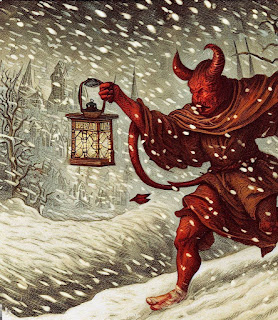
Old Katy Catkin, who earns a meal and room to sleep in exchange for cleaning and other chores around the inn. She works less and less and appears to rely more and more on the charity both of Marigold and of passersby. She is the most likely source of gossip concerning Hob o’ the Well and may also share gossip about Beatrice and Crespin (who has been paying with silver for her to attend him in his room). Katy has heard Crespin bragging to Beatrice about his plans and, unlike Beatrice herself, she has enough familiarity with folk magic to recognize the makings of a spell in their act of theatre.
Crespin’s plan
Crespin plans to break the locks that keep the three wanderers bound. He hopes to lure them to Athgeld’s Inn on Christmas Eve, where Beatrice will display her “baby” – actually a ghastly little scarecrow of daub and straw, with sky blue little robin eggs of eyes. Crespin has cast a spell over the “baby” to make it appear lifelike. This deception will, he hopes, induce the three wanderers to hand over their gifts to the infant they think is the Saviour. He can then use the three gifts as potent instruments when casting future spells.
The Wanderers
The three sorcerers are long dead, but their spirits live on, carrying a thousand years of rage and frustration. If addressed in the right way, they may recall their original pilgrimage to pay homage to a new spirit of hope in the world.
Calcifer retains the desiccated spirit of the Kaikuhuran desert; if roused to anger he strikes with hot sand and lightning. His visage is swaddled in dry sackcloth.
Shazz Ul Haq has grown a new eye each year since arriving in Ellesland. He now has nine hundred and ninety five, and to glimpse them is to go mad.
Grupus has adjusted best to the climate of Ellesland. He has become a master of mist, mire, and darkness. He is the most likely to stray far from the rocks and the party may encounter him while exploring.
The gifts
Calcifer’s gift for the saviour was a small handful of sand from the desert, in a box of ivory, a symbol of the endlessly shifting sands of Kaikuhuru and of his fealty.
Shazz Ul Haq had brought an orb of diamonds, each diamond showing a different vision of what may come to pass.
Grupus’s offering was an embalming unguent in a silver pot.
These treasures lack the awesome power that Crespin imagines and craves – their significance was largely symbolic. However, they have some value both as magical talismans and as saleable treasures.
Locations
Beeley Manor – a decaying manor house with a small study, a feasting hall, kitchen and larder downstairs, and a master bedroom and three small bedrooms upstairs. The house is fortified but vulnerable either to a determined assault or to an inside job, since there is a front door, a back door and a kitchen door.
Athgeld’s Inn – a large hostelry with a generous common room, a parlour with several snugs (where Grauves and Crespin prefer to have their conversations), a sweltering kitchen and half a dozen upstairs rooms. The Inn also has outhouses, storehouses, and a stable.
Saint Afric’s chapel – a tiny chapel on the steep slope above the road and beneath the great stones that locals call the Three Wanderers. It was Saint Afric who bound the ghosts of the three sorcerers and imprisoned them in cracks in the rocks. The chapel door is jammed – rust or ice? – but may yield to force or to patient prayer. Inside, a candle flame flickers, although there is no sign of a caretaker and everything is covered with dust – it seems to have been neglected for years. A cracked fresco shows a three part scene: three great kings following a man with a crescent on a fishing rod; the same three figures with demonic visages; Saint Afric brandishing a cross, with the three figures dismayed and prostrate.
A sufficiently successful roll on intuition suggests that the paintwork around the cross is of a different quality. Chipping away at the fresco reveals a silver cross concealed within the plaster. It has, it seems, been unearthed and buried once before. A grey hair is wrapped around the join of the cross – a relic of Saint Afric himself?
Hob’s Well – locals know of the well, and water taken from it is said to have a restorative quality provided that a suitable offering of flowers or food is placed by the well, thanks are given, and implicit permission is sought by a declaration of good intent. Without those measures the water has a bad-eggs aroma and unpleasant warmth, but will do no harm.
The well is unusually tall, more like a chimney or a little tower than a well, with the lip seven feet above the ground. To draw water requires a little agility, or fashioning some kind of perch on which to stand. Looking down the well reveals a crescent moon, reflected from the heavens. What is strange is that the crescent moon is there, day and night, whether the moon in the sky is new or full.
At the bottom of the well is a loose stone, and behind it, a sack with the three ancient treasures in it. The sack, oddly, is undecayed. Anyone brave enough to dive into the water can retrieve the moon too (the permanently shining silver crescent with which Hob lured the three scholars astray) but they may have to reckon with Hob or the local fauna – perhaps a savage pike, or a plague of worms and leeches, or an irate owl, as the referee prefers.
The Wanderers - the three black boulders described in the introduction.
Timeline of events, if the party do not intervene
Grauves and his men have demanded entry to Beeley Manor and been refused by Thunrulf and his steward. Grauves claims that Baron Aldred has appointed him lord of the manor in Thulrulf’s place, and has sworn to return with a Warrant of Possession signed by the baron.
Thunrulf sends his steward to Athgeld’s Inn to discover more. The player-characters could enter the adventure either as Thunrulf’s guests or as travellers at the inn – or both.
At the inn, there is an argument between Grauves and Crespin. Crespin sends Grauves and his men up to the rocks with a promise that they will only get the letter when they’ve done their job. The party may overhear this argument, which takes place is Crespin’s room.
Grauves and his men go up to the rocks. Crespin has equipped them with an iron spearhead of ancient Selentine design, enchanted so that it can prise the silver crosses off the iron bars.
Only five of the men return, and they are in a state of terror, having encountered Shazz Ul Haq. Grauves himself is among them, having got separated from the others in the snow; thus he was spared the harrowing encounter with the ghost.
Anyone going up to the rocks now will find the iron bars have been pulled away from the inside.
Grauves presents the three crosses to Crespin as proof of his deed, claims his forged letter, and ventures out to Beeley Manor to try to claim it from Thunrulf. Other men may go missing every time they venture out in the dark.
On Christmas Eve the three magi, now at large, will close in upon the stable at Athgeld’s Inn, to meet Beatrice and Crespin and the “baby”.
Secrets that the party may discover
The Three Wanderers are ancient sorcerers from a thousand years ago.
They were led astray by Hob o’ the Well, who put a silver moon on a stick and stole their gifts.
The moon and the gifts are concealed at the bottom of Hob’s well. The silver moon might be used to lead the sorcerers away towards the holy land.
Crespin has forged a warrant declaring Grauves de Courtai the rightful lord of Beeley Manor.
Pessimus Broil plans to do away with Martin Marigold and become innkeeper (he fell out with Marigold years ago when he worked at the inn).
There is a sacred relic concealed behind the fresco of Saint Afric’s chapel. It is one way to cow the three sorcerers.
Crespin’s magic is unlikely to fool the three sorcerers, but his enchantment to give the “baby “ a semblance of life may be more potent than he anticipates, given the forces assembling at Christmas Eve.
Motivations
Sir Thunrulf wants to retain his manor and his dignity, but is also duty-bound to protect travellers through his manor from harm – including the residents of Athgeld’s Inn.
Beatrice has been promised money by Crespin but will not risk her life once danger threatens.
Crespin hopes to fool the wanderers and secure their treasures.
The Wanderers are barely sentient now; they are malevolent after their long imprisonment but may be calmed by Beatrice and the baby.
Grauves is hoping to take possession of the manor; if thwarted he is likely to try to make trouble and resort to ordinary theft and assault.
Hob o’ the Well is bent on devilish mischief (the high flavour of mischief that does not balk at causing death or lasting injury) and highly amused by the Wanderers, although there is a risk he oversteps himself. His is only a little local devil, after all, and they are mythic ghosts.
Pessimus Broil hopes to leave Thunrulf’s service and take over at the Inn, although he has not fully thought through how this will be achieved. Murder of Martin Marigold is not impossible. He might also try to strike a bargain with Grauves.
Katy Catkin likes to gossip, knows a lot, and will easily be persuaded by some coin (or perhaps flattery or even earnest curiosity). She may relate some of the legend of the Three Wanderers. She may also point out that, although abandoned, Afric’s chapel has long seemed inviolate and protected by the Saviour.
and for kids:
Friday, 24 November 2023
A sense of shame
Tsolyáni culture strongly values honourable behaviour. Ignoring this aspect of the culture in role-playing means that the game becomes little more than D&D with interesting monsters. These new rules help encourage players to act more like real Tsolyáni. Players are given the choice: observe the Tsolyáni code of honour and get to the top of the heap, or disregard it and remain a free agent.
The rules measure any blemish against a character as Discredits. Too many Discredits will hinder promotions, and may even result in the character losing rank and social prestige. A new attribute, Honour, is introduced. Characters with high Honour are often forced to act whenever they acquire Discredit; characters with low Honour have more freedom of choice, but may find themselves passed over for promotions.
Honour
A character’s Honour attribute is rolled for on 2D10. (Players can just decide their own Honour score.) Honour indicates the degree to which the character feels obligated to act according to the unwritten code of correct behaviour that pervades Tsolyáni life.
A character with high Honour finds it difficult to compromise their ideals of duty and propriety. They are likely to take offence at any remark that might cause himthem to lose face. A character with low Honour is what 20th Century psychologists call "unscripted": a person motivated by free will rather than by the sense of shame and duty that forces the actions of most Tsolyáni.
Having low Honour does not necessarily mean that the character is a scoundrel. He or she might indeed be a Machiavellian schemer hiding behind a facade of noble action, but they could just as easily be simply amoral. Such a one could be an enlightened Adept of Dra, for example.
Stung into action
An unmodified Honour check is made whenever a character incurs a Discredit. If the 2D10 roll is less than or equal to Honour, the character is obliged to settle the Discredit (for example by duelling one who has insulted him). A roll higher than Honour leaves the character free to accept the Discredit without being forced to take action.
Players are free to settle Discredit burdens voluntarily without making an Honour check. If they do this they have the option to increase or decrease their Honour score by 1. This represents the fact that the Honour check indicates the character’s careful weighing-up of the exact limits of his required behaviour. A person who acts without this careful consideration is demonstrating that he is a free agent whose actions are not necessarily dictated by the need for public respect.
Burden of duty
Any duty carries with it a Discredit, the value of the Discredit indicating the loss of face the character will suffer if he fails in the duty.
Example: Lieutenant Vajra hiMichashin is ordered by her captain to carry a message past enemy lines, but she stumbles into an ambush and loses the message while retreating. Vajra makes an Honour check. Success means she must suffer the full weight of the Discredit burden. A failed check means her lack of honour allows her to ignore the shame. (She may still be punished for her failure, but that is a separate matter. The Honour check merely determines if she personally feels compelled to atone for it.)
Discredit where it’s due
A Discredit is any burden of obligation, and one who allows himself to build up a large debt of Discredit will lose the respect of others. This is no slight matter in a society as status-conscious and bound by tradition as Tsolyánu. A lord who has a large Discredit and does nothing about it will find his retainers drifting away. A merchant will lose his customers. A priest may lose the favour of the gods.
If a character receives a very large Discredit (25 points or more) from a single action and then fails to discharge it, they may feel obliged to "do the decent thing"—either resigning or (in extreme cases) sacrificing themselves to the gods. The character can avoid this by failing an Honour check.
Example: Shazir and Khiro are told by their clan elders to escort a clan-cousin from another city and see that no harm comes to him. Unfortunately, while passing through a forest their group is attacked by Dzor and the man is killed.
Both must make Honour checks. Shazir’s Honour is 12 and, rolling 7 on 2D10, his check is successful. He immediately incurs a Discredit of 25 points value. If he is not excused by his clan elders, Shazir will have to lose his life to atone for the shame of having failed in his duty.
Khiro’s Honour is 4 and he rolls a 6. A narrow scrape, but he manages to find some loophole that lets him squirm out of having to immolate himself. He must still tally the 25 point Discredit on his character sheet. The disgrace is such that he is automatically demoted from 10th to 9th social Circle, as a 10th Circle character must not have an outstanding Discredit of more than 20 points. Still, as he notes the preparations for Shazir’s sacrifice to Vimuhla, Khiro reflects inwardly that life without honour is better than honour without life.
Discredit values
When a character incurs a Discredit, the referee should tell them the value of the Discredit based on the guidelines given in the table. The maximum Discredit a character can safely have at any one time depends on their Circle. If they go above this maximum they will find it difficult to hold their head up among their peers. Their influence will decline and they may even be demoted within their profession. No one in Tsolyánu has respect for a man or woman who does not repay their Discredit.
The following sections provide guidelines for you to determine Discredit penalties. You may also decide to enforce smaller Discredit penalties for minor matters, and these can often act as a spur to move the game-action along when players are being a little sluggish.
When two actions conflict and a character is liable to incur a Discredit either way, the proper course is to undertake the action with the larger potentional Discredit. The other action then incurs no Discredit. This is because the character has behaved correctly, and no-one can think ill of him because he was forced into a dilemma. (If ordered by your fathers to refuse a challenge to duel, for instance, you should obey; there is no Discredit penalty for refusing the challenge in this case.) This only applies if both sides of the dilemma are publicly known, though. Discredit represents public shame, and even a character who behaves correctly must accept a Discredit if the reasons for his action are not clear to others.
For most Tsolyáni the paramount duty is one’s duty to family. Bringing the family into disrepute or causing the death of a relative incurs a Discredit of 25-30 points. Failing to defend the family or avenge a relative’s murder incurs a Discredit of 20-25 points. Taking no action when your family is insulted brings a Discredit of 1-25 points (depending on the source and severity of the insult). Disobeying the heads of family incurs a Discredit of 10-15 points. In all cases the heads of family can grant a dispensation which absolves the character of any Discredit.
Next comes duty to the clan. Discredit values for transgressions against clan-cousins of other lineages are 90% of the values given above for family.
A character who joins a legion or temple is expected to give the same loyalty to his superiors that he or she would give their lineage elders. In practice, however, the moral imperative is not quite so strong. Discredit values for transgressing against one’s superiors in the army, priesthood or bureaucracy are about 75% of those listed above for family. Large undischarged Discredit in these circumstances will result in dismissal from the legion, temple or Palace.
Characters are not very likely to receive a direct command from the Emperor, but it could happen. The Emperor’s command should be treated as carrying a potential Discredit just 1 or 2 points less than the command of one’s clan elders or liege lord. A powerful lord could thus countermand an Imperial order given directly to a vassal, but would be uncomfortable if he received the order himself.
Insults
It is tremendously important to Tsolyáni that they avoid losing face in front of others. Any disgrace that falls upon a character’s good name, or the name of his family, must be avenged.
When you insult someone, you place a Discredit on them that can only be removed by a payment of Shamtla or a duel. If you succeed in an Etiquette check (with a modifier of -1 to -5, depending on the insult) then the other person has no redress and cannot demand Shamtla. They can challenge you to a duel, but you are perfectly within your rights to refuse. If you fail the Etiquette check, on the other hand, you cannot legitimately refuse Shamtla or a duel without taking a 10 point Discredit yourself.
Wiping the slate clean
It is possible to reduce your accumulated Discredit by outstanding actions that bring strong public approval. Such actions include great bravery, making a good marriage, lavish spending on a family banquet, etc. The referee will permit such actions to reduce accumulated Discredit by 1 to 5 points.
How soon they forget
A character’s accumulated Discredit is reduced by 1 point in any month in which the character has not gained any further Discredit.
Thursday, 16 November 2023
When life gives you limes...
Few people have done more to keep the gamebook flame burning than Stuart Lloyd, whose blog Lloyd of Gamebooks continues to feature top-notch news, ideas and design tips. And once a year the cherry on the cake is the Lindenbaum Prize, a competition that Stuart co-runs with Peter Agapov of Augmented Reality Adventure Games to find the new gamebooks pushing the medium forward into fresh territory.
Everything you need to know about this year's Lindenbaum Prize is right here. Entries open on December 6 and run through to February 20. Better get planning.


